Axios Crypto

June 03, 2025

Investors are, once again, acting like crypto prices are going to go up forever, and that always turns out great 🙄. The latest trend is publicly traded companies that turn themselves into something like leveraged crypto ETFs.
🚨 Situational awareness: A bunch of amendments are listed on the stablecoin legislation now in the Senate.
Today's newsletter is 1,054 words, a 4-minute read.
1 big thing: Digital asset ticking time bombs

A number of public companies have recently made moves into acquiring bitcoin, and it's easy to see why — the market's been handsomely rewarding businesses that buy up digital assets.
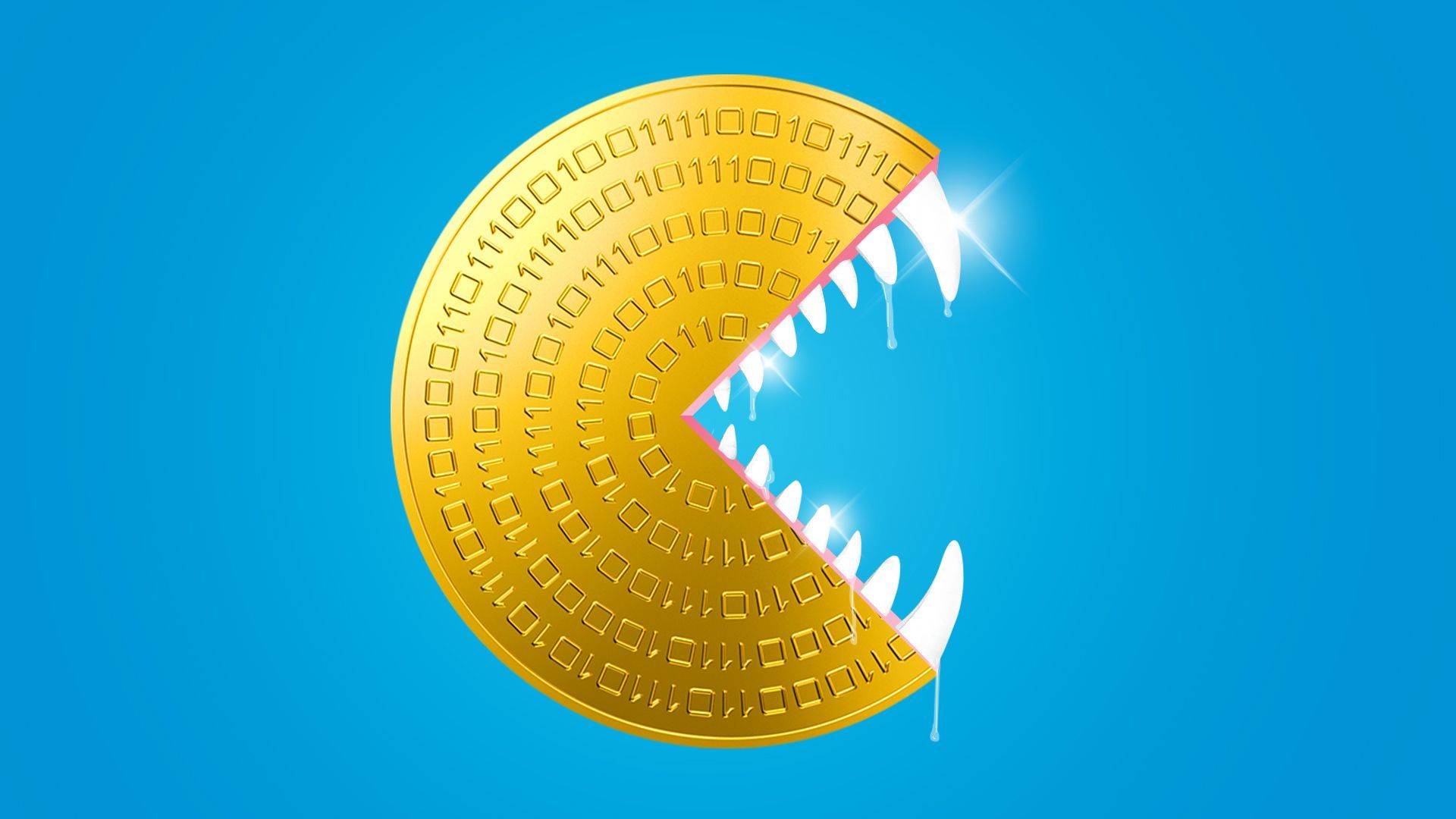
Why it matters: Digital asset treasury companies (DATs) are on the rise, giving investors an easy way to take leveraged bets on an inflection point for cryptocurrencies — a nice gig, as long as prices keep rising.
How it works: The core idea driving DAT investment philosophy is to trade an inflationary asset (dollars) for a scarce asset (cryptocurrency), particularly one believed to be catching on.
- The pitch to investors is that DATs are a better buy than a crypto-based exchange-traded fund because they'll grow holdings per share.
- In short: If a DAT company's share represented, say, 1 bitcoin at purchase, it might be worth 1.5 in a couple years. Or that's the theory.
Strategy (aka MicroStrategy, trading under MSTR), the leader in the DAT movement, has been trading at twice the value of its bitcoin holdings and its underlying business, according to analysis by VanEck.
- MicroStrategy pioneered the notion of BTC yield — the rate at which bitcoin per share grows — and is targeting a rate of 4% to 8%. It holds 580,250 bitcoin, 2.8% of the maximum supply, a chunk now worth about $60 billion.
Threat level: The fuel driving the buying is typically convertible notes, a low-cost debt that works as long as the company's shares keep rising and holders convert the notes to shares in the end.
- But if bitcoin prices fall, and the DAT's stock doesn't perform, convertible investors will instead demand their money back — in dollars — at the end of the term.
Between the lines: A big enough downturn in crypto prices, and a resulting drop in a DAT company's shares, could start a vicious cycle.
- It could force DATs to sell some of their crypto to repay their borrowing, which would accelerate a drop in crypto prices — perhaps enough to put the whole crypto market into bear mode again.
State of play: Other cryptocurrencies are getting brought in on the act. A few companies have announced the same strategy for solana, such as Upexi, SOL Strategies and DeFi Development Corp. Just yesterday, an ed tech company announced plans to raise $500 million with convertibles to build a solana treasury.
- Others are getting into XRP.
- Blockchain-focused investors turned a company for marketing to sports gamblers, SharpLink Gaming, into a bet on the second-largest digital asset, Ethereum's ether with a $425 million private placement.
What we're watching: The best-positioned firms will be the ones that accumulated in the bad times.
- Strategy's massive BTC war chest has been purchased at an average price of $68,459 (as of April 27), a 30% discount on current prices. So it has headroom.
- But even at 0% interest rates, debt has to be paid back eventually, one way or another. Investors should ask themselves where the money to do that is going to come from.
2. Quoted: Trump's meme coin speed bump
"The Trump family engagement in the meme coin world has made this work more complicated because it has distracted, I think, our members, both Republican and Democrat, from what we need to do."— House Financial Services chair French Hill (R-Ark.) Friday at the 2025 Reagan National Economic Forum.
Context: It's not the first time Hill has said that, but he also pivoted last week to say that, for those who think investors need to be warned off meme coins, the best move would be to pass legislation for a disclosure-based regime for crypto assets.
- That is, his CLARITY act, introduced the day before his comments at the event.
3. Staking is not a security

An SEC commissioner has come out with a new statement saying that there's no investment contract created when someone participates in staking.
Why it matters: Participating in staking — the process of collectively insuring the security and accuracy of a blockchain network — is vital for network consensus, not to mention an easy way for people to passively earn some yield.
- Determining that the practice constitutes an investment contract — which the prior SEC did — makes it a security and subject to SEC regulations.
- And the previous SEC leadership was critical of staking.
The latest: "Uncertainty about regulatory views on staking discouraged Americans from doing so for fear of violating the securities laws. This artificially constrained participation in network consensus," Crypto Task Force chair Hester Peirce writes in the new statement last week.
How it works: Staking is a way to provide decentralized security for a network, one favored by many of the newer chains. (Bitcoin takes a different approach.)
- Participants post some of the native coin of the network in order to participate in staking and earn network rewards for doing so.
- The point of the stake is this: If members of the network determine a participant is failing in their responsibilities or acting maliciously, their stake can be taken.
- Risking that is what gives participants confidence in the work of these strangers on the internet sharing in the checking and doublechecking of a blockchain network's accuracy.
What we're watching: Ethereum ETFs.
- Holders of ether ETFs are missing out on significant yield due to the fact that issuers of these instruments have not been permitted to participate in staking on the world's second largest blockchain.
4. Catch up quick

🖼️ Guests at President Trump's meme coin dinner just got special NFTs. (Decrypt)
💳 Credit card legislation promoters want to attach it to stablecoin legislation. (MarketWatch)
🎢 Stablecoin company Circle has upped its IPO valuation target. (Axios Pro)
🏹 Robinhood closed its deal for crypto exchange Bitstamp, giving it licenses in Europe and Asia. (Axios Pro)
🎰 An insider's high-level take on Bitcoin 2025 in Vegas. (Blockspace Media)
5. Texas passed it

We've been doing lots of intermittent updates on this, but, it is now definitely true: Texas has sent a bitcoin reserve bill to the governor.
- Texas was the first-mover after President Trump kicked off the conversation about governments holding onto bitcoin that comes their way.
The latest: After a conference committee, the Texas Senate took the final vote Saturday to confirm the bill. It was sent to Gov. Greg Abbott on Sunday.
What's next: A decision by the governor about whether or not to sign the legislation.
- No comment yet from the governor's office.
This newsletter was edited by Pete Gannon and copy edited by Carolyn DiPaolo.
🌻 My poppies are coming up in my wildflower garden. If there's any other native plant enthusiasts out there, please send photos. —Brady
Sign up for Axios Crypto