Axios Crypto

March 11, 2025

Happy Tuesday! We're watching another important hearing on digital asset legislation in the House. Today's a bit of a preview, based on the testimony published yesterday.
- It's wild out there. Bitcoin's still down from where it has been, but it's also way, way up from a year ago. 🧘♂️ This is the way of things.
📬 Are you a congressional staffer who reads these emails? Please let me know: [email protected].
Today's newsletter is 1,158 words, a 4-minute read.
1 big thing: Stablecoins in the House
Stablecoins are the topic du jour in a hearing today before the House Financial Services Committee, as we increasingly believe they'll be the topic of the year in crypto.
- Why it matters: They're the first order of business as Congress considers how to write the crypto industry into U.S. law.
State of play: Today's agenda is centered on a discussion draft of the STABLE Act, written by Rep. French Hill, (R-Ark.), the committee's chair, and Rep. Bryan Steil (R-Wis.).
- The written testimonies of the four chosen witnesses all err on the side of advancing U.S. interests by greenlighting the stablecoin economy here, but they differ on some priorities.
Zoom in: Innovation should be free of government interference, Randall Guynn, of the financial institutions group at the Davis Polk law firm, argues in his testimony.
- "People have been free during most of human history to innovate in the creation of private money," he writes, arguing that stablecoins are the latest form. "Including any requirement to obtain government permission to do so."
Yes, but: Carole House, a senior fellow at the Atlantic Council, argues that the world is much more interconnected than it has ever been.
- She says that stablecoin legislation should be part of a larger, holistic approach to regulation of payments platforms, "which are growing enough in complexity and adoption."
- On that front, Stripe CEO Patrick Collison's testimony echoes what a bank in Puerto Rico recently told us: Businesses really like stablecoins. (Stripe made a massive acquisition of Bridge, a stablecoin company, last fall.)
Between the lines: Other fault lines engendered by a disruptive technology can be teased out, a bit, by different testimony offered.
- For example, Caroline Butler, the head of digital assets at BNY Mellon, notes that her firm (a systemically important bank) welcomes policy that will "allow banks to participate in the stablecoin ecosystem."
- That might be read as a gesture to the preceding era, when banks were implicitly prevented from offering stablecoins and even from providing their custody services to crypto firms.
Witnesses also spelled out details for amendments. A few examples:
- Paxos CEO Charles Cascarilla would like to see Treasury given a deadline to decide whether a given nation's stablecoin regime merits reciprocity with the U.S. (Paxos had run Binance's stablecoin before it ran into issues with New York state and runs PayPal's stablecoin today.)
- Guynn of Davis Polk argues that the list of reserve assets permitted to back stablecoins should be loosened a little, so issuers could hold slightly longer dated U.S. Treasuries (only up to six months).
- And House of the Atlantic Council would like to see the anti-money laundering requirements stiffened, as they were in the legislation drafted by the committee's chair and ranking member in the prior Congress.
The hearing kicked off at 10am ET.
What we're watching: Over in the Senate, the Banking Committee is set to vote on a separate bipartisan stablecoin bill Thursday led by Sen. Bill Hagerty (R-Tenn.), an updated version of The GENIUS Act.
2. Charted: Scammy domains

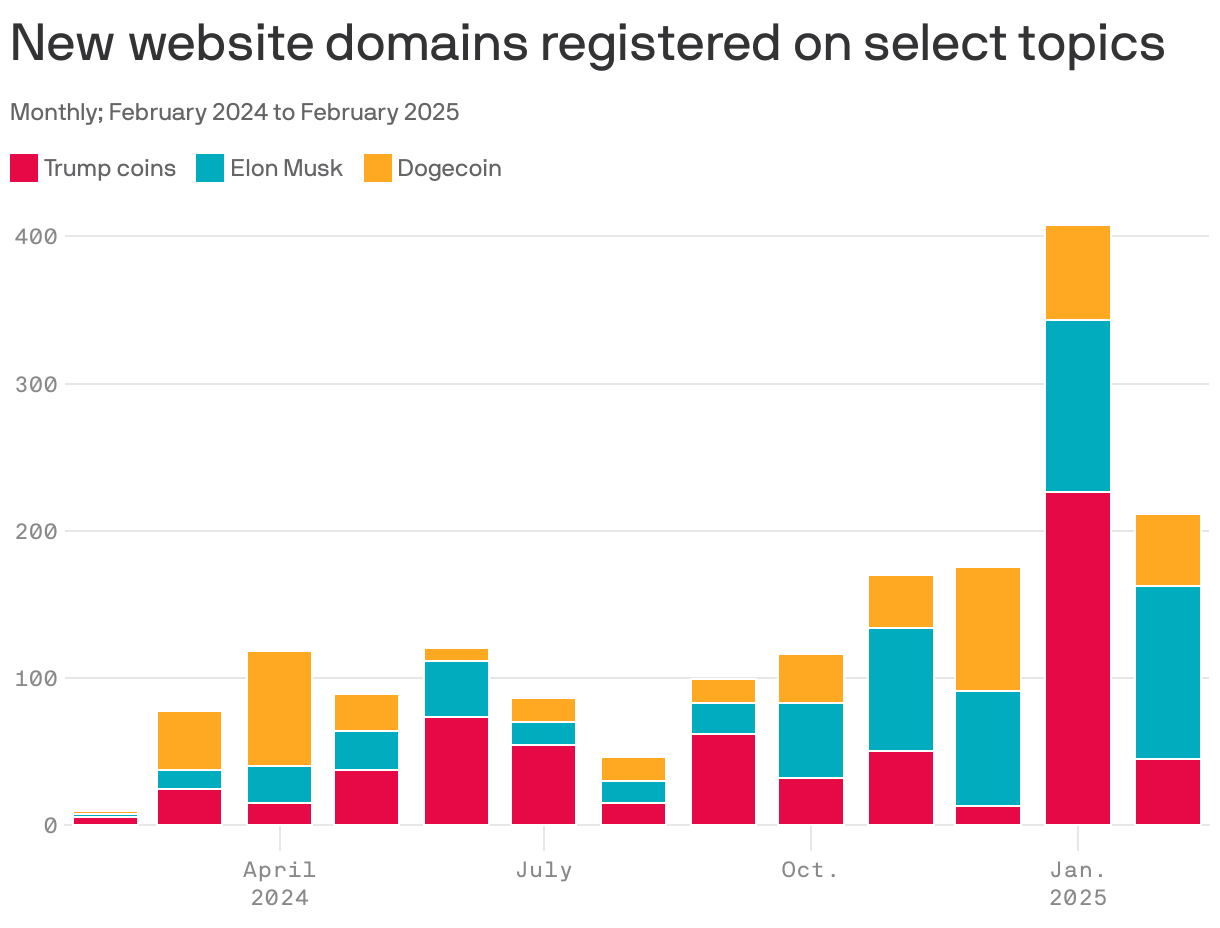
A new report, shared in advance exclusively with Axios by BrandShield, reveals a little of how scammy operators work.
How it works: Miscreants seem to identify a person or brand that people are talking about, come up with something that you think people might buy associated with that brand, and throw up a quick website offering that thing.
- Then, give anyone who bites a way to pay for it and probably don't send it. Don't even make it.
What they found: Folks come up with all kinds of ridiculous websites that touch on key brands. In the chart above, BrandShield found sites associated with the brand Dogecoin (which was first a jokey cryptocurrency but now the brand is running the federal government), Elon Musk and "Trump Coin."
- The latter is probably more limited as the Trump brand is just too big, but also Trump coins were a pretty big thing before he offered a coin.
- Swindlers seem to have taken to Musk.
Zoom in (way, way in): Some seem so bad it's hard to believe anyone would fall for them (we are not linking to any of this stuff).
- A Dogecoin faucet site offering free DOGE. (Bitcoin oldheads will tell you there was once a Bitcoin faucet, but that was long ago.)
- Trump Coin Shop, which for some reason doesn't have a picture of President Trump. It has images of aliens and flying saucers.
- The Ultimate Meme, that is $MUSK, which features Elon Musk as a cartoon dog walking Muppets.
💭 Brady's thought bubble: It's a little hard to feel bad for anyone who fell for any of these.
- But all we know from the report is that these sites went up, not that anyone did.
3. Quoted: Swift shift to Bitcoin
"The only way we can collectively solve for open, cheap, global, 24/7 global money movement is to build on Bitcoin, because it is truly the only settlement asset and network that's sufficiently neutral and decentralized to be fit for this mission."— David Marcus, CEO of Lightspark, on why moving money globally with Bitcoin is the right way to do it and Facebook's Libra project (which he ran) was not.
4. ICYMI: Thursday and Friday
This little corner of Axios was busy as last week ended.
- First, on Thursday night, Trump scooped his party and dropped the game plan for the Strategic Bitcoin Reserve and the Digital Asset Stockpile.
Between the lines: It seems like the teasing about XRP and SOL (and etc.) was a bit of a head fake. The truth is, the president only has eyes for bitcoin.
How it works: The executive order authorizes Treasury and Commerce to buy more bitcoin for the reserve, but they can't buy any other cryptocurrency.
- It has to be budget neutral. In other words, they need to find new revenue streams to do it (like maybe a fee on something).
What we're watching: Treasury Secretary Scott Bessent and Commerce Secretary Howard Lutnick probably want to get their own moments out of this order.
- Watch for each to make announcements with related orange coin fanfare about their plans to boost the U.S. bitcoin cache.
And then came the Digital Asset Summit, which didn't seem to have its own big news piece.
- In fact, when Trump showed up at it, he seemed a bit more excited about his meeting with FIFA, the soccer people, than digital assets.
- He had the FIFA chief bring the World Cup trophy to the summit to show it off before starting. It looks like a giant gold coin, with a literal twist. The president loved it.
Yes, but: As it ended, the Office of the Comptroller of the Currency announced that banks wouldn't have to ask permission to do fairly normal business in the crypto space any longer.
- That doesn't mean they aren't regulated, by the way. They will still be running the activities by their supervisors at regular meetings, but banks don't have to wait on a piece of paper to proceed if no objections are raised.
This newsletter was edited by Pete Gannon and copy edited by Carolyn DiPaolo.
🤓 Venkatesh Rao has been one of the best internet philosophers since the early days of blogging. In this essay on Terry Pratchett's Discworld books, he calls blockchains the closest things our world has to a substance like Discworld has, something ubiquitous that makes things more interesting. —Brady
Sign up for Axios Crypto