Axios Crypto

October 12, 2022
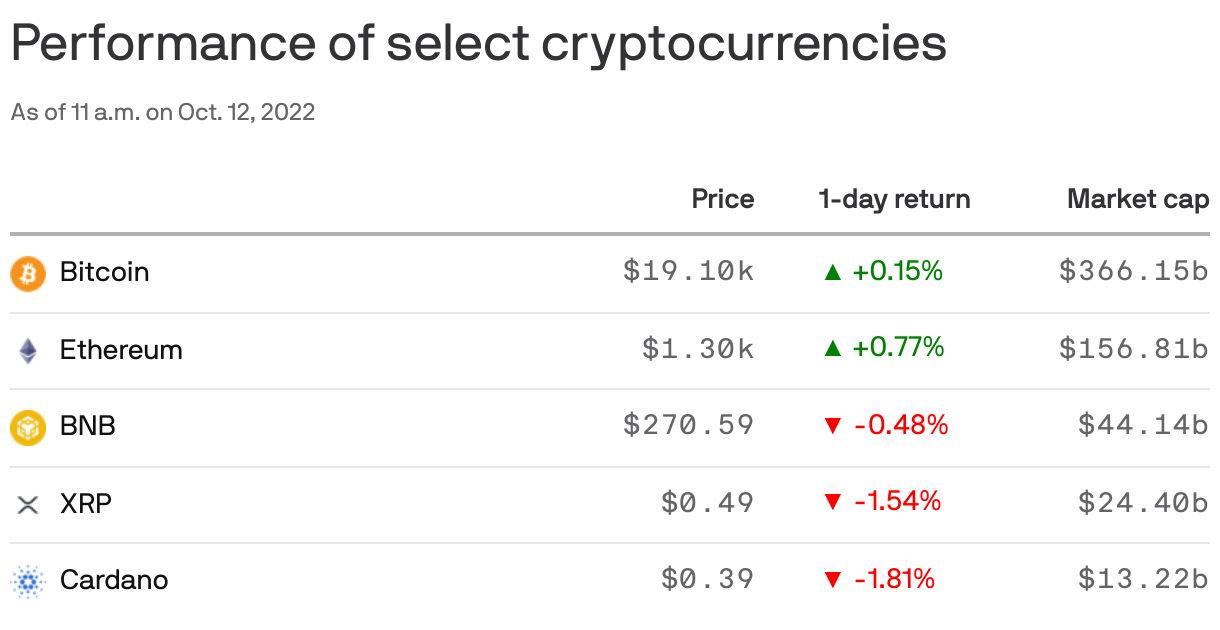
A lot of white button-down shirts went through the laundry to make today's crypto newsletter! Old banks are hopping in and musty rules are getting updates. Crypto is going from dodgy to stodgy.
- 🤨 Which big, boring company would surprise you the most if it said it was getting into crypto somehow? Tell us: [email protected]
Today's newsletter is 1219 words, a 5-minute read.
🔬 1 big thing: The tax man is focusing his crypto microscope
Illustration: Aïda Amer/Axios
The G20 knows you're hiding those sweet, sweet gains.
- Well, probably not you, but it knows there are lots of crypto rich out there who haven't paid their taxes on money made in various crypto booms, Brady writes.
Driving the news: The Organization for Economic Co-operation and Development (OECD) released its plan for information sharing among firms that crypto investors use to move between currency and cryptocurrency, in order to better detect tax dodgers.
Why it matters: Well, everyone else has to pay taxes when their other investments make money. Crypto shouldn't be any different, right?
What they're saying: “Today’s presentation of the new crypto-asset reporting framework and amendments to the Common Reporting Standard will ensure that the tax transparency architecture remains up-to-date and effective,” OECD Secretary-General Mathias Cormann said.
In the weeds: The goal is to make the crypto asset reporting framework, or CARF, the single global standard for information sharing of this kind.
- It covers most crypto assets — even, as the report says, "some NFTs," though it seems like it would be any that had value — but not NFTs or tokens that are useless for payments, stablecoins readily redeemable for currency, or central bank digital currencies (CBDCs).
- Covered companies will have to report inflows and outflows of such assets as well as income that comes in other forms, such as earnings from staking crypto assets.
- Payments to merchants using crypto also have to be reported.
Yes, but: The OECD has added CBDCs to its older, more established common reporting standard, so that people can't dodge reporting on traditional bank accounts using CBDCs (when/if they become a thing).
- Other changes were also made to those standards in light of the proliferation of crypto, such as including blockchain-specific language in its rules for derivatives.
The other side: "These rules are focused on the exchanges and wallet providers and seek to impose tax-reporting obligations on these entities as they act as on-ramps and off-ramps to the blockchain," Tony Tuths, Digital Asset Practice Leader at KPMG, said in a statement, via a spokesperson.
- "The reporting obligations hit fiat-to-crypto exchanges, crypto-to-different-crypto exchanges and crypto transfers."
What we're watching: Most G20 member states are expected to turn these rules into local laws, and the OECD has provided model rules for doing so.
Be smart: The U.S., however, will operate on its own timeline with its own rules, as the U.S. does.
😖 2. Charted: Bitcoin is so difficult

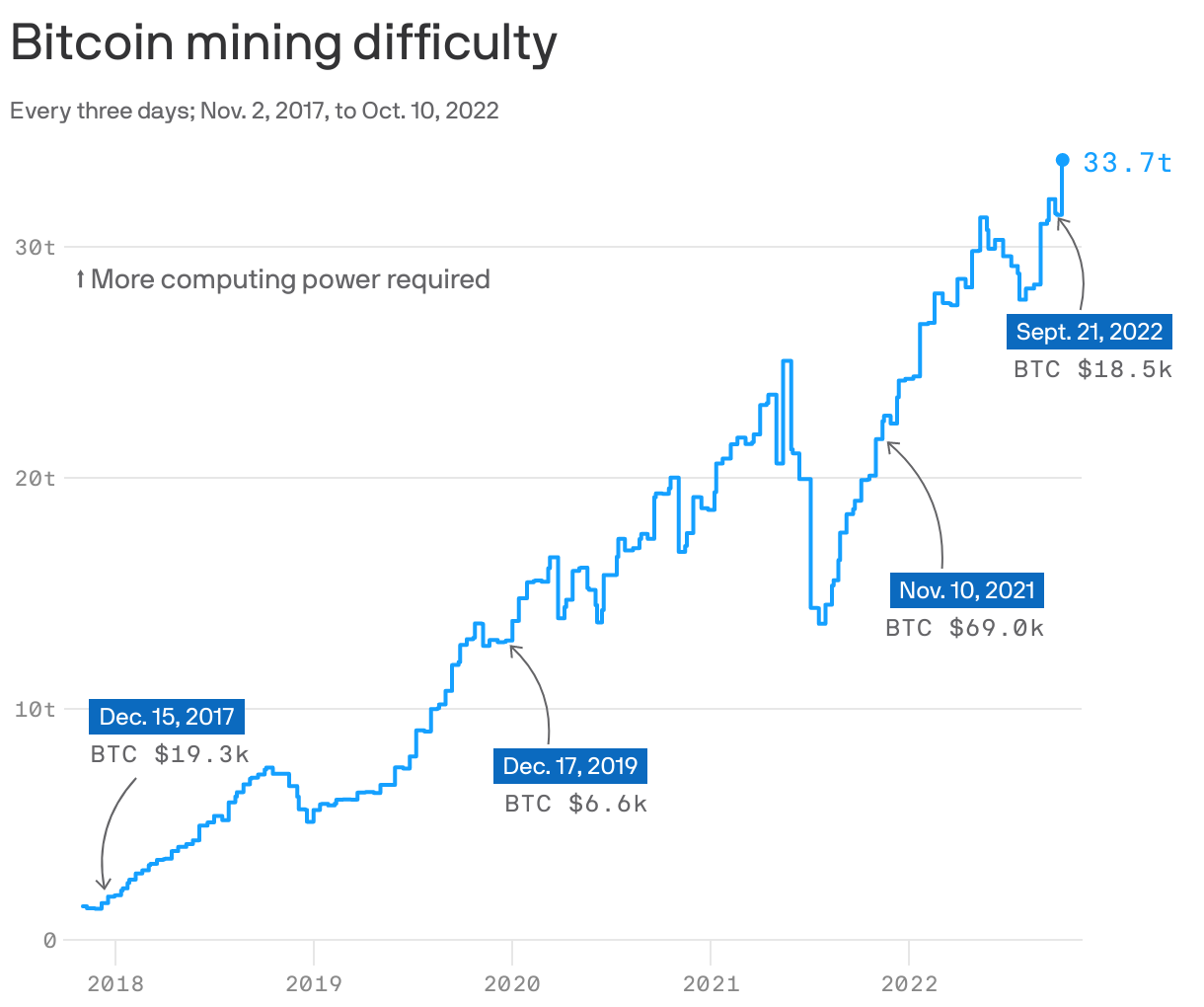
Bitcoin has set a new record for difficulty, which means there are more machines mining it now than ever before, Brady writes.
- Between the lines: "Difficulty" refers to the challenge cryptographic hash miners have to solve in order to enter a block and earn 6.25 new BTC (worth roughly $119,000) for doing so.
- Every 10 days, the network automatically adjusts the difficulty up or down so that most blocks take about 10 minutes, depending on how many machines are trying.
What they're saying: "The miners that are coming online are primarily the deliveries from the orders that were placed in the last bull market, and many carry a premium price tag so there's an urgency to install them ASAP to start generating a return," Erin Dermer, a spokesperson with Canadian miner Hut8, tells Axios via email.
Of note: That big drop before November's all-time high had nothing to do with economics. That one was politics.
- Lots and lots of machines came offline at the time after China banned bitcoin mining in mid-2021.
What we're watching: "Expect hashrate to grow until less efficient miners capitulate," William Foxley of Compass Mining tells Axios, who explained that next-generation miners, ordered at the height of the bull run, are getting unboxed now.
- Miners running older rigs will give up eventually as they lose too many blocks to cover their electricity bills.
🏠 3. BNY Mellon begins providing BTC and ETH custody services

Illustration: Aïda Amer/Axios
It's been eight months since BNY Mellon announced it would begin holding onto bitcoin and ether for its institutional clients, but the service is finally online for a few large customers, according to a statement.
Why it matters: Some major institutional investors can't — or won't — invest in assets that don't have a qualified custodian, so each time a major custodian gets into the cryptocurrency market, that opens up new, gigantic pools of money to bet on the assets, Brady writes.
- In the weeds: BNY Mellon only plans to take on bitcoin and ether for now. More crypto-native custody firms already take on many more tokens and coins.
What they're saying: "Touching more than 20% of the world's investable assets, BNY Mellon has the scale to reimagine financial markets through blockchain technology and digital assets," CEO Robin Vince said in the statement.
- BNY Mellon told City A.M. in February that it was working with technology firm Fireblocks on its custody offering.
By the numbers: A survey commissioned by the bank said that 41% of institutional investors already hold some crypto assets, while another 15% planned to get in within two to five years.
Flashback: BNY Mellon has been one that many have been waiting on to enter the market. When it first announced its plan in February, bitcoin was trading at over $45,000.
- Another big custodian people have been waiting on: State Street. The firm told Bloomberg (specifically, our own Crystal Kim) in February that it would be ready to offer such services as soon as regulators gave it the OK.
- A State Street spokesman confirmed to Axios that its offering remains a work in progress while it awaits regulatory clarity. It previously announced it was working with London-based Copper on its custody solution.
Zoom out: The two largest firms in the space, by assets under custody, are Coinbase (at around $140 billion) and BitGo (at around $64 billion) as of December 2021, according to a report from The Block.
- Of note: Crypto prices are way down since late 2021. Coinbase's Q2 shareholder letter says it had $49 billion in institutional assets on platform, though it's not clear if that's all strictly under its custody program.
🐬 4. Catch up quick
🔥 Bittrex received record fines from the U.S. Treasury for breaking sanctions from 2014 to 2017. (The New York Times)
🌶 Grayscale called the SEC's rejection of its application to turn its bitcoin trust into an ETF “arbitrary, capricious, and discriminatory" in a legal brief. (CoinDesk)
💸 A thief, following a market manipulation exploit, proposes Solana-based Mango Market basically close its bad debt and let the thief keep the rest of its money, about $70 million. (The Block)
😖 BNB successfully completes a hard fork after the roughly $100 million hack on it. (The Block)
🤜🤛 5. Culture hash: The PayPal/bitcoin connection
Screenshot: @sthenc (Twitter)
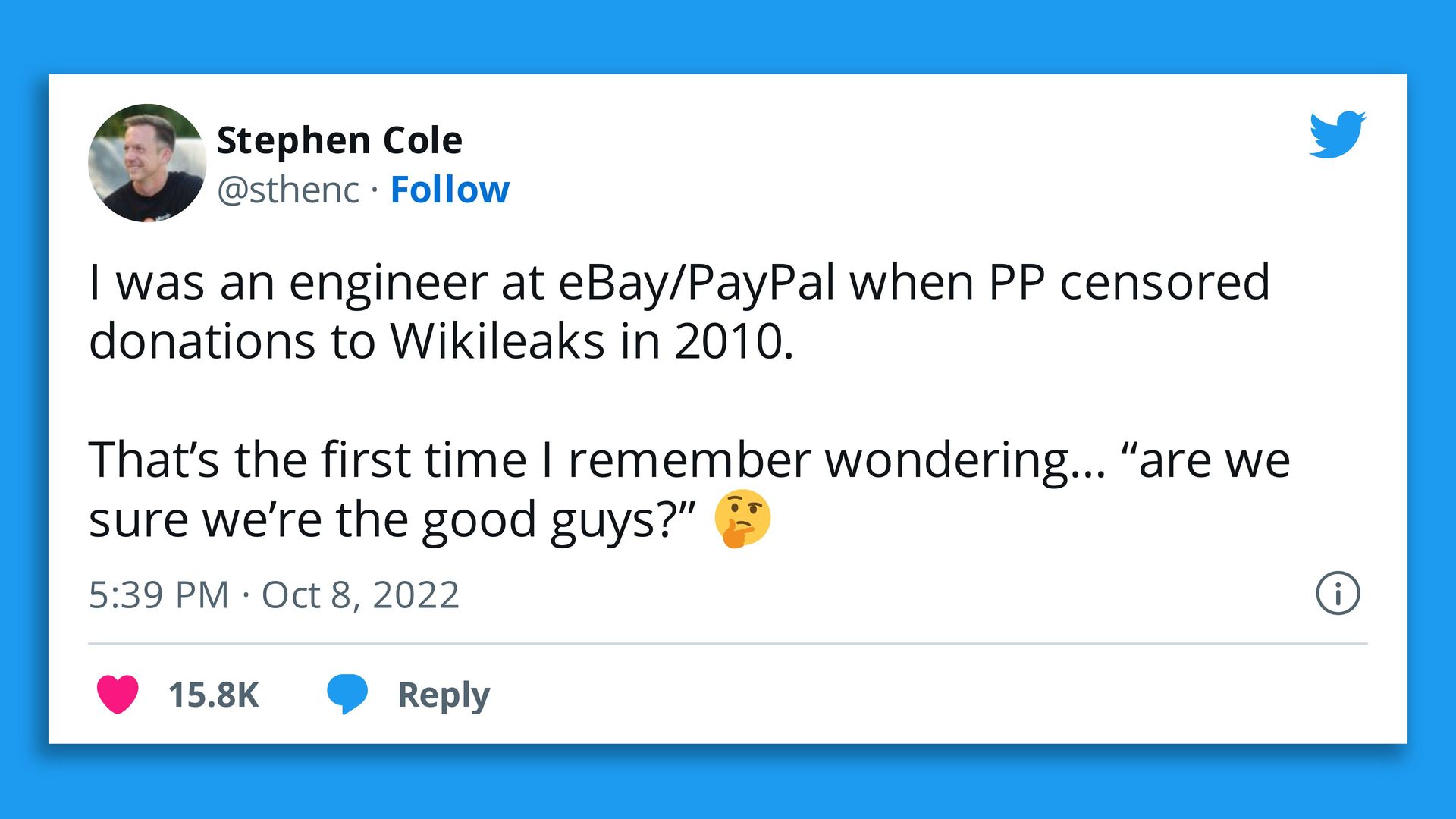
If it weren't for payment censorship, bitcoin might not be the cultural force it is today, Brady writes.
Flashback: In 2010, all the payments companies, including PayPal, decided that they weren't going to support donations to Wikileaks any longer. So the organization turned to bitcoin for support.
- Satoshi Nakamoto didn't actually feel like the project was up to it at the time.
Catch up fast: Lots of longtime bitcoiners were reminded of that moment this weekend when people found PayPal's forthcoming policy that seemed to include $2,500 fines for spreading "misinformation."
- The company backpedaled before the holiday weekend was over.
Plot twist: The misinformation clause would have been new, but the $2,500 fine was not. It was already there all along (see the first paragraph of PayPal's current acceptable use policy).
This newsletter was edited by Pete Gannon and copy edited by Nick Aspinwall.
Bitcoin is harder than ever but we hope you find our newsletter easy! —C & B
Sign up for Axios Crypto

Brady Dale covers crypto and blockchain impacts on markets and regulation.