Axios Crypto

July 26, 2022
Here's Tuesday! We're looking at the investing world through the perspective of a crypto venture capitalist, reviewing the dealmakers' count and digging into central bank digital currencies or CBDCs.
🚨 Situational awareness: The House stablecoin legislation we wrote about last week is not going to get through committee before recess. It could still happen in September, but that makes the whole bill even less likely to pass in this Congress.
Talk to us: [email protected]
This newsletter was edited by Pete Gannon and is 1,150 words, a 4.5-minute read.
🥪 1 big thing: Kraken VC sees crypto sticking
Illustration: Aïda Amer/Axios
Fintech and blockchain are converging, according to Kraken Ventures partner Akshi Federici, during her "VC perspective" talk at the Ethereum Community Conference or EthCC in Paris last week.
- Fintech, financial services and blockchain will be "inseparable" and "indistinguishable," she said. That trend and continued investment from Wall Street firms are rallying points for the crypto industry, Crystal writes.
Why it matters: All major aspects of financial services could use the blockchain, including capital markets, asset management, payments, retail and institutional banking, and insurance, Federici said.
- "Fintech" refers to anything that combines financial services with technology. Examples include customer-facing mobile applications that facilitate stocks or crypto trading or back-office software.
What's happening: "Roughly eight or nine of the 50 top innovative companies in fintech for two years consistently have been crypto/blockchain-first companies," she said, referencing Forbes rankings.
- The 2022 ranking includes Chainalysis, Circle and FTX alongside fintech darlings Carta and Stripe.
- "We have to adjust for the market recently, but extremely encouraging from a VC perspective to see this," she said.
The big picture: "There is obviously a lot of frustration from a regulatory perspective in the United States, and there's this view that a lot of innovation in crypto, fintech, blockchain, et cetera is going to come from—external to the United States," she said while acknowledging that previous investments from bulge-bracket firms were "encouraging."
Traditional Wall Street firms are invested.
- "There are more traditional financial institutions than ever that are betting on the blockchain," Federici said, adding they're pretty much "table stakes."
- Morgan Stanley, Goldman Sachs, BNY Mellon, Commonwealth Bank and Citi have invested in a variety of companies including NYDIG, Anchorage Digital, Blockdaemon, Fireblocks, Gemini, and Talos, according to Federici's presentation.
Catch up fast: Recall investment bank Moelis & Co. just threw its hat in the ring, starting a unit to focus on blockchain deals in spite of the crypto winter.
Yes, but: There are also many hurdles, she said.
- Federici listed the issues related to infrastructure — scalability, security/privacy, interoperability, and access. She also cited legal and regulatory issues — jurisdiction questions and ambiguity around how courts will recognize blockchain.
Flashback: Exchange operator Kraken launched its eponymous venture arm in February 2021 led by Brandon Gath, Kirill Gourov and Federici.
What others are saying: Spencer Bogart, general partner at Blockchain Capital LLC, says startups and founders will have to make some sacrifices to stay flexible amid what could be a prolonged market downturn.
- "Access to capital might be limited. Means, you might have the opportunity to raise. But you also have to be diligent about your burn, so you have at least two to three years of runway," he tells Axios.
Crystal's thought bubble: Perhaps the crypto winter will drive more general-fintech-meets-blockchain M&A.
🤴 2. Charted: Kingmakers

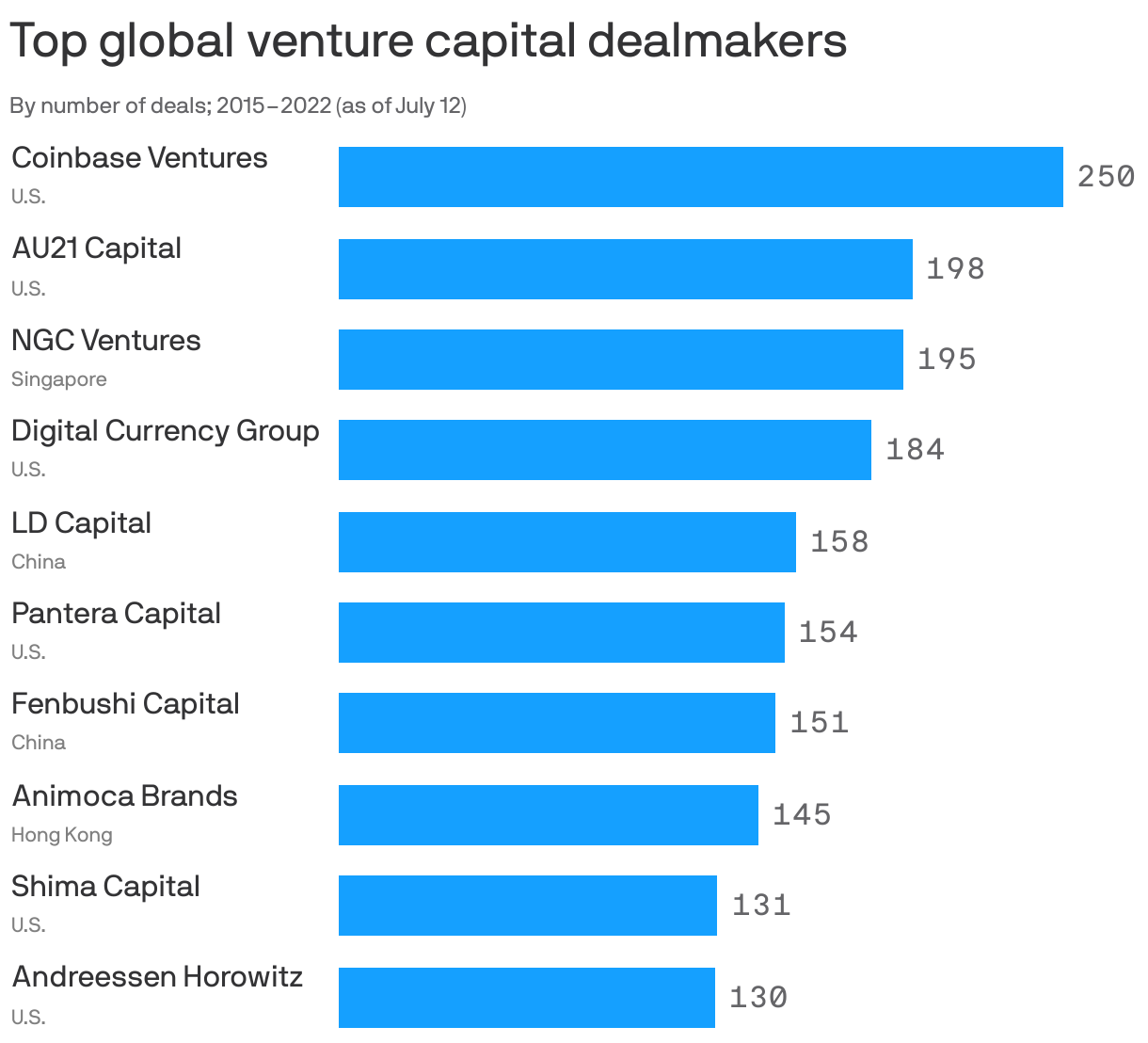
Coinbase Ventures has closed the most number of deals since 2015 through mid-July, according to data compiled by PitchBook, Crystal writes.
Yes, but: Deal counts declined 34% in the April to June months compared to January through March, the exchange operator said last week on its company blog.
- Context: Overall, U.S. crypto and blockchain deals by dollar volume were down almost 37% to $4 billion over the same time period.
Of note: "This quarter, we were also excited to back five teams founded by former Coinbase employees, including the aforementioned Coherent and Farcaster, as well as three others not yet announced," Coinbase said.
🚗 3. The road to digital currency
Illustration: Victoria Ellis/Axios
Governments around the world are taking steps to launch their own versions of digital cash — a global race in which the United States is notably lagging, Courtenay Brown wrote as part of the "Axios AM Deep Dive: Crypto's many lives."
Why it matters: Broad issuance of central bank digital currencies (known as CBDCs) could reshape how people and businesses use money, and may even expand access to the financial system.
How it works: A CBDC is a virtual version of an existing currency issued and backed by central banks. A digital dollar in the U.S., for instance, would be legal tender pegged to the value of the physical dollar — and fully backed by the Federal Reserve.
Where it stands: About 109 countries are exploring a CBDC, nearly half of which are developing, piloting or launching digital cash, according to the Atlantic Council, a think tank that tracks digital currencies. (Others, like the U.S., are still in the research phase.)
- The design and functionality of each CBDC differs from country to country.
- A small number, for instance, are testing digital coins that enable bank-to-bank or consumer transactions across borders.
- The biggest CBDC pilot in the world is underway in China, where the "e-CNY" does not use blockchain technology — a key distinction from cryptocurrency. Rather, the country's central bank holds records of every real-time payment.
What to watch: Of the G20 nations, there are only three countries still considering whether or not to move forward with a CBDC — including the United States.
Between the lines: Perhaps the most immediate sticking point comes down to process.
- The Fed says it will wait for the OK from Congress ("ideally in the form of a specific authorizing law," officials wrote in a paper this year) before it begins developing digital cash. But it's unclear how big of a priority it is in Congress, so a green light could be slow to come.
The bottom line: A digital dollar backed by the full faith and credit of the U.S. government is years away.
🏇 4. Catch up quick
🚨 The SEC is investigating Coinbase Global over whether it listed tokens that are actually securities. (Bloomberg)
📢 CFTC chairman bemoans the blurry boundaries between different agencies' authorities with regard to blockchain. (CFTC)
🤝 FTX might buy Bithumb, of South Korea, another exchange. (CNBC)
⚖️ Binance's CEO has sued Bloomberg over its profile of him from June. (Decrypt)
Top coins

🔪 5. Culture hash: Know thyself
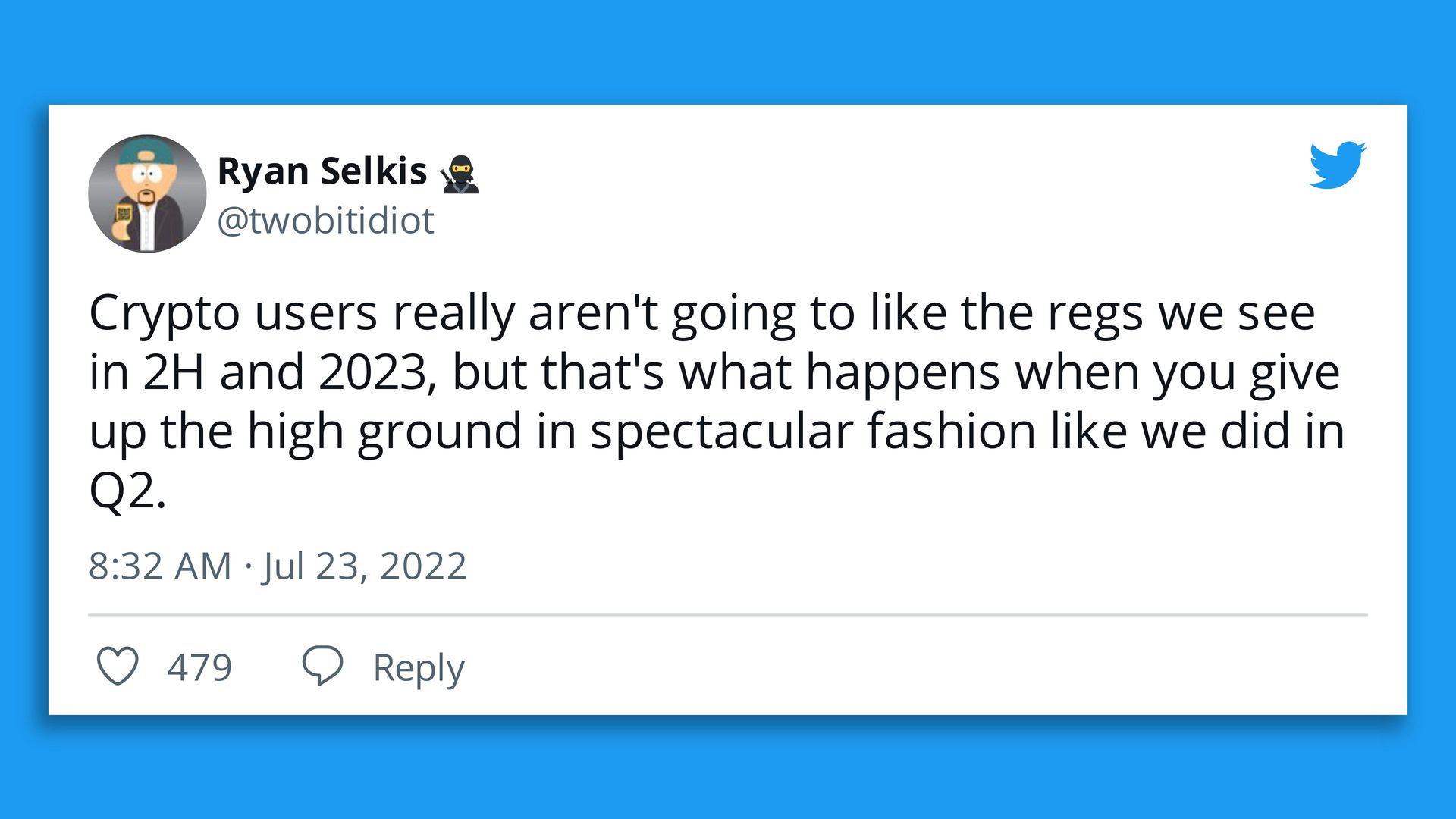
Screenshot: @twobitidiot (Twitter)
Ryan Selkis is founder and CEO of Messari, a blockchain data company.
- The data piece is part of a much larger vision, however, that goes back to the very beginning of the company: for the digital asset industry to unify around some sort of self-regulatory body that governments would find credible.
- It's a drum he continues to beat, Brady writes.
Zooming out: Selkis is not one to mince words.
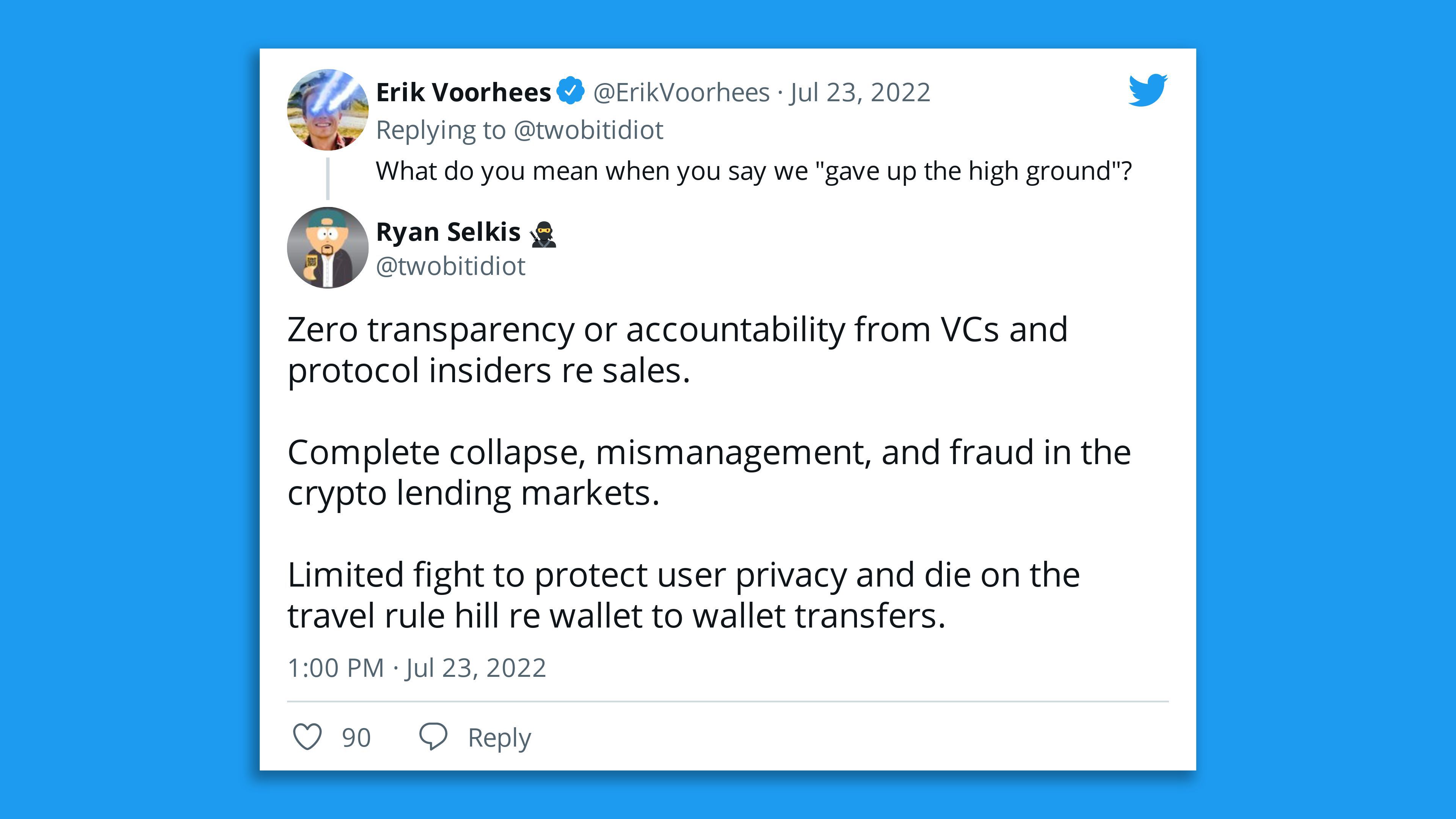
The "sales" he's referring to here are token sales. Basically, big investors can buy tokens before anyone else at very low prices. Those tokens can win support from regular people by touting investment from name-brand investors.
- But those name-brand investors might sell all or a lot of their cheaply bought tokens (euphemistically: "dumping") just as the public gets excited about the project.
- Random aside (no reason): Ex-Facebook employees announced raising $150 million for a whole new blockchain called Aptos yesterday.
The lending market collapse is something we've covered at length.
On user privacy, one major fight has been lost. The industry has been much more excited about getting big money in, Selkis is arguing, than keeping prying eyes out.
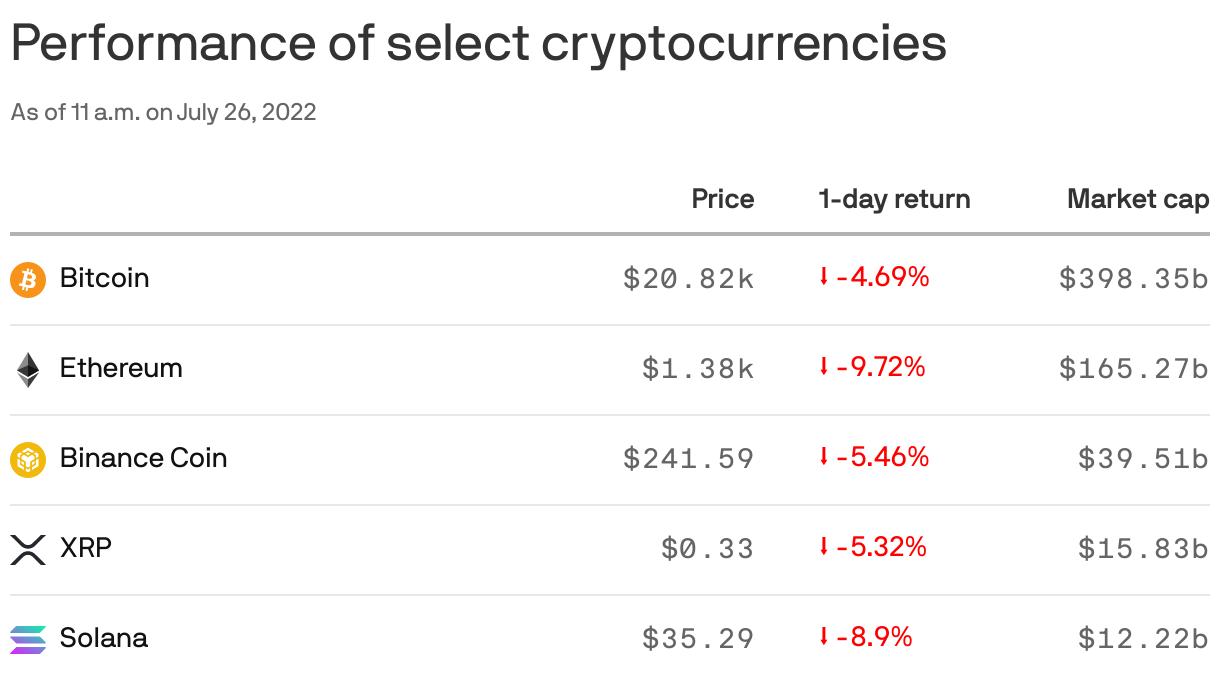
Bitcoin's holding steady near $20,000 like it's bracing for more bad news. —B & C
Sign up for Axios Crypto

Brady Dale covers crypto and blockchain impacts on markets and regulation.