Axios Crypto

May 08, 2023
Happy Monday! Today we take a trip to the Bahamas.
💡 State of play: In San Francisco on Wednesday, it's BFD. The crypto-curious will want to watch the appearance by Cathie Wood. You can watch online, even if you can't get to SF.
Today's newsletter is 1,255 words, a 4.5-minute read.
🇧🇸 1 big thing: Updating rules in the Bahamas
Illustration: Shoshana Gordon/Axios
The Bahamas is moving to update its crypto law passed in 2020, the Digital Assets and Registered Exchanges Act.
Why it matters: The country was home to the biggest blowup in the history of cryptocurrency and one of the worst corporate unravelings of all time, the implosion of FTX and its related companies, Brady writes.
What they're saying: "The Bahamas doesn't really have a real domestic market for crypto," Christina Rolle, executive director of the Securities Commission of The Bahamas (SCB) told Axios in a phone call.
- "The problem for jurisdictions like the Bahamas, of which there are many . . . You're faced with a dilemma of the possibility of external players coming into your market and being licensed to operate," she said.
Zoom out: The unraveling of FTX is obviously very much part of the conversation for these new rules, though it is not the singular focus.
- "I would say that the majority of the provisions that are in that new piece of legislation are not FTX-specific," Rolle said.
- Because of her government's active role in that controversy, she wasn't able to speak specifically to how the new measures reflected lessons learned from FTX.
Details: The SCB has highlighted several facets of the new rules.
- It expands the definitions of digital assets businesses to capture more kinds of businesses under the license.
- It sets up rules for how stablecoins should function, largely based on the approach taken in New York state, Rolle said.
- It provides a disclosure regime for companies providing staking-as-a-service.
Meanwhile, the Bahamas won't license proof-of-work mining operations. The country — which is not well-suited to such businesses — wants to avoid the situation of entities domiciling there but operating elsewhere, outside of the government's ability to supervise them, Rolle explained.
Of note: Financial services make up a small but notable part of the local economy (Rolle estimated it was something like 12%), with far better salaries than the main industry, tourism.
Timeline: Rolle said it is likely that the Bahamas will pass the legislation to update their rules this year.
The Bahamas is aware of new kinds of structures of companies and projects in the cryptocurrency world. It's staying abreast of decentralized autonomous organizations and smart contracts that operate on their own.
- "At some point, they are going to have to fit within frameworks that can manage the risks that can pose to consumers and investors," Rolle said. "There are some realities around the ethos about how decentralized finance is supposed to work that just cannot happen."
🤡 2. Charted: Bitcoin fees


Bitcoin fees are crazy at the moment, Brady writes, and they really spiked this weekend.
State of play: The world's oldest blockchain is seeing an uptick in demand right now for exotic use cases, making it much more expensive for regular users as well.
Driving the news: Binance actually shut down bitcoin withdrawals twice yesterday due to the congestion.
- Based on what Binance said about the pauses, it sounds like its systems were proposing fees that were too small for miners to want to pick up under the current load.
- Meanwhile, rival OKX made sure to let everyone know it was having no trouble.
Be smart: As a decentralized network, users have to pay the network itself for it to do anything, because no one entity is paying to run it (like everything else people use on the web).
- Sending a transaction causes the Bitcoin network to do a little bit of calculation. In fact, every computer on the network has to run that calculation, so to pay for that work each transaction comes with a fee.
- Bitcoin doesn't care what you're doing or how much bitcoin you're sending. It's just a question of how much work you're asking it to do.
- Transaction fees are set via an auction. The more people try to squeeze into blocks, the more expensive they get.
Between the lines: Until the Ordinals project came along, there wasn't an excess of demand. Lots of blocks would be finalized without using all the data available. Not lately though.
- Now people are trading Meme coins and NFTs that run on Bitcoin, and it's getting a bit crazy.
- As of this writing, over 400,000 transactions are waiting to become official. 😮
Flashback: The last time they were this high was May 2021 (before this newsletter existed).
- The highest they have ever gotten was in April 2021, when sending a transaction could cost over $60.
For newbies: The high fees have no impact on trading fees on exchanges like Coinbase or Huobi or Binance. Exchanges operate off-chain.
- The fees on a blockchain only matter to exchange users if they want to withdraw a cryptocurrency to hold in a personal crypto wallet.
🖖 3. The weekend chain split on Bitcoin
Illustration: Natalie Peeples/Axios
Bitcoin very briefly had a chain split over the weekend, Brady writes.
Driving the news: BitMex research detailed that the split only lasted for two blocks, in a battle between Antpool and Foundry Pool USA, two giant collections of disparate bitcoin miners.
What's that mean: First of all, it's important to understand that the canonical chain in Bitcoin is the longest chain.
- Chain splits happen, but the transactions on branches don't count if miners don't keep building on that chain. The branch that miners keep building on is the real chain.
How it works: Bitcoin mining works by miners putting transactions into a "block" (a chunk of the ledger — the latest transactions) roughly every 10 minutes.
- Then they encrypt that data and try to break the code. The first to break the code on a block has "mined" the block.
- A proof gets sent around the network and verified. Then miners start building on that new block, and the winning miner gets the block reward of new bitcoins and whatever transaction fees were in that block.
But, but, but: Sometimes two miners crack a block at very nearly the same time. As the proof propagates around the world, some miners might think that one has won and others might first hear about another.
- So there can be a block or two of confusion until the network comes back to a consensus.
Quick take: It's not clear if situations like this become more frequent during moments of intense demand for the blockchain or not.
Be smart: Those two blocks that came about because of the chain split are now known as "orphan blocks."
- They were composed. They were solved. They were verified. But no one is building on them, so those transactions aren't actually part of the ledger (some or all of them probably also made it into the blocks that are, however).
🚴 4. Catch up quick
🐸 The price of the pepe Meme coin is sliding fast (who could have seen that coming?) (The Block)
👯♀️ SushiSwap became the latest decentralized exchange to copy concentrated liquidity from Uniswap after its license on the concept expired in April. (The Defiant)
🤯 Deus DAO lost its users' $6.5M from an implementation vulnerability, and its stablecoin broke. (Rekt News)
Top coins

🫤 5. Culture hash: Satoshi who?
Screenshot: @udiWertheimer (Twitter)
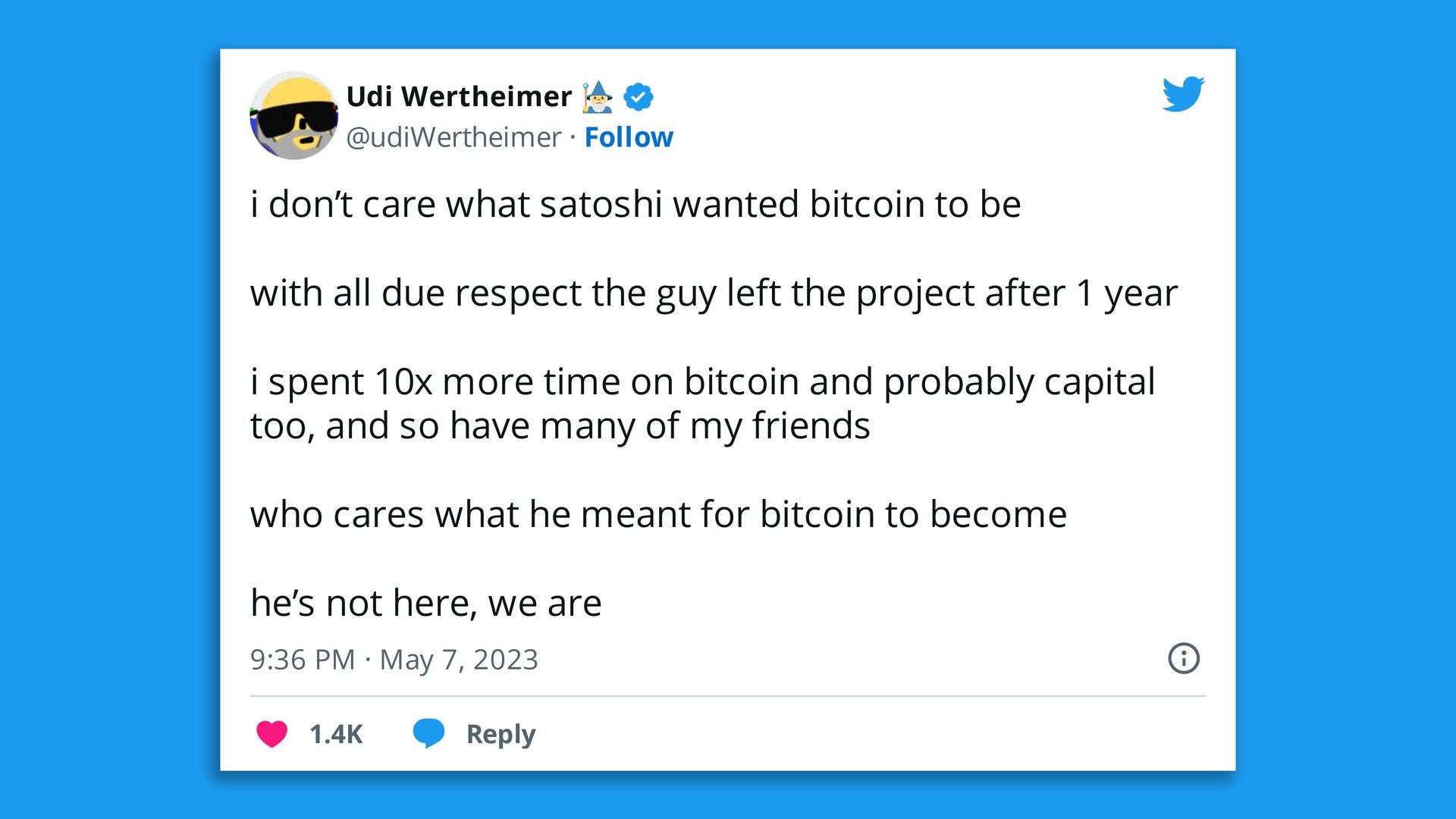
Shots fired!
We introduced readers to Wertheimer in September, a longtime slayer of sacred cows.
- Wertheimer is also behind Taproot Wizards, the first NFT project on Bitcoin that really got people excited.
- It has a manifesto written like something out of a Tolkien book.
Be smart: "Satoshi" refers to Satoshi Nakamoto, the pseudonymous and long-absent creator of the Bitcoin protocol.
The latest: The same upgrade that enabled NFTs on Bitcoin also has enabled the creation of tokens. A project called BRC-20 has people minting all kinds of silly tokens on Bitcoin just because they can.
This newsletter was edited by Pete Gannon and copy edited by Gail Hughes.
Thanks for being here with us! —C & B
Sign up for Axios Crypto

Brady Dale covers crypto and blockchain impacts on markets and regulation.