Axios Crypto

April 04, 2024
Hello! Checking out the NFT scene on the ground is not encouraging, but Bitcoin has a new idea coming soon.
Today's newsletter is 966 words, a 3.5-minute read.
🏵 1 big thing: Better token tech for Bitcoin

Illustration: Annelise Capossela/Axios
Right after the Bitcoin halving event later this month (when the daily emission of new bitcoins will drop in half), a new protocol is expected to launch on the oldest blockchain, Brady writes.
Why it matters: Runes, as it's known, is meant to improve how Bitcoin supports additional tokens. If it works, out, the blockchain will be more useful. And like anything, the more useful Bitcoin becomes, the more valuable it will be.
- With Runes, tokens will work in a more Bitcoin-way, one that puts less stress on the network.
Catch up quick: Runes is the brainchild of Casey Rodarmor, the same person who introduced the Ordinals standard for Bitcoin last year.
- Ordinals allowed the creation of Bitcoin-powered non-fungible tokens, which were hot for a bit during the bear market. They work by attaching artwork or other data to the smallest unit of a bitcoin, a satoshi.
- The Ordinals protocol was used to create other fungible cryptoassets on Bitcoin, so-called BRC-20 tokens, which have largely been used to create meme coins.
The big picture: Until BRC-20, Bitcoin's only fungible asset was bitcoins. Franklin Templeton just praised the spate of recent innovations.
- Ordinals have been good for miners too, because they've generated a lot more transactions, which means more miner revenue.
- Usually, transaction fees are a small portion of miner revenue, but it's occasionally broken 20% of revenue in the last few months — good news ahead of the halving.
Friction point: However, the BRC-20 standard generates a lot of clutter data on the blockchain. Plus, it relies on data held off Bitcoin, which is not technologically elegant.
Enter Runes: In September, Rodarmor proposed the protocol, a way to create tokens without holding data off-chain, with greater efficiency and ease for users.
- Runes won't have complex functionality, like tokens on smart-contract chains like Solana and Ethereum.
- But they will have a neat feature that could be important: Runes will work on Bitcoin's best-known layer-2 network, Lightning — which enables faster, cheaper transactions.
- As it happens, a little company named Coinbase finally connected to Lightning yesterday, which could mean users finally start showing up there at scale.
What they're saying: "Should such a thing exist? I don't know. It's about as simple as possible," Rodarmor wrote in his announcement last year. "On the other hand, the world of fungible tokens is a near totally irredeemable pit of deceit and avarice, so it might be a wash."
🖼 2. NFT.bleak
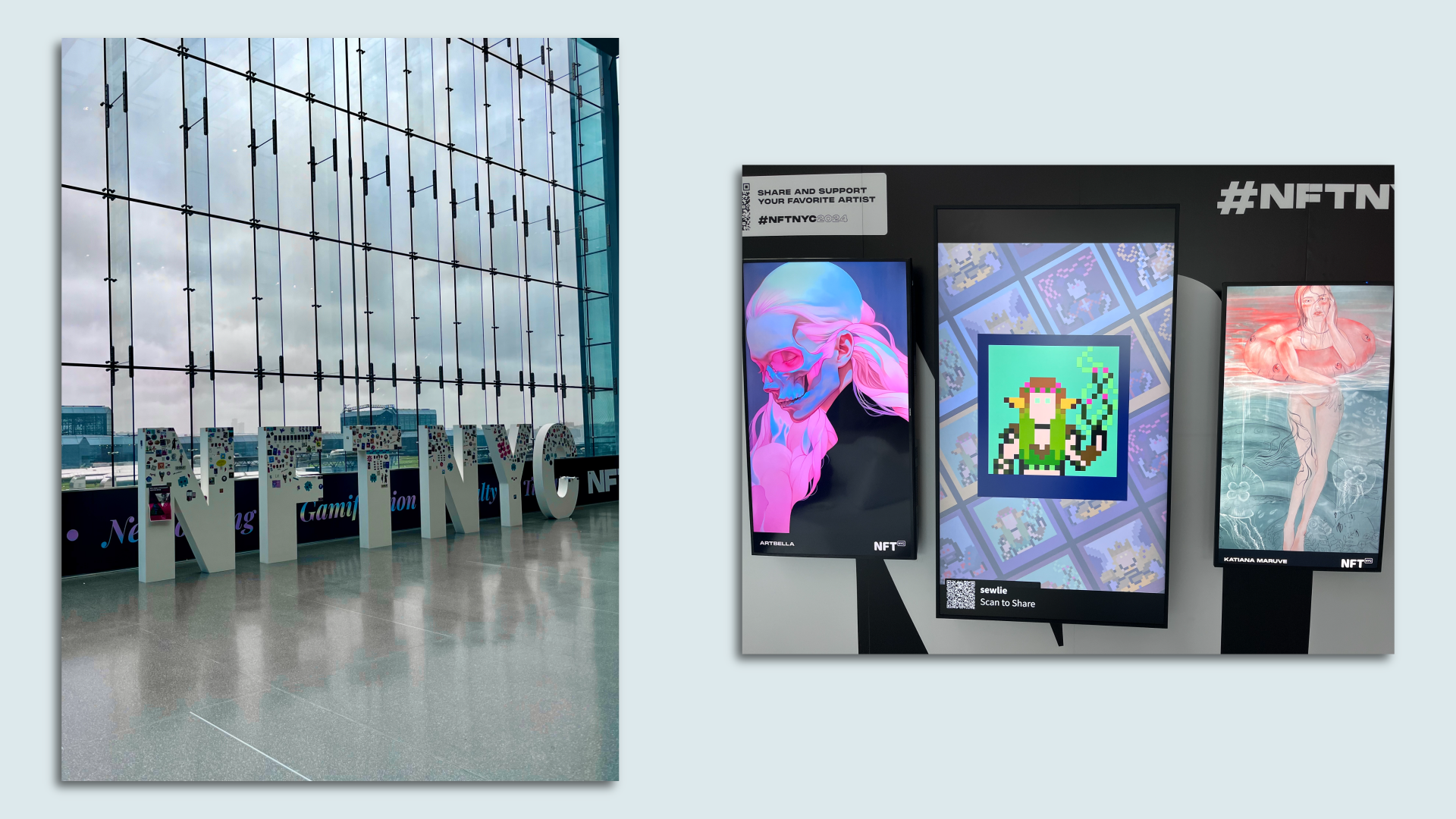
The NFT.nyc logo accepting additions of promotional stickers and some works seen in the Artist Village at the event. Photo: Brady Dale/Axios
The weather in NYC yesterday was maybe the worst possible — cold rain, lots of wind, all day, but at least there was no sleet, Brady writes.
- So it's no wonder that the energy (and attendance) was down at the annual NFT.nyc conference at the Javits Center yesterday. But also... energy was really, really down.
The big picture: Hundreds of millions of dollars are still changing hands in NFTs every month, but it's a shadow of the kind of volume that was moving in 2021, when the sector was hot.
- Bitcoin is back in business, but art on blockchains definitely is not.
In the room: The event yesterday was lots of much-too-eager smiles as small nodes of groups formed outside conference sessions and plenty of elbow room.
- Both at the event itself and one side event we checked out in the morning, it seemed like there was a lot of talk about two things: Bitcoin ordinals and meme coins, particularly the blink-and-you'll-miss-them markets enabled by Solana's Pump.fun.
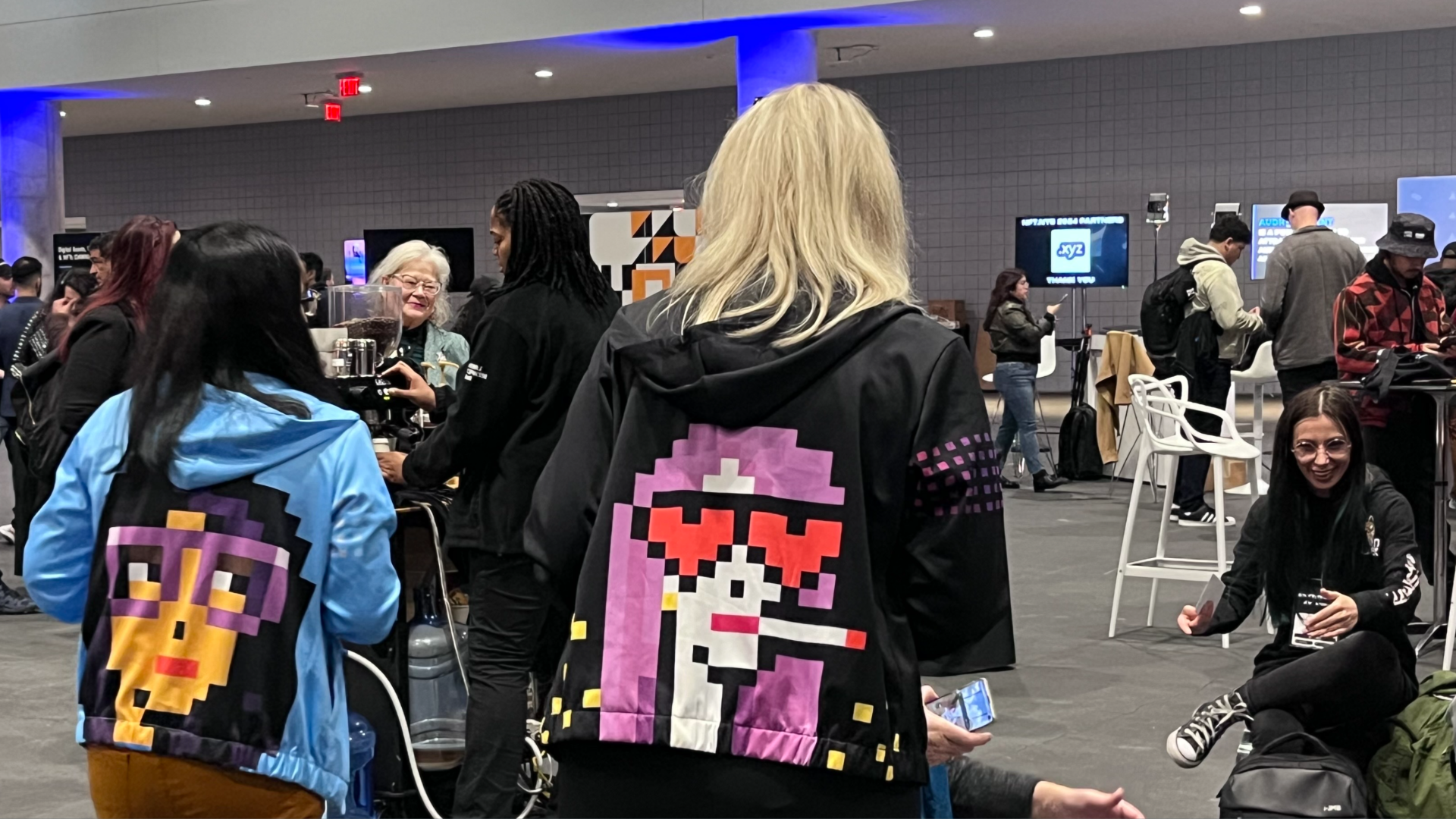
The intrigue: A project called SquidGrow — which, even looking at their website, I can't figure out what they do — had folks in masks giving away cans of lemon coffee.
- Lemon coffee is something that sounds so bad you have to know. Turns out, it's like a lemon soda with some coffee mixed in.
💭 Brady's thought bubble: I had a feeling I should skip NFT.nyc this year and that I shouldn't snag a can of lemon coffee, but I did both anyway.
- I saw a man with an acoustic guitar take the stage while the sun was still out. 👋
💫 3. Catch up quick

Illustration: Natalie Peeples/Axios
🌌 The Cosmos ecosystem of blockchains has been connected to Ethereum. (Blockworks)
🧸 Binance's NFT marketplace will soon end support for such tokens on Bitcoin. (Binance)
🙄 Ripple plans to enter the stablecoin arena. (Bloomberg)
📲 4. Google takes two scammy app makers to court
Illustration: Brendan Lynch/Axios
Google has brought a lawsuit in the U.S. Southern District of New York against two people it accuses of making scammy apps that trick people out of their money, Brady writes.
Why it matters: As more companies move to app-store models, where software is downloaded with an imprimatur of curation by big companies like Apple and Google, it's incumbent on those firms to actually protect people.
How it works: The lawsuit brought by Google accuses the firms of operating apps that make it look like deposits by users are turning into outsize rewards.
- There've been lots of these apps, but the basic idea is simple: show victims graphs where the value of their investments is going up and up, so that they will invest more.
Details: The complaint names Yunfeng Sun and Hongnam Cheung, both of whom are believed to live in China.
Flashback: Axios saw similar behavior when we talked to one of our readers who had been bilked for a bit of cash in a pig-butchering scam.
- He was also made to download a phony app that made it look as though he was getting rich.
- The first footnote in Google's complaint notes that the apps described in its suit were part of such schemes.
The bottom line: "When individual victims attempted to withdraw their balances, Defendants and their confederates would double down on the scheme by requesting various fees and other payments from victims," attorneys at Freshfields Bruckhaus Deringer write in the complaint, on behalf of the tech giant.
- The firm seeks a jury trial.
This newsletter was edited by Pete Gannon and copy edited by Chris Speckhard.
The halving was successful! (on Bitcoin Cash 😹) —C & B
Sign up for Axios Crypto

Brady Dale covers crypto and blockchain impacts on markets and regulation.