Axios Crypto

December 13, 2023
GM!
Second place might usually be the first loser, but lots of projects would love (kill) to be fourth in this industry. An upset is looking increasingly likely.
Today's newsletter is 1,243 words, a 4Β½-minute read.
π 1 big thing: The fight for fourth place


A reshuffling could be underway among the most important crypto assets, Brady writes.
Why it matters: The leading ecosystems in cryptocurrency attract the most investment, talent and users.
What we're watching: If Binance's BNB falls a spot and stays down, that would be a huge upset.
- At the start of the year, BNB was twice as big as the next largest non-stablecoin. But it's been suffering since spring.
- The token gives its holders discounts on the world's most active exchange and certain indirect profit-sharing mechanisms.
- But last month, Binance was hit with a $4.3 billion settlement with the U.S. government, an outcome that β while expected β led to a loss of its CEO and tough consequences.
Zoom in: U.S. customers have long been banned on Binance, but there were always ways around it. Now, with the company under the eye of U.S. regulators over a commitment to keep U.S. users out, it's losing a big market.
The challenger, XRP: With its $33.3 billion market cap, it sits just over $5 billion below BNB.
- It's displayed staying power β one of the cryptocurrencies that's held on to a place in the top 10 going back two cycles.
- XRP has two things going for it: A vociferous fan base known as the XRP Army, and a big win in the courts this year when a judge ruled that it was not a security (a ruling that could be overturned).
The intrigue, Solana: This is probably the ecosystem to watch. Solana's daily active users have been ticking up since October and went into hockey stick growth in November.
- It runs much faster than Ethereum.
- In fact, Solana overtook Ethereum proper for daily transactions in November (though Ethereum's still larger when layer-2 chains are factored in).
- Active users on Solana are still well down from early 2022, however.
Meanwhile, the leading American stablecoin, usd coin (USDC) has also suffered all year.
- It's a stablecoin, so none of the losses are speculative. Folks are just pulling money: It seems like it never really recovered from when its peg broke amid the regional banks' kerfuffle early this year.
- USDC, ranked seventh overall by market cap β could easily lose another spot. The gap between it and Cardano's ADA is only $2.7 billion.
Be smart: Much of the changes here, stablecoins aside, are driven by speculative activity. When bitcoin price rises, it tends to get lesser cryptocurrencies into a tizzy.
- With people actually doing things on chain these days, investors have something like fundamentals to look at, and they are gravitating to projects with stronger metrics.
The bottom line: Bitcoin ($823 billion market cap), Ethereum's ether ($262 billion) and the stablecoin tether ($90 billion) hold the top three spots and that looks wildly unlikely to change in the foreseeable.
π 2. Charted: Avalanche making moves


But wait, there's more!
Stepping back: The leaderboards are typically defined by the market capitalizations of tokens or coins, Brady writes.
- That is: price X circulating supply = market cap.
Avalanche, a smart contract blockchain created by a professor at Cornell University and longtime researcher in the space, Emin GΓΌn Sirer, has come from the back of the pack recently, surging past Tron (TRX) and Dogecoin (DOGE).
- Tron is also technically a smart contract chain, but it mainly serves as the settlement layer for the tether stablecoin.
- Dogecoin is, of course, Dogecoin: the best-known memecoin by far.
By the numbers: Avalanche's AVAX was trading around $37 yesterday afternoon, well down from its all-time high of $145 in November 2021.
What we're watching: By the time bitcoin sees a fresh all-time high, the top 10 cryptocurrencies list could look very different.
πΌ 3. Crypto gets four of the IRS's top 10 (debatably)
Illustration: Lindsey Bailey/Axios
Four of the top-10 tax fraud cases busted by the IRS this year involved cryptocurrency.
- Not bad for an off year!
Driving the news: The nation's tax collector has published its greatest hits for 2023.
In eighth place, Amir Bruno Elmaani, aka Bruno Block, creator of 2018's Oyster Pearl token (we've never heard of it, either).
- He got four years in prison this year.
- The creator of Oyster Pearl bought yachts in 2018 with his token's proceeds while reporting zero income to the IRS the same year.
Quick take: Dude...
In seventh place, James Zhong, who hacked the Silk Road forever ago and got his hands on 50,000 BTC ($2 billion). His arrest was announced in April.
- Silk Road was a dark web marketplace for drugs and guns and β arguably β the first real-world use case for Bitcoin.
- There's a 2017 book about it called "American Kingpin" and it is great (even my mom loved it and she doesn't understand any of this stuff).
In fourth place, a bitcoin entrepreneur, Ian Freeman, was convicted of operating a network of bitcoin ATMs that were heavily used by various kinds of scammers.
- He received an eight-year sentence for failing to participate in the nation's anti-money laundering system, though he disputes the state's claim that he did nothing to protect users from blackmailers and other miscreants.
- During trial, the state showed evidence that he and his co-conspirators opened bank accounts under the name of various religious organizations, including the Crypto Church of New Hampshire.
Finally, in third place, a co-founder of OneCoin β which was a cryptocurrency in the same way a Tonka is a truck β was sentenced to 20 years in prison.
- Karl Sebastian Greenwood got 20 years for operating OneCoin. His co-founder and the face of the project, Ruja Ignatova, cannot be found.
- OneCoin was a straight Ponzi scheme. Its founders never bothered to build a blockchain.
The No. 1 spot went to a scheme to claim biofuel tax credits fraudulently.
π’ 4. Catch up quick
Illustration: Sarah Grillo/Axios
π¨ The U.S. charged two men with operating a cryptocurrency Ponzi scheme netting $25 million. (Department of Justice)
π SBF's lawyer confirmed our reporting: He was really bad on the witness stand. (Bloomberg)
π²πͺ Terraform Labs cofounder Do Kwon's tenure in Montenegro has been extended. (Bloomberg)
π₯Έ MetaMask was caught using single-pixel tracking to harvest data from users. (Protos)
π 5. Culture hash: A trade agreement
Screenshot: Unchained Crypto (YouTube)
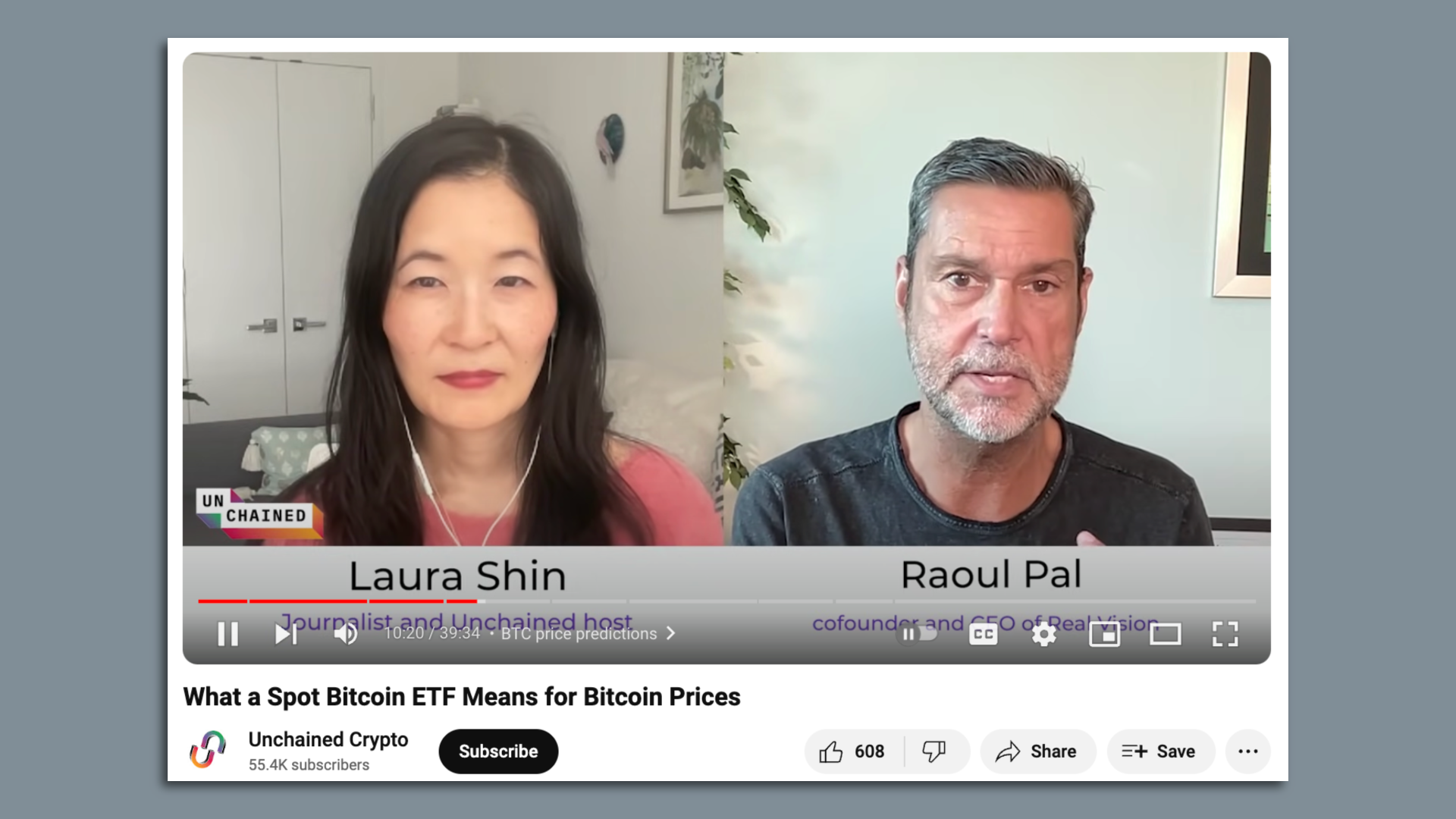
Raoul Pal, CEO of the financial media network Real Vision, offers a metaphor to explain why he believes a Bitcoin ETF will drive prices up for the world's oldest cryptocurrency. He spoke on Laura Shin's podcast, Unchained.
- He says investors should think of the ETF as a free trade agreement, Brady writes.
The crypto world is a nation on the internet, he argues β it's a developing economy with developing-economy-like growth.
- Traditional finance is a developed nation. Lots of money but less growth.
- Crypto is tough for people in the developed nation to access: It's weird, they don't know the rules or they can't be bothered.
What they're saying: "We've got a population growing at 100% a year, that's the number of active wallets. If you think of it: [We] had a massive recession in 2022 and population grew 42%," Pal said.
- With that kind of population growth, he says it's obvious that the metaphorical "GDP" is going to grow.
And so: Investors can think of a Bitcoin ETF as a free trade agreement. It's an easy way for TradFi to access the growth of this adolescent market without doing anything differently.
Be smart: This idea of crypto as a "nation" is not just a metaphor. It's how lots of people in the industry think about it.
- The idea goes back to a book that basically everyone in Silicon Valley with even a smidge of Libertarianism has read: 1997's "The Sovereign Individual," by James Dale Davidson and William Rees-Mogg.
This newsletter was edited by Pete Gannon and copy edited by Carolyn DiPaolo.
How the mighty have fallen. βC & B
Sign up for Axios Crypto

Brady Dale covers crypto and blockchain impacts on markets and regulation.