Axios Crypto

April 25, 2023

Hello, Tuesday. Today we hit the courts, the cloud and Congress.
- Do any of these stories raise questions? [email protected]
Today's newsletter is 948 words, a 4-minute read.
👨⚖️ 1 big thing: Coinbase sues back

Illustration: Maura Losch/Axios
Coinbase is attempting to turn the tables on the Securities and Exchange Commission, Crystal writes.
Driving the news: The U.S.'s largest crypto exchange filed with the Third Circuit Court of Appeals a writ of mandamus, which is a request that it order the regulator to carry out its duties or correct discretionary abuse.
Zoom out: Coinbase is using the U.S. legal system to argue that the SEC has been slow to respond to the company's petition last year asking for crypto rules, even as it deals with the Wells notice it was handed by the regulator just weeks ago.
Details: The exchange's plea is for "basic rulemaking" so that exchanges could register, and issuers could list digital-asset securities on those exchanges with some level of clarity around what the ground rules are, according to Paul Grewal, Coinbase's chief legal officer.
- "Eight to nine months later we're still waiting for an answer," he tells Axios, nodding to the Administrative Procedure Act.
Flashback: Coinbase filed its petition around two important events last year— the Justice Department charged a former Coinbase employee with insider trading and the SEC, separately, alleged securities fraud.
The latest: Coinbase says the delay in the regulator's response to the petition became untenable, with the chair and other SEC officials making informal public statements saying no new rules were coming.
- Context: Chair Gary Gensler has said as much on Twitter, in interviews, and most recently, in front of Congress.
What we're watching: As for the Wells notice Coinbase received, Grewal said: "That process remains pending and underway."
☁️ 2. Google Cloud's crypto offering

Illustration: Rae Cook/Axios
Google Cloud rolled out benefits that web3 startups specifically can tap when applying for its general startup cloud program, Crystal writes.
Why it matters: The industry has taken hits over the past year, both self-inflicted and in the regulatory sphere, yet major service providers appear to be making a more direct play for those focused on blockchain.
- Of note: Google Cloud and AWS are sponsors of CoinDesk's Consensus conference in Austin this week.
What they're saying: James Tromans, head of web3 engineering at Google Cloud, tells Axios in an emailed response that the company is "committed to supporting the growth of the web3 ecosystem."
What others are saying: "This is an instance where it is clear that the world's leading technology giant is taking a significant step into web3," Alex Svanevik, chief of blockchain analytics platform Nansen, tells Axios.
- Startup benefits include discounts on Nansen products, among other things.
The bottom line: Cloud providers look open to crypto.
Editor's note: This piece has been updated with a revised quote from Nansen chief Alex Svanevik, who says the PR firm who gave Axios the original quote misrepresented his position.
🏛 3. New draft stablecoin legislation

Illustration: Aïda Amer/Axios
You know an issue is important when people hold press briefings about legislation that hasn't been introduced yet, Brady writes.
- Driving the news: Yesterday, House Financial Services staff began circulating a new draft of legislation that would create a legal framework for regulating crypto.
Why it matters: The legislation appears written to allow crypto entrepreneurs a way to create and deploy stablecoins, while preventing state actors from being too obstructionist about new stablecoin products.
How it works: The legislation focuses on payment stablecoins. That is, crypto assets that stand in for U.S. dollars, created for the purpose of transactions.
- Regulated entities that want to issue stablecoins would do so under their existing regulators.
- Non-regulated entities would be regulated by the Federal Reserve, or by a state entity, with the Fed also keeping an eye on them on a secondary level.
Meanwhile, all federal regulators would need to have the same set of rules, and the law gives them 180 days to write it from passage.
- It has a bunch of common sense rules for issuers, like monthly attestations and limits on what kind of assets can back stablecoins.
- In a bankruptcy, stablecoin holders would get paid back before the company that issued it or its creditors.
Zoom in: The draft seems to take pains to prevent regulators from obstructing the industry.
- Case in point: Every six months, regulators would have to report to Congress on all applications that they have marked incomplete for six months or longer.
- If an application is denied, the regulator would have to give a reason why, pointing to which of the criteria it believes the applicant failed.
Of note: This draft doesn't expressly forbid creating features around such stablecoins.
- For example, it doesn't rule out sharing the interest earned on its underlying assets or, perhaps, offering special discounts from certain vendors for their use.
Context: This draft reflects feedback from Republican members late last year. Unlike the prior discussion draft, it doesn't say anything about stablecoins like Terra and doesn't call for another study.
- This legislation is designed to focus on payment stablecoins.
What's happening: Nothing, really. Paper is moving around. This is a long way from real.
What we're watching: What gets introduced, and if Democrats play along or introduce their own legislation.
🛼 4. Catch up quick
🇰🇷 Prosecutors in South Korea indict Terraform co-founder Daniel Shin, nine others. (Bloomberg)
💧 Arbitrum starts governance token drop for ecosystem DAOs. (The Block)
🚫 U.S. drops more sanctions on three individuals in the over-the-counter trading market for helping North Korean hacking groups. (CoinDesk)
🪵 That crypto mining bill we mentioned earlier this month in Arkansas has been signed into law by the governor. (Arkansas.gov)
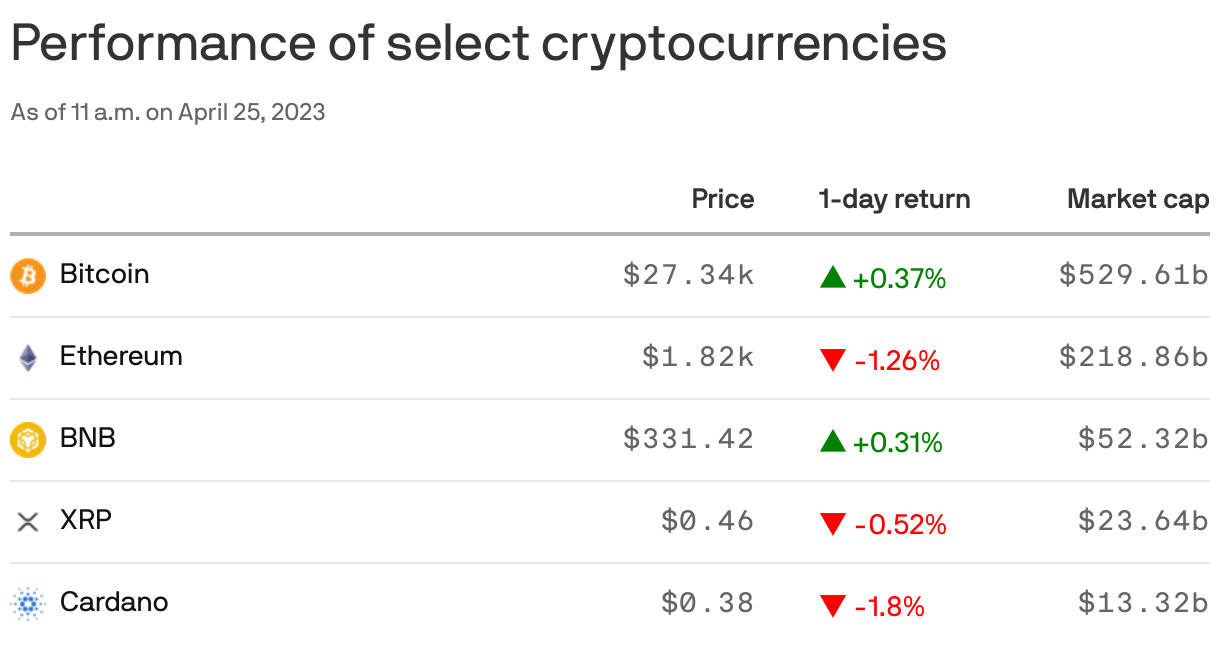
Top coins
💾 5. Culture hash: Data wants to be free
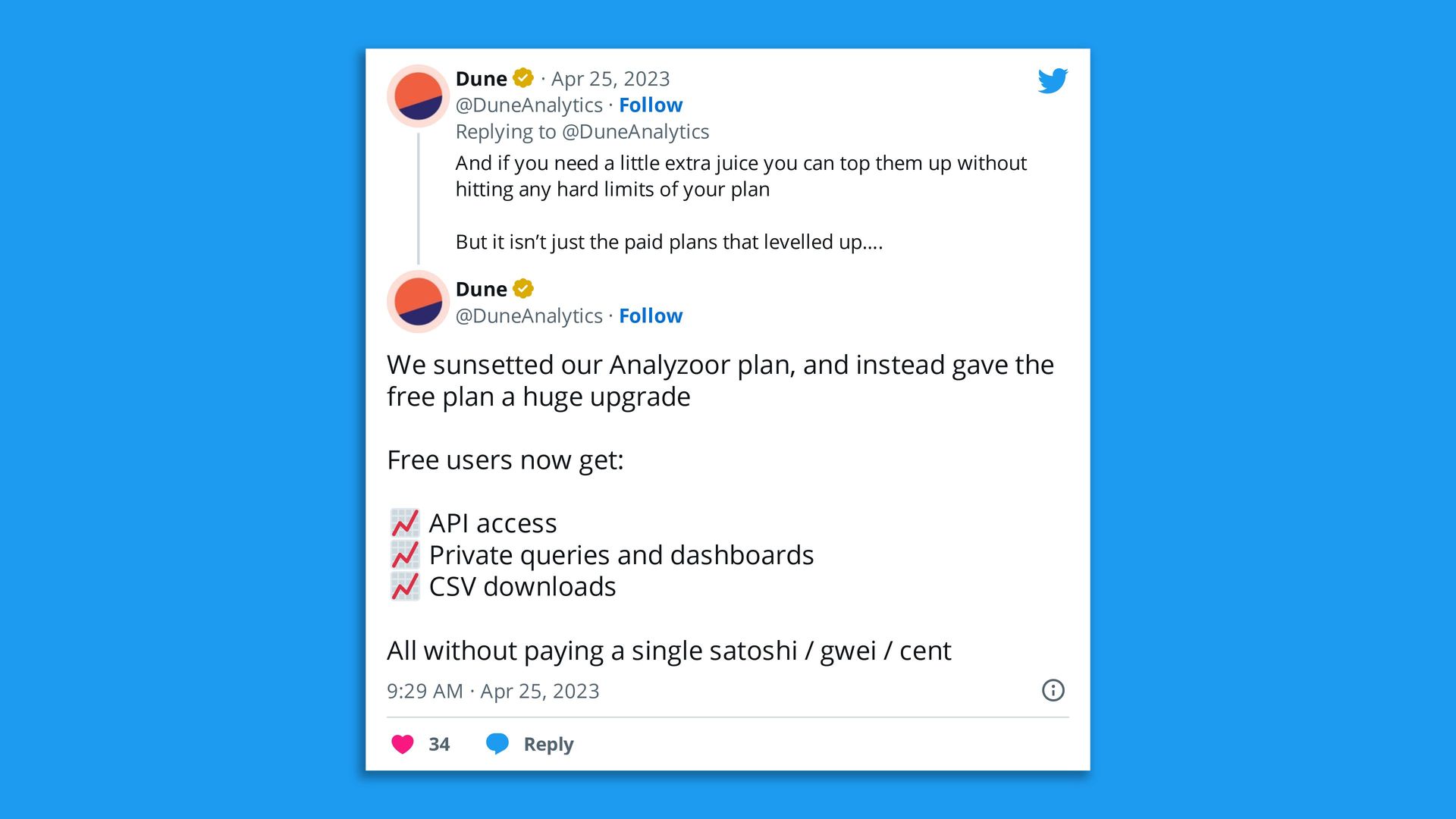
Screenshot: @DuneAnalytics (Twitter)
Crypto is awash in data, but making sense of it can be tough. Dune Analytics is a service that makes it easier to pull comprehensible information out of blockchains, Brady writes.
- However, a lot of those services are fairly pricey to really use. In particular, the data underlying its many charts is often paywalled.
Driving the news: One of those paywalls has just fallen down.
Be smart: Creating queries in Dune takes some skill (more than I have).
This newsletter was edited by Pete Gannon and copy edited by Carolyn DiPaolo.
That's all, folks. —C & B
Sign up for Axios Crypto

Brady Dale covers crypto and blockchain impacts on markets and regulation.