Axios Crypto

March 06, 2025

GM! Tomorrow might be a big day in crypto policy.
- If you have the inside scoop on tomorrow's meeting at 1600 Pennsylvania Ave., please hit us up: [email protected].
Today's newsletter is 1,232 words, a 5-minute read.
1 big thing: The White House Crypto Summit
My gut instinct expects a surprise at tomorrow's White House Digital Assets Summit.
Why it matters: On Sunday, the president goosed the crypto market by announcing he would put several cryptocurrencies in his reserve (not just bitcoin), but I suspect it was a PR sleight of hand.
- Get everyone talking about one thing for a week and then come out of left field with something else.
- But also for sure we will hear more about the reserve. Crypto and AI Czar David Sacks is teasing that today.
Inside the room: It's hard to glean much from the guest list. If there's one commonality among the folks who have said they are going, it's that they — in almost all cases — have deep pockets.
- There's Michael Saylor, behind the publicly traded bitcoin buyer Strategy (you probably still know it as MicroStrategy).
- There are the heads of exchanges. Brian Armstrong of Coinbase, Arjun Sethi of Kraken, Crypto.com's Kris Marszalek, and Vlad Tenev from Robinhood.
- Some investors will be on hand, including Matt Huang, co-founder at crypto investor Paradigm, which just released its policy guidelines this week; Kyle Samani of Multicoin Capital, the VC contrarian; and Zach Witkoff, investor and co-founder of World Liberty Financial, the Trump-affiliated DeFi project.
- Brad Garlinghouse of Ripple will be there, the firm that stewards xrp (XRP). And two others we know: Sergey Nazarov of Chainlink Labs, the top oracle network and JP Richardson, Exodus, a self-custodial wallet maker.
- And members of the administration, of course
(*If someone above hasn't publicly confirmed their attendance on social media, we've confirmed it with their company)
That said, as of this writing, the White House has not published an invite list.
Who's not going: Reporters, as far as we know. I'm not. But a White House spokesperson tells me that something will come out for reporters.
- At least one longtime trade group has confirmed to Axios that it won't be there and another longtime fund also won't be there.
- And Cardano creator Charles Hoskinson is not invited.
💭 Our thought bubble: If I had to guess what kind of surprise announcement might hit, I'd put it in the energy area. I could imagine a world where a deal is announced for a big energy production facility.
- This would be exciting for Bitcoin miners.
- Or maybe he brings in someone from the SEC with a bunch of ETF approvals.
What we're watching: The plan for the crypto reserve.
- Sacks has been clear that a plan is coming.
- My guess is that there's some surprising funding stream to buy crypto assets. Since there's already $17 billion worth (or so) in the custody of the U.S. Marshals, maybe they plan to devote some portion of sales of other seized property to buying cryptocurrency.
Zoom out: If the U.S. does it, other nations will do it, too.
Worth your time: One Cato scholar has explained why, if past is prologue, the U.S. will probably never sell any crypto assets it holds, so it will never pay down any debt.
2. A buyback from Bakkt


Apex Fintech is weighing a potential acquisition of Bakkt (NYSE: BKKT) to buy back the crypto trading technology it sold the firm in 2023, Axios has learned.
- Why it matters: It's another example of how the policy swing between the Biden and Trump administration has created whiplash in the industry.
Context: Apex, which embeds stock trading into other apps, agreed to sell that business to Bakkt in 2022 in part because of the heavy regulatory scrutiny on crypto.
- Apex Crypto then became Bakkt's main business — and was considered key to a turnaround attempt for the company — but the product has stumbled under its stewardship.
- The new administration, though, has signaled it is significantly friendlier to crypto and has pared back multiple SEC lawsuits against exchanges.
Zoom in: Bakkt has been struggling. Its market cap is $175 million today.
The bottom line: It's unclear how serious talks are. But Apex Fintech, which previously sought a $4.7 billion valuation in a 2021 SPAC deal, is looking for ways to get back into the crypto game.
3. DeFi broker rule
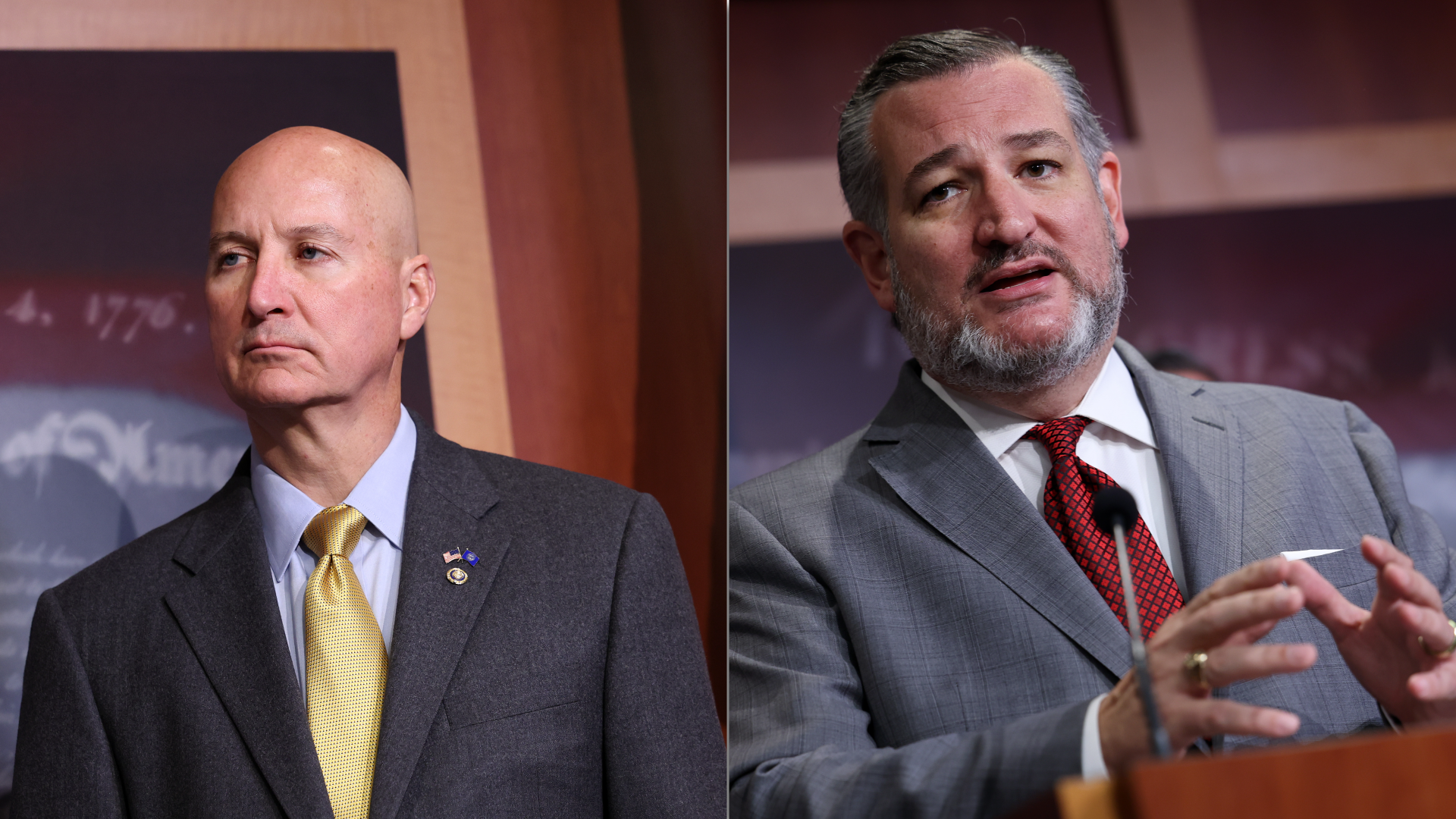
The Senate passed two measures this week to overturn crypto-related regulations inked late in the Biden administration.
The big picture: Nixing some regulations made by a prior administration has become a ritual for the first Congress following a change in White House leadership.
- The crypto industry is benefiting somewhat from the fact that the Biden administration took a while to finish its blockchain work.
Driving the news: The Senate passed the CRA resolution to repeal the IRS DeFi broker rule Tuesday by a vote of 70 to 27.
- The resolution was introduced early in this Congress by Sen. Ted Cruz (R-Texas) and supported by the Trump administration.
- The IRS rule, in an attempt to bring in more funds from crypto trading, expanded the reach of the Internal Revenue Service's reporting requirements into automated operations running on decentralized systems.
Then, yesterday, the Senate passed another CRA resolution (51-47) that seeks to overturn a January rule by the CFPB that expanded its authority to supervise fintech apps in the payments space.
- The resolution was introduced only late last month, by Sen. Pete Ricketts (R-Neb.).
Zoom in: This one is bigger than just crypto, however. Using fintech apps to make payments has become very popular in the U.S.
- The CFPB rule, among other things, expands obligations under the Electronic Funds Transfer Act to cryptocurrency wallets known as "non-custodial."
- Friction point: With non-custodial crypto wallets, developers have no control over assets deposited in them, making "it difficult or virtually impossible to comply with the obligations imposed," as attorneys in Perkins Coie noted in a blog post on the rule.
The other side: The CFPB rule deals with much more than non-custodial wallets, however, and its concept of drawing these new applications under the regulator's authority is one the advocacy group Better Markets has supported.
- "The CFPB's proposal will ... protect the wallets of the rising number of Americans using these technologies," Stephen Hall, the organization's legal director, said in a statement last year.
What's next: Neither rule would be rescinded until the House passes each one.
4. Catch up quick
🇸🇻 The IMF continues to object to El Salvador's bitcoin bullishness, ordering it to quit making purchases. (Decrypt)
⛏️ Bitcoin mining machines stuck in ports under the previous administration are starting to get released. (Reuters)
🦊 Sources say that xrp will go in the U.S. reserve because Ripple pushed for solana. (Unchained)
😲 Yes, but: Solana's chief architect expressed ambivalence about the notion of a national reserve. (X)
5. About togetherness
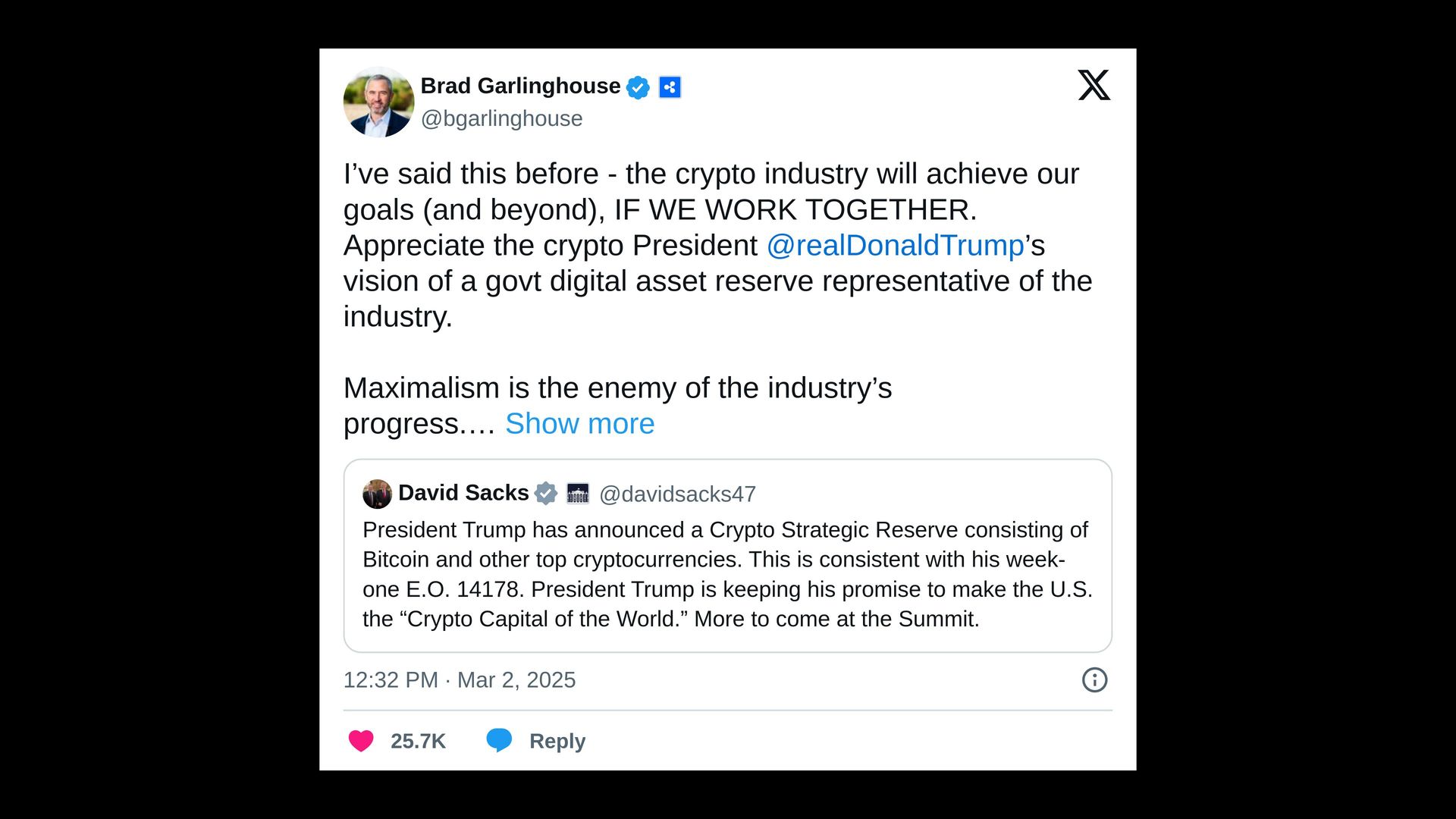
Ripple's Brad Garlinghouse now advocates that the crypto community stick together rather than giving in to maximalism, ever since the currency he owns gallons of, xrp, got floated for inclusion in a strategic reserve.
Flashback: In 2022, as the market was coming off its November all-time high, but before Terra and FTX had totally wrecked the party, Garlinghouse's co-founder at Ripple funded a campaign to attack Bitcoin for its proof-of-work consensus mechanism.
- For $5 million, it sicced Greenpeace on the world's most popular cryptocurrency, urging its developers to shift it to a less energy intensive consensus mechanism.
Brady's thought bubble: There's no way Larsen or anyone at Ripple believed this would work, in terms of changing Bitcoin.
- Who knows what the environmentalists believed.
Yes, but: Now that XRP has been invited to the party Bitcoin started, togetherness is cool again.
This newsletter was edited by Pete Gannon and copy edited by Carolyn DiPaolo.
📺 Is anyone else watching "Daredevil: Born Again"? It's just not the Netflix-era stuff. It's trying hard to be same-but-different. —Brady
Sign up for Axios Crypto