Axios Crypto

April 08, 2025

Who has $20 billion cash ready to go and is raring to change payments in the U.S. forever? Well, it's not Venmo.
- State of play: The Deribit futures market is no longer an even bet between $80K and $100K BTC. The favorite price now is $70K, but the buyers at $100K aren't that far behind.
- Do you think the U.S. has a responsibility to reveal the identity of Satoshi if someone in the government knows who it is? Let us know: [email protected].
Today's newsletter is 839 words, a 3-minute read.
1 big thing: 🧾 Tether point-of-sale
Tether CEO Paolo Ardoino told me I was getting warm this week when I flat out asked him if he was thinking of paying to build a stablecoin-enabled Square competitor here in the U.S.
- Tether, the controversial issuer of the world's largest stablecoin, has a vision for the U.S. — and the financial heft to see it through, Ardoino tells Axios in an interview.
Why it matters: With legislation on the horizon, a major IPO in the works from rival Circle and a growing list of competitors positioning for a piece of the market, the industry's giant looks unlikely to sit out the coming race for stablecoin supremacy in the United States.
The big picture: Other issuers, Ardoino expects, will chase U.S. institutional customers who use stablecoins for things like crypto trading and decentralized finance, or DeFi.
- But Ardoino sees a better opportunity in the U.S. consumer market.
- Tether is likely to set up a new company in the U.S. and create a payment token for the country, he says.
- Its token, USDT, the largest stablecoin in the world, will continue to serve the international market and the developing world.
What they're saying: "Here's the big difference: In the U.S., people would use a stablecoin as their checking account, while, outside the U.S., people use USDT as their savings," Ardoino said.
Friction point: Stablecoins might be a cheaper way to do payments, but the problem is most people don't have stablecoins. They have dollars inside banks.
- To make stablecoins work as day-to-day payments, Tether would have to solve that problem: getting people to hold stablecoins in digital wallets, ready to use for purchases.
- And then merchants, the places where people would make those purchases, would also need to be able to accept them.
Between the lines: So when asked whether Tether would consider building a Square competitor that would also accept stablecoins, Ardoino said:
- "I cannot spoil all our strategy, but you are on the right track."
What we're watching: The IPO for the issuer of Tether's closest competitor, Circle. With capital drying up for investment, fintech IPOs have been getting canceled, but Circle appears to be staying the course.
- It may have little choice. It will need capital to compete if Tether is determined to come here soon, never mind companies like Bank of America eyeing the space.
- Circle is targeting a $5 billion valuation while, in our conversation, Ardoino said Tether has more than that in cash on hand.
The bottom line: "We have $20 billion in profit that we did not distribute to the shareholders. So I'm pretty sure that we can move at the speed of light," he says.
2. Giving back gains


Did you know the market was down?
Flashback: Bitcoin broke through to a new high right after the election. Then it charted another high on Inauguration Day.
- So it's hard not to credit President Trump with those gains.
Yes, but: Those gains are basically gone.
- When BTC price rose over $80,000, that was notable because it was the inflation-adjusted high since the prior peak in 2021.
- But now it's back below $80K.
💭 Brady's thought bubble: The most successful bitcoin investors think in years, not months.
3. Nebraskacoin
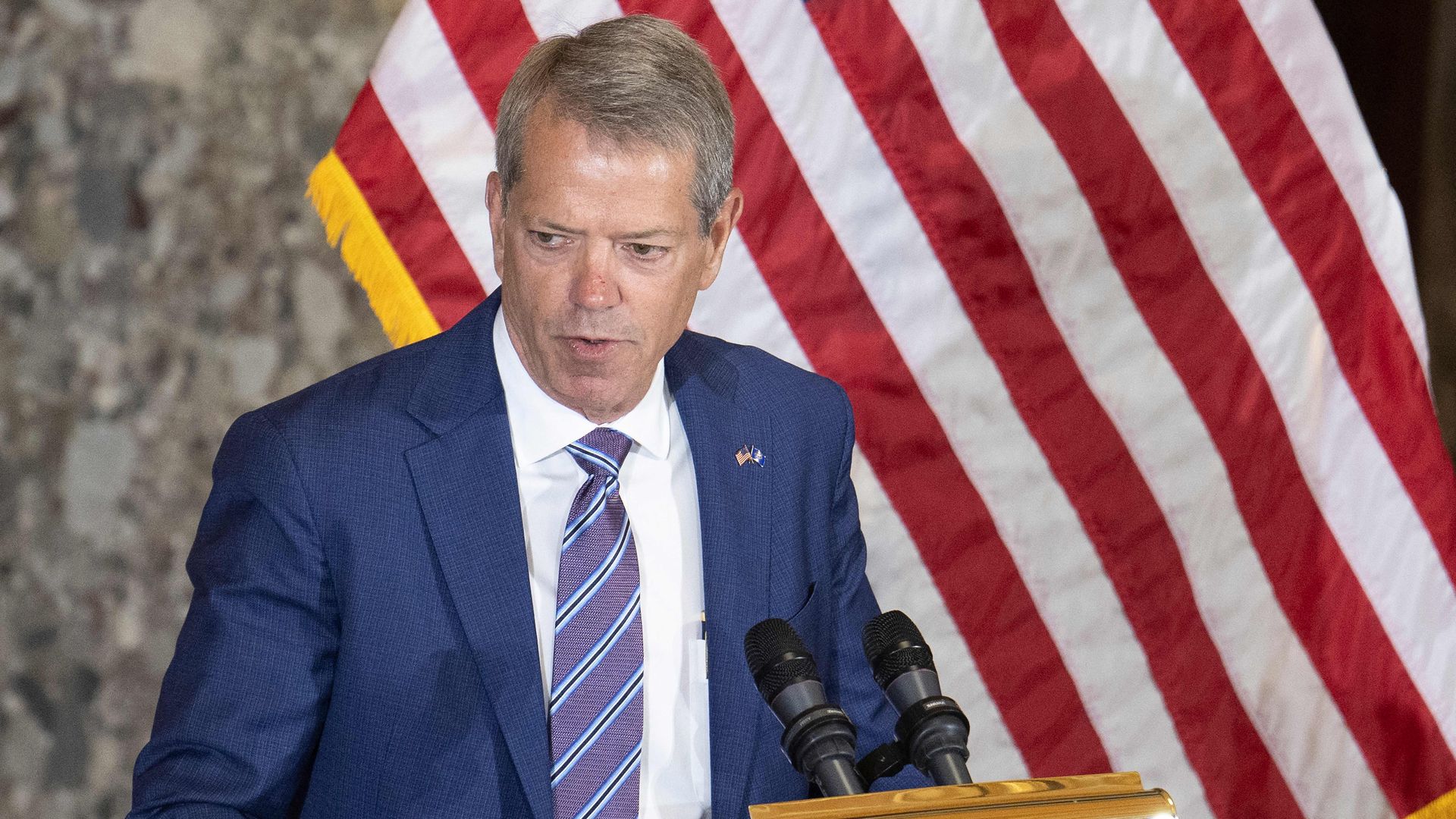
Nebraska is ready and willing to put its imprimatur on stablecoins.
Catch up quick: The private company Telcoin got the green light from Nebraska regulators in February to become the state's first crypto deposit bank. It's expected to launch its stablecoin, eUSD, early this year.
- It's the result of the state's Nebraska Financial Innovation Act, passed four years ago, which created a path for its banking regulator to approve a stablecoin, Nebraska finance director Kelly Lammers tells Axios.
Between the lines: The law is live, and the state isn't waiting on federal action, but Lammers is watching the forthcoming legislation from Congress.
- Nebraskan officials are working now on a framework regulators can use to assess the riskiness of a token by taking into consideration its underlying blockchain, tokenomics, governance and other issues.
- This is meant to complement the CAMELS system that regulators already use to assess banks.
Fun fact: Nebraska's law was championed in the state legislature by Republican Rep. Mike Flood, now in the U.S. House.
Worthy of your time: Nebraska's pioneer spirit endures – this time with digital assets
4. Catch up quick

🙈 The White House won't try to rewrite Fed rules via executive order. (Unchained)
🚥 A White House memo ordered the DoJ to get out of crypto regulation. (ABC News)
🤝 Ripple announced a deal to acquire prime brokerage Hidden Road for $1.25 billion. (Axios Pro)
👀 UPDATE: Nothing came out about the reserves or stockpile yesterday, but as we told you last week, that's not unexpected.
5. Culture hash: Web3 gaming

Remember when web3 was the hot topic?
The latest: I stumbled on two reports about web3 gaming projects that are a hot mess.
- Shrapnel was expected to be crypto's Call Of Duty. It's in trouble.
- Treasure DAO was one of the hot video game projects. Now it's restructuring fast.
The bottom line: Don't put your Xbox on eBay quite yet.
This newsletter was edited by Pete Gannon and copy edited by Carolyn DiPaolo.
🪷 Walton Goggins' character didn't make any sense in the new "White Lotus," but that was still a pretty solid season, right? Kind of felt like it could be a series finale, though. —Brady
Sign up for Axios Crypto