Axios Crypto
May 17, 2024


TGIF! Lots of green on the ole crypto boards, though we're told everyone in the coins on social media is hyperventilating. There's a solution for that! Quit social media.
- Email with us instead: [email protected]
Today's newsletter is 1,064 words, a 4-minute read.
1 big thing: 🦬 Oklahoma is bitcoin country
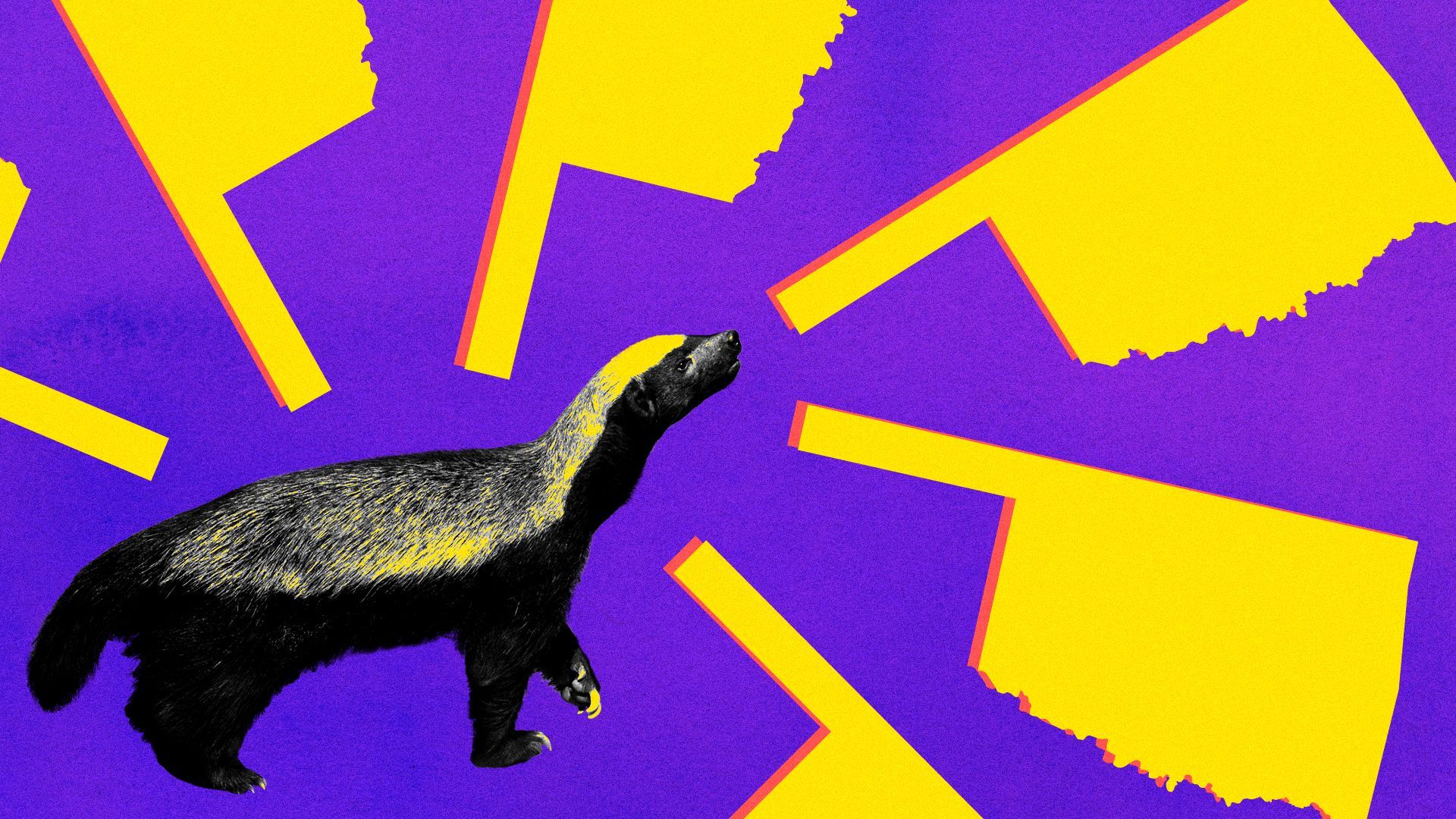
Oklahoma is the first state to sign legislation into law that protects its citizens' right to self-custody their bitcoins and other digital assets.
Why it matters: Enabling people to keep and control digital wealth without the help of a third party was one of the main reasons Satoshi created Bitcoin.
- Cash can be kept in a wallet or under a mattress, but there was no way to hold value digitally without involving a bank or fintech company before Bitcoin.
The latest: Gov. Kevin Stitt signed it into law Monday.
- House Bill 3594 passed both of Oklahoma's legislative chambers with strong majorities.
Oklahoma's Bitcoin rights law also protects the rights of citizens and companies to mine Bitcoin (though they have to comply with local laws, like noise ordinances).
- The legislation was pushed by the Satoshi Action Fund, which has been working state-by-state to enact legislation protecting the use of cryptocurrencies.
- Previously, it successfully pushed for laws to protect the rights of Bitcoin miners in Arkansas and Montana.
- Dennis Porter, the fund's CEO, told Axios that his organization sees passing state legislation as a way to move laws through the U.S. Congress later.
Zoom out: Very nearly all cryptocurrency mining — particularly at scale — is Bitcoin mining.
- The lion's share of new blockchains use a proof-of-stake mechanism to validate transactions, which can easily be run in the cloud.
- The only other top 25 blockchains that still use Bitcoin's proof-of-work are Dogecoin, Bitcoin Cash and Litecoin.
Under the law, special taxes can't be imposed on purchases just because they were made with cryptocurrency.
- Miners can't be subjected to rules that only apply to their businesses. For example, a community can have a noise ordinance, but it can't have a noise ordinance that only applies to bitcoin miners.
- It also specifies that operating a node of any kind of cryptocurrency network does not constitute a money transmitter business in the state.
- The law expressly does not exempt cryptocurrency businesses from Oklahoma's securities laws.
What they're saying: "Oklahoma is now a forerunner for Bitcoin and digital asset policy in the country," Storm Rund, president of the Oklahoma Bitcoin Association, said in a statement from the group.
The governor has not replied to a request for comment from Axios.
What's next: The law goes into effect on Nov. 1, and miners will say: Oh what a beautiful mornin'.
2. 📝 First crypto legislation passes Congress
/2024/05/16/1715897698104.gif?w=3840)
SEC chair Gary Gensler has done the nearly impossible: He got a non-emergency bill through Congress.
- It just wasn't one he wanted.
The latest: Both chambers have passed legislation that would nix SAB 121, the SEC's staff accounting bulletin that makes the crypto custody business unattractive for many companies.
- It's the first piece of crypto legislation Congress has passed, though President Biden vowed to veto it.
By the numbers: Yesterday the Senate voted 60-38 to send it to him.
- Across the two chambers, all Republicans, one independent and 32 Democrats voted to repeal the guidance, which the Government Accountability Office found to be a rule.
The other side: In a statement sent to Axios, the SEC called SAB 121 "non-binding" and reiterated its position that it "enhances important disclosure" to investors in firms that custody crypto.
- It did not address the result of the Senate vote.
The big picture: The SEC had been feeling more confident after a procedural win on most points in its case against Coinbase, the country's largest cryptocurrency exchange, and on key points in the case against Terraform Labs.
- However, that follows a string of losses, such as on the characterization of the cryptocurrency XRP and approval of a spot bitcoin ETF.
- And now the full Congress rebuked the agency's custody accounting rule.
What's next: The president will weigh in.
3. 🚴 Catch up quick

🐖 Pig-butchering rings are kidnapping people in India, holding them in Cambodia and making them target people in the Philippines. (SCMP)
🔮 Chicago's CME is looking likely to open spot bitcoin trading. (FT)
🚫 The token for the Telegram-based "game," notcoin, (designed to appeal to our dumbest selves) was airdropped this week and its market cap briefly broke a billion dollars. (Decrypt)
🤡 The fun stopped pumping after a $2 million flash loan attack this week. (Blockworks)
4. 💡 What's this: Email, but make it Bitcoin
Open standards are great for mass adoption.
- You are reading this thanks to a variety of open standards, such as email and HTML.
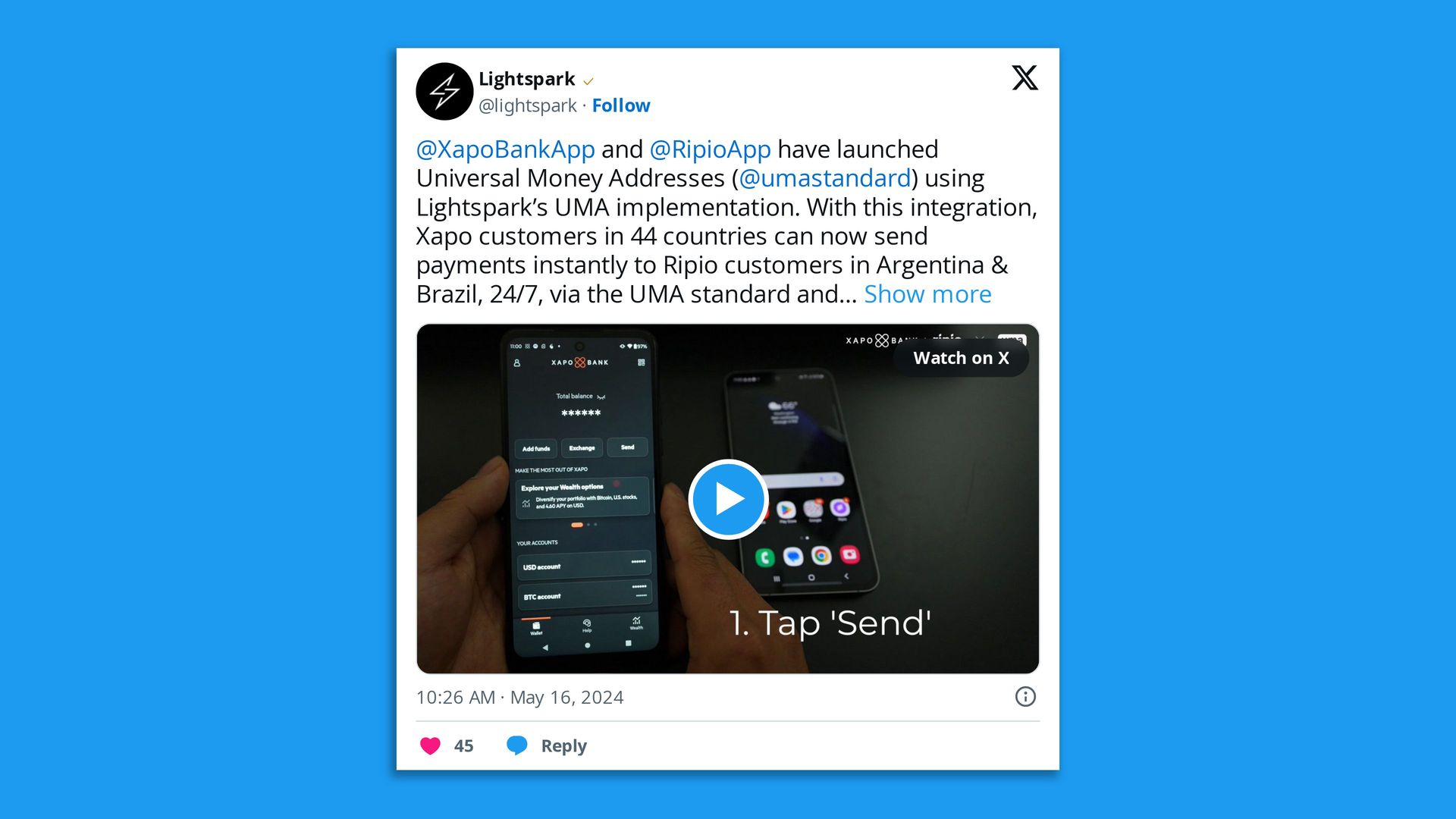
The latest: Xapo, the digital asset manager, and Ripio, an Argentine crypto fintech, just announced their deployment of Lightspark's open standard for sending bitcoins: the universal money address, or UMA.
How it works: Users of any bank or fintech that integrates UMA will get an address something like an email.
- So, if I had an account at Xapo (I don't), I might have a UMA address as [email protected]. If Crystal had an account at Ripio (she doesn't) she might be [email protected].
- If I wanted to send her a little BTC, all I'd need to know is that address. (Click the link under the image for a video demo.)
Under the hood, it's all over the Lightning network, including data embedded in the transaction that helps the two companies meet their compliance obligations.
- Using Lightning means these transactions will be super fast and nearly free.
The big picture: Imagine if the various fintechs with a sideline in bitcoin started integrating UMA. Bitcoin would be even easier than Venmo because it wouldn't be limited to users of the same app.
- Friends could easily do things like making bets in satoshis, paying each other for favors or sharing travel expenses, and it wouldn't matter if they were using different banks or neobanks.
- Digital nomads could easily have a cheap bitcoin economy among each other, without worrying about local currencies.
Zoom out: Venmo makes it easy to send money to other Venmo users, and Cash App does the same thing.
- But a Venmo user can't send to a Cash App user. That's the nature of closed things.
- Lightspark's UMA is open. Any company supporting bitcoin could integrate it, just as anyone running an internet server can host email addresses.
Fun fact: Lightspark's CEO, David Marcus, used to run PayPal.
Yes, but: Don't hold your breath, that kind of thing would almost certainly run afoul of money transmitter rules in the U.S.
- Either way, Axios has hit up a bunch of fintechs with bitcoin to ask them to let us know if they implement UMA.
💭 Brady's thought bubble: This is cool.
This newsletter was edited by Pete Gannon and copy edited by Carolyn DiPaolo.
Sign up for Axios Crypto