Axios Communicators

October 29, 2026

🎃 Hey communicators! Two days 'til Halloween, so it's time to think about what I should wear to go trick-or-treating with the kiddos.
- Situational awareness: Hydration giant Liquid I.V. named Jenny Danzi its new CMO, overseeing communications.
This edition of Axios Communicators, edited by Christine Wang and copy edited by Kathie Bozanich, is 1,628 words, a 6-minute read.
1 big thing: 🤝 The real test of community-building
Comms leaders are spearheading ambitious community initiatives that go far beyond messaging, but they aren't always easy to measure.
Why it matters: CCOs need to make the business case for these investments with returns that are difficult to directly link to communications alone.
By the numbers: Two recent studies show how important community engagement is for brands — and how challenging it is for leaders to demonstrate that impact.
- A new study from agency Civic, based on a survey of 2,000 Americans, found that 55% say they've advocated for or defended a brand because of its community involvement.
- Among Gen Z, that figure rises to 65%.
- A recent Edelman study found that 62% of senior corporate affairs leaders "lack clear ways" to quantify how stakeholder engagement actually impacts business outcomes.
The big picture: As comms moves beyond shaping messages, the most meaningful results may be the partnerships, business decisions and stronger relationships it helps create, not just what audiences hear.
- Media theorist Douglas Rushkoff, who contributed to Civic's research, says that brands should consider what participants gain: "What are you providing them? What are you asking for, if anything, in return?"
- Civic CEO Stuart Ruderfer's advice: Figure out what your company can uniquely contribute to a community, then put resources toward delivering that value before spending to promote it.
Zoom in: Ford Motor Company communications chief Mark Truby helped launch an initiative supporting skilled trades that has grown into a coalition of major companies.
- It's also created opportunities for Ford to deepen relationships with commercial customers.
- "If all you cared about was the bottom line, well, look at it as an opportunity to spend a lot of time and get closer to your customers and their needs," Truby told Axios.
- For initiatives supporting veterans and military families, Truby takes a longer view. "I don't think Bill Ford wants me to come and say, 'Now show me where that paid off in sales,'" he said.
At Sam's Club, acting VP of communications JD Byrum points to membership trends, shopping frequency and brand perception as indicators of progress in the ongoing work to reposition around a sense of community.
- Customer feedback from the Member's Mark community has helped shape products, while internal surveys track how consistently employees articulate the value of membership.
- Byrum said the strategy originated with the company's then-chief communications officer, but marketing, merchandising, operations and other teams brought it to life.
- "Execution has to come from everywhere," he says.
Between the lines: The more comms shapes what a company does, the harder it becomes to isolate its contribution.
- A new product, stronger customer relationship or industry partnership might originate with comms, but it would require other teams to deliver the results.
- That leaves CCOs in a tricky spot: They can't take sole credit for broader business results, but they can't ask for more resources on faith alone.
Before pitching a community initiative, three questions are worth asking:
- Who actually benefits? Be clear about what a "win" looks like — not just for the bottom line, but for the community you're building.
- What's actually changing? Turnout is a start, but look deeper. Are behaviors shifting? Are relationships getting stronger? How will you know?
- What's our fair share of the credit? Be honest about what comms drove directly versus what it helped accomplish alongside other teams.
The bottom line: It's not enough for brands to convene people — CCOs need to show what changed as a result.
2. 💼 Exclusive: Brunswick hires S&P Global investor perception team

Brunswick is expanding its investor intelligence capabilities, hiring an eight-person team from S&P Global that specializes in analyzing how institutional investors perceive companies, Axios has learned.
Why it matters: Communications advisory firms are investing in deeper stakeholder intelligence to help shape corporate strategy, not just communicate it.
The big picture: The team, led by longtime S&P Global investor intelligence executive Robin Auten, will join Brunswick's global financial practice, co-led by Jonathan Doorley and Simon Sporborg.
- The S&P Global team conducts about 60 investor perception studies annually and brings historical research that helps companies compare findings with their peers.
- Brunswick has conducted investor perception studies for decades, but the hires significantly expand its research capacity.
How it works: Investor perception studies use confidential interviews with investors and analysts to learn about a company's strategy, leadership, performance and valuation.
- Because their responses are anonymous, investors can be more candid about concerns they might not raise directly with company leadership.
- The findings give executives and boards a clearer picture of investor sentiment, where they see problems and how the company stacks up against its peers.
What's next: Brunswick plans to integrate that intelligence into its existing advisory work, including M&A, shareholder activism and periods of market volatility.
- For example, investor research could help companies identify vulnerabilities before an activist campaign, understand what investors want following an acquisition and assess whether strategic changes are improving perceptions.
What they're saying: "Combining direct investor intelligence and proprietary benchmarking data with our existing advisory expertise will strengthen the counsel we provide to boards and management teams, particularly at moments of significant change or scrutiny," Doorley said.
The bottom line: Brunswick is betting that a deeper understanding of investor sentiment will help it deliver more strategic advice when companies face high-stakes decisions.
3. 🤔 GEO starts with the question

Before trying to get AI to cite your company, findings from a new study shared exclusively with Axios suggest figuring out what your audience is asking about in the first place.
Why it matters: As communications teams invest in generative engine optimization, they risk spending time and resources on media coverage or content that doesn't show up in the AI answers their audiences are looking for.
Zoom in: A new Muck Rack and Generative Pulse report found that what AI cites depends heavily on the question and platform.
- Practical guides accounted for 68% of citations responding to how-to questions, buyer's guides and reviews were cited in 45% of answers to best-of queries, and expert analysis led industry-trend questions at 41%.
- For communicators, that means starting with what stakeholders want to know, then deciding whether your website, original research or outside coverage can best answer those questions.
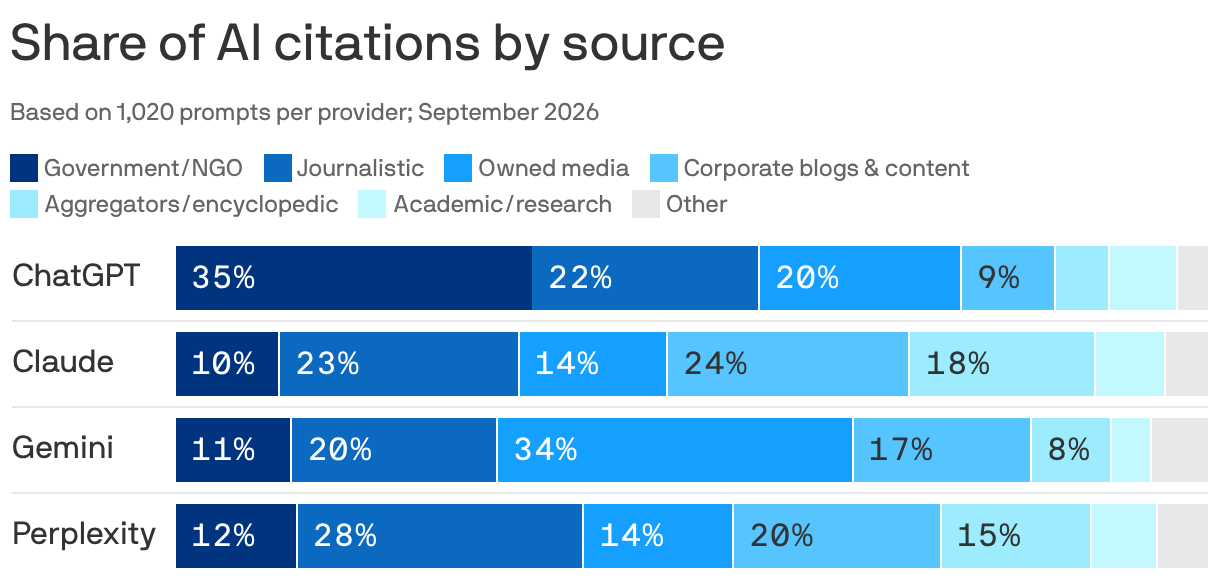
By the numbers: Researchers tested the same 1,020 prompts across ChatGPT, Claude, Gemini and Perplexity and found major differences in their sources.
- ChatGPT drew 34.6% of citations from government and nonprofit sources, while Gemini relied most heavily on company-owned content at 34.4%.
- Perplexity cited journalism most frequently, at 27.8%, while Claude favored third-party corporate content, at 23.5%.
The big picture: The findings also challenge the conventional GEO wisdom that news coverage is the surest route to visibility.
- Journalism's share of citations in the research fell from roughly 27% in May to 22.2%, below third-party corporate content at 25.1%.
- There's an opportunity for communicators to go beyond news orgs and think about targeting researchers, industry experts, nonprofits and other influential sources.
Yes, but: When researchers asked ChatGPT the same questions twice on the same day, just 41% of cited domains overlapped, making one-off results unreliable measures of success.
The fine print: Researchers tested 1,020 mostly general consumer questions per platform, then combined those results with broader monitoring of mostly brand-related queries. Together, the datasets covered more than 40 million responses.
- Models included GPT-5, GPT-5 nano, Gemini 2.0 Flash, Gemini 2.5 Flash, Claude Haiku 4.5 and Perplexity Sonar Pro.
- The report noted model updates may explain some shifts, and citations don't necessarily reflect what actual users encounter or how favorably a brand is portrayed.
The bottom line: GEO is a moving target. Start with what your audience wants to know, not just where you want your company to appear.
4. 🗞️ Reading list
💍 MSG Sports tricked employees with a Knicks championship ring giveaway that turned out to be a cybersecurity phishing test. (The Athletic)
- "The process of securing and reminding our employees to protect our IP was not a mistake, but the choice to use the ring to do so was a mistake," an MSG spokesperson said in a subsequent apology. (NBC New York)
⚽️ Soccer star Kylian Mbappé, Real Madrid and the Spanish football league are also apologizing after an offhand comment Mbappé made in April referring to Mao Zedong as a dictator resurfaced. (Associated Press)
- Mbappé was referring to a meme that superimposed his face on a Mao-like portrait. A reminder that some topics deserve caution, even in lighthearted contexts.
🤖 Anthropic warned investors that its own AI could threaten humanity in an IPO filing containing more than 90 pages of risk factors. (Axios)
- Many major news outlets have covered this, but it isn't driving the news cycle as Jacob Coxon's interviews did. What will be the next AI safety moment that breaks through?
👔 The CEO isn't always the most credible messenger, according to new We. Communications research that found 86% of business decision-makers prefer executives with subject-matter expertise. (Axios)
- A gaming analogy: Think of it as leveling up every member of your party evenly; make sure your CFO, CTO and others are out there getting experience talking about the topics they're strongest on.
5. 🏎️ 1 fun thing: How fast is 175 MPH?

It's very, very fast!
- This was just a split second before braking hard into turn 12 of the Circuit of the Americas.
Incredible experience last week courtesy of IBM at the F1 race weekend here in Austin, Texas.
Thanks for reading!
- Spot an interesting trend or story? Email me or connect with me on LinkedIn.
- For exclusive reporting, deep dives and events, apply to join Mixing Board, powered by Axios.
Sign up for Axios Communicators

Unpacking the topics and trends driving Communications.