GEO starts with the question, not the answer

Add Axios as your preferred source to
see more of our stories on Google.
Before trying to get AI to cite your company, findings from a new study shared exclusively with Axios suggest figuring out what your audience is asking about in the first place.
Why it matters: As communications teams invest in generative engine optimization, they risk spending time and resources on media coverage or content that doesn't show up in the AI answers their audiences are looking for.
Zoom in: A new Muck Rack and Generative Pulse report found that what AI cites depends heavily on the question and platform.
- Practical guides accounted for 68% of citations responding to how-to questions, buyer's guides and reviews were cited in 45% of answers to best-of queries, and expert analysis led industry-trend questions at 41%.
- For communicators, that means starting with what stakeholders want to know, then deciding whether your website, original research or outside coverage can best answer those questions.
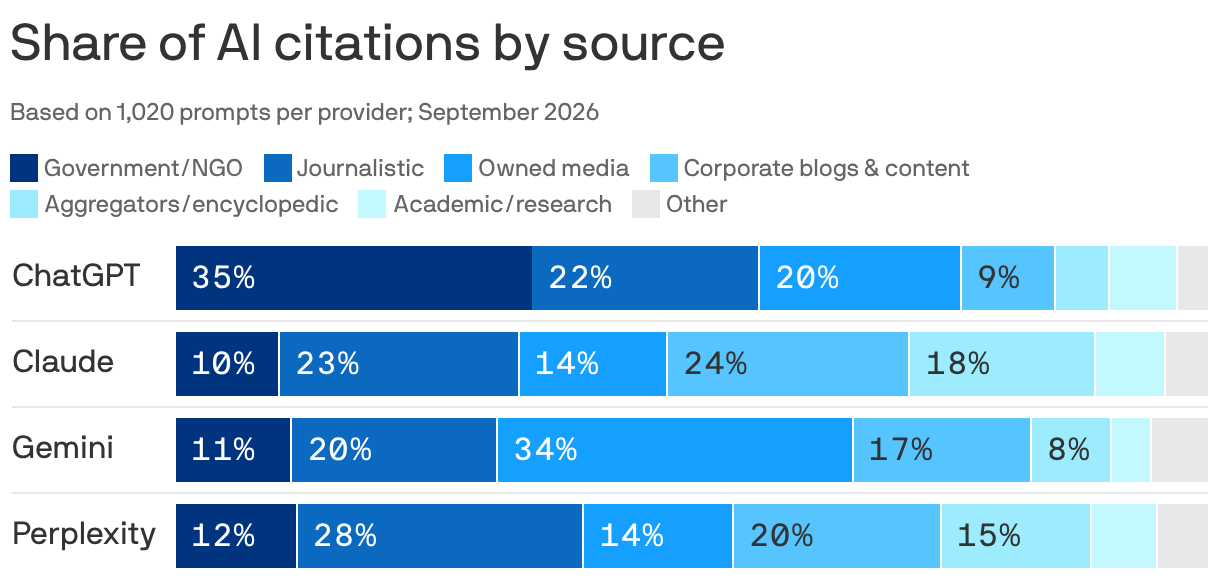
By the numbers: Researchers tested the same 1,020 prompts across ChatGPT, Claude, Gemini and Perplexity and found major differences in their sources.
- ChatGPT drew 34.6% of citations from government and nonprofit sources, while Gemini relied most heavily on company-owned content at 34.4%.
- Perplexity cited journalism most frequently, at 27.8%, while Claude favored third-party corporate content, at 23.5%.
The big picture: The findings also challenge the conventional GEO wisdom that news coverage is the surest route to visibility.
- Journalism's share of citations in the research fell from roughly 27% in May to 22.2%, below third-party corporate content at 25.1%.
- There's an opportunity for communicators to go beyond news orgs and think about targeting researchers, industry experts, nonprofits and other influential sources.
Yes, but: When researchers asked ChatGPT the same questions twice on the same day, just 41% of cited domains overlapped, making one-off results unreliable measures of success.
The fine print: Researchers tested 1,020 mostly general consumer questions per platform, then combined those results with broader monitoring of mostly brand-related queries. Together, the datasets covered more than 40 million responses.
- Models included GPT-5, GPT-5 nano, Gemini 2.0 Flash, Gemini 2.5 Flash, Claude Haiku 4.5 and Perplexity Sonar Pro.
- The report noted model updates may explain some shifts, and citations don't necessarily reflect what actual users encounter or how favorably a brand is portrayed.
The bottom line: GEO is a moving target. Start with what your audience wants to know, not just where you want your company to appear.
