Axios Communicators

April 10, 2025

Welcome back!
- 🎉 We just celebrated one year of Axios Communicators Pro! Not yet a member? Join today.
- 📬 Have pitches, tips or feedback? Reply to this email or send me a note.
Today's newsletter is 1,495 words, a 5.5-minute read.
1 big thing: Tariffs ignite brand backlash
Anti-American sentiment abroad has been on the rise, with President Trump's unpredictable trade policies exacerbating the issue.
Why it matters: Communication and marketing teams at multinational companies are grappling with how America's reputation might be affecting their own.
State of play: Since Trump took office in January, the average net favorability of the U.S. has fallen by roughly 20 points worldwide, with consumer markets in North America and Europe seeing some of the biggest declines, according to a Morning Consult analysis.
- Canadian consumers are among the most likely to avoid American brands due to U.S. trade policies.
In response, U.S. companies that operate internationally are preparing for backlash or boycotts as geopolitical tensions rise.
What they're saying: Engaging regional stakeholders — employees, vendors, partners and trade associations in the region — is important during moments of geopolitical tension, says Dave Samson, chief corporate affairs counsel at iQ360.
- "Business leaders should not shout from the mountaintops, because you don't want to invite unnecessary scrutiny, but opening up clear channels of communication with your employees, with your key stakeholders, is important," he said.
- "It seems like common sense, but in moments like this, people tend to hunker down when it's actually a time to speak out more, but not do it in a way that's going to invite public backlash."
Zoom in: One way to dodge backlash is to make sure regional marketing campaigns and consumer communications strike the right tone.
- "You're going to probably have some brand erosion," says Anne Marie Malecha, CEO of Dezenhall Resources. "I don't think there's any way around that right now, but the name of the game is survival. And survival happens by, first and foremost, doing no harm, no unforced errors."
- To avoid this, she adds, American multinationals should have communication experts in the region who "understand the culture in which they're operating" to make judgment calls on what locals might favor in terms of messaging.
Zoom out: Signaling to regional markets that you're anti-tariff could help soften the blow, says Lauren Tomlinson, principal at Cornerstone Government Affairs.
- "It's good to go out and talk about the impact that these tariffs will have on your particular business," she said. "For example, if you have to raise the cost of your product because it's more expensive to make, that is something that you should go out and talk about to kind of distance yourself from the tariff policy of the United States at the moment."
The bottom line: America's reputation "is the greatest geopolitical brand ever created," Wall Street Journal editor at large Gerry Baker recently wrote.
- "Brands have real value. It isn't always easy to calculate, but businesses from BlackBerry to Bud Light know when they have lost it. Destroying geopolitical brand value can be devastating too."
Case in point ... 👇🏻
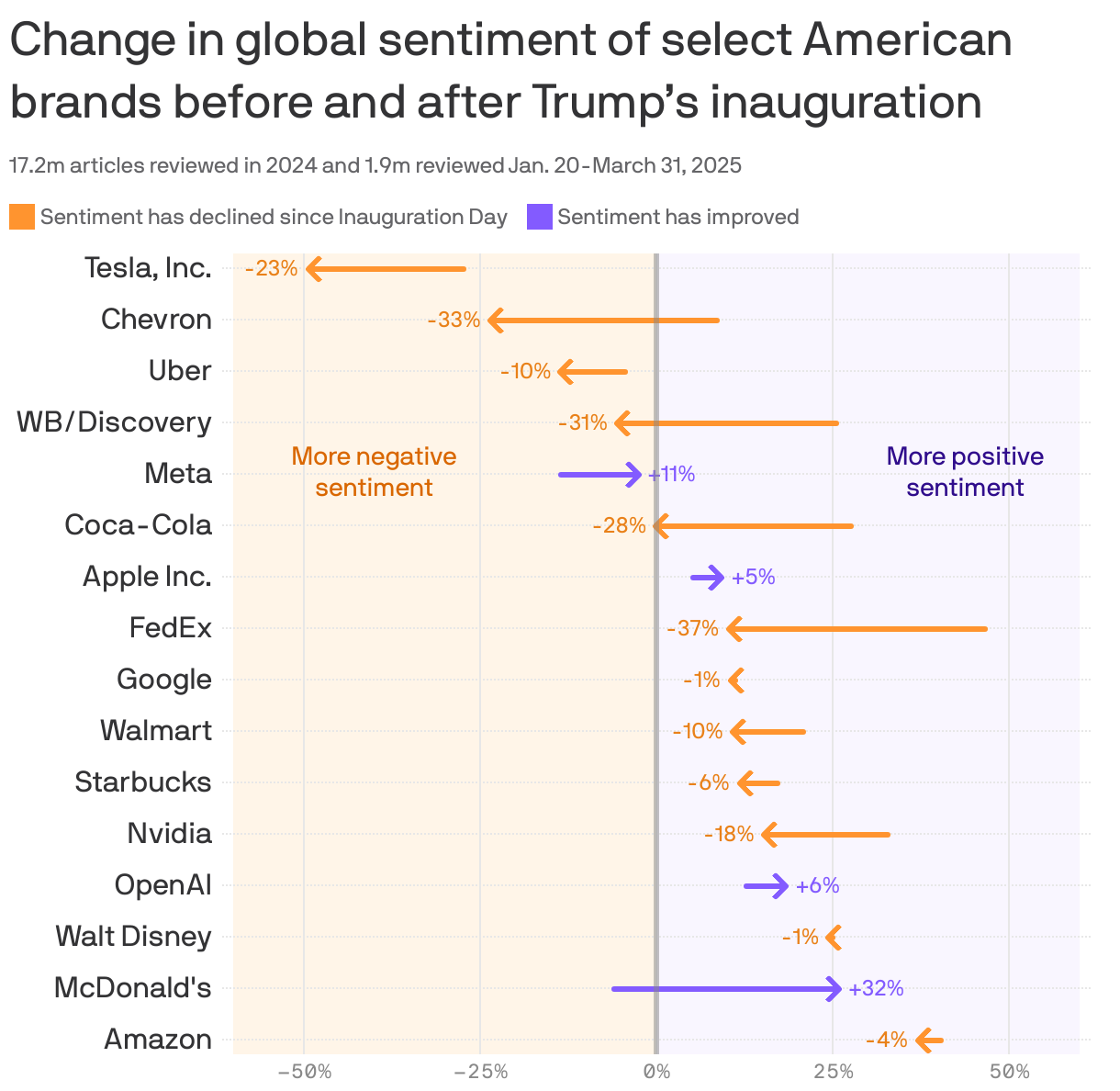
2. How U.S. brands are faring so far
3. What they're saying

While CEOs have stayed mostly mum on tariffs for fear of retribution, earnings season has forced some executives to discuss how Trump's trade policies could affect their businesses.
What they're saying: America's top business leaders are starting to communicate through the uncertainty in anticipation of changing consumer habits and prices.
- "It's clearly a fluid environment. And while we don't know everything that's going to happen, of course, we do know what our priorities are, and we know what our purpose is, and we'll be focused on keeping prices as low as we can. We'll be focused on managing our inventory and our expenses well," Walmart CEO Doug McMillon said during an investor presentation yesterday.
- "There is increasing consumer uncertainty and concern over returning to more inflation, and this has impacted consumer sentiment, particularly in the last month ... as many are worried about the future, job security and rising costs," McCormick chairman, president and CEO Brendan Foley said last month.
- "When it comes to tariffs, that's just another cost in the equation that we have to understand mutually," Home Depot CFO Richard McPhail said at a retail conference on April 3.
- "With broad economic uncertainty around global trade, growth has largely stalled," Delta Air Lines CEO Ed Bastian stated in an earnings release.
Meanwhile, Levi Strauss & Co. president and CEO Michelle Gass is leaning on brand loyalty and reputation to help navigate macroeconomic challenges.
- "As an iconic brand with more than 170 years of history, we've weathered challenging times before," she said in an earnings call this week. "We have a playbook that begins with leveraging the strength of our brand and our deep connection with consumers.
- "We know, especially during times like these, people turn to the brands they know and trust and prioritize value and quality, and that's what Levi's has always stood for. "
Some are simply voicing frustration with Trump's tariff chaos.
- "So look, I think basically that the game has changed and now it's, it kind of doesn't matter where you go, I mean, except America," RH chairman and CEO Gary Friedman said on an earnings call right after Trump's tariff announcement on April 2.
- "Tariff is not a beautiful word. I disagree with that — we are in a global economy. ... You cannot apply this type of gridlock and this much friction to the world's trade," Life Time Group Holdings CEO Bahram Akradi said in an interview with the Wall Street Journal.
- "These tariffs are turning me in to a dem," GameStop CEO Ryan Cohen quipped on X.
Zoom in: Internally, executives are highlighting the steps they took in advance to prepare for tariffs.
- Some have also formed task forces, while others have opted for all-staff meetings to provide real-time updates and address employee questions.
Of note, privately held companies and nonprofits are choosing to stay quiet.
- "Some say that it's too soon to fully understand the ramifications, so they're holding on communicating until there's more clarity on what's happening and how it affects their organization," says Shallot Communications co-founder Tim Granholm.
What to watch: How business leaders communicate — and whom they blame — should a recession take shape.
- "Most CEOs I talk to would say we are probably in a recession right now," BlackRock CEO Larry Fink said during a lunchtime appearance at the Economic Club of New York on Monday, according to Bloomberg.
4. Bonus chart: Word of the week


What to watch: How business leaders attempt to quell concerns amid the chaotic economic environment.
- Most will likely opt for "We can't give guidance right now."
5. 📚 Reading list
- ⚖️ Many big-company CEOs are leaning on trade organizations for tariff talks, as the U.S. Chamber of Commerce considers suing the Trump administration to halt its global trade policies. (Fortune)
- ⏸️ Trump administration freezes funding for Cornell and Northwestern as part of its ongoing DEI crackdown. (Wall Street Journal)
- Also of note: "As a matter of policy, we do not respond to reporters with pronouns in their bios," White House press secretary Karoline Leavitt, recently told an NYT reporter. (New York Times)
- 🔎 Publishers are bemoaning the decline in web traffic since Google debuted its AI overviews atop search results. (Bloomberg)
- 🤖 Shopify CEO Tobi Lutke told employees to prove jobs can't be done by AI before asking for more headcount or resources. (CNBC)
- 💸 Courting Trump has yet to pay off for tech CEOs. (New York Times)
- 🍎 OpenAI targets college students in its "first scaled marketing campaign." (Adweek)
6. Exclusive: Netflix taps new policy chief

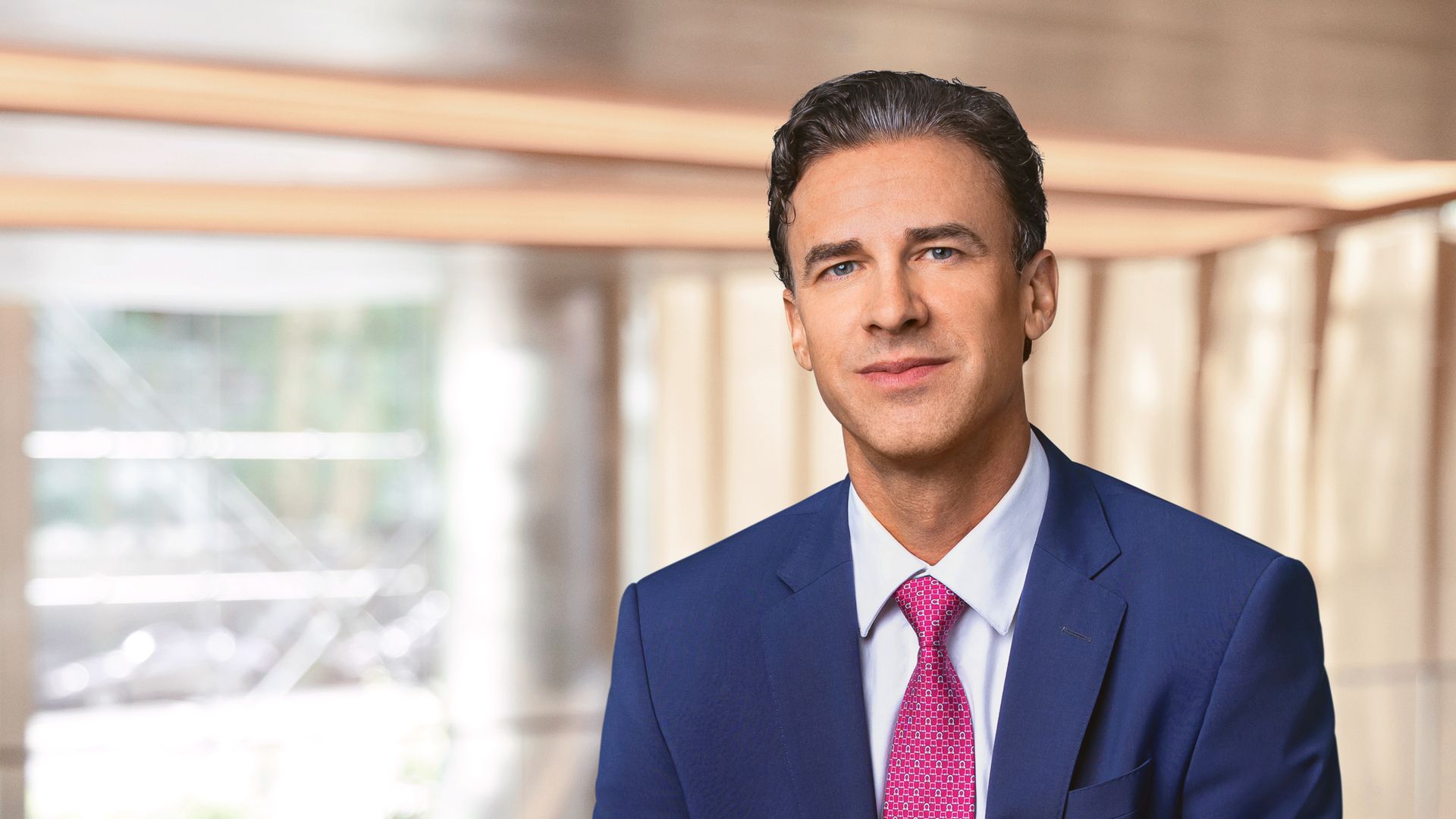
Netflix has tapped Clete Willems, a veteran D.C. trade attorney, as its chief global affairs officer, Axios has learned.
Why it matters: Willems has experience working for the Trump and Obama administrations. His global economic and trade policy expertise is essential to Netflix, which does business in more than 190 countries.
- Willems joins Netflix from Akin Gump, a prominent law and lobbying firm, after five years. He previously served as deputy assistant for international economics to President Trump in his first term and legal adviser and chief counsel at the Office of the U.S. Trade Representative during the Trump and Obama administrations.
Zoom out: Willems will only oversee the company's global policy strategy, not communications.
- Netflix was reportedly looking to combine both functions after former communications chief Rachel Whetstone and former vice president of public policy Dean Garfield departed in October.
- The company is still searching for someone to lead its communications efforts.
7. 🐺 1 fun thing
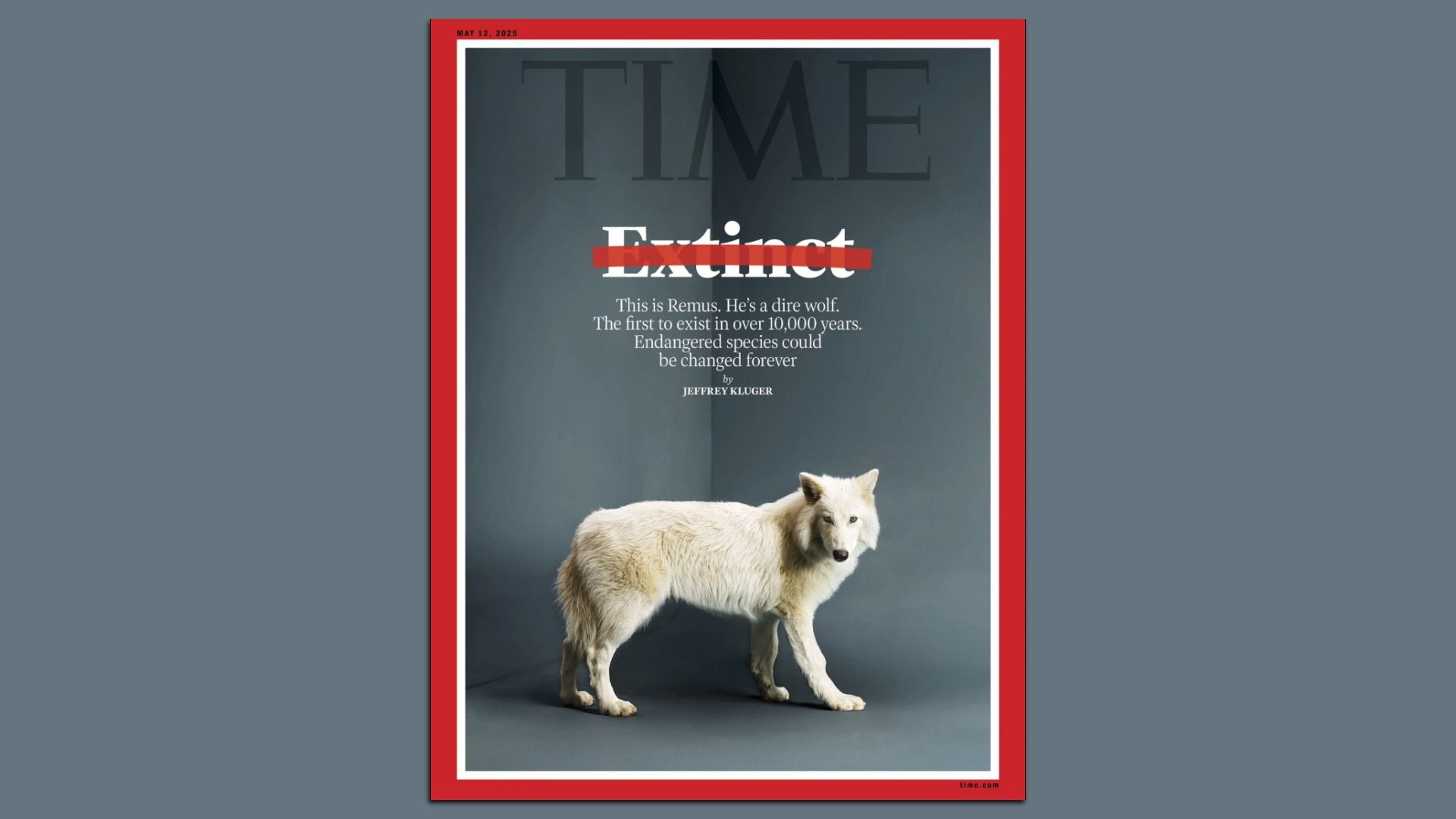
Dire wolves have great PR.
Why it matters: When was the last time a company or person secured Joe Rogan, a New Yorker story, a Time cover and an Elon Musk tweet in one day?
Catch up quick: Genetics company Colossal Biosciences announced it has brought back dire wolves, which had previously been extinct for more than 10,000 years.
- Yes, but: Some experts are disputing Colossal's claim, which is generating even more conversation about the technological advancement.
Regardless, this just goes to show that major stories can break through, even in this fragmented media landscape.
- 🎉 Congrats to the PR teams at R&CPMK and Zeno Group for this rollout.
☑️ Thanks to editors Christine Wang and Kathie Bozanich.
To go deeper on all things comms, become an Axios Communicators Pro member.
Sign up for Axios Communicators