Axios Communicators

August 27, 2026

👋 Hey, y'all! The AI data center fight isn't easing up anytime soon.
- This week we're previewing a potential messaging counteroffensive from proponents, recalling lessons from the fracking boom and looking at the polls.
This edition of Axios Communicators, edited by Nicholas Johnston and copy edited by Jay Bennett, is 1,925 words, a 7.5-minute read.
1 big thing: 📢 The coming data center comms offensive
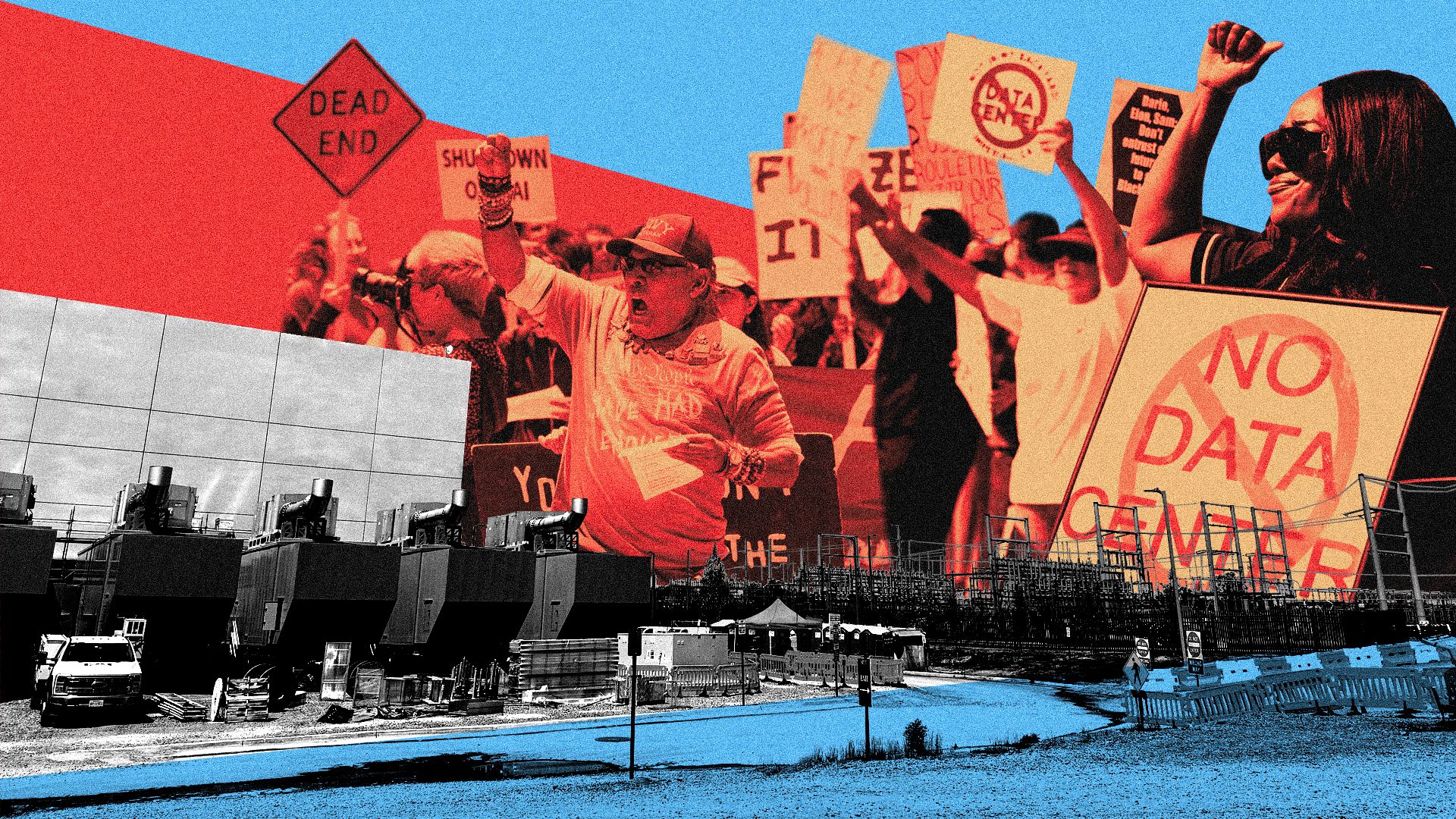
We're in the midst of a roiling online debate about whether the data center backlash is just a comms problem or something more fundamental.
- "[H]ey guys we gotta figure out a new narrative on this data center thing...." Alexis Ohanian, Reddit co-founder and entrepreneur, posted on X last Friday.
Why it matters: Opposition to data centers crosses political, geographic and cultural lines as they become a stand-in for much larger anxieties over AI, jobs and economic inequality.
The big picture: On X, the social media platform of choice for tech, the debate over what the industry should do next is playing out publicly and in real time.
One camp believes the underlying terms of data center projects need to be reassessed.
- "This is a structural material question, and we have to meet it with structural material answers," says Jim Prosser, a veteran communications strategist with experience at Google, Twitter and SoFi. "This is not something that you can just persuade away or educate on."
This means bringing comms in much earlier to avoid a problematic site altogether, instead of trying to message your way out of a mess.
- "Going in when you do site selection, being aware of what the community hot-button issues are," says Shifali Erasmus, vice president at Crackle, which works with some data center companies. "It's not about trying to sweep things under the rug."
Case in point: Microsoft's approach is the model to follow, says Prosser.
- Its "Community-First AI Infrastructure," published in 2026 after the company abandoned a proposed Wisconsin data center amid local opposition, promises to cover the electricity costs its facilities create, reduce and replenish water use, add jobs, grow the tax base and invest locally.
- "You get better communications outcomes when you develop specific programs that address the issue, not when you modify messaging," Microsoft chief communications officer Frank Shaw told Axios.
The other side thinks industry needs to go on offense and make a stronger case for what communities stand to gain while pushing back harder on what they see as misinformation and, in some cases, foreign influence.
One of the strategists developing that argument is Sam Lyman, head of research at the Bitcoin Policy Institute and former chief speechwriter for Treasury Secretary Scott Bessent.
- Lyman previewed to Axios a proposal that calls for "data center dividends," cash payouts modeled on Alaska's oil fund, in which communities could turn some of the tax revenue generated by the facilities into direct checks, scholarships or other benefits for residents.
- And while he acknowledged that most opposition is organic, he said "exposing foreign influence" remains important and confirmed his group will continue researching that front.
Between the lines: AI itself can feel abstract and unstoppable, but a proposed data center in your community does not.
- Drew Pusateri, OpenAI's director for strategic communications, argued on X that data centers have become an "avatar" for much broader societal fears around AI and tech.
- If tangible questions about water, electricity costs, noise, jobs and taxes become secondary to a more fundamental rejection of AI development, he said, it becomes "deeply unclear" how much improvements on those issues can move public opinion.
Simon's thought bubble: If I were leading up this unenviable challenge, I'd spend less on broad national persuasion campaigns and more on hyperlocal direct engagement.
- I'd also look for credible independent groups willing to scrutinize company commitments and track whether they're being met and acknowledge measurable progress when it occurs — a strategy I saw work with Oxfam's Behind the Brands campaign.
What's next: The midterm elections will test the persuasiveness of local data center messaging, and they could bring into office candidates pushing for stricter moratoriums and guardrails.
2. 🥊 Lessons from the fracking fights

The data center debate is giving some communicators flashbacks to the fracking boom, which became a national political fight even as local battles frequently scrambled familiar left-right lines.
Why it matters: As it is with data centers, the comms challenge was never persuading communities to cheer for more industrial sites but instead finding ways to address local concerns while making the economic case for development.
By the numbers: Fracking never became broadly popular nationally, though opposition softened over time.
- In 2025, 45% of Americans favored expanding fracking while 51% opposed it, according to a Pew Research Center survey of 5,085 adults conducted April 28-May 4.
- In 2020, opposition stood at 60%, while just 37% were in favor, according to a Pew survey of 10,957 adults conducted April 29-May 5.
Case in point: Economic arguments can still help the industry win individual fights.
- In Colorado in 2018, the oil and gas industry spent tens of millions of dollars fighting Proposition 112, which would have "dramatically increased" setbacks for new projects, reported the Denver Post.
- The industry emphasized the economic fallout that would come from restricting development, and voters rejected the measure 57% to 43%.
Yes, but: Winning one ballot-box battle didn't put the issue to rest.
- Months later, Colorado enacted a sweeping oil and gas regulation bill that prioritized health and safety and gave local governments greater authority over drilling but also included industry-backed provisions to prevent "overly restrictive setbacks, delays or de facto bans."
The other side: Denton, Texas, demonstrated the limits of trying to outspend local resistance or dismiss it as foreign-influenced, reported the Texas Tribune.
- In 2014, the industry-backed campaign opposing a fracking ban raised more than $700,000, more than 10 times what Frack Free Denton collected, spending on mailers, television ads and a PR and polling firm.
- All of this in a town with a population of 123,000 at the time.
- Two state oil and gas regulators and an industry-funded group also suggested, without evidence, that local activists were working with Russia to protect its natural gas interests.
- Nearly 59% of voters approved the ban anyway, including voters in precincts that also backed Republican Greg Abbott for governor.
What they're saying: "If you don't tell your story, someone else will tell it for you. And you won't like their story," said DUX Group CEO Amos Snead, who has worked energy and infrastructure fights for more than 20 years.
- "The data center and energy growth stories can avoid that outcome by showing up early in these communities, in person, with a story they own and defend proactively."
The bottom line: When the fight reaches your backyard, the terms of the project, the credibility of the company and residents' feelings about being heard can matter more than the industry's best talking points.
3. 📉 Positive coverage is drying up


Positive media coverage of data centers is fading just as public skepticism is rising.
Why it matters: Data center proponents are losing the luxury of making the case for data centers on their own terms.
By the numbers: PublicRelay shared with Axios data showing the share of favorable data center stories among 14 major U.S. utilities fell from 28% in January to 10% through Aug. 20.
- Negative coverage rose only modestly, from 1% to 5%, suggesting the bigger shift is away from favorable stories rather than toward overwhelmingly hostile coverage, a thin silver lining for AI communicators.
Zoom in: Americans are increasingly skeptical about the tradeoffs involved.
- Marquette Law School polling found the share of adults saying the costs of data centers outweigh the benefits rose from 62% in January to 73% in July.
- Over the same period, the share saying the benefits outweigh the costs fell from 37% to 27%.
The bottom line: For the public, the costs are becoming more visible while the benefits are getting harder to see.
4. Spotlight: David Kim, U.S. Forces Korea

Eun Chong "David" Kim knows precision matters, working at the intersection of military operations, the media and the U.S. alliance with South Korea.
As senior press officer for United Nations Command, Combined Forces Command and U.S. Forces Korea, Kim prepares leaders, coordinates across organizations and helps shape messages around events that can carry very different meanings across cultures.
Why it matters: Communicators don't just exist in boardrooms and agencies — careful judgment, nuance and close relationships are prized in diplomatic and military affairs.
🏋Learning the ropes: His predecessor, Kim Yong-kyu, worked in that role for nearly 40 years and taught Kim the profession "is a form of craftsmanship, refined over time through experience, judgment and trust."
- "You become a witness to history, but the real currency is trust, built over years with U.S., Korean and international leaders, colleagues and journalists."
🫣 Tough lesson: "Relationships matter before you need them."
- "You cannot wait until a crisis or difficult story to start building trust with journalists, colleagues or partners."
🌎 Trendspotting: Communicators may be underestimating just how fragmented the information environment has become. "Monitoring coverage is no longer enough," he said.
- "Communicators need to understand why a narrative is gaining attention, who is driving it and how different audiences may interpret the same information."
- "As a Korean national working within a U.S. military organization, I see firsthand how the same words, decisions or events can carry very different meanings across cultures and audiences."
🕔 Off the clock: Kim spends time with people outside the military and public affairs world, including journalists and people in completely different fields.
- "It's easy to become immersed in the same context and priorities every day. Those conversations remind me to keep things clear and simple."
- "A few rounds [of boxing] during the week help clear my head and give me a lot of energy."
📚 Currently consuming: Rereading Franz Kafka's "The Trial."
- "I keep coming back to it because I like how it explores bureaucracy, uncertainty and the way people navigate systems they do not fully understand."
💡 Best advice: "Know the mission. See the need. Move."
- "Good judgment is not about avoiding risk. It is about understanding it well enough to act."
- And above all, be trustworthy. "Credibility takes time to build and very little time to lose."
5. 🎧 One fun thing: AI is the new drum machine, says Dr. Dre

In an interview with the New York Times, longtime music moguls and business partners Dr. Dre and Jimmy Iovine talked about AI's role in the creative process.
- "I don't see it as a threat," said Dre. "I think the only people that see it as a threat are the people who have trouble creating."
Why it matters: Dre suddenly gave the pro-AI argument something tech companies have struggled to find: a credible creative messenger.
What they're saying: Dre shared a conversation he had with AI skeptics.
- "'OK, you sound like the person that would have been against the drum machine when it came out.' Or synthesizers, right? It's a new tool for creativity."
The big picture: Billionaires aren't being shy about their fondness for AI tools.
- Investor Stanley Druckenmiller said "of course" he'd used AI in writing an op-ed for the Wall Street Journal, likening it to using a calculator to do math.
In the interview, Iovine also took a shot at AI communicators.
- "The AI companies have the worst public relations in the history of the world," he said. "Let's just put it this way: They have terrible communication skills. That's why everybody is all up in arms."
Is Iovine right? What do you think, readers? Where have AI comms gone wrong, and what's the way forward?
Thanks for reading!
Spot an interesting trend or story? Email or connect with me on LinkedIn.
For exclusive reporting, deep dives and events, apply to join Mixing Board, powered by Axios.
Sign up for Axios Communicators