Axios Communicators

September 18, 2025

Welcome back!
π€ Join me in Austin, Texas, Oct. 27-29 for a summit we are hosting in partnership with Mixing Board. I will be interviewing Dear Media's Lauryn and Michael Bosstick, Poppi co-founder Allison Ellsworth and Walmart executive vice president of corporate affairs Dan Bartlett.
- Space is limited, so register here.
Today's newsletter, edited by Christine Wang and Kathie Bozanich, is 2,136 words, 8 minutes.
1 big thing: What Trump's quarterly earnings shakeup could mean for corp comms and IR

President Trump's push for companies to report earnings semiannually instead of quarterly could force companies to rethink strategies for engaging retail investors.
Why it matters: Fewer earnings reports could make it harder for investor relations teams to keep the retail crowd engaged.
What they're saying: Retail shareholders are more likely to buy and hold, even amid downturns, "when they feel connected to a brand. ... But issuers need to stay in frequent touch with those investors, managing their expectations, in order to earn that loyalty and trust," Townsend Belisle, CEO of Haystack Needle, tells Axios.
- "You're not going to see an across-the-board reaction," says Erik Gerding, former director of corporate finance at the SEC.
- The pressure on investor relations teams to attract retail investors will likely correlate with the size of their retail shareholder base.
Situational awareness: The proposed changes come as retail investors have become more formidable market participants.
- Robinhood just launched a social platform within its app intended for retail investors to monitor earnings calls and reports.
- Nearly half of the top 10 performing stocks year-to-date are retail darlings that have seen fairly consistent inflows from novice traders.
- Companies and banks are making IPOs increasingly accessible to retail investors, which make up a quarter of trading volume overall.
Between the lines: Shifting to semiannual earnings doesn't mean companies will only communicate with investors twice a year, says Kelly Sullivan, a partner at the communications firm Joele Frank.
- "Very few companies will want to limit themselves to what is required when there is an opportunity to have a best-in-class investor program that is specifically tailored to the company's calendar and shareholder base," Sullivan tells Axios.
The big picture: Companies have been testing new channels to communicate with investors in a more retail-friendly way β through vertical videos, infographics and across platforms like LinkedIn or X.
- During an appearance on the tech podcast "TBPN," Lyft CEO David Risher said he's interested in delivering earnings in the form of a podcast.
- "If I ever convince my [IR team] to do that ... maybe we'll get you guys to host it," he said to hosts John Coogan and Jordi Hays.
Yes, but: Institutional investors could end up with more access to corporations between half-year earnings, putting the retail investors behind just as they were catching up.
- "The game is being changed to help put them at another disadvantage that they didn't have before," Tom Bruni, editor in chief of Stocktwits, a social media platform for retail traders, tells Axios.
What we're watching: Will companies feel pressured to engage the retail crowd for fear of losing them?
- Will they continue to operate on a quarterly earnings schedule, even if just for internal purposes? Several corporate communicators Axios spoke to say these quarterly earnings served as an accountability mechanism across their organizations.
- Perhaps they will relish having only half the number of quarterly earnings calls to prep for.
2. What's different about recent firings
Companies are reacting to pressure from Republican officials and right-wing advocates and quickly firing anyone who attempts to justify or minimize the killing of Charlie Kirk β or even criticize the slain conservative activist.
Why it matters: These firings could be legal, lawyers say, but they demonstrate fast-changing norms around free speech that many find troubling.
- They also signify an increased vigilance among employers when it comes to workers' social media posts.
Where it stands: Dozens of such terminations have been publicly reported at media companies, airlines, sports teams and federal agencies.
- In the public sector, teachers, government workers and community officials have also been fired or put on leave in recent days due to their commentary on the violence.
- "These situations are very fact-specific and really depend on what the individual said and the context in which they said it," Ellen Davis, senior managing director at August, told Axios. "It also depends on what the social media policies the individual's employer has."
- Davis added that condoning or calling for violence is typically grounds for termination. "And if companies don't have clear social media policies by now, they should," she said.
Reality check: This isn't new βΒ employers in the past have fired workers for social media posts, both left- and right-leaning, that were deemed unacceptable.
The big picture: In the U.S., most employment in the private sector is "at will," meaning companies can fire workers for any reason that isn't clearly discriminatory β terminating someone because of their race, gender or age.
- Some states, including California and Colorado, have laws that prohibit companies from firing people for their political speech.
- Union contracts also may include some prohibitions β though in the federal government, the White House has canceled contracts for hundreds of thousands of employees.
What they're saying: "The robust free speech protections that we think of in this country are somewhat lesser in the context of employer-employee relationships," says G.S. Hans, a professor at Cornell Law School who focuses on the First Amendment.
- That's even true in the public sector βΒ the Supreme Court has said that employees surrender some free speech rights to take government employment, notes David Super, an administrative law expert at Georgetown Law.
Zoom out: Still, typically, employers have been more hesitant to act β held back by norms around free speech. And, typically, government officials don't pressure or threaten workers β that's the most concerning piece of what's happening now, say constitutional lawyers.
- "It seems quite at odds with what we think about as being the free speech tradition of a country," says Hans. "That's not an absolute protection, but it's certainly a cultural one."
Yes, but: Whether these firings pass legal muster depends on what happens after the firing β whether workers challenge these actions in court and if state protections, or others, apply.
3. Corporate affairs is ripe for AI disruption


More than 80% of corporate affairs work can be augmented and automated by AI, according to a new Boston Consulting Group (BCG) report.
Why it matters: AI presents so much opportunity for efficiencies and cost savings that it cannot be ignored, BCG chief communications officer Russell Dubner says.
State of play: Most communications teams are experimenting with generative AI, like large language models, which produce new content based on prompts.
- However, few have implemented agentic AIs, which act autonomously, can execute tasks and adapt to changes based on memory.
- That is where the real time and cost savings will come, the report finds.
By the numbers: BCG examined tasks that are repetitive, data-driven and content-intensive within the corporate affairs portfolio, and found employees can reclaim 26% to 36% of their time by using AI.
- Today, AI support presents about 14% to 18% in cost savings for a corporate affairs team, per the report.
- In three to five years' time, AI integration across all of corporate affairs could create productivity gains of 34% to 47% and cost reductions between 20% and 28%.
- According to the study, roughly 9% of corporate affairs work can be totally AI-led, while 83% requires AI-human collaboration, assistance or supervision. Only 8% of the work is fully human-led.
Zoom in: Agentic AI creates the most potential cost savings among the operational, planning and analytical tasks of corporate affairs (28%-39%), followed by external and media communications (22%-31%), and ESG and community comms (21%-30%).
- The functions with fewer opportunities for cost savings include strategic and executive communications (12%-16%), public affairs (16%-22%) and internal comms (18%-24%).
Yes, but: Cost reduction doesn't necessarily mean fewer employees, says Dubner.
- "I'm not of the view that humans are going to be replaced by AI, but you can create a more efficient function, if you choose to [and] if that's your priority," he says. "If your CEO wants you to make it the most cost-effective, there is the opportunity to do that too."
Keep reading. ... See the report.
4. Spotify gets in on the joke
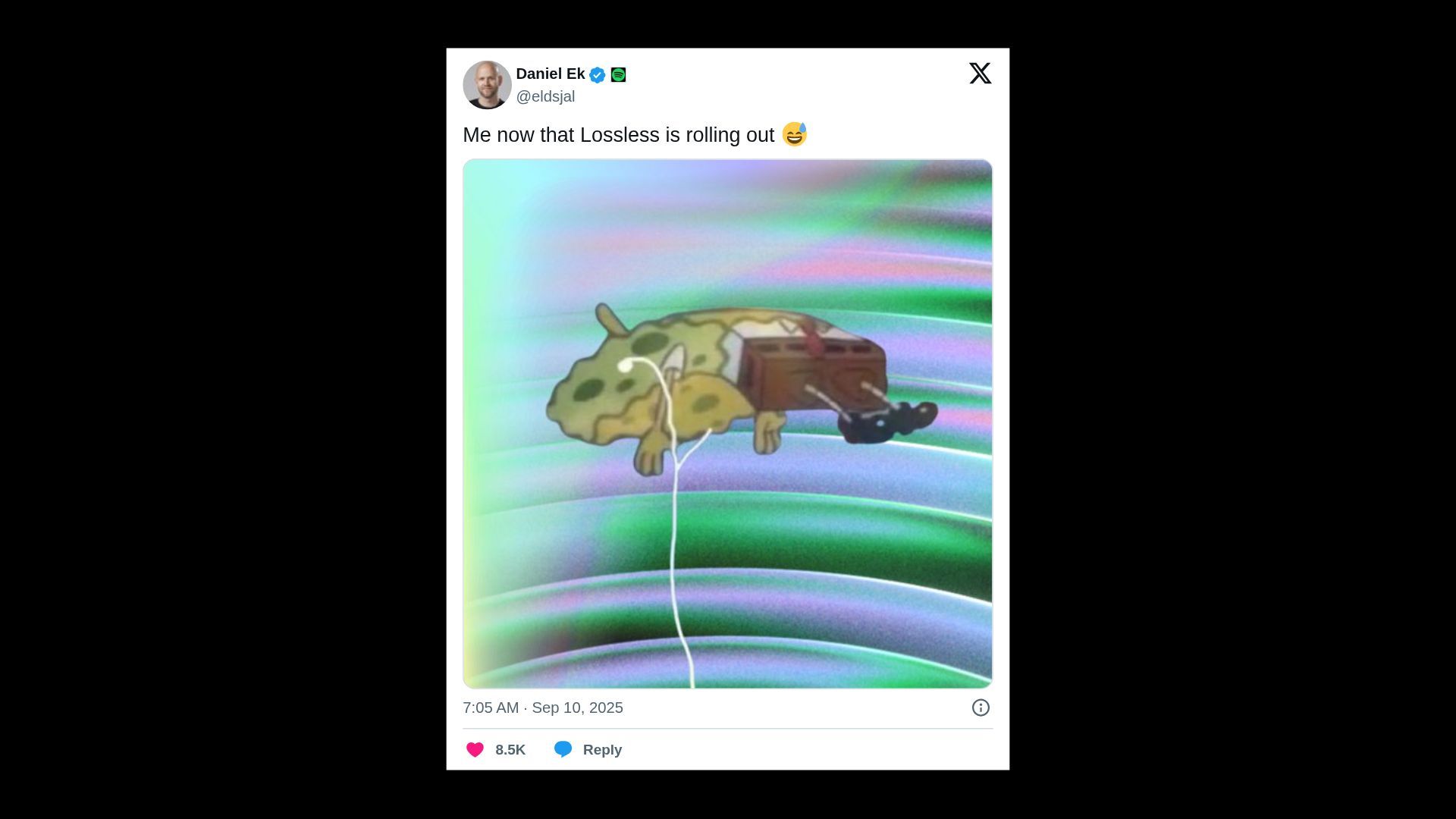
In 2021, Spotify tapped music artists Billie Eilish and Finneas to help announce the rollout of a high-fidelity audio feature, called "lossless," which would be available later that year. Months passed, but the feature didn't launch.
- Yes, but: Last week, lossless audio "finally" arrived.
Why it matters: The long-awaited rollout presented a tricky communication challenge, but instead of ignoring how much time had passed, the audio streamer leaned in.
Between the lines: Had the messaging followed a regular product launch playbook, Spotify would've likely been called out by its listeners β the most avid of whom had made a habit of asking about lossless in the comments of all of CEO Daniel Ek's social media posts.
- By acknowledging the elephant in the room, Spotify got ahead of internet critics and was able to own the narrative.
What they're saying: The thought process was to either lean into the joke or become the butt of it, says Spotify's co-head of communications CJ Stanley.
- "We take our products, our customers and our rollouts very seriously, but it would have come across as pretty tone deaf if we didn't acknowledge the time that had passed and lean in on humor," she said. "And we wanted to share that view in a way that was organic and felt native to audiences that were most engaged."
Zoom in: The communications team at Spotify tackled this by embracing humor across its executives' social media accounts, providing detailed FAQs across owned channels, offering influencers early access and launching a Reddit strategy for the most engaged Spotify listeners.
- "We saw the Reddit community was counting down to the launch and had questions, and we wanted to show up in a way that felt very community-oriented and centered on those people who were invested," said Alex Pezzotti, associate director of social media at Spotify. "So we put one of our engineers on the channel to do an AMA about the launch of lossless."
- Plus, as an added bonus, many of the comments were reshared across other subreddits, making the AMA a source of truth across the platform.
Zoom out: Spotify's branded social media channels β the ones owned by marketing β took a more straightforward approach to the announcement.
- The strategies were tailored to audience, with marketing speaking to all Spotify users β many of whom might not have been aware of the lossless delay β and comms focused on the influencers, media and most engaged communities.
What's next: Tomorrow, Finneas will join Spotify for an in-person event to "finally" celebrate the launch of lossless.
5. Anthropic launches first brand campaign for Claude

Anthropic β the AI research lab behind the large language model Claude β has launched its first brand campaign.
Why it matters: Anthropic has been a key player in enterprise AI, but hopes this campaign will help raise awareness within the consumer market that's dominated by its competitor OpenAI.
Details: The multimillion-dollar "Keep thinking" campaign will run across international markets starting Thursday.
- The spot will also run during sports moments, across streamers like Netflix and Hulu, and in print with the New York Times and Wall Street Journal.
- Out-of-home will run in a dozen cities, including San Francisco, New York City, Washington, D.C., and Los Angeles.
- Anthropic is also partnering with top influencers and podcasters "that naturally align with the ethos of this campaign," per a statement.
Flashback: Last year, Anthropic joined its Big Tech competitors by running an ad during the Super Bowl.
- The company aired a five-second ad that did little to explain what Claude was or how it could serve users.
Now, the messaging of the "Keep thinking" campaign attempts to position Claude as a safe AI solution for solving complex challenges and not a replacement for critical thinking.
- "There has never been a better time to be a problem solver," the spot says.
Between the lines: Anthropic seemed to learn from the highly criticized Apple ad released last year, called "Crush," which showed creative tools like paint, cameras and musical instruments being crushed by a hydraulic press to form an iPad.
What they're saying: Anthropic's new ad "is intended as both a rallying cry and a promise" for responsible AI that helps to solve problems, not create them, says Andrew Stirk, Anthropic's head of brand marketing.
- "Claude is for those who see AI not as a shortcut, but as a thinking partner to take on their most meaningful challenges," he said in a statement.
What's next: The campaign debuts with a 90-second film, which is available on YouTube.
Thanks for reading! For more comms content, become an Axios Communicators Pro member.
Sign up for Axios Communicators