Axios Communicators

January 12, 2023

🙋🏻♀️ Welcome back!
- 🇨🇭 Attending the World Economic Forum in Davos, Switzerland, on Jan. 16-20? Request an invite to Axios House.
Today's newsletter is 1,095 words, a 4-minute read.
1 big thing: NFL's communication shift

Illustration: Eniola Odetunde/Axios
The National Football League's response to Buffalo Bills safety Damar Hamlin's on-field injury signals a major cultural shift for the professional sport, and at the center of culture is communications.
Why it matters: The NFL has been known for fumbling its public communications, but last week the league took a clear, powerful stance on player safety and mental health — even if it was delayed.
Catch up quick: During last week's "Monday Night Football" game, Hamlin went into cardiac arrest, was resuscitated on the field and then taken to the hospital for further treatment.
- An hour later, the NFL announced the game would be postponed, and eventually, it was canceled.
Zoom in: During that hour of uncertainty, fans took to social media in droves to bash the NFL for its inaction. Roughly 8,000 conversations took place online and 43% carried a negative sentiment, according to Cision.
- “The NFL’s leadership and communications team was significantly slower to respond, which caused a great deal of doubt and uncertainty about the NFL’s priorities," Mike Berland, partner at Penta Group, told Axios. "In a crisis, timing is critical to impact."
Yes, but: After the announcement to cancel the game was made, the sentiment shifted and fans, players, coaches and commentators applauded the decision.
- In the week following, online conversations around the NFL have remained positive as users praise the league for its continued support of Hamlin and prioritizing the mental health of players, Cision found.
What they're saying: The league aggressively pushed back against any suggestion that it wanted the game to go on, with executive vice president of football operations Troy Vincent calling that notion "inappropriate, insensitive and [lacking] empathy and compassion."
Between the lines: Audiences "want leaders and organizations to react swiftly and with humanity,” said Cision’s head of global analysis Chelsea Mirkin.
- The NFL did that, by aligning all of its various stakeholders — from owners to coaches and broadcasters — and coming to a logical, compassionate conclusion in just an hour's time.
What we're watching: Since Hamlin's injury, the league has publicly offered mental health support to players, which signals a culture shift within the NFL, Axios' Jeff Tracy and Tina Reed report.
- "What was different to me was how the Bills and their staff handled it," Dallas Cowboys sports psychologist Yolanda Bruce Brooks told Axios.
- "You weren't seeing ... entities doing their jobs. You were seeing someone responding to the players as a person. That's a different mindset."
2. Bonus chart: NFL's news cycle


Readership of NFL-related news peaked the day after Hamlin’s collapse.
- The NFL’s decision to postpone and later cancel the Bills vs. Bengals game was met with a positive response from the media and drove over 3.8 million readers, who signaled support for the NFL's player-first approach.
3. Scoop: Strange Brew Strategies launches startup offering

Illustration: Shoshana Gordon/Axios
Most PR firms aren't equipped to serve startups, but even at the earliest stage, founders must establish their brand and share what sets them apart.
Driving the news: Strange Brew Strategies — a tech-focused communications consultancy — is launching a new offering for startup clients, Axios has exclusively learned.
- "Bringing on communications support early can differentiate between competitors and help to attract investors or recruits," Strange Brew Strategies founder John O'Brien told Axios.
- "It used to be that if you're a seed stage company, then you should just be building and never communicate with the outside world — but I think the world is too competitive for that now."
Details: The offering, called OnBoard, will provide startups with speedy, result-driven communications counsel and meet founders where they are ... on Slack.
- "Startup founders are busier and move faster than ever, so the best way to communicate with them is through lower friction communications," says O'Brien. "If founders want to work primarily on Slack, then we won't fight that."
- For a flat fee of $5,000 a month, OnBoard will provide startups with a designated senior comms strategist who will help with messaging, funding and product announcements, conferences and award submissions. OnBoard will also give founders access to training from outside experts and detailed comms playbooks.
What we're watching: Legacy accounts are out and startup clients are in.
- In recent years, there's been a race for startup business, with new agencies like Six Eastern and Notably swooping in to fill the void. Strange Brew Strategies is the latest to join this trend.
4. Marketing agency enlists AI "interns"

Codeword's AI "interns" created their own images and names, Aiko (left) and Aiden. Photos: Courtesy of Codeword
Artificial intelligence might be gunning for communications and marketing jobs.
Why it matters: As the economy tightens, more industries are beginning to capitalize on tools like ChatGPT and AI image generators like Dall-E 2 in place of living, breathing talent.
Driving the news: Instead of hiring human interns, Codeword — a tech-marketing agency within WE Communications — is leaning on AI technology to produce menial yet necessary tasks.
- The "interns" are technically digital software models that created their own images and names, Aiko and Aiden. The pair will work on graphic designs, do research and generate editorial content.
- Codeword will use the AI "interns" to support its editorial and design teams, and in return, the "interns" will share their experiences across the company blog and social media.
Zoom out: This AI technology can produce the same level of quality work that someone new to the workforce might deliver, says Richard Bowman and David Boyle — authors of the new book, "Prompt: A practical guide to AI-powered brand growth with ChatGPT."
- "Is it always right and perfectly insightful? Certainly not ... [but] ChatGPT is able to perform certain tasks for free that are currently requiring a person" earning $60,000 a year. "And it can do in five minutes what would take someone at least a day to do. That’s remarkable…and that’s just a start."
The bottom line: As gimmicky as it seems, Codeword might be on to something — especially as these AI tools become more tested and trusted among the mainstream population.
5. 👀 What CCOs are watching

Illustration: Eniola Odetunde/Axios
Economic uncertainty and attracting and retaining talent is a top concern for global communication leaders, according to a recent Page Society survey.
By the numbers: While the findings aren't revolutionary, it is clear that top business leaders remain focused on internal communications and corporate culture.
- 65% believe there is an opportunity to do more with stakeholder capitalism issues like sustainability, diversity and values-driven communications.
- 32% want more to be done in support of employee engagement and culture.
What they're saying: “As businesses prepare for increasingly challenging economic conditions, do not lose or abandon the focus that has been placed in recent years on employee engagement, ESG and diversity, equity and inclusion.”
6. Tweet du jour
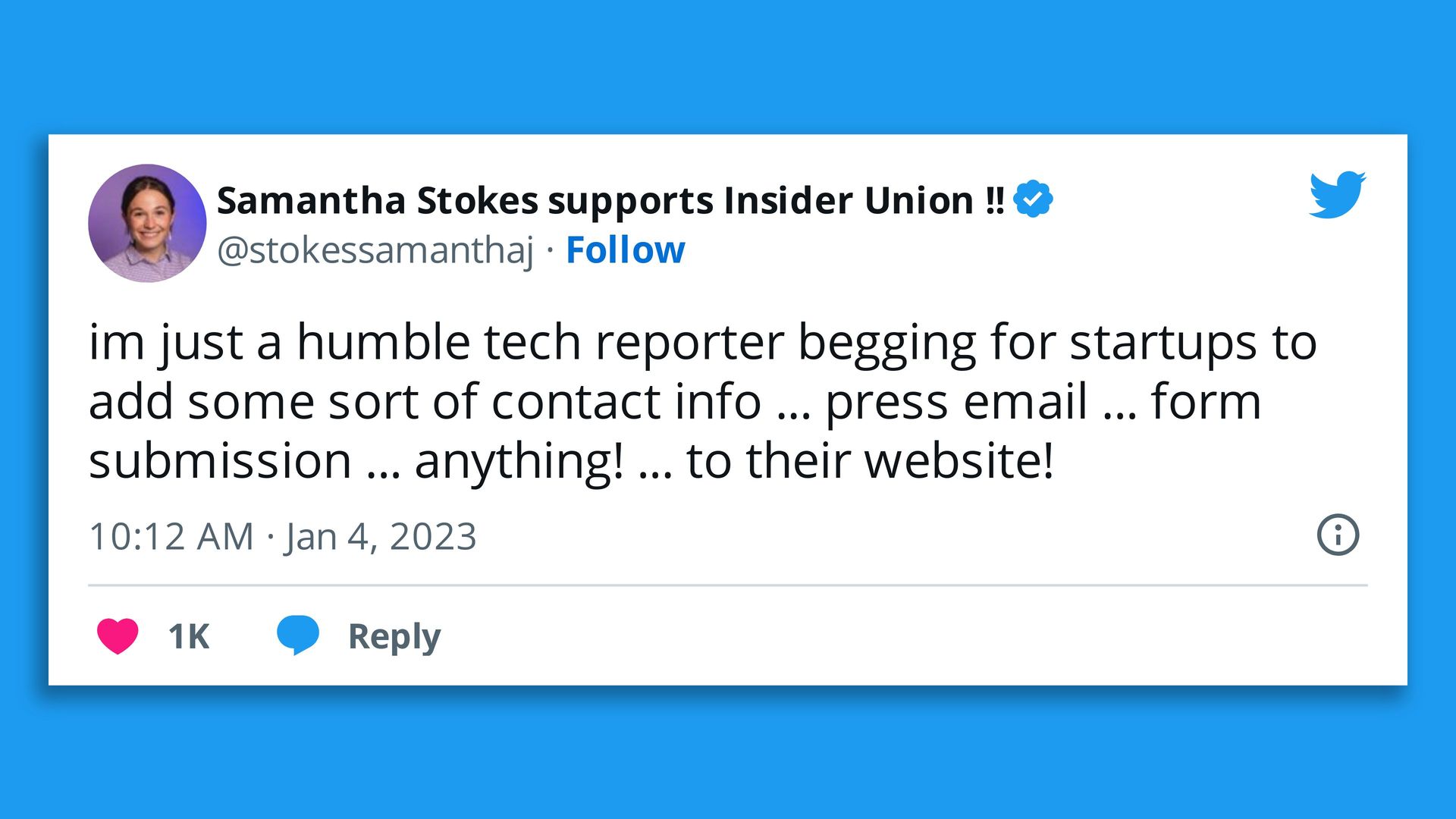
Screenshot: Twitter/@stokessamanthaj
⬆️ This should be enough of a reason for startups to embrace communications.
✅ Thanks to editor Nicholas Johnston, copy editor Kathie Bozanich and to you for reading!
Invite your communicator friends to subscribe.
Sign up for Axios Communicators

Unpacking the topics and trends driving Communications.