
Axios Communicators

February 05, 2026

💖 Welcome back!
- 🗂️ Mixing Board powered by Axios members will receive Monthly Moves tomorrow. Submit this form to be included in the round up and click here to become a member.
Today's newsletter, edited by Christine Wang and copy edited by Brad Bonhall, is 1,815 words, 7 minutes.
1 big thing: CEOS tongue-tied on AI
Business leaders are struggling to tell their AI story to employees, shareholders, customers and regulators as skepticism of the technology grows.
Why it matters: If they can't message it, they certainly won't be able to implement it and prove its return on investment.
- And so far, that's proving true.
State of play: CEOs are bullish on AI as a productivity booster, but across employee bases, skepticism, skills gaps and unclear use cases are slowing adoption — exposing a growing disconnect between what leaders want and what's actually happening.
- According to an MIT study, 95% of businesses are failing to implement AI, showing zero return despite the large enterprise investment in generative AI tools.
- This is due in part to communication hurdles — particularly apprehension and confusion across the employee base. According to a study from AI consulting firm Section, clear access to tools and training is still lacking for most employees.
- Because of this, they see little time-savings or efficiencies from these tools.
- A recent Workday survey found that 8 in 10 respondents saved one to seven hours a week by using AI, but about 37% of that time savings was lost to correcting or reworking the AI output.
Plus, there are concerns that AI adoption leads to job losses for both white- and blue-collar workers.
- Last year, more than 55,000 layoffs in the U.S. were attributed to AI, according to a study from Challenger, Gray & Christmas.
- Meanwhile, companies like Amazon, Dow, HP, Mastercard, UPS and Workday have trimmed their workforces — or have announced plans to — with many citing AI.
Zoom in: This is creating a major roadblock to AI implementation and causing individual contributors (68%) and managers (46%) to feel anxious or overwhelmed by AI, per Section's study.
- At a recent Axios event in Davos — under the Chatham House rule — communication leaders connected a lack of trust to the lack of implementation.
- "I think there's a curve of trust, and we really need to understand how our people see themselves and their work relative to AI," one comms executive from a tech company said. "Most of the conversations that I've had here have been less about AI the technology and more about communicating to build trust, thinking about how people work."
- "We've massaged the messaging. But it's always been very important for us, from a reputation perspective and from a trust perspective, to talk about AI's impact on jobs really clearly, because it will dramatically shift our workforce," another comms executive said.
- To help bridge the divide, some leaders are dedicating their entire learning and development budgets to AI upskilling and trainings, while others are bringing on an AI operations role to help identify how the tech can best support communications.
Between the lines: According to a recent Burson reputation study, companies with AI people strategies outperformed those using AI solely as a tech strategy by 11.8%.
- But to understand how AI agents might automate work and support employees, managers must understand the workflows of their teams, which many are hesitant to disclose.
What they're saying: "The gap between AI messaging to shareholders and employees isn't a communications problem; it's a trust problem," says Ethan McCarty, CEO of Integral. "When the investor deck says 'efficiency' and the town hall says 'empowerment,' employees hear doublespeak. They're not wrong."
- This creates an opportunity for communications teams to not just craft the message but to deploy the strategy, McCarty adds. "Employee communications folks are being enlisted to do things that would otherwise have been called change management back in the day."
What to watch: CEOs should be on guard as AI skepticism is likely to show up at the ballot box in 2026 and beyond.
- A new report from conservative think tank the Institute for Family Studies found that most Trump voters want more AI regulation.
- Threats of rising electricity bills, children's online safety and job loss are populist issues that could turn AI into a political wedge issue.
What's next: While CEOs have struggled with their AI messaging internally, that hasn't stopped them from flexing in front of investors during earnings season.
Case in point … 👇🏻
2. Chart: AI chatter


Business executives are continuing to talk more about AI's impact on the workforce with investors.
By the numbers: Mentions of "agentic AI," "AI workforce," "digital labor," and "AI agents" were up 4,425% from Q4 of 2023 to Q4 of 2025.
- With earnings season just underway, there have already been more than 100 mentions.
3. AI's influence on institutional investors


Most institutional investors say AI is a key part of their investment research process, according to a new report from Brunswick Group.
- 🧠 Why it matters: It's not just young retail investors that are relying on AI to inform investing strategies.
By the numbers: 54% say AI outputs are an important part of their research, per the report.
- Roughly 7 in 10 say AI has changed the way they approach earnings calls, with 46% saying they are more likely to skip the calls altogether and review AI-generated summaries instead.
- Of note, 4 in 10 say they trust AI summaries of financial content as much as ones written by the sell-side.
Zoom out: The influence of nontraditional media interviews are also growing in importance.
- 39% of institutional investors say they value podcasts or in-depth interviews with management or competitors, while 28% refer to newsletters from influential industry participants. This is neck-and-neck with mainstream financial media (29%).
In response, we've seen executives take their messages to nontraditional or emerging platforms.
- For example, Coinbase CEO Brian Armstrong hosted a Reddit "ask me anything" (AMA) session, and Lyft CEO David Risher recently joined web show "TBPN" to frame the company's Q3 results.
What's next: Given the rise of large language models as an information gathering source, corporate communications teams are likely to begin crafting their IR messaging in a way that is easy for chatbots to regurgitate.
What to watch: AI may be too good for financial analysts in particular.
- According to a recent Stanford study, AI is expected to decrease wages for financial analysts — one of only two sectors predicted to face pay declines of the 22 studied.
💭 Thought bubble from Axios' Madison Mills: Information is edge on Wall Street, and the best analysts will survive by continuing to get information that isn't available to AI that informs their stock ratings.
- Without that informational edge, the work may be increasingly outsourced to large language models.
4. CEO reputation rift
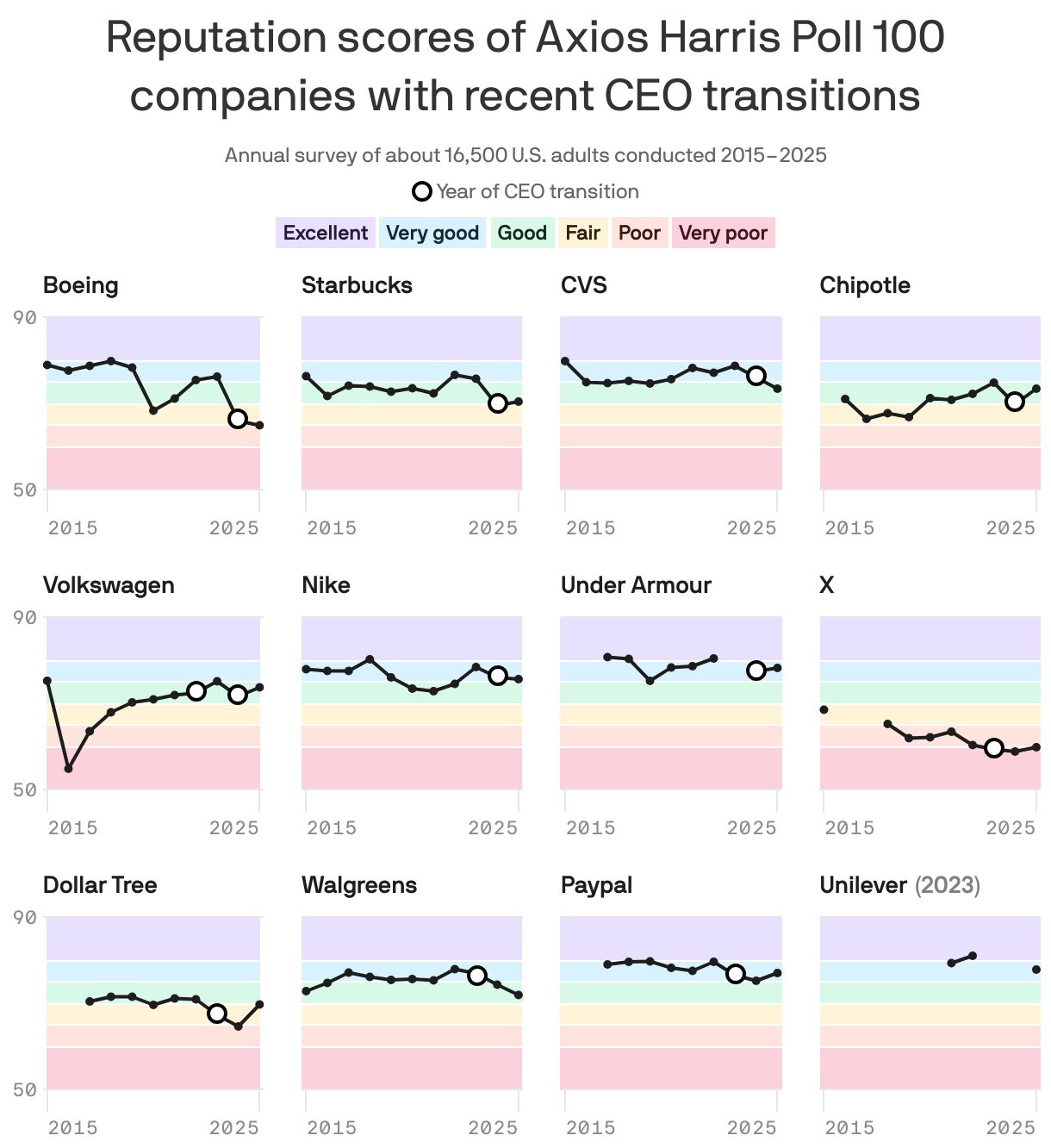
There continues to be a direct link between a CEO's perceived performance and the company's reputation.
Driving the news: This week, PayPal announced that HP's Enrique Lores would succeed Alex Chriss as CEO, citing a disappointing "pace of change and execution."
- Meanwhile, Michael Fiddelke began his first week as CEO of Target as the retail giant continues to sit in the political crosshairs.
- Plus, Disney tapped Bob Iger's much anticipated successor — parks boss Josh D'Amaro.
Between the lines: Most executive transitions occur when corporate reputation is in freefall, according to trend data from last year's Axios Harris Poll 100 reputation rankings.
- Roughly 6 in 10 say a CEO affects their opinion of a company, but only 27% say the CEO's stances on social or political issues are a consideration, according to a recent Harris Poll survey.
- To the public, a company's reputation is a reflection of how the CEO is performing.
What to watch: Outside forces can shape corporate reputation as much as earnings, leading CEOs to carefully navigate issues including affordability and polarized debates over Trump's ICE operations.
5. 📚 Reading list
Here are the other stories that caught our attention this week…
- 📺 The culture wars returned as conservative senators grilled Netflix CEO Ted Sarandos about "woke" content, not antitrust issues. (CNN)
- 👀 Before Masha Bucher began Day One Ventures, she was Jeffrey Epstein's publicist and guide to Silicon Valley. (The Information)
- 🤖 Moltbook, a Reddit-style social network for AI agents to communicate with one another, has launched. Tens of thousands of AI agents are already using the site. (Axios)
- 💸 Affordability messaging is starting to take shape. Pepsi announced it will slash prices as much as 15% following consumer complaints. (The Wall Street Journal)
- Meanwhile, McDonald's is proactively pushing its economic impact story, highlighting employment numbers, supply chain and tuition grants. (LinkedIn)
- 🔄 There's a Meta to OpenAI talent pipeline, with roughly 20% of OpenAI's workforce having come from the social media giant. (The Information)
- Plus, OpenAI could follow the Facebook playbook as it looks to turn personal data into an advertising goldmine. (Axios)
- 🤢 How CEO's really feel: "When the U.S. government starts to engage in corporate America in a way that tastes of favoritism, I know for most CEOs that I'm friends with, they find it incredibly distasteful," Citadel's Ken Griffin told The Wall Street Journal.
6. Battle of the AI ads
Anthropic is pledging to keep advertising out of Claude, alongside a Super Bowl spot that takes a direct shot at competitors like OpenAI integrating ads into their chatbots.
- Why it matters: This could become the key differentiator for AI brands: those that become ad platforms and those that don't.
Driving the news: The post is the serious side of Anthropic's position; the Super Bowl ad is the pitch to consumers.
- It features a man talking to an AI-generated therapist about his communication issues with his mom.
- After some bland advice, the "therapist" pitches a paid dating app to connect with older women. (Watch here)
Between the lines: It's a swipe at OpenAI, which is offering chatbot ads to dozens of advertisers already.
- It's also a line in the sand for Anthropic, which is now promising it will remain ad-free, with no sponsored links or third-party placements influencing responses, a policy it frames as protecting usefulness and trust.
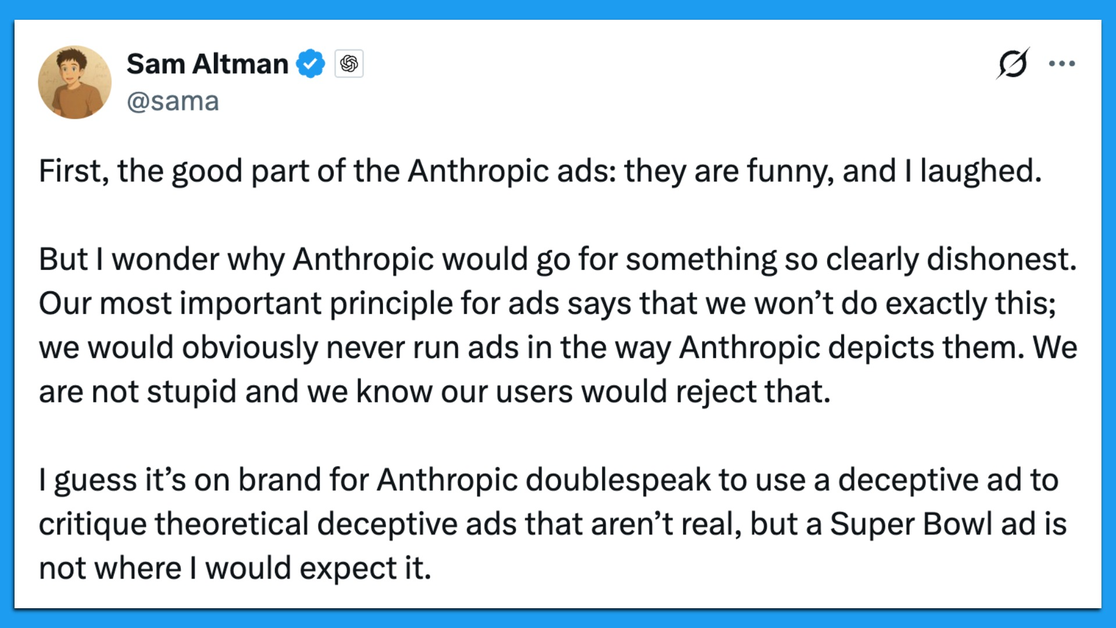
The other side: OpenAI CEO Sam Altman responded to the ads by calling them "funny" but "clearly dishonest" and "on brand" for Anthropic.
- "We would obviously never run ads in the way Anthropic depicts them. We are not stupid and we know our users would reject that," Altman said in his 400-word, 12-paragraph tweet.
- The AI giant's chief marketing officer also responded directly to the ad.
❓ Have thoughts on the Anthropic ad campaign or OpenAI's response? Send me a note.
7. 💭 1 quote to go
Many of you texted me about this quote, so I thought it was worth sharing en masse.
"People ask me, like, what job is safe from AI. I personally think if I were to bet on one job that's only going to increase in importance, it's things around communication, strategic communications, investor relations, PR.…"— Scott Galloway, on a recent edition of the "Pivot" podcast
✅ Thanks for reading! For exclusive reporting, deep dives and events, apply to join Mixing Board, powered by Axios.
Sign up for Axios Communicators