
Axios Communicators

March 27, 2025

βοΈWelcome back! It's a big week for the Signal PR team. More on that below, plus my vacation week brain dump.
- π§ ICYMI: Axios is expanding its Pro Deals coverage, adding beats like biotech and supply chain. Plus, Lucinda Shen will now author a PM companion to Dan Primack's Pro Rata morning newsletter. More info here
Today's newsletter is 1,579 words, a 6-minute read.
1 big thing: Tough talk returns
The return of the Big Boss Era has brought with it tough talk, as corporate leaders take a more candid tone internally.
Why it matters: How CEOs are communicating with employees has evolved from "bring your best self to work" to "step it up."
The big picture: The slowing labor market and economic uncertainty have given management an upper hand it didn't have during the COVID era.
- This has been underscored by return-to-office mandates, diversity, equity and inclusion walk backs and layoff fears. Now, once-vocal employee bases are just trying to hang on to their jobs.
- These macro factors, paired with the cultural shift toward more corporate "masculine energy," have created a work environment that looks unrecognizable from that of a few years ago.
- Meanwhile, leaders in Washington and corporate America are working to battle bureaucracy, increase efficiencies and do much more with much less, believing these drastic changes will ultimately pay off.
What they're saying: "There seems to be this shift among employees, with some understanding that most CEOs are in tough positions and they don't want their company to become a target for this administration," says Shallot Communications co-founder Teal Pennebaker.
- "They want their company to succeed, and they sort of understand what their CEO is up against. But these leaders have to explain why the change is happening and tie it back to the broader business strategy or mission."
Yes, but: While employees might not be outwardly dissenting, they are leaking potentially unflattering audio from internal meetings.
- In recent weeks, there's been leaked audio of JPMorgan Chase CEO Jamie Dimon's curse-laden town hall, Starbucks CEO Brian Niccol's rallying cry for employees to step it up and Amazon CEO Andy Jassy's critique of managers with "fiefdoms" who are slowing down the company.
The intrigue: There's a case to be made for strategically leaking these tough talks, says Seven Letter partner Mike Ricci.
- "These leaks are another way to show board members, investors or stakeholders in Washington that they're taking action and they're trying to push change forward."
Plus, this corporate tough talk is in line with the cultural shift that's taking place in the era of Trump 2.0, adds Ricci.
- "It certainly fits the ethos of the moment β which is all about strength, directness, toughness, and what's being called radical transparency. I think these leaders sharing their genuine thoughts is a part of it, but there's also definitely a sense of urgency behind it. These leaders see all the change happening in Washington, and they need their cultures to move faster and to adapt."
Zoom in: Return to office appears to be one of the biggest sticking points within corporate America, even as Trump leads the RTO push.
- Nearly 40% of the 457 business leaders Axios HQ surveyed say they plan to increase their in-office requirements this year, with most citing collaboration and competitive pressures as the reasons.
- Meanwhile, 31% of remote or hybrid employees say they'd accept termination or look for a new job if in-office days increased. However, roughly half said an increase in benefits would help soften the RTO blow.
Between the lines: Consistency in tone and style is key when delivering unpopular news, Pennebaker said.
- "Employees want to feel like they're hearing from the same leader, even if that message is changing," she said. "And when there's a stark change, employees question, 'Is this actually the CEO that I signed up to work for? Have they ever been speaking to me authentically?'
- "When a CEO can be super real and use their own, frank language, it can serve as a rallying cry and a very important aligning moment."
What to watch: Some executives might have overcorrected during the COVID era by being too touchy-feely or insincere in their employee communications.
- This overcorrection will inevitably happen again, with some CEOs β like Meta's Mark Zuckerberg β going too hard or venturing too deep into the "manosphere."
2. Early signs that abandoning DEI hurts corporate reputation
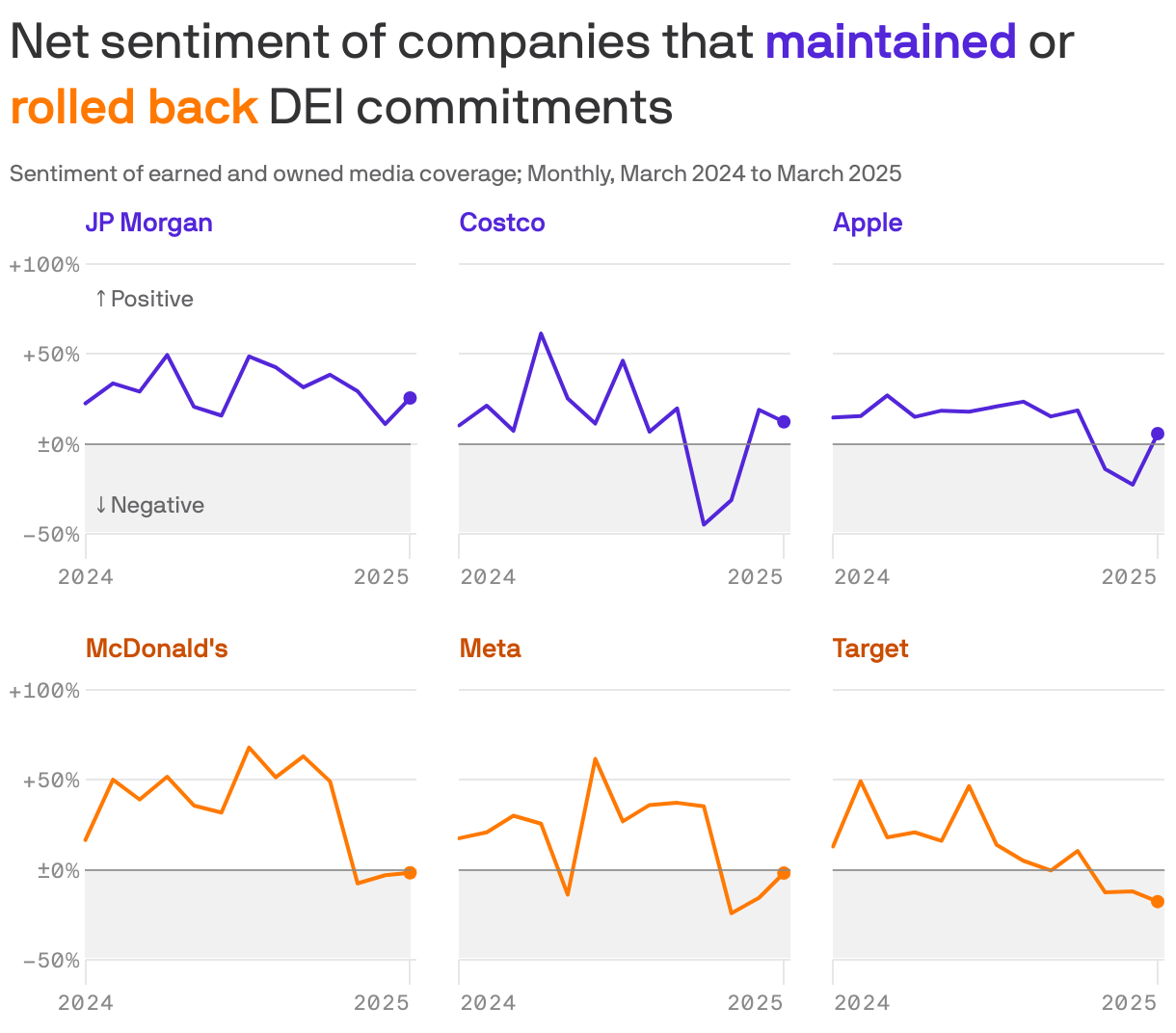
Early data reports show that changes in corporate diversity, equity and inclusion (DEI) policies are affecting reputation.
By the numbers: Among the companies that rolled back their DEI commitments, Target's reputation has taken the biggest hit, according to data from intelligence platform Signal AI.
- Companies that maintained their DEI commitments saw positive sentiment grow by an average of 4.4%, while those that revised their DEI commitments saw positive sentiment drop by 11%.
- Before the November 2024 election, companies that maintained their DEI commitments already had higher positive sentiment compared to companies that later rolled them back. However, after the election, the gap widened by more than 20 percentage points.
Zoom in: Companies that changed their DEI programs received more mentions than those that kept DEI policies in place.
- Amazon, Walmart and Meta are the most frequently mentioned companies in news articles and online conversations about DEI walk backs, according to Signal AI data shared with Axios.
Yes, but: Regardless of where companies land on the DEI debate, those that tie action to corporate messaging fare best.
- According to a separate analysis by reputation intelligence platform MAHA Global, companies with poor track records on DEI saw a bump in reputation when they dropped their policies.
- The inverse was true for companies that had weaker historical DEI performance but kept their policies in place.
3. The IPO comms comeback
StubHub, Klarna, Hinge Health and eToro recently filed public offerings.
Why it matters: Three (or more) make a trend, which means it's time to dust off the IPO comms playbooks.
Flashback: In 2023, I examined the communication opportunities that come with taking a company public.
- "An IPO is the moment to tell the world why a company matters β and telling the right story with the right messaging to the right people is crucial for a successful listing," I wrote at the time.
Yes, but: The media landscape has drastically changed since the last IPO boom in 2021.
- π±Shifting spheres of influence and news consumption habits will likely alter the IPO comms playbook too.
- π§ I'll write about this in a future edition of the newsletter, so share your thoughts.
What to watch: This movement also signals more job opportunities for communicators in the months ahead.
4. π Reading list
Here's what we're reading this week ...
- π€ Tesla chair remains silent amid backlash to Elon Musk's political activities. (Axios)
- βοΈ 9-to-5ers are using LinkedIn to make more money and build their personal brand. (The Wall Street Journal)
- π Founder drama: StubHub filed for an IPO and rewrote part of its history in the process by omitting any mention of co-founder Jeff Fluhr. (Axios)
- π±TikTok's public affairs campaign continues as it touts itself as a champion of small businesses while ban looms. (The New York Times)
- π€ A Ford executive kept a meticulous list of colleagues' verbal flubs β but who here hasn't mixed a metaphor? (The Wall Street Journal)
- π¨ And in case you missed it: the story about a journalist inadvertently being added to a Trump administration group chat about Yemen war plans. (The Atlantic)
5. π―οΈ 1 SignalGate quote
"We don't care what the media says. We can easily handle what would kill any other administration. This will blow over."β A White House official told Axios' Marc Caputo when asked about military strike plans being discussed by high-level Trump administration officials over Signal.
Yes, but ... ππ»
6. Reality check: It's the biggest story of 2025 so far


Rarely do U.S. national security stories gain this much traction so quickly around the world, Axios' Sara Fischer points out.
Zoom in: #SignalGate is more than just a revelatory report, it's a viral sensation that's driving meme mania online.
- #SignalGate was the top story in the world across all English-language articles, according to NewsWhip, which measures social media engagement across Facebook and X.
- News stories about the disclosed war plans have seen 25 million readers across 463 articles as of March 25, according to readership numbers from media monitoring platform Memo.
Catch up quick ... Top 4 takeaways from Trump Cabinet's explosive leak of Yemen war plans
7. π 1 book thing to-go
Meta's response to "Careless People" β the tell-all book written by its former global head of public policy, Sarah Wynn-Williams β is fueling book sales, encouraging more people (me included) to read it.
- The memoir made the New York Times bestseller list. Plus, it got the attention of Congress and the parliaments of the UK and European Union.
Why it matters: Meta is indirectly doing most of the book's publicity by igniting the Streisand effect.
The intrigue: According to reports, the publisher avoided publicizing or promoting the book ahead of print as a way to curtail Meta's legal team.
- Yes, but: Meta quickly filed an arbitration dispute claiming Wynn-Williams violated a non-disparagement clause in her contract.
- While Wynn-Williams is personally prohibited from promoting or distributing the book, the publisher is not.
What they're saying: "We are appalled by Meta's tactics to silence our author through the use of a non-disparagement clause in a severance agreement," Macmillan spokesperson Marlena Bittner told The New York Times.
- "The book went through a thorough editing and vetting process, and we remain committed to publishing important books such as this."
The other side: "This book is a mix of out-of-date and previously reported claims about the company and false accusations about our executives," said Meta spokesperson Andy Stone.
- Since Wynn-Williams departed the company, she "has been paid by anti-Facebook activists and this is simply a continuation of that work," he added. "Whistleblower status protects communications to the government, not disgruntled activists trying to sell books."
Go deeper ... Rolling Stone's "11 WTF moments" from the book.
π Thanks for reading! For more Axios Communicators content, join Axios Communicators Pro.
An extra thanks as always to editors Christine Wang and Kathie Bozanich.
Sign up for Axios Communicators


/2025/03/27/1743084514175.gif?w=3840)