Axios Communicators

March 05, 2026

Welcome back!
- 🤠 Join us at SXSW from March 13–15. Axios House guests include star athlete and Reckitt Catalyst's "entrepreneur-in-residence" Serena Williams, Tory Burch Foundation president Tiffany Dufu, Jeni's Splendid Ice Creams founder Jeni Britton and more. RSVP here.
- 📇 Last call for job news! Monthly Moves will hit inboxes tomorrow. Submit here.
Today's newsletter, edited by Christine Wang and copy edited by Kathie Bozanich, is 2,009 words, 7.5 minutes.
1 big thing: Corporate pushback begins to percolate

Corporations are starting to find their backbone, from AI labs resisting military ultimatums to retailers successfully suing the president.
Why it matters: The prevailing corporate strategy has been one of high-profile compliance, particularly with the Trump administration. Now, companies are pushing back because the cost of that is existential.
Driving the news: Anthropic CEO Dario Amodei rejected a Friday deadline from the Pentagon to strip safety guardrails from its AI models for military use.
- The standoff: Defense Secretary Pete Hegseth demanded "unfettered access" to Claude, rebuffing Anthropic's proposed restrictions on mass domestic surveillance and fully autonomous lethal targeting.
- The threat: The Pentagon threatened to label Anthropic a "supply chain risk," a blacklisting usually reserved for foreign adversaries, if it didn't acquiesce.
- The backbone: Amodei stated the company "cannot in good conscience" comply, arguing that today's AI is simply not reliable enough to power autonomous weapons without risking American lives.
The big picture: This refusal to bend is part of a broader "no" taking shape across corporate America.
- In the courts: Following a legal campaign from dozens of U.S. companies, the Supreme Court ruled 6-3 that the president lacks the authority to use emergency powers to impose tariffs.
- Now, companies like Costco, FedEx, Hasbro, Kohl's and L'Oreal are suing the administration for refunds.
- In states: More than 60 Minnesota-based CEOs signed an open letter calling for de-escalation following the administration's ICE operations that resulted in the fatal shootings of two U.S. citizens by federal agents.
What they're saying: "You are starting to see companies find their footing in standing up to some unpopular policies," says Steve Dowling, co-host of the Communication Breakdown podcast and former head of communications for OpenAI and Apple.
- "Even if we are witnessing some kind of turning point, companies on the whole still seem far from confident in openly criticizing the administration. They just haven't found their voice yet. You can see them trying in some cases, but it feels exceptionally cautious."
Between the lines: This isn't necessarily charity or altruism. These moves could be positive from a profit margin perspective.
- Anthropic knows its multibillion-dollar valuation depends on its brand as the "safe" alternative to rivals, and its pushback to the Pentagon has resulted in generally positive PR for the company — particularly among technical talent, a key stakeholder group for AI labs.
- Retailers stand to get up to $175 billion in refunds from tariffs previously paid that are now deemed unlawful.
- The response by business leaders in Minnesota helped to curtail mass boycotts and backlash within their local communities, while also easing employee concerns.
The bottom line: The corporate pushback is strategic — not ideological — because even in this political climate, protecting long-term shareholder value and reputation ultimately trumps President Trump.
2. ICYMI: AI PR wars charted


While Super Bowl ads provided a positive pop for OpenAI and Anthropic, the real shift in favorability came from the Pentagon fallout.
Why it matters: The reputational gap between Anthropic and OpenAI is narrowing.
- Anthropic has a net favorability of about 10%, while OpenAI's hovers around 12%, according to Morning Consult data shared with Axios.
Catch up quick: Anthropic lost its Pentagon contract Friday over a dispute about military use of Claude, shortly after Trump blasted it as a "Radical Left AI company."
- Hours later, OpenAI announced its own Pentagon deal after the Defense Department agreed to safety restrictions similar to those Anthropic had sought.
By the numbers: In the week leading up to Feb. 8's Super Bowl, Anthropic outpaced OpenAI in gains across awareness, usage and favorability.
- OpenAI maintains category leadership, but the in-week shifts suggest Anthropic's Super Bowl presence translated into stronger immediate consumer movement, according to Morning Consult data.
Yes, but: Those gains were challenged in mid-February after it was reported Anthropic's Claude was used in the U.S. military operation to capture Venezuelan President Nicolás Maduro.
The big picture: The Pentagon saga has made both companies vulnerable to reputational swings.
- Anthropic's favorability score has increased since it walked away from the Pentagon deal, while OpenAI's has declined after its Pentagon deal.
The bottom line: Ads moved the needle for a week, but the Pentagon fight moved the narrative, and it's the narrative that's narrowing the reputational gap between Anthropic and OpenAI.
🧠 This is part of a recent deep dive created for Mixing Board, powered by Axios members. To read the entire case study, apply to become a member.
3. AI investment climbs, but transformation trails
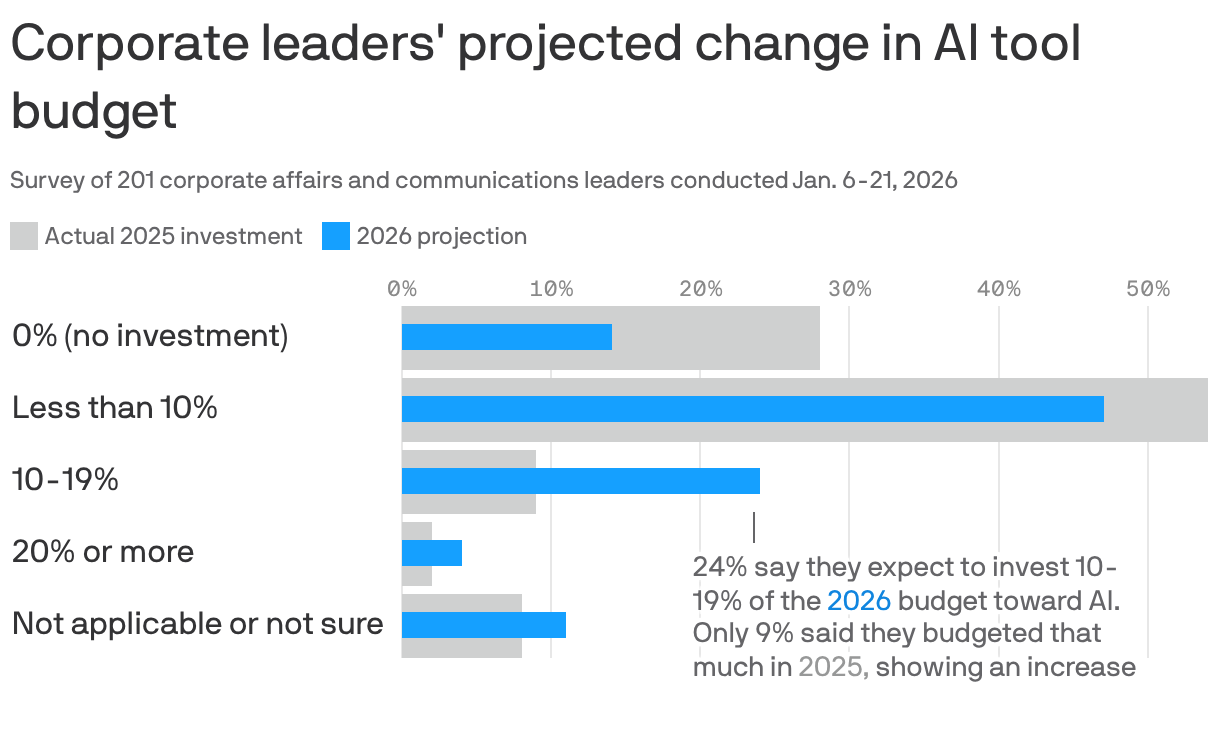
Roughly 1 in 4 corporate affairs and communications leaders say they will dedicate more than 10% of their budget to AI tools, but a majority (88%) aren't prepared to lead the AI transformation for their function, according to a new study by BCG.
Why it matters: Finding the budget is just the first of many steps for implementing AI.
Zoom in: While those who have integrated GenAI say it has saved time and money, only 8% currently reinvest these time or cost savings into building new team capabilities.
- Instead, 23% say they plan to redeploy their teams, while 12% plan to reduce headcount and 15% plan to freeze hiring in the next 12 months.
Zoom out: More than 80% of comms and corporate affairs work can be augmented or automated by AI, according to BCG, and PR agencies may bear the brunt.
- 37% of comms leaders are considering reducing agency spend by more than 5% over the next year, per the report.
- "The sky's not falling," BCG chief communications officer Russell Dubner told Axios. "But there are shifts happening. For agencies, that means they have to get super clear on the value that they're bringing — and make sure it's not overlapping with what GenAI can do pretty readily for an in-house function."
Between the lines: Only 31% of comms chiefs report meaningfully scaling GenAI beyond pilots, while 68% identify as AI laggards.
- "You have CEOs accelerating and CCOs hesitating," says Dubner. "That could result in a mismatch of agenda and expectations."
What to watch: To help with the deployment and integration of AI tools, some communications teams at Yahoo and Anthropic are hiring AI operations leads.
- "The companies hiring for these roles now — or at least carving out significant portions of existing roles to focus on AI transformation— will be leaps ahead of their competitors," says Gab Ferree, founder of Off the Record.
- "Everyone says AI is a priority, [but] very few are actually hiring for it. The gap between talk and action is where competitive advantage is being built right now."
4. Sally Susman to join FGS Global board

Former Pfizer executive Sally Susman has been appointed to the global executive board of FGS Global, Axios is first to report.
Why it matters: Susman brings the perspective of a Fortune 100 chief corporate affairs officer at a moment when CEOs are navigating heightened volatility, stakeholder activism and political backlash.
Zoom in: The global executive board was established after KKR's 2024 acquisition of the firm, a deal that valued FGS at $1.7 billion.
- Susman is one of two independent members of the board, which also includes McKinsey & Company senior partner Homayoun Hatami, KKR partner and global head of public affairs Ken Mehlman and members of FGS' executive leadership team.
Catch up quick: Susman is credited as one of the early architects of the modern corporate affairs function.
- She spent 18 years at Pfizer, where she managed three CEO transitions, supported the rollout of the COVID-19 vaccine and helped the company dodge a high-profile proxy battle.
- Prior to Pfizer, Susman led communications and corporate affairs at the Estée Lauder Companies and American Express and supported legislative affairs in the U.S. Senate and Department of Commerce.
Between the lines: Her appointment signals FGS' ambition to position itself as a strategic partner to CEOs and boards confronting risk in an increasingly fraught operating environment.
What they're saying: Susman's voice on the board will be an important representation of the client's point of view, FGS Global CEO Alex Geiser said.
- "Sally is very publicly respected and regarded as someone who operates at the forefront of the sector," Geiser said. "She also understands what is truly meaningful to clients, and we want that perspective and thoughtfulness as we think about growing the firm."
What's next: FGS posted double-digit revenue growth over the last year and is leaning into expansion, including recent acquisitions of health care advisory Tarplin, Downs & Young and threat intelligence firm Memetica, alongside the launch of an AI advisory practice.
5. 📚 Reading list
Here are other stories that caught our attention this week ...
- 👀 PRSA, the public relations trade organization, has made sweeping layoffs after years of operating in the red.
- "This difficult decision was driven by financial realities and our fiduciary responsibility, and we deeply value the contributions of the employees impacted by this change," PRSA said in a statement.
- 🗣️ Trump is communicating in ways that didn't exist for past presidents in wartime, via his own web videos, social media platform he controls and chatting directly with reporters on his cellphone. (CNN)
- 🗂️ People moves: Haun Ventures alum Rachael Horwitz joined Airwallex, where she will oversee public affairs and communications, while Maggie Mitchell has departed SiriusXM for Moloco, where she will oversee global internal and external communications.
- Plus, Levi Strauss chief communications officer Kelly McGinnis announced her retirement after 12 years with the retailer.
- 🍔 McDonald's CEO Chris Kempczinski was mocked for appearing reluctant to eat a "Big Arch" burger during a tasting video the company posted on social media. Meanwhile, Burger King CEO Tom Curtis and Wendy's president Pete Suerke replied with their own video. (USA Today/People)
- 📣 Precision Strategies, founded by Democratic strategists Stephanie Cutter and Teddy Goff, has acquired Republican firm Firehouse Strategies, bringing together those who "have sat on opposite sides of the same campaigns." (Axios)
6. Seeking comment
The New York Times took readers into the newsroom to explain the calculus behind seeking comment and what it's like working with communications teams in tech.
🗞️ Here's what they're saying ...
- On when to seek comment: "Sometimes it makes sense to reach out with an open-ended question and an open invitation for an interview at the outset of reporting. Other times, it makes more sense to reach out later in the reporting process, when we have more information." — Pui-Wing Tam, deputy business editor
- On front-running scoops: "Something annoying that happens more often than I'd like: I'll call a company for comment, and they'll call a competing outlet to tell a more positive version of the same scoop I'm working on in order to shape the narrative in their favor. But the smarter communications executives know this is bad form for them in the long run." — Mike Isaac, tech reporter
- On going direct: "There are entire communications agencies pushing the idea that media is irrelevant, and all tech companies should just tweet out news and bypass reporters entirely. This is an attractive idea for executives who are frustrated that we aren't acting as stenographers. But I don't think this will work out for them." — Isaac
🎁 Read the story ... Gift link
7. ✅ 1 list to go
Select publishers have more visibility across large language model outputs than others, according to Muck Rack's generative pulse data.
- 🧠 Why it matters: The information that feeds these chatbots becomes more important for PR teams as consumers, investors and regulators turn to LLMs for search.
Zoom in: Based on a monthly analysis of more than 15 million AI response citations across Gemini, ChatGPT, Perplexity and Claude, the five most cited traditional news sources include ...
- Reuters
- Forbes
- The Guardian
- Financial Times
- CNBC
Of note: Many outlets have licensing deals with some of these AI companies, which allow the LLMs to scrape and cite their reporting.
✅ Thanks for reading! For exclusive reporting, deep dives and events, apply to join Mixing Board, powered by Axios.
Sign up for Axios Communicators