Axios Communicators

July 23, 2026

☀️ Hey y'all! Triple-digit heat here in Austin, Texas. How's your summer going?
📺 Nvidia CEO Jensen Huang joins Axios' Mike Allen for a wide-ranging conversation about AI, China and the future of work. Huang dives deep on why he believes fears about mass job losses and an AI apocalypse are overblown. Watch on YouTube.
This edition of Axios Communicators, edited by Christine Wang and copy edited by Kathie Bozanich, is 1,631 words, a 6-minute read.
1 big thing: When brands blend with culture
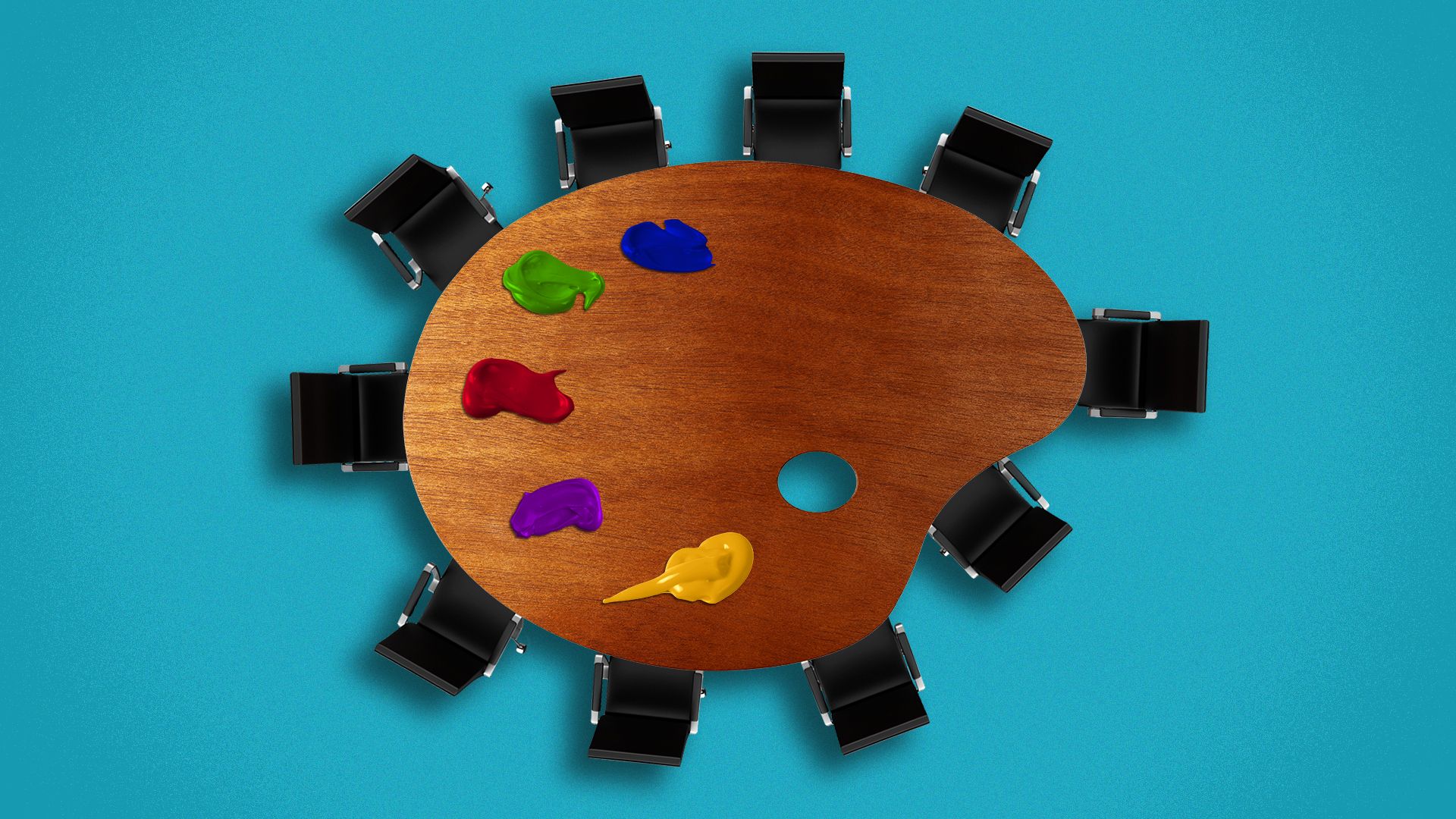
Brands are increasingly tapping graffiti, hip-hop music and other connections to cultural communities to create campaigns that don't feel like traditional advertising.
Why it matters: Communication leaders overseeing these efforts need to walk a fine line of participating in a community without coming off as exploitative.
Zoom in: This summer, insurance company Lemonade launched a campaign across multiple cities with graffiti-like billboards and signage.
- The primary purpose of the campaign was to tell the brand's story and show how "we do things in a different way," co-founder and co-CEO Shai Wininger says.
- Wininger was careful to avoid linking the campaign with street art. "To call it 'art' would be an insult to art," he says, emphasizing instead the "sloppy by design" nature of the signs.
- Lemonade's approach is to run multiple ad campaigns simultaneously, he says, and test them through a "survival of the fittest" approach, ditching the flops to try something new instead.
The big picture: Consumers are bombarded with ads across every platform, making it increasingly harder for brands to cut through.
- AI tools are also contributing to a "sameness" across advertising, making campaigns that feel human, imperfect and culturally connected stand out.
Zoom out: Sprite's summer campaign builds on its history of participating in music and global culture.
- Sprite's "Obey Your Thirst" campaign dates back to the 1990s and has featured artists like Nas and A Tribe Called Quest. That legacy makes it possible for the brand to engage with hip-hop culture without being accused of co-opting it.
- "Sprite was one of the brands that tried to serve as a platform for the genre and its artists — not take from the culture," says Oana Vlad, Sprite's global brand vice president.
- To keep the brand safe from any explicit or offensive lyrical content, anything that threatens Sprite's "authentic, inclusive and progressive" brand values gets a "hard no," Vlad says.
Between the lines: At the heart of these decisions is the relationship among communications, marketing, legal and other functions.
- Communicators have to stay on top of both the internal and external environments in which the campaign will exist, explains Josh Rosenberg, CEO of Day One Agency.
- The best campaigns, he says, live in the middle between "brand truth" and "fan truth."
- "They're so authentic to the brand, the consumer sees themselves reflected back in that campaign."
Case in point: Duolingo launched a Japanese animated series on YouTube, featuring their mascot, Duo.
- It was a natural extension of something the brand had observed: people turn to Duolingo to learn Japanese to get into anime, said chief marketing officer Manu Orssaud.
- The brands that cut through show up where people care, in communities like sports, gaming, art or music, he said. "But there has to be a genuine connection between that community and what your brand stands for."
- This is where comms has to show up, Orssaud added: "They have a strong pulse on what conversations are already happening in culture and where there's an authentic opportunity for the brand to participate."
The bottom line: Communicators have to understand the cultures and conversations their brand is entering — and make sure every campaign is grounded in the company's values.
2. 📨 Substack's AI transparency play
Substack is betting that subscribers, and the sponsors they attract, value authenticity and are willing to pay for content that is verifiably created by humans.
Driving the news: The media platform is partnering with Pangram, an AI-detection tool, to allow users to estimate how much text on the platform — including posts and comments — was made with AI.
How it works: Users on the iOS app or on a browser will be able to scan text in notes, replies, comments and posts and get an estimate of how much was human-written versus AI-generated.
- It only works for text longer than 100 words and published after July 21, when the news was first announced. Substack said the feature is coming to Android soon.
- Creators will also have access to Pangram to review their drafts as well as report and remove scans they believe are mistaken.
- Substack is also adding a feature for creators to insert a "How I make this" statement, where they can disclose whether they use AI.
Catch up quick: Substack is increasingly part of a comprehensive communications strategy for companies.
- Many journalists who previously worked for larger outlets have found loyal, paying audiences on Substack, covering subjects like tech, venture capital and health.
- The State Department, Tory Burch and a16z have turned to Substack for new owned communication channels.
- With Pangram, readers can now run this content through leading AI detection tools.
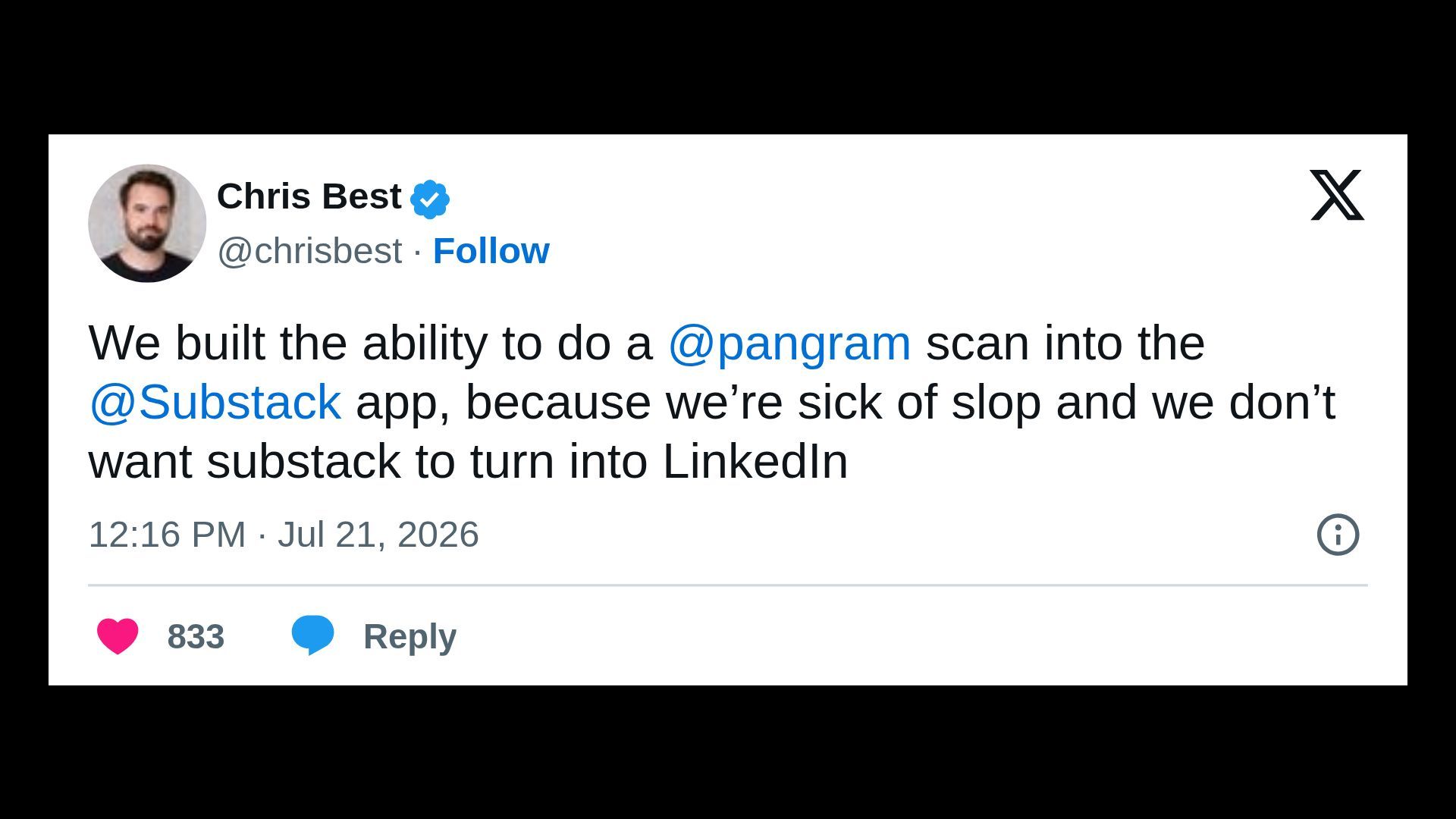
What they're saying: "When content made by no one takes over parts of the internet that are supposed to be human, it pollutes the commons and makes it hard to discover and hear human voices," wrote CEO Chris Best.
- "When readers have to wonder if what they're reading is real, it undermines trust in authorship and threatens the livelihood of writers — including those who use AI tools thoughtfully to produce work they believe in."
The big picture: He argued the problem with "Claudefishing" is that readers are unwittingly investing time and attention in content that wasn't created by a human.
- Best also ribbed LinkedIn, saying Substack doesn't want to turn into the professional network platform.
- While LinkedIn has surged in popularity with business leaders and professionals looking to become thought leaders, so has the amount of AI content.
- Labels disclosing AI-generated content are becoming increasingly common, particularly on visual platforms. Meta, Google and TikTok automatically label content made with their own AI tools.
What we're watching: Whether creators embrace Substack's push toward transparency around AI use and how rival platforms respond.
- Beehiiv allows AI use as long as it supports the creator's "original voice," is substantive, editorially relevant and "avoids manipulative practices."
3. 📰 Reading list
⚽ Sunday's World Cup final drew more than 62.8 million viewers in the U.S., making it the most-watched soccer telecast ever in the country. (Axios)
- This is a huge jump from the 26.7 million who watched the 2022 final, underscoring that the World Cup has become one of the few global "monoculture" events.
📱 The Justice Department issued subpoenas to obtain the phone records of New York Times journalists — and some family members — who reported on the new Qatari-donated Air Force One jet. (New York Times)
🥬 The cyclospora outbreak news cycle continues. The FDA is again narrowing in on Taylor Farms as a likely source, after acknowledging over the weekend a "false positive" in its initial testing. (Axios)
- The FDA also says it never offered Taylor Farms an apology.
⚖️ Madison Square Garden filed a defamation suit against Wired magazine over a story alleging the entertainment arena tracked celebrities, assigned "risk scores" and kept tabs on the sexual orientation of some. (USA Today)
- Wired responded by removing the paywall on the stories and promoting them on Instagram.
4. Communicators spotlight: Stacy Martinet

As Adobe's recently appointed chief content and creative officer, Stacy Martinet leads how the company shows up across creative and advertising, editorial content, collaborations and experiences.
Why it matters: Adobe sits at the intersection of tech and creativity, and is now pitching AI tools to filmmakers, designers, illustrators and other creatives.
The path here: "Looking back, I've been fortunate to have a front-row seat to several major shifts in technology and culture," Martinet told Axios.
- She started her career at the New York Times, then joined Mashable.
- When she joined Adobe in 2016, she initially focused on operations and strategy, before taking on leadership roles across marketing and communications.
Tough lesson: You can't do big things alone.
- "I've got plenty of ambition and grit, but grit alone doesn't get you there," she said. "You have to bring people in, listen to them and be willing to adapt to what you hear."
Trendspotting: Companies are building a content software stack alongside their traditional marketing and technology systems, Martinet said.
- The shift is less about adding AI tools and more about connecting people, workflows, data and decision-making to speed up storytelling.
- "Content and creative teams are increasingly being asked to operate more like media companies — with editorial instincts, production infrastructure, audience relationships and always-on storytelling capabilities," she said.
Reading list: "Whistler," by Ann Patchett.
- "There are very few authors who can write characters like Ann Patchett," Martinet said.
Morning ritual: Water before anything else.
- "Some mornings include a workout; others are spent getting the kids out the door. I've stopped pretending every morning needs to look the same after my cup of tea," she said.
Best advice: "My first boss at the New York Times told me that great opportunity often comes from chaos," she said.
- "It has helped me find the silver lining through cultural and industry shifts, and it feels especially poetic today as AI is changing the way we work."
Have a colleague, mentor or comms hero you want to see in this series? Let me know.
5. 1 fun thing: Chip prices soar


No, not those chips.
Intersnack, a German snack manufacturer, announced it intends to buy 50% of Utz's shares at a 91% premium and take the Pennsylvania-based potato chip maker private.
- Bonus: See how many times "snack" is used in the press release.
Thanks for reading!
Spot an interesting trend or story? Email me or connect with me on LinkedIn.
For exclusive reporting, deep dives and events, apply to join Mixing Board, powered by Axios.
Sign up for Axios Communicators