Axios Columbus

October 17, 2024

It's Thursday. When you feel like quitting, think about why you started.
☀️ Today's weather: Another frosty morning. But don't worry, it'll be sunny the rest of the day — and through the weekend! High near 60.
🎵 Sounds like: "21st Century (Digital Boy)" by Bad Religion.
Today's newsletter is 917 words — a 3.5-minute read.
1 big thing: The drawbacks of data centers




Ohio continues to welcome new data centers, the vital yet sometimes controversial facilities underpinning our digital lives and the AI explosion.
Why it matters: More than 5,000 of these key tech facilities now dot the American landscape, often requiring massive amounts of energy and land and receiving big government incentives.
- Given these costs, some communities are starting to push back.
The big picture: Whenever you join a Zoom meeting, save photos to the cloud or stream videos online, you're depending on a data center.
- The centers resemble windowless warehouses and usually employ a few dozen people.
State of play: There are around 100 data centers in Central Ohio alone, including some by tech heavyweights like Amazon, Facebook and Google.
- Ohio is one of 30 states with legislation providing tax incentives to attract new projects.
Zoom in: Microsoft is among the latest to reap local benefits. The company will receive a 100% property tax abatement for 15 years on a planned $420 million data center in New Albany and is also eligible for a sales tax credit on its hardware investment.
- Microsoft officials have said the center will create 30 jobs with a total payroll of roughly $50,000 per worker when it opens in 2027.
What they're saying: "If you're looking at cost-benefit here, we're spending hundreds of millions of dollars for puny numbers of jobs from companies who are no two-bit operations," Zach Schiller, an economist for the progressive think tank Policy Matters Ohio, told Cleveland.com.
- Data centers will claim an estimated $250 million in state sales tax exemptions through 2025 this year and next, the news outlet reported.
The other side: "While data centers do not directly create large employment opportunities, they do create a significant amount of high-end construction employment for a period that typically runs around 24 months," per researchers at investment firm CBRE.
Threat level: Data centers also face bipartisan scrutiny in other states on issues like aesthetics, noise, national security and the surge in electricity demand.
- Central Ohio's grid capacity will be "constrained" over the next two to three years, commercial real estate firm JLL warned this spring.
- Barclays researchers see data centers accounting for at least 9% of overall electricity demand by 2030, up from 3.5% today.
The bottom line: America needs data centers — what's less clear is where to put them.
Go deeper: Data centers are suddenly everywhere — but some say "no thanks"
2. 🏥 The IV fluid shortage's local impact
Central Ohio's four hospital systems are working together to conserve IV and dialysis fluids in the face of a nationwide shortage exacerbated by the recent hurricanes.
Why it matters: If the situation worsens, some local elective surgeries that require a lot of fluids could be postponed, the Central Ohio Hospital Council warned in a statement.
- That's already happened in Toledo.
Yes, but: For now, area hospitals are still operating as normal.
The big picture: Hurricane Helene temporarily shut down a Baxter International plant in North Carolina that supplies more than 60% of the nation's IV solution.
- The supply of fluids and other sterile injectable products was already tight before Helene.
- Baxter's goal is to restart production there in phases by the end of the year, though there's no timeline for when activity will be restored to pre-hurricane levels.
- In the meantime, the company is ramping up production at other worldwide facilities.
What's next: Local hospitals are keeping "regular communication" while monitoring their inventories and, when possible, are working with other manufacturers to get supplies.
The bottom line: "As this issue evolves, our hospital systems will continue to collaborate to lessen any impact on patient care," the Council statement reads.
3. Nutshells: Gaming the news
/2024/10/16/1729102232312.gif?w=3840)
🤔 Some Whitehall residents and city council members are questioning their police department's decision to buy a $49,000 drone, citing privacy concerns. (WCMH-TV)
📉 Fatal car crashes attributed to distracted driving dropped by 19.4% statewide year-over-year, along with overall crashes, after a stronger state law took full effect. (Gov. DeWine's Office)
🗳 Ohioans can no longer use voter drop boxes to deliver ballots for family members, which advocates argue creates hurdles for voters with disabilities.
- The Ohio Supreme Court upheld the new rule from Secretary of State Frank LaRose because the legal challenge came too late in the election cycle. (WSYX-TV)
🕹 Older adults are connecting with young gamers through a new initiative called LevelUpLand Ohio to combat loneliness and learn about digital literacy. (Dispatch)
🍷 Firefly Winery opens today in Old Hilliard, serving wine slushies and cocktails and a variety of pours sourced from California. (614 Magazine)
4. 📰 Throwback Thursday: They liked Ike
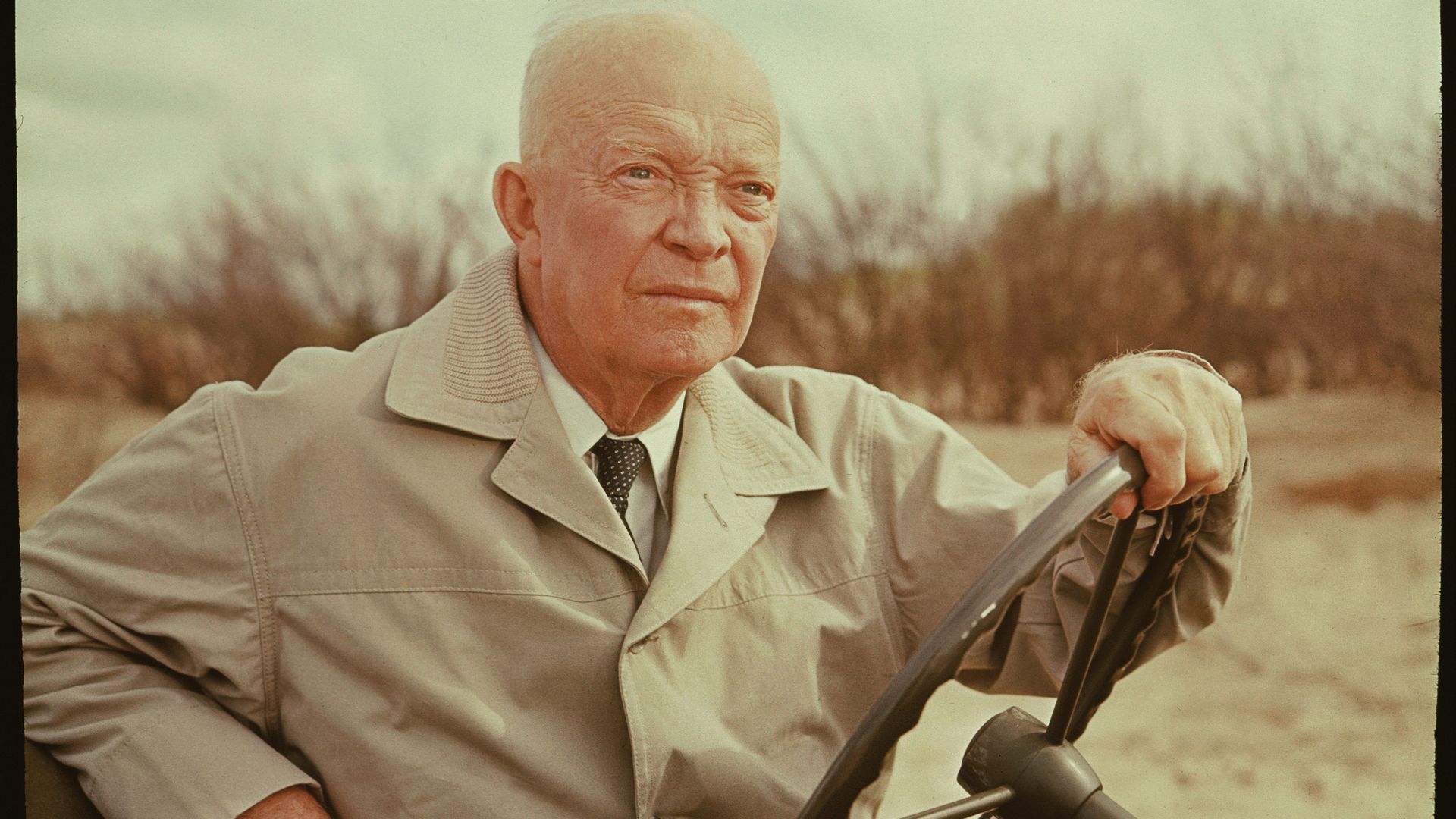
This week in 1964, former President Dwight D. Eisenhower rallied for GOP candidates here and called criticism against his party nothing but "tommyrot."
Flashback: Columbus was known as "the seat of Ohio Republicanism" back then and Eisenhower received a warm reception at the Memorial Auditorium (located at the current site of the National Veterans Memorial and Museum).
- Around 15,000 people gathered for the speech, many of them downtown workers on their lunch breaks.
The intrigue: Eisenhower flew in from his home in Gettysburg, Pennsylvania, which was on daylight savings time.
- Ohio didn't begin observing daylight savings time until 1970, though.
- It seems nobody told Eisenhower, who accidentally showed up an hour early.
State of play: The Buckeye State voted for Eisenhower twice in the 1950s and supported his vice president, Richard Nixon, in the 1960 race.
Yes, but: Weeks after Eisenhower's speech, voters overwhelmingly supported Democrat Lyndon B. Johnson over Republican Barry Goldwater.
- Johnson received a higher percentage of Ohio's vote than any Democratic candidate in state history.
Thanks to Tyler Buchanan for editing today's newsletter.
Our picks:
😤 Tyler is going to start using "tommyrot" in everyday conversation.
🎃 Alissa is adding some extra ropes to her Jack Skellington inflatable after watching this dashcam video of a runaway giant pumpkin.
Sign up for Axios Columbus
