Axios Columbus

March 20, 2025

It's Thursday, Columbus!
🏀 To commemorate the start of March Madness, the second-biggest gambling occasion of the year, today's newsletter is focused on Ohio's sports betting landscape.
💨 Today's weather: Very windy, with a chance for showers in the evening and a high around 50.
🎂 Happy birthday to our Axios Columbus member Rick Shepherd!
Today's newsletter is 972 words — a 4-minute read.
1 big thing: 💰 Ohio's new moneymaker


Legal sports gambling has become a large revenue source for Ohio, but has also created a new set of challenges for the state.
Why it matters: The state's embrace of sports gambling in all its forms has paid off handsomely for its tax coffers.
State of play: Axios reviewed records and spoke to team officials, a top regulator and a problem gambling nonprofit for a comprehensive look at sports betting since the 2023 launch.
The big picture: We're far from alone — 38 states and D.C. legalized sports gambling as of February, each with different laws and restrictions.
Flashback: The 2009 legalization and 2012 rollout of casinos gave Ohio something of a blueprint, but this was even more complex.
- "Compared to standing up sports gambling, that was a walk in the park," Matt Schuler, the Ohio Casino Control Commission's executive director, says.
How it works: Ohio issues operating licenses for mobile apps and establishments like casinos, plus betting kiosks at small businesses.
The fine print: In addition, Ohio restricts the type of bets and how sportsbooks can market themselves.
- You can't bet on random events like coin flips or on player-specific prop bets for college sports.
Friction point: Major sportsbooks like DraftKings and Barstool have paid fines for breaking rules.
- "It was a bumpy start," Schuler says. "Sometimes, in new jurisdictions, operators will kind of push on the regulator to see how far they can go."
Follow the money: Ohioans wagered over $17.5 billion through the first 25 months of legal betting.
- That generated over $1.8 billion in revenue for sportsbooks and $330 million in state tax revenue.
- Nearly all of that money goes to the state's General Revenue Fund for schools.
What we're watching: The state takes a 20% cut of all taxable revenue.
- Gov. Mike DeWine wants to double it, but faces opposition.
2. 💵 Charted: What Ohio has brought in


3. 📈 Problem gambling is on the rise
The rise of sports betting has coincided with a statewide explosion of problem gamblers.
Why it matters: Gambling addiction can be as crippling as drug addiction, and Ohio invests 2% of its sports betting tax proceeds toward combatting it.
How it works: Nonprofit Problem Gambling Network of Ohio promotes resources like the problem gambling helpline, gamblers anonymous meeting locator and financial counseling.
- It also offers services for gamblers to self-ban themselves from casinos and betting websites, and launched the Ohio Gambling Telehealth Network.
- The state has its own responsible gambling initiative.
State of play: PGNO's leader sees shifts in how people become addicted.
Threat level: Slot machines have historically been the game most associated with addiction risk, executive director Derek Longmeier says, but mobile sports betting is even riskier.
- "What makes slot machines so addictive is how many repetitions you can have within a short amount of time," he says. "Now, you can do that … 24/7 in the palm of your hand."
Between the lines: Sports gambling hasn't been legal here long enough for a comprehensive study on its addiction impact, but warning signs already existed.
- Around 6% of Ohioans were at-risk or problem gamblers in 2012 when casinos first opened.
- By 2022, it was 20%.
Flashback: PGNO's growth during Longmeier's nine years at the helm demonstrates the magnitude of need.
- In 2016, his entire program was funded by a $20,000 grant, he says. The 2025 budget — funded by state grants and contracts, donations and gambling tax revenue — is $3 million.
4. 📱 Online dominates retail betting
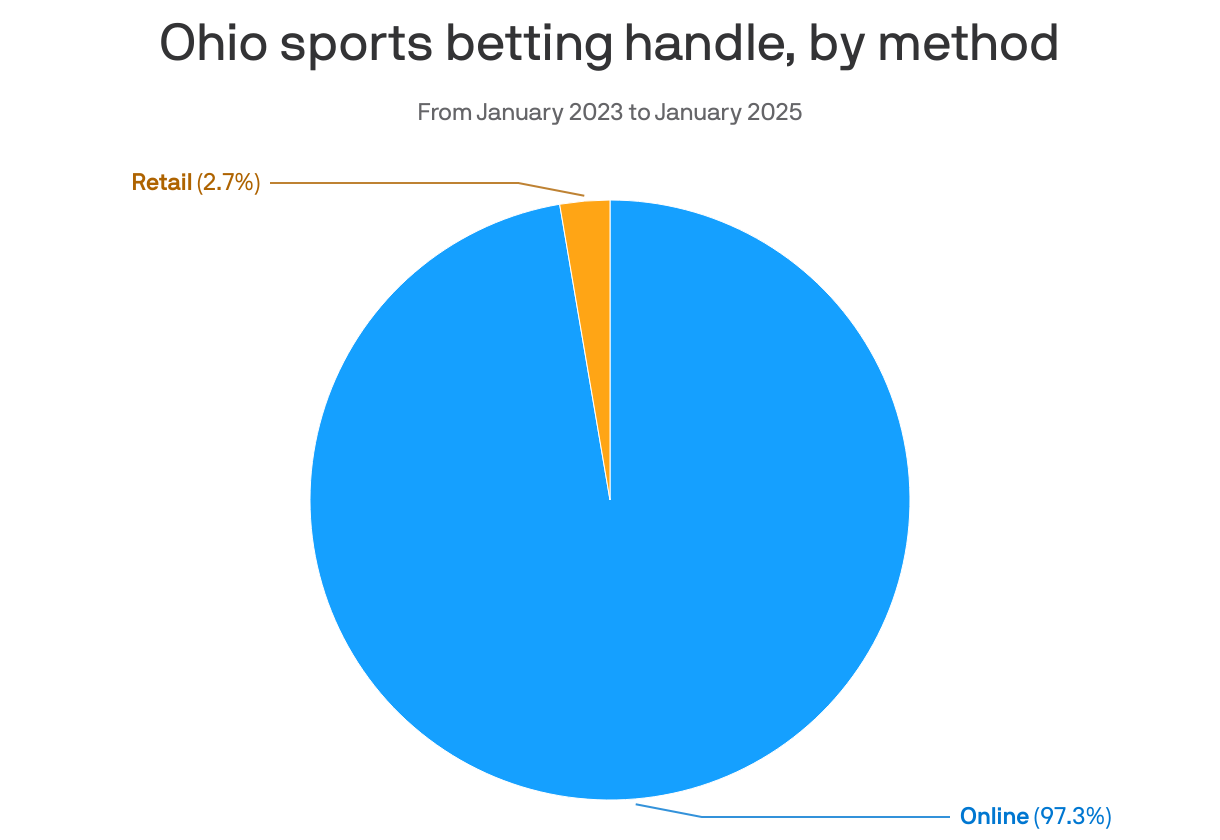
Legalization has flooded our market with in-person sportsbook concepts, but the vast majority of wagers are being placed online.
Why it matters: Ohio businesses that once fought for retail licenses are seeing only a sliver of bets placed, while hundreds of gambling kiosks around the state generate virtually no revenue.
By the numbers: Just 2.7% of all money wagered statewide is done in person, with 0.15% collectively bet at hundreds of licensed lottery kiosks — 43 in Columbus alone.
Reality check: Schuler, of the Casino Control Commission, tells Axios the state expected online bets to make up at least 90% of wagers but didn't anticipate such an extreme split.
- He says those with higher hopes were likely imagining "visions of brick-and-mortar (sportsbooks) in Vegas," that aren't a reality elsewhere.
Between the lines: Schuler says in-person sportsbooks are largely a product of gaming companies owning both casinos and online apps.
Case in point: Penn Gaming owns the local Hollywood Casino and the ESPN Bet app. It's rebranded the casino's former Barstool Sportsbook to ESPN Bet.
The bottom line: Returns for in-person sports betting might be low, but Schuler says retail gambling isn't a cost issue or problem for state regulators.
5. 🏅 Maintaining integrity in sports

While sports leagues and gambling operators partner up, athletes and team staff must avoid betting at all costs.
Why it matters: League rules are in place to uphold the integrity of games, and punishment can be career-ending.
Threat level: Over just the last two years, an Alabama baseball coach, an NBA player and an MLB umpire have been fired or banned for alleged gambling infractions.
- Cincinnati Reds legend Pete Rose was famously banned for betting on baseball. Decades later, he placed one of Ohio's first legal sports bets.
How it works: Each league has its own policies, but most ban participants from betting or disclosing private information.
- College players are banned from wagering on any NCAA sport or its professional equivalent.
Zoom in: Ohio State athletes are regularly provided educational materials about gambling, while Crew and Blue Jackets players receive education each year.
- There are no gambling kiosks in OSU, Blue Jackets or Crew arenas and spokespeople for all three tell Axios there are no plans for any.
Yes, but: For the professional teams, partnerships have blurred the lines.
- Fanatics is an official Blue Jackets partner with a sportsbook next door.
- The Crew partnered with short-lived sportsbook Tipico, featuring logos on jerseys and a "Tipico Sportsbook Club."
📣 What is your view of Ohio's sports betting landscape? Reply with your thoughts and we may include them in an upcoming newsletter.
Our picks:
🥺 Alissa is looking at photos of the zoo's adorably teeny-tiny new baby seahorses.
🐶 Andrew is on nonstop ball-throwing duty in this weather.
😉 Tyler is totally working hard and not watching March Madness all day.
Thanks to Tyler Buchanan for editing today's newsletter.
For help with problem gambling, call 1-800-589-9966 or visit GamblingHelpOhio.org.
Sign up for Axios Columbus