Axios Codebook
February 27, 2024

Happy Tuesday! Welcome back to Codebook.
- 📆 Somehow this is the last edition of February — 2024 is flying!
- 📬 Have thoughts, feedback or scoops to share? [email protected].
Today's newsletter is 1,276 words, a 5-minute read.
1 big thing: Inside a private Chinese hacking firm
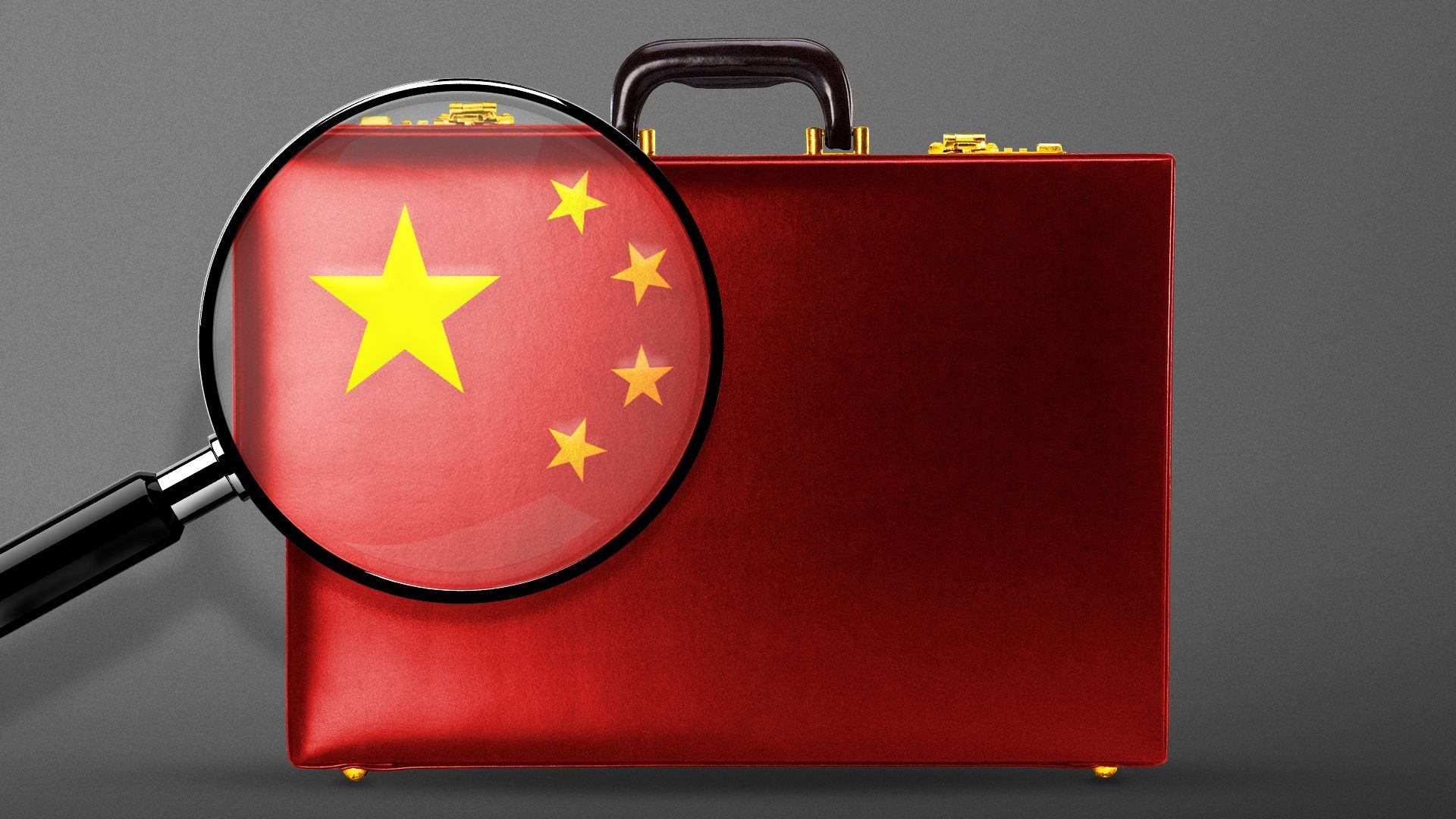
Illustration: Gabriella Turrisi/Axios
A trove of leaked documents is providing government officials and security researchers a rare public glimpse inside I-Soon, a private China-based offensive cybersecurity company.
Why it matters: The documents — which were posted and removed from GitHub last week — provide details about whom I-Soon has targeted, which Chinese government agencies it has worked with, and conversations between executives and employees about financial hardships.
The big picture: It's long been known that China had outsourced some of its hacking operations to private companies, just like other world powers.
- But many of the details about how China's hacking program works have been kept top secret.
What's inside: An Axios review of the documents — translated into English by security researcher Michael Taggart — found a detailed list of the victims I-Soon is believed to have targeted and whom it worked with.
- I-Soon targeted government agencies in Taiwan, Malaysia, Kazakhstan, South Korea, Thailand and several other countries at the request of its customers.
- The company advertised that it worked with China's Ministry of Public Security, and internal conversations show it worked with some of Beijing's own hacking teams, as well as the Ministry of State Security.
Zoom in: The leaked documents include a product manual from 2020 that details the specific hacking tools that I-Soon either used itself in operations or sold to customers.
- According to the manual, I-Soon offers tools that the company says allowed hackers to remotely control and surveil Apple, Android, Windows and Linux systems — as well as tools that let hackers encrypt and exfiltrate data from hacked devices.
- Other tools allow hackers to track someone's precise location, take screenshots of their desktops, and intercept text messages before a victim notices.
- The documents also offer tools they claim let hackers crack victims' passwords and bypass two-factor authentication.
Yes, but: Researchers are still working to determine the legitimacy of the documents, although many suspect that the level of detail and types of documents shared mean they're real.
- I-Soon's website has gone offline, and the company has not publicly said anything regarding the leaks.
Catch up quick: U.S. government agencies have increasingly disclosed details about China's vast hacking prowess and the threats it poses in recent months.
- This month, government agencies released an advisory detailing how Chinese government hackers have gained and maintained access to U.S. critical infrastructure for years.
- Top officials warned Congress last month that China has also shown a persistent willingness to maintain that access to American infrastructure.
Between the lines: I-Soon's stock of stolen documents shows that it's also been helping the Chinese government spy on Taiwan ahead of a potential invasion.
- One spreadsheet shows that I-Soon hacked National Taiwan University's applied mechanics program and hospital.
- Another indicates that I-Soon has hundreds of gigabytes of data about Taiwan's road maps and Taiwanese telecommunications and cloud providers.
The intrigue: The leaked screenshots of text conversations and emails detail not only what kinds of strategic operations China is pursuing, but also the internal strife that the offensive cyber firm has been facing.
- In one text conversation from 2022, an apparent I-Soon employee shares how they hadn't received a raise in three years and was now looking for a new job.
- An employee also said in a text that "everyone else is looking at opportunities" to leave the company in 2021.
What we're watching: Chinese authorities are actively investigating the leak, according t0 the Associated Press.
- It also remains unclear who leaked the documents and for what reason.
2. Biden admin issues new cyber road map

Illustration: Sarah Grillo/Axios
The Commerce Department's National Institute of Standards and Technology (NIST) debuted a highly anticipated revamp of its cybersecurity framework Monday.
Why it matters: The agency framework has long provided a baseline for federal cybersecurity regulations and informed how private companies build and regulate their own cybersecurity practices.
What's inside: NIST's Cybersecurity Framework 2.0 details how companies can best structure their organizations to address various security issues, such as supply chain security and identity management.
- The framework is organized around six functions: governing internal cyber programs, identifying potential weaknesses and threats, protecting against those threats, detecting abnormal activity on a network, responding to a cyberattack, and recovering from one.
- NIST has published a reference tool, user guides and examples of ways to implement the framework to help organizations digest the material.
Catch up quick: NIST first published its framework in 2014, and this week's update was two years in the making.
- The first version of the framework focused on advice for critical infrastructure organizations. Now, the framework explicitly provides advice for all organizations, NIST said.
The big picture: Cybercriminals and nation-state hackers have become stealthier and more sophisticated in the decade since NIST first published its framework.
- And artificial intelligence tools are expected to help hackers get faster and better at writing phishing emails and malware.
What's next: The NIST framework is voluntary for most companies but could be a basis for government requirements that contractors face.
- The agency expects that it will take the "pulse of industry" every couple of years to assess when another update is needed, Adam Sedgewick, NIST's acting associate director for IT standardization, said during an Aspen Institute event Monday.
3. Exclusive: Firms flock to passwordless tech
Illustration: Annelise Capossela/Axios
Most companies plan to have their employees ditch passwords soon, according to a survey released today by LastPass and first shared with Axios.
Why it matters: Hackers increasingly rely on leaked login credentials and reused passwords to break into corporate networks.
- Ditching phrase-based passwords for other login tools, like biometrics or authentication codes, could help crack down on the number of hacks.
By the numbers: 55% of organizations said they had a plan in place to move employees away from passwords.
- Among those organizations, 32% said they plan to reduce password reliance in the next year and 54% plan to do so over the next two years.
The big picture: More websites are starting to support passwordless technologies for online accounts — making the transition away from phrase-based passwords possible.
- Password managers, including those from LastPass, 1Password and others, can now store passwordless login keys.
- And websites like Google, PayPal and other major sites now let users log in using a passkey.
Yes, but: Passwordless technology is still working out some of its friction.
- Not all password managers or websites support passkeys or other passwordless logins yet.
4. Catch up quick
@ D.C.
🗳️ Democratic lawmakers and cyber experts worry that Republican secretaries of state could soon turn against the Cybersecurity and Infrastructure Security Agency's election security work. (Wired)
💻 The White House's Office of the National Cyber Director released a paper calling on the tech sector to switch to memory-safe programming languages. (CyberScoop)
🕵🏻♂️ Ex-Trump administration officials say the former president is likely to shake up the nation's intelligence community and "weaponize" the spy agencies for his political agenda if he wins a second term. (Politico)
@ Industry
👀 MGM Resorts said in a securities filing that federal and state regulators are investigating the company regarding a September cyberattack that disrupted operations at the casino operators' properties. (Cybersecurity Dive)
@ Hackers and hacks
☁️ The Five Eyes intelligence alliance warned that the Russian hackers behind the 2020 SolarWinds intrusion are now targeting cloud infrastructure in their attacks. (BleepingComputer)
🚧 The LockBit ransomware gang has started rebuilding its web infrastructure after last week's extensive law enforcement takedown. (The Record)
🐈⬛ The BlackCat ransomware gang is believed to be behind a cyberattack that's been disrupting pharmacies' ability to fill prescriptions over the last week. (Reuters)
5. 1 fun thing
Screenshot: @JusticeRage/X
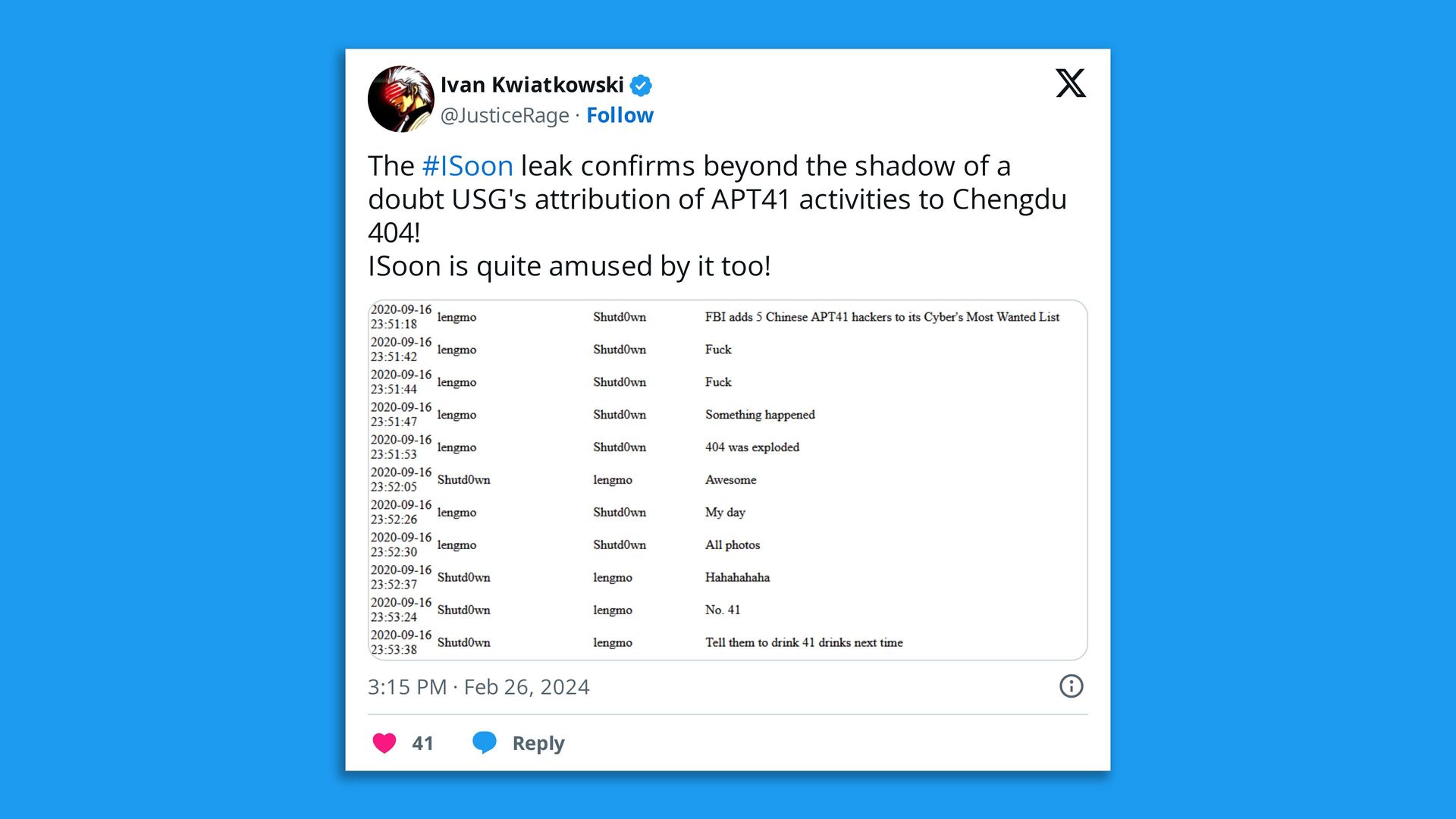
More insights from inside the I-Soon data dump: A starkly normal conversation between I-Soon executives in 2020 reacting to the FBI's most wanted poster for members of China's APT 41 hacking group.
- "Tell them to drink 41 drinks next time," one executive wrote.
☀️ See y'all Friday!
Thanks to Megan Morrone for editing and Khalid Adad for copy editing this newsletter.
If you like Axios Codebook, spread the word.