Axios Codebook

August 06, 2024

Happy Tuesday! Welcome back to Codebook.
- 👋🏻 I'm moderating a fireside chat at the Black Hat AI Summit this afternoon. Come say hi if you're in the crowd.
- 📬 Have thoughts, feedback or scoops to share? [email protected].
🚨 Situational awareness: French prosecutors said they're investigating a ransomware attack against the Grand Palais exhibition hall, one of the venues for the Paris Olympics.
Today's newsletter is 1,413 words, a 5.5-minute read.
1 big thing: The search for a new way to report AI model flaws

AI security researchers will spend their week in Las Vegas figuring out how to report security flaws to AI model operators — and what kinds of flaws warrant a report.
Why it matters: Technology companies don't currently have a standardized way to accept findings from well-intentioned hackers who find flaws in their AI products.
- Even the reports they do receive are often about non-scalable problems, such as a difficult-to-guess group of questions that someone found that can be used to trick a model into sharing data it shouldn't.
The big picture: Reporting security flaws to companies is a common practice within the cybersecurity industry.
- Doing so helps firms find bugs that they might not otherwise have discovered on their own — bugs that could have provided an entry point for malicious hackers.
- Good-faith hackers who find these flaws and report them to companies are often rewarded with money for their discovery.
Between the lines: Reporting bugs to AI companies requires a new approach, Sven Cattell, founder of DEF CON's AI Village, told Axios.
- AI models are susceptible to different security flaws than other software and hardware are.
- A standard piece of software could have flaws in its code or network configurations that create an entry point for hackers, whereas AI models can also have problems with the ways they interpret and answer queries.
- Common AI model flaws include generating answers that accidentally include sensitive personal data, racial biases or confidential corporate information.
The intrigue: So far, AI security testing has been a cat-and-mouse game.
- People test large language models to see if they will produce inaccurate information, and when they do, the hackers report that specific instance to the model operator.
- But those one-off reports don't get to the foundational reason why someone was able to break a model, Cattell said.
Driving the news: The annual Black Hat and DEF CON conferences, two of the largest cybersecurity gatherings, kick off in Las Vegas today.
- During DEF CON this weekend, the AI Village will host its second annual generative AI red teaming exercise, which will focus on how security researchers should submit information about new bugs to companies.
How it works: The AI Village is working with the Allen Institute for Artificial Intelligence to test its open-source large language model.
- Once participants find flaws in the model's outputs, they'll be asked to submit a report to the Allen Institute explaining why they believe these flaws are allowed to bypass existing guardrails.
- The Allen Institute will then review those reports to either accept or reject the findings — and also to figure out what is and isn't working about the current process of reporting security bugs.
- "Doing disclosure for AI systems is tricky and hard. No one's actually done it before," Cattell said. "We're trying to figure this out together."
Flashback: This year's AI Village exercise is more advanced than the open-testing spree the organizers hosted at last year's conference.
- Last year's exercise focused on basic jail-breaking: Roughly 2,200 participants flooded the village to test eight LLMs to see if they could get them to break their own rules.
- The White House co-sponsored the event.
What we're watching: Cattell is eager to see if this week's large-scale experiment will help answer lingering questions about what security researchers can replicate from existing bug reporting processes — and what part of the process needs to be reinvented for the AI age.
- "The reason why we did the [Generative Red Team exercise] last year was to start getting the conversation going," Cattell said.
- "Now, we can actually talk about how disclosure should really work and how [the] community can help make sure these models are more aligned."
2. Hackers to back Harris at Vegas fundraiser

Members of the cybersecurity community will express support for Vice President Kamala Harris' presidential campaign at a fundraiser on the sidelines of two major conferences this week.
Why it matters: This is the first major presidential fundraising event hosted by and for the cybersecurity industry this election cycle.
What's happening: Former White House cyber officials Jake Braun and Kemba Walden are hosting the fundraiser, called Hackers for Harris, on Thursday at a bar in the Las Vegas Convention Center.
- Nearly 100 people had already RSVP'd to attend as of yesterday afternoon, Braun told Axios.
- Tickets start at $250 for students and are as high as $10,000 for co-sponsors, according to an event flyer seen by Axios.
Zoom in: Braun, a co-founder of the DEF CON Voting Village, said he was motivated to host this event after Harris supported the election security community in 2018.
- At the time, lobbyists for voting machine vendors were attacking the Village for its plans to test voting machines for security flaws.
- Harris and other then-members of the Senate Intelligence Committee, including Sens. Mark Warner (D-Va.), James Lankford (R-Okla.) and Susan Collins (R-Maine), sent a letter to one vendor urging it to support the Village's work and learn from its findings.
Between the lines: Some facets of the hacker community are known for their distrust and wariness of the government.
- "I've been pushing for a while to help the hacker community get more civically engaged," Braun said. "One aspect of civic engagement is engagement in the electoral process and politics and so on. "
Flashback: Hillary Clinton's presidential campaign also hosted a fundraiser at Black Hat in 2016 — with the event happening just days after the Democratic National Committee suffered a cyberattack.
What we're watching: It's unclear which industry players will attend the event and whether there will be another Hackers for Harris fundraiser.
3. CrowdStrike fights back against Delta

CrowdStrike is fighting back against Delta Air Lines' claims that the cybersecurity vendor didn't provide enough assistance during its recent global IT outage.
Why it matters: How a judge rules in Delta's lawsuit against CrowdStrike could set a precedent for other companies that choose to take legal action over the outage.
Driving the news: Delta CEO Ed Bastian told CNBC last week that the outage cost the airline $500 million and forced it to cancel more than 5,000 flights.
- CrowdStrike has said that faulty content data in a configuration update is what caused the July 19 global IT outage that brought a "Blue Screen of Death" to millions of Windows computers.
- Delta filed a lawsuit against CrowdStrike last week, and Bastian claimed that CrowdStrike had made zero offers to help the company financially.
Zoom in: On Sunday, CrowdStrike's outside legal counsel sent a letter to Delta saying the company "strongly rejects any allegation that it was grossly negligent or committed willful misconduct."
- "Within hours of the incident, CrowdStrike reached out to Delta to offer assistance and ensure Delta was aware of an available remediation," the letter says.
- "Additionally, CrowdStrike's CEO personally reached out to Delta's CEO to offer onsite assistance, but received no response."
Between the lines: The fallout from the outage has started a wider conversation about how companies can strengthen their network resilience — and whose responsibility it is to ensure companies aren't as vulnerable to a similar outage in the future.
- Delta is arguing it was CrowdStrike's responsibility to ensure its internal processes were ironclad against a network outage of this scale, while CrowdStrike argues it was Delta's responsibility to have backup plans in place.
4. Catch up quick
@ D.C.
🗳️ Five secretaries of state sent a letter to Elon Musk urging him to fix X's AI chatbot, Grok, after it wrongly told users that Vice President Kamala Harris had missed the deadline to get on the ballot in several states. (Axios)
📲 The Justice Department sued TikTok and its parent company, ByteDance, for violating a federal children's online privacy law. (Axios)
🤖 Microsoft told congressional committees it plans to add new safeguards around its AI hardware and intellectual property partnership with Emirati AI firm G42. (Politico)
@ Industry
✈️ Three travelers have filed a proposed class action lawsuit against CrowdStrike over flight delays caused by last month's global outage. (Axios)
📈 Insured losses from the CrowdStrike outage could hit $1 billion, according to a new estimate. (Cybersecurity Dive)
@ Hackers and hacks
👀 Roughly 4.6 million records about Illinois voters were publicly accessible after a third-party election management service failed to properly secure a database. (Wired)
📚 Schools are still facing a wave of cyber threats a year after the White House stepped in and provided new resources. (Nextgov)
5. 1 fun thing
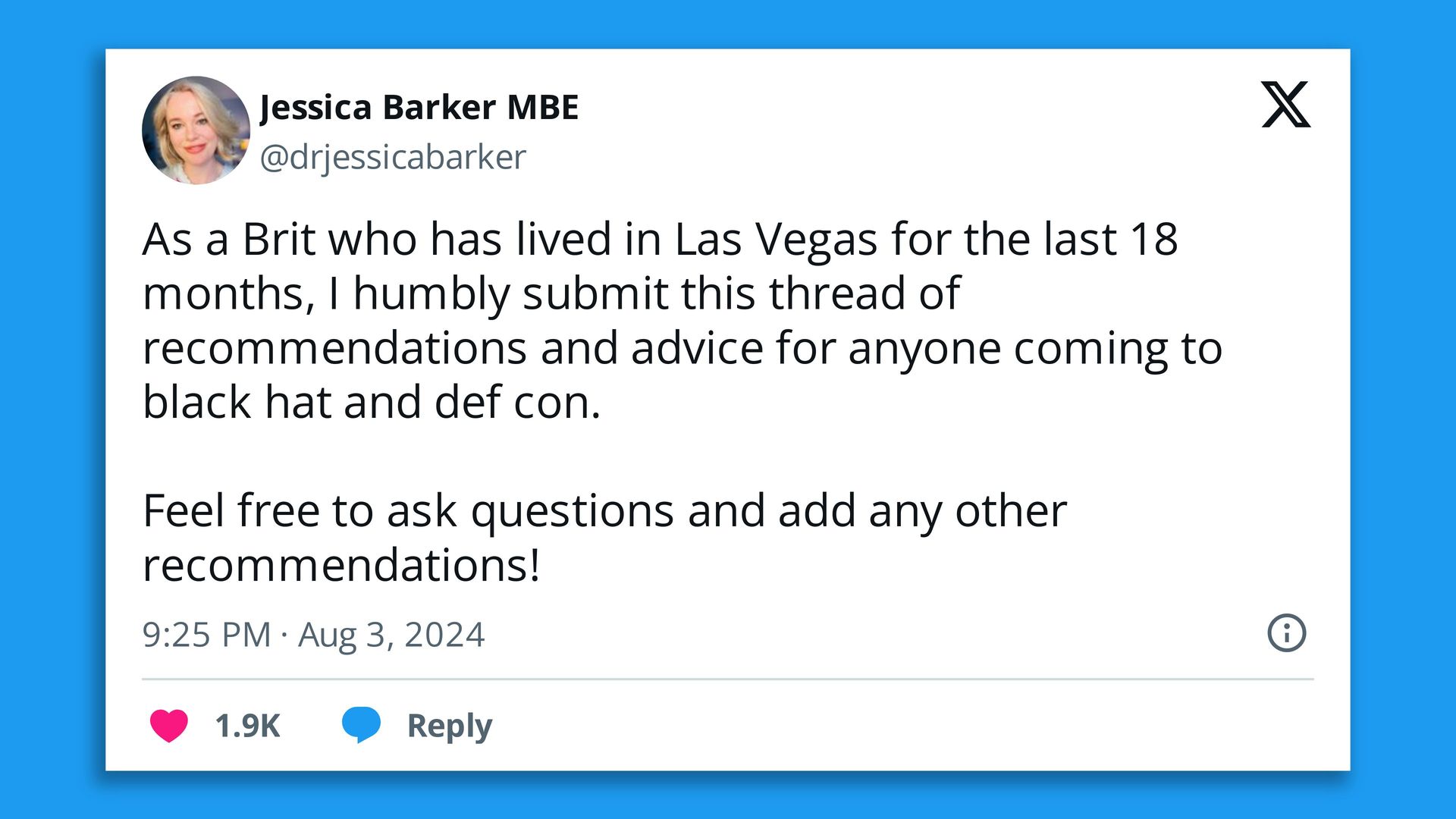
If you're also at the Black Hat and DEF CON conferences this week, I found this thread of fun things to do in Las Vegas (including activities off the Strip) super helpful.
🌇 See y'all Friday!
Thanks to Megan Morrone for editing and Khalid Adad for copy editing this newsletter.
If you like Axios Codebook, spread the word.