Axios Closer

October 23, 2026

βΎοΈ It's Friday and I'll be living and dying with my Milwaukee Brewers in the World Series starting tonight. If they lose this series, I'll be needing some time off to recover. But for today...
Today's newsletter is 949 words, a 3Β½-minute read.
π The dashboard: The S&P 500 closed down 0.5% today and finished the week down by the same amount.
- π’οΈ Brent crude rose to $117 a barrel, marking its biggest weekly rise in two months.
π₯ Today's stock spotlight: CrowdStrike (+8.3%) led gains in cybersecurity stocks following warnings this week that websites around the world were vulnerable to hackers.
1 big thing: AI anxiety
Soaring sales, booming backlogs and gangbusters guidance from AI-related companies just doesn't cut the mustard in this market moment.
- Why it matters: The lackluster response to still strong AI-related earnings points to growing investor doubts about the durability of the boom.
π Catch up quick: A broad swath of AI-related shares took it on the chin this week, including:
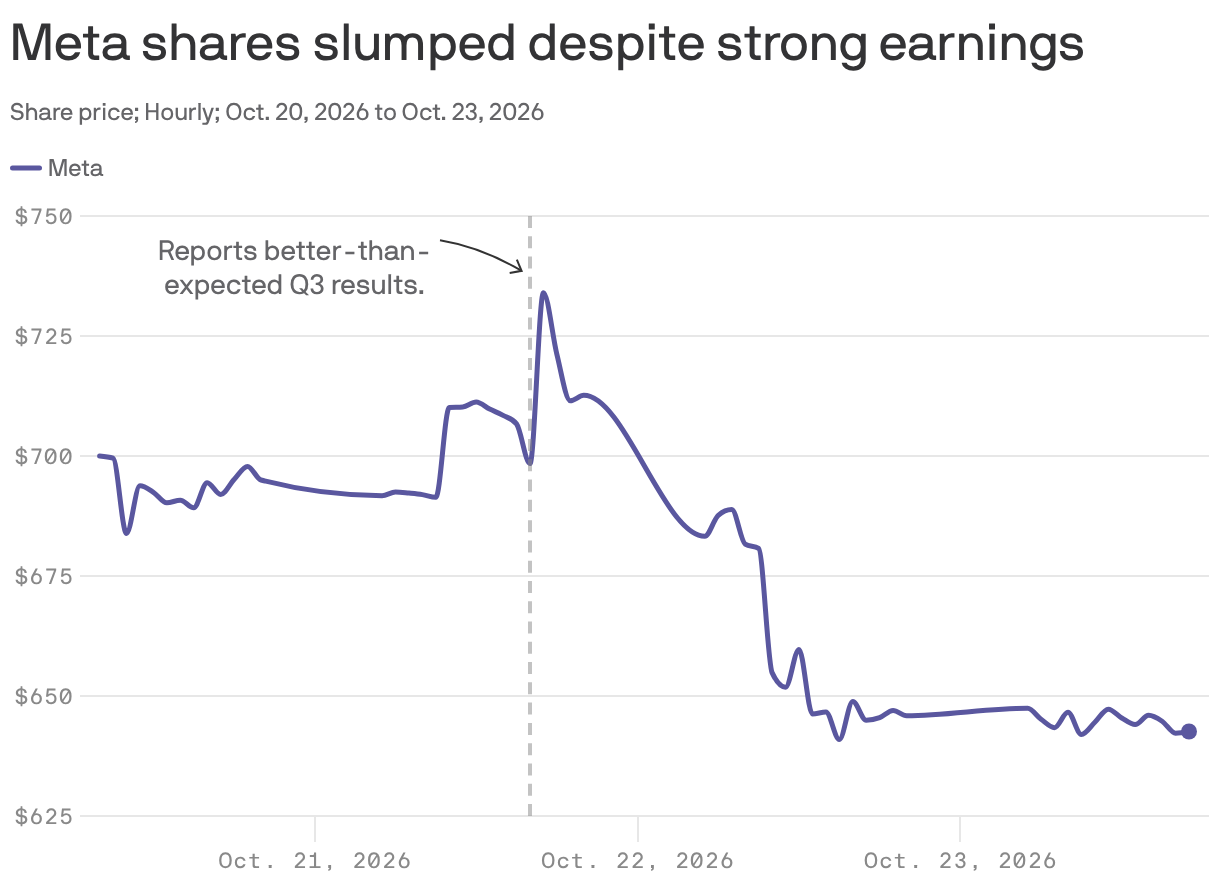
- Hyperscaler Meta (down 9.4%).
- AI-construction plays like HVAC provider Comfort Systems (-19.3%) and engineering and construction giant Quanta (-13.5%).
- And AI power trades like turbine maker GE Vernova (-11.5%) and Bloom Energy (-12.7%).
Between the lines: The slump came despite some of those very same companies reporting the kind of top-line Q3 results that likely would have received the market's version of a standing ovation last year.
Cases in point: Meta's third-quarter results Wednesday were great. It was a legit beat-and-raise. The stock plunged 7% the next day.
- Western Digital, a maker of hard disk drives that suddenly became indispensable components of data centers, also reported astounding figures yesterday. EPS rocketed up by 161% year over year. And yet... crickets. The shares slipped 3% today.
π€¨ Reality check: The AI trade has suffered through crises of confidence before.
- Remember the DeepSeek freak in early 2025?
Yes, but: The inability of AI shares to elicit any enthusiasm from investors is a big problem for the market.
- In back-of-the-envelope terms, AI-related shares β using the tech sector plus Meta, Amazon and Alphabet as a proxy β represent more than 50% of market capitalization of the S&P 500.
π The bottom line: If the AI trade stops working, it's quite hard to see how the overall market keeps any kind of forward momentum. Buckle up.
2. The iPhone fold rush

Apple iPhone Duo seekers never had a chance, Axios' Pete Gannon writes.
State of play: Apple's first foldable iPhone went on sale in stores today in limited supply β and it reportedly went fast.
- The highly anticipated launch had Apple diehards and foldable-curious consumers lining up on streets from New York to Berlin to Beijing, reports noted.
- Most store supplies were tied to preorders, but a small number of devices were available for walk-ins.
π± Why it matters: The iPhone is central to Apple's consumer hardware business, accounting for a significant share of the company's sales and supporting a vast network of suppliers and partners, Axios' Ina Fried has noted.
- And Apple hasn't been shy about pumping up the Duo, which starts at $1,999, with marketing executive Greg Joswiak calling it "the most transformational iPhone experience since the original."
π What we're watching: Supply constraints have limited Apple's production of the Duo, with JPMorgan analysts recently estimating around 8 millionβ9 million units shipped this year, down from earlier expectations of 10 million, per CNBC.
- Sales data is expected in the coming weeks, and Apple is scheduled to report quarterly earnings on Nov. 2.
Can you still get one? Delivery dates for the Duo now show late January on Apple's website, though customers are being told to check back tomorrow for more store availability.
3. Other happenings
π¨π¦ The U.S. is exempting some Canadian agricultural and forestry products from 50% tariffs, reportedly in a bid to help Republicans in midterm elections. (WSJ)
π€ OpenAI is blocking internet access for its frontier model training following the Hugging Face incident and other examples of model "misalignment." (Bloomberg)
4. π¬ The Holmes truth
βΌοΈ Spoiler alert: This is my take on the new Elizabeth Holmes documentary. I'm steering clear of any giveaways β but if you're avoiding reading everything before "You Can See Everything," don't say I didn't warn you...
I joined the Cool Kids Club earlier this week and saw "You Can See Everything," the new Elizabeth Holmes documentary.
- My verdict: It was captivating.
π¬ State of play: Here's what to expect from the film co-directed by and starring Nathan Fielder:
- You don't need to know the backstory of how Holmes was convicted on fraud charges for her reign at blood-testing startup Theranos β though it would help because the filmmakers did not attempt to relitigate the facts of the case.
- Holmes and her romantic partner, Billy Evans, granted unprecedented access to Fielder and co-director Lance Oppenheim in the apparent hope of humanizing her.
- She maintains that she did nothing wrong.
π My thought bubble: Everyone seems to have a different perspective on the big takeaways of the film, so here's mine:
- It was a fascinating depiction of the complicated pursuit of the truth β and what happens when we get a close-up view of people attempting to bend reality.
- Put it this way: I wrote an entire book on why people believe things that aren't true, and yet to see Holmes maintaining β without blinking β that she did nothing wrong was still jaw-dropping.
The bottom line: It's worth the nearly three-hour runtime to judge it for yourself.
ποΈ On this day in 2001, Apple unveiled the iPod and completely changed the way people listened to music. The device also helped transform Apple into a mainstream consumer brand, paving the way for the iPhone six years later.
Today's newsletter was edited by Pete Gannon and copy edited by Sheryl Miller.
- Did a friend forward this to you? Sign up here to get Axios Closer in your inbox.
Sign up for Axios Closer