Axios Closer

June 03, 2026

Wednesday ✅.
Today's newsletter is 861 words, a 3-minute read.
📉 The dashboard: The S&P 500 closed down 0.7%.
🥶 Today's stock spotlight: Broadcom reported weaker-than-expected revenue in its fiscal Q2, sending the chipmaker's shares down 7% in extended trading.
🚨 Situational awareness: SpaceX disclosed that it plans to raise $75 billion in its initial public offering, which is expected to occur within a few weeks. This would be the largest IPO ever, and it's not even close. (Axios)
1 big thing: Magic behind the Yum
Yum Brands is using AI, data science and predictive market research to identify potential menu winners across Taco Bell, KFC, Pizza Hut and Habit Burger & Grill, the company revealed exclusively to Axios.
🎰 Why it matters: Restaurants spend millions developing new menu items with no guarantee that customers will bite.
The big picture: At the center of the effort is Yum's Global Innovation Database, developed by Collider Lab, the company's in-house strategy and innovation group made up of social scientists, strategists and data scientists.
- The database contains more than 7,000 food, beverage and marketing concepts evaluated across 35 countries.
- The system uses predictive market research, asking consumers to forecast how others will respond to concepts rather than relying solely on traditional consumer research, per Greg Dzurik, Yum's vice president of marketing and innovation strategy.
Zoom in: The system has informed products including Pizza Hut Melts and KFC shakes, according to Yum.
- It has been used to evaluate beverage concepts at Taco Bell, where drinks have become a key growth driver, according to Liz Matthews, who oversees food innovation at the company.
- The database has also surfaced broader consumer shifts, including demand for snackable foods, protein-focused products and specialty beverages.
What they're saying: Chief marketing officer Ken Muench said the company views AI as a tool that complements — rather than replaces — human creativity.
The bottom line: Yum executives say AI can help identify patterns and inspire ideas, but marketers, chefs and innovation teams still decide what ultimately makes it to menus.
2. Macy's sees few clouds ahead
Macy's Inc. raised its outlook after posting its strongest quarter in four years, saying it has yet to see signs that consumers are pulling back, Axios' Kelly Tyko writes.
💵 Why it matters: While many retailers are warning that surprisingly resilient consumers from Q1 may not stick around, Macy's says its predominantly middle- and upper-income shoppers continue to spend.
📈 Zoom in: The company's strongest growth is increasingly coming from its upscale Bloomingdale's and Bluemercury brands, which continue to outperform the Macy's banner.
- Bloomingdale's comparable sales jumped 10.2% in the quarter.
- Bluemercury's comparable sales rose 6.4%.
📺 Macy's CEO Tony Spring leaned into the company's appeal to high-income shoppers on the call, noting a line from the Apple TV+ series Margo's Got Money Troubles — "There are no victims in Bloomingdale's" — saying the retailer quickly incorporated the phrase into social and experiential marketing campaigns.
The big picture: Macy's results suggest that wealthier shoppers remain a bright spot for retailers navigating an uncertain economic backdrop.
- "We're pleased with the second quarter performance to date," Spring said. "There were no vagaries between one month to the next."
3. Other happenings

🏦 Anthropic is said to have picked Morgan Stanley and Goldman Sachs to lead its initial public offering. (Bloomberg)
🎯 CrowdStrike beat earnings expectations as CEO George Kurtz cited an "AI inflection point," but the cybersecurity company's stock tumbled in after-hours trading as traders cashed in on a huge run-up this year. (CNBC)
4. 🍺 Hedging bets
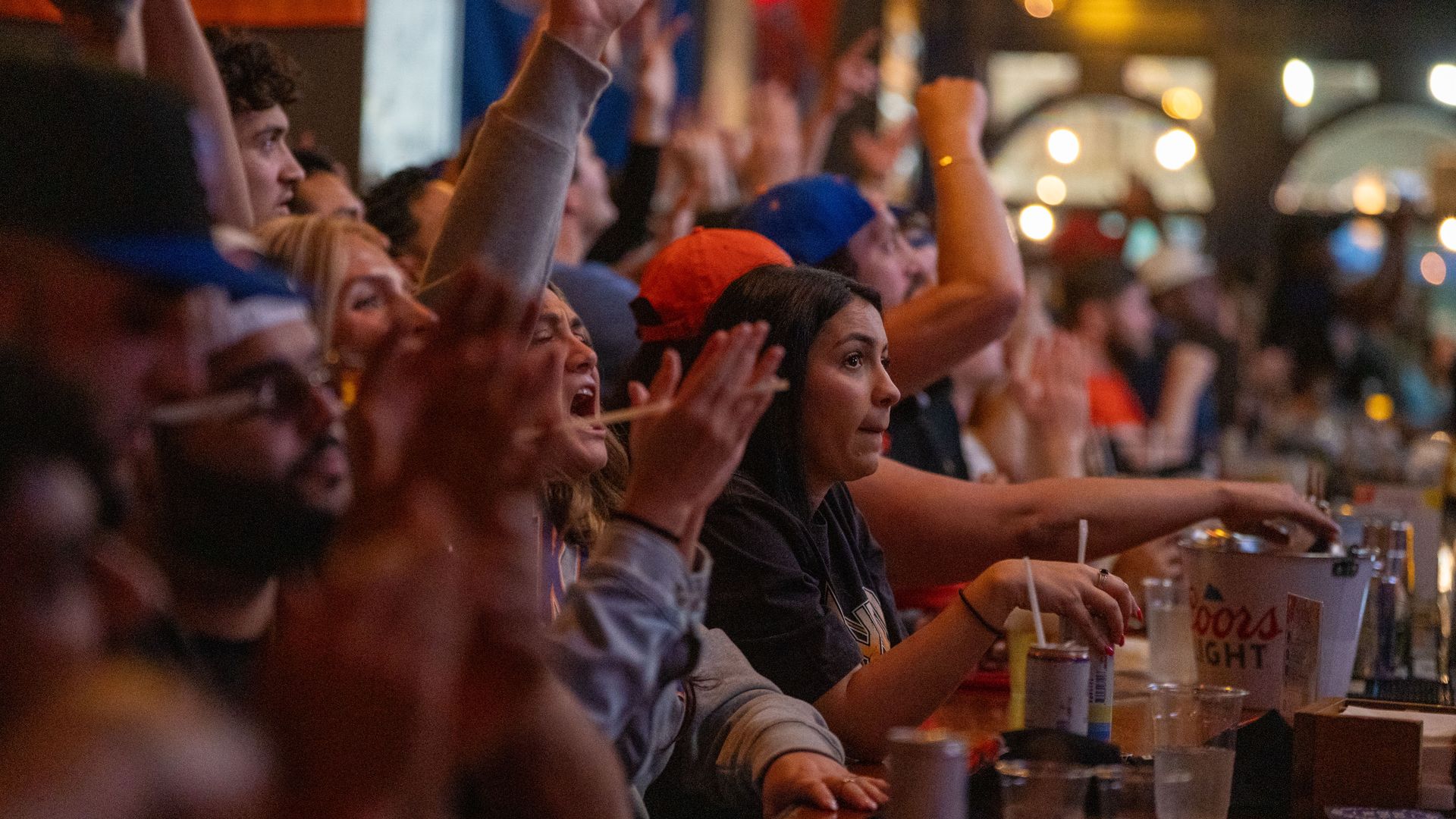
If the Knicks beat the Spurs tonight in Game 1 of the NBA Finals, the roar at The Jeffrey on East 60th St. will be especially loud, Axios' Pete Gannon notes.
Driving the news: The bar is picking up the first $100 on fans' tabs if the Knicks pull it off, as long as they've been settled onto their stools before tip-off.
- Owner Andy Freedman won't be sweating the outcome either way though — at least in terms of the bar tabs.
- 💸 As several reports have noted, he financially hedged his promotion on the prediction market Kalshi, paying $5,000 for contracts that will pay out $13,500 if the Knicks pull it out.
🍺 Follow the money: Promotions like this draw crowds — and big bar tabs — and Freedman calculates that with the hedge, he'll win a little bit either way, while avoiding a high-stakes gamble.
💼 The big picture: Kalshi surely feels like a winner too — prediction markets are doing everything they can to present their contracts as financial instruments with real-world applications, and not just a not-so-fancy sports bet.
- Yes, but: As Hardika Singh points out in her First to Market newsletter this morning, prediction markets still lack sufficient liquidity to function as efficient futures markets on a bigger scale.
Until then though, The Jeffrey surely won't mind if we say — Go Knicks!
🗓️ On this day in 1621, the Dutch West India Company received its charter for New Netherland — a beaver-pelt trading monopoly funded by everyday investors through one of history's earliest joint-stock companies. The English seized the whole colony 43 years later, and its small outpost on the Hudson River became New York.
Today's newsletter was edited by Pete Gannon and copy edited by Amy Stern
- Did a friend forward this to you? Sign up here to get Axios Closer in your inbox.
Sign up for Axios Closer