Axios China

May 31, 2022

Welcome back to Axios China. Today we're looking at calls for the UN's top human rights official to resign, Pacific islands news, the Biden administration's long-awaited China strategy speech, and lots more.
- If a friend forwarded this newsletter to you, you can subscribe here to receive Axios China in your inbox every Tuesday.
Today's newsletter is 1,877 words, a 7-minute read.
1 big thing: Advocates denounce UN official's China visit
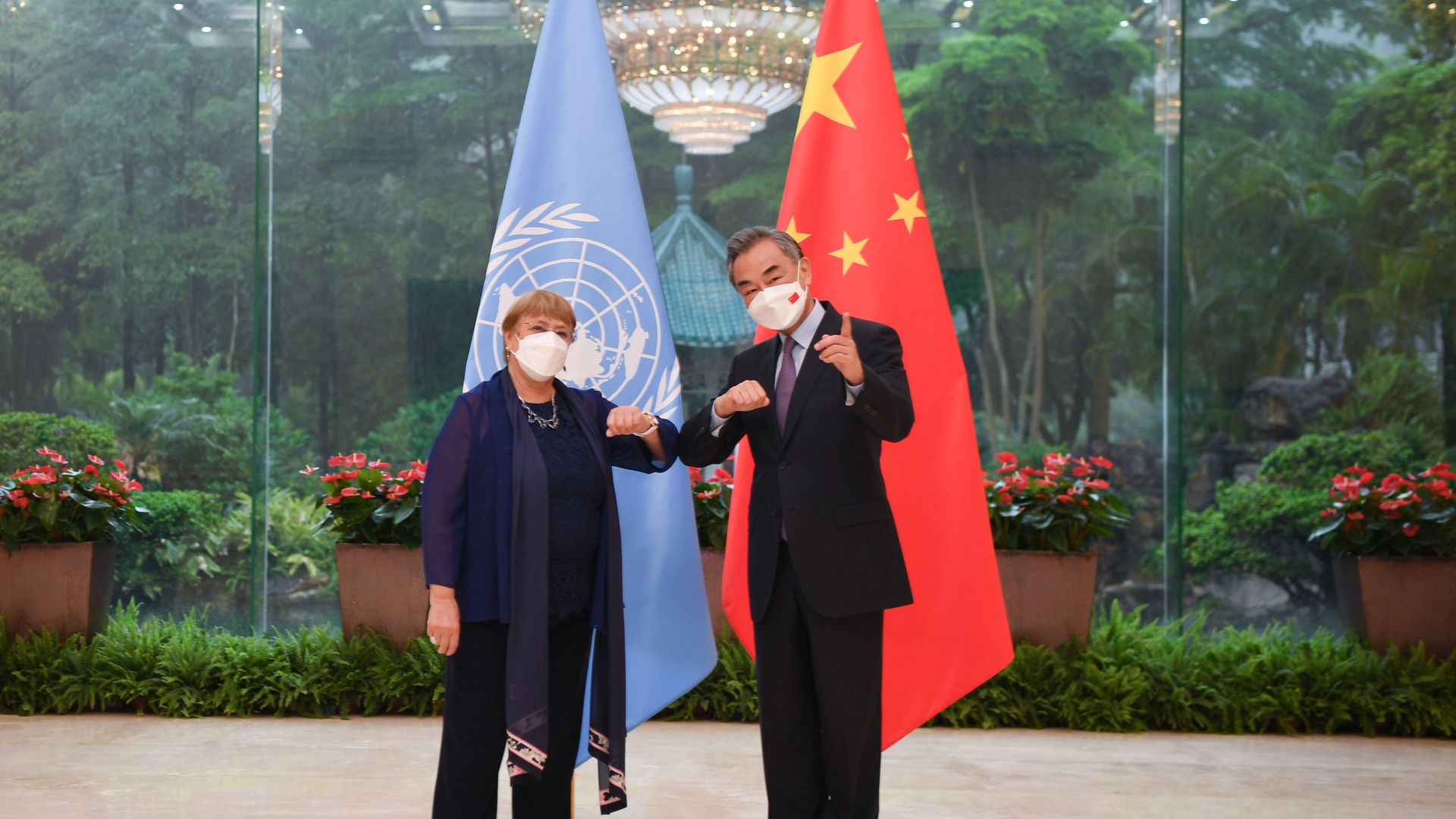
Chinese Foreign Minister Wang Yi meets with the UN High Commissioner for Human Rights Michelle Bachelet in Guangzhou on May 23. Photo: Deng Hua/Xinhua via Getty Images
Genocide scholars and rights advocates are calling for the resignation of a top United Nations human rights official after her visit to Xinjiang ended with her repeating, rather than denouncing, Chinese government propaganda about an ongoing genocide there.
Why it matters: The visit illustrates how the UN is caught between China and the West, and it suggests Beijing increasingly holds sway over the organization.
- "Beijing has already spun this trip as a huge success and an affirmation of their policies. It's bringing the entire UN into disrepute," said Azeem Ibrahim, a director at the D.C.-based Newlines Institute for Strategy and Policy, which recently published a report about the genocide in Xinjiang.
What's happening: Over the weekend, UN High Commissioner for Human Rights Michelle Bachelet completed a trip to China that included a visit to the northwest region of Xinjiang, where the Chinese government has detained more than 1 million Uyghurs and other minority ethnic groups as part of an ongoing genocide.
- It was the first visit of a top UN human rights official to China since 2005. The Office of the High Commissioner for Human Rights first requested this visit in 2018 as reports of mass detentions in Xinjiang emerged.
- Extensive evidence from satellite imagery, Chinese government documents and survivor testimonies indicates that Chinese authorities have used mass detentions, forced sterilization, forced labor, mass incarceration, family separation, torture, surveillance, political indoctrination, and bans on religious and cultural practices to stamp out Uyghur identity.
But at a May 28 press conference in Beijing, Bachelet used Chinese government talking points to frame her remarks on Xinjiang, casting the policies there as a form of "counter terrorism" intended to combat "violent acts of extremism." She also referred to mass detention facilities as "vocational education and training centers," the government's euphemism for the camps.
- She did not denounce the genocide or demand that the Chinese government end its repression of Uyghurs and other ethnic groups in the region.
- She also praised the Chinese government's achievements in poverty alleviation and health care in other parts of the country.
- Bachelet mentioned she had spoken with Uyghurs outside China who had "lost contact" with their detained relatives; the commissioner urged Chinese authorities to provide "information" to the relatives of detainees but did not call for their release.
China's propaganda apparatus hailed the visit as a global stamp of approval on its Xinjiang policies.
- Chinese state media ran photos of Bachelet bumping elbows with Foreign Minister Wang Yi and touted her visit as "an opportunity to observe and experience first-hand the real Xinjiang."
- Bachelet's visit "[n]ot only vindicated, but justified" China's human rights model, Zha Liyou, consul general at the Chinese Consulate in Kolkata, India, posted on May 30.
- Bachelet's office did not respond to a request for comment.
What they're saying: Human rights advocates and Uyghur activists were stunned and swiftly condemned Bachelet's actions.
- "If the one institution that was supposed to stand by us ended up aiding the Chinese government’s own narrative, what more could we do to change the victims’ lives?" said Rayhan Asat, a human rights lawyer and Yale Law fellow whose brother is detained in Xinjiang, calling this the "ultimate betrayal."
- The institution of the High Commissioner for Human Rights is now "badly compromised," said Frederick John Packer, a professor of law at the University of Ottawa who served on the drafting committee secretariat at the 1993 World Conference on Human Rights, where the plan to establish the post of High Commissioner for Human Rights was created. Packer said he was "still in shock" at how the visit had turned out.
- "The world cannot afford this," he said. "She must resign along with those who advised this awful course."
The Campaign for Uyghurs, a D.C.-based advocacy group, also demanded Bachelet's resignation.
- "Bachelet neglects the duties of her office, her mandate to the world to stand up for human rights, and the UN’s founding principles," the group said in a statement.
Background: Before the trip, government officials and rights advocates around the world warned that Chinese authorities would heavily orchestrate the visit and deny Bachelet and her team the access needed to conduct their investigation.
- Chinese authorities said Bachelet and her team would only have contact with a limited number of carefully selected people to help guard against COVID infections.
- On May 20, a group of 40 legislators from 18 countries, including the U.S., Germany, France, Lithuania, New Zealand and Japan, warned that Chinese authorities planned a "Potemkin-style tour" and criticized Bachelet for going through with the visit without securing promises of unrestricted access.
- "The UN should never undertake any of these trips unless it is under conditions that they specify, and not conditions that are dictated to them," Ibrahim said.
What to watch: Back in December, Bachelet's office promised to soon release a report on conditions in Xinjiang. That report has yet to be released.
2. Pacific nations wary of China's security proposal
Illustration: Annelise Capossela/Axios
At a summit in Fiji last week, Beijing proposed a sweeping security and economic agreement for 10 Pacific island nations. None signed it.
The big picture: The countries don't want their region to become the locus of a superpower showdown. But some may still choose to deepen partnerships with Beijing in the future.
- The proposal comes as Australia sounds the alarm about China's encroachment in its neighborhood.
What's happening: Chinese Foreign Minister Wang Yi laid out an extensive deal, including trade, cybersecurity, data networks and law enforcement to leaders from the 10 countries gathered at the meeting, including Tonga, Kiribati, Papua New Guinea, Vanuatu, and the Solomon Islands.
- Last month, the Solomon Islands signed a five-year security agreement with China. The agreement could see Chinese military vessels docking and refueling at ports there.
- Last week, Wang and Solomon Islands Prime Minister Manasseh Sogavare celebrated what they called "iron-clad" ties between the two countries.
But none of the countries signed up for the sweeping new proposal.
- "Geopolitical point-scoring means less than little to anyone whose community is slipping beneath the rising seas, whose job is being lost to the pandemic, or whose family is impacted by the rapid rise in the price of commodities," Fiji Prime Minister Frank Bainimarama said after the summit concluded.
- Micronesia's President David Panuelo warned that signing the agreement could result in a regional Cold War between the U.S. and China.
- The U.S. also urged caution. "We don't believe that importing security forces from the PRC and their methods will help any Pacific Island country," U.S. State Department spokesperson Ned Price told Reuters.
What to watch: A sweeping regional agreement may not be in the offing, but smaller bilateral deals may be.
- Samoa inked an economic and technical cooperation agreement with Beijing over the weekend, and other countries may follow.
Go deeper: Solomon Islands becomes unlikely epicenter of U.S.-China competition
3. Catch up quick
1. The U.S. and China are planning a face-to-face meeting between their top defense officials, the Wall Street Journal reports.
2. China's Premier Li Keqiang said economic growth is likely to "fall far short" of GDP target amid COVID restrictions, the South China Morning Post reports.
3. Beijing sent 30 warplanes near Taiwan as a U.S. congressional delegation visits. Go deeper.
4. China orders national textbook review after math books with "ugly, sexually suggestive, pro-American" images were found in elementary classrooms, CNN reports.
5. The Philippines' President-elect Ferdinand Marcos Jr. said he would uphold a 2016 tribunal ruling that rejected Chinese claims in the South China Sea, The Diplomat reports.
4. Blinken: China poses "most serious, long-term challenge" to world order
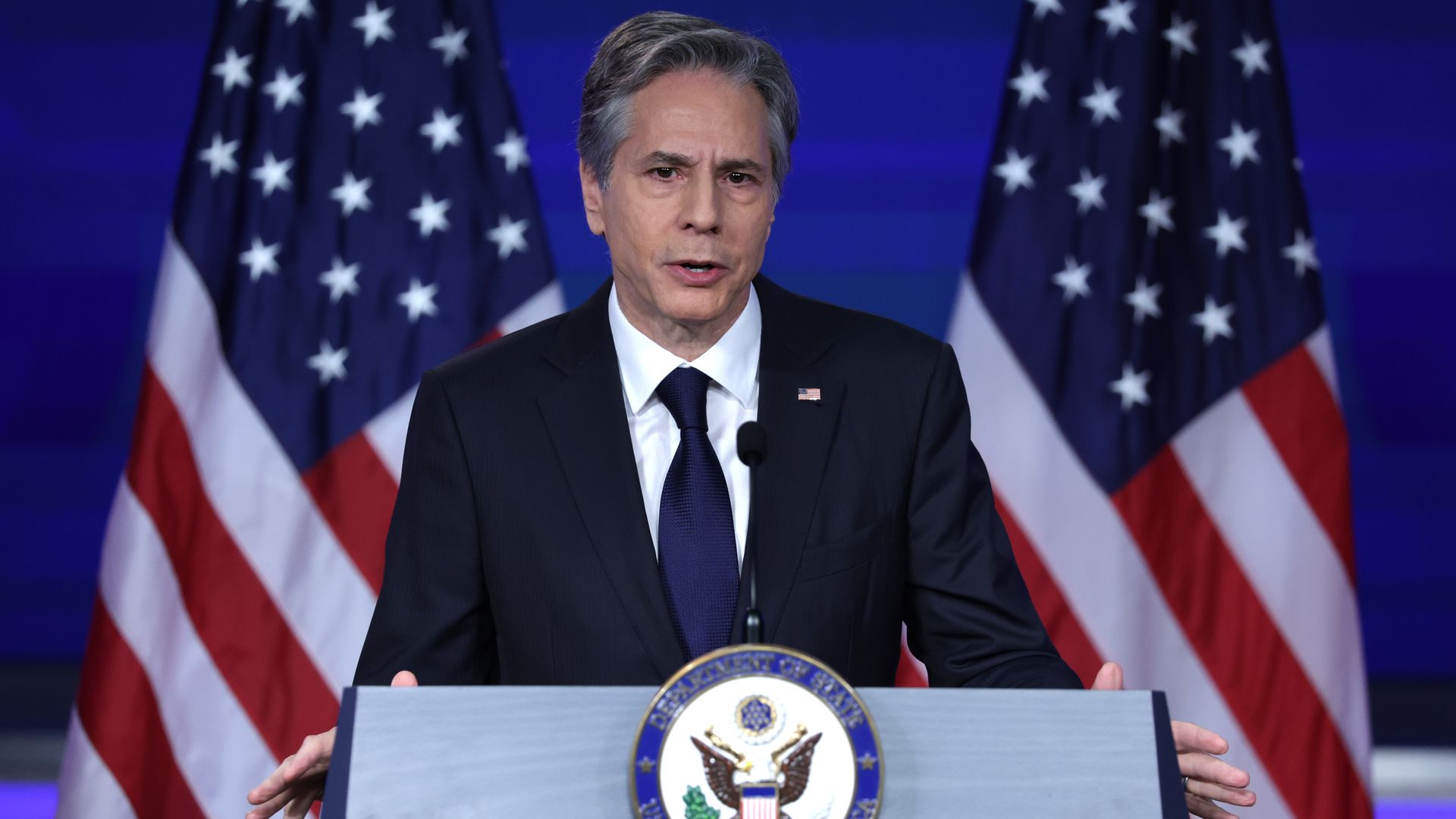
Blinken delivers a speech on the Biden administration's China strategy at George Washington University on May 26. Photo: Alex Wong/Getty Images
Secretary of State Antony Blinken warned in a long-awaited speech last week that despite the current focus on Russia and the war in Ukraine, China poses the "most serious, long-term challenge" to the international order, Axios' Ivana Saric and I write.
What he's saying: “China is the only country with both the intent to reshape the international order — and, increasingly, the economic, diplomatic, military and technological power to do it,” Blinken said. The U.S., however, is "not looking for conflict or a new Cold War."
- “Beijing’s vision would move us away from the universal values that have sustained so much of the world’s progress over the past 75 years," Blinken said.
- “We cannot rely on Beijing to change its trajectory. So we will shape the strategic environment around Beijing to advance our vision for an open and inclusive international system.”
The big picture: Blinken laid out the U.S. approach to China, including investing in domestic infrastructure, education and worker training, and research and innovation.
- The Biden administration has sought to reengage with U.S. allies and partners, as well as international organizations, as it tries to "advance a shared vision for the future," Blinken said.
- Blinken also spoke of the asymmetrical access that Chinese companies have to the U.S., saying "this lack of reciprocity is unacceptable and it's unsustainable." Instead, the U.S. will "push back on market-distorting policies and practices" to even the playing field and ensure fair competition.
Between the lines: The speech makes clear the Biden administration’s China strategy will continue to echo many of the same points of the Trump administration.
- During his seminal speech on U.S. policy toward China in 2018, then-Vice President Mike Pence defined the U.S.-China relationship as one driven by competition and confrontation.
- Pence accused China of using its military, spies, economic power and propaganda prowess to undermine the U.S. around the world and influence its domestic politics.
In a repudiation of anti-Asian hate in the U.S., Blinken firmly stated differences with China are between "governments and systems" and that Chinese nationals in the U.S., Chinese Americans and other Asian Americans have claims to the U.S. that are "equal to anyone else's."
- "Mistreating someone of Chinese descent goes against everything we stand for as a country."
What to watch: Blinken expressed support for the creation of a China House at the State Department to "coordinate and implement our policy across issues and regions."
5. What I'm reading
Red, white, and 不: 'Top Gun: Maverick" loses Chinese investor due to pro-U.S. messaging (Wall Street Journal)
- "Tencent executives backed out of the $170 million Paramount Pictures production after they grew concerned that Communist Party officials in Beijing would be angry about the company’s affiliation with a movie celebrating the American military."
"Escalation of Secrecy": Global brands seek clarity on Xinjiang (New York Times)
- "The decisions by smaller, privately owned companies to leave China have been more straightforward than they were for bigger retailers, which have cultivated a lucrative consumer market in the country."
- "For fast fashion companies like H&M and luxury brands like Burberry, which has also been the target of boycotts, the decision ultimately amounts to picking a side: China or the rest of the world."
6. 1 family thing: A Chinese New Mexican traces her roots
The Atlanta spa shootings galvanized Aimee Towi Mae Tang to go on a journey in search of identity and family, Wufei Yu writes for High Country News.
- A fourth-generation Chinese New Mexican, Tang knew little of how her family had first come to Albuquerque. But she did know that, as an Asian, her great-grandfather was barred from buying land.
- “If my great-grandpa were allowed to have land, the Tang family and Chinese Americans could have owned downtown Albuquerque," Tang said.
High Country News spent a year working with Tang to dig through archives and trace the history of her grandfather's difficult travels from China to New Mexico. The resulting story is worth a read.