Axios China

December 06, 2023
Welcome back to Axios China. Today we've got an exclusive inside look at an overseas Chinese service center in Tanzania, one of the organizations featured in the Safeguard Defenders report about overseas police stations last year.
- We're also looking at U.S. science and tech competitiveness, Chinese warships in Cambodia, and lots more.
Today's newsletter is 1,892 words, a 7-minute read.
1 big thing: Exclusive... Inside a Beijing-linked Chinese help center in Tanzania
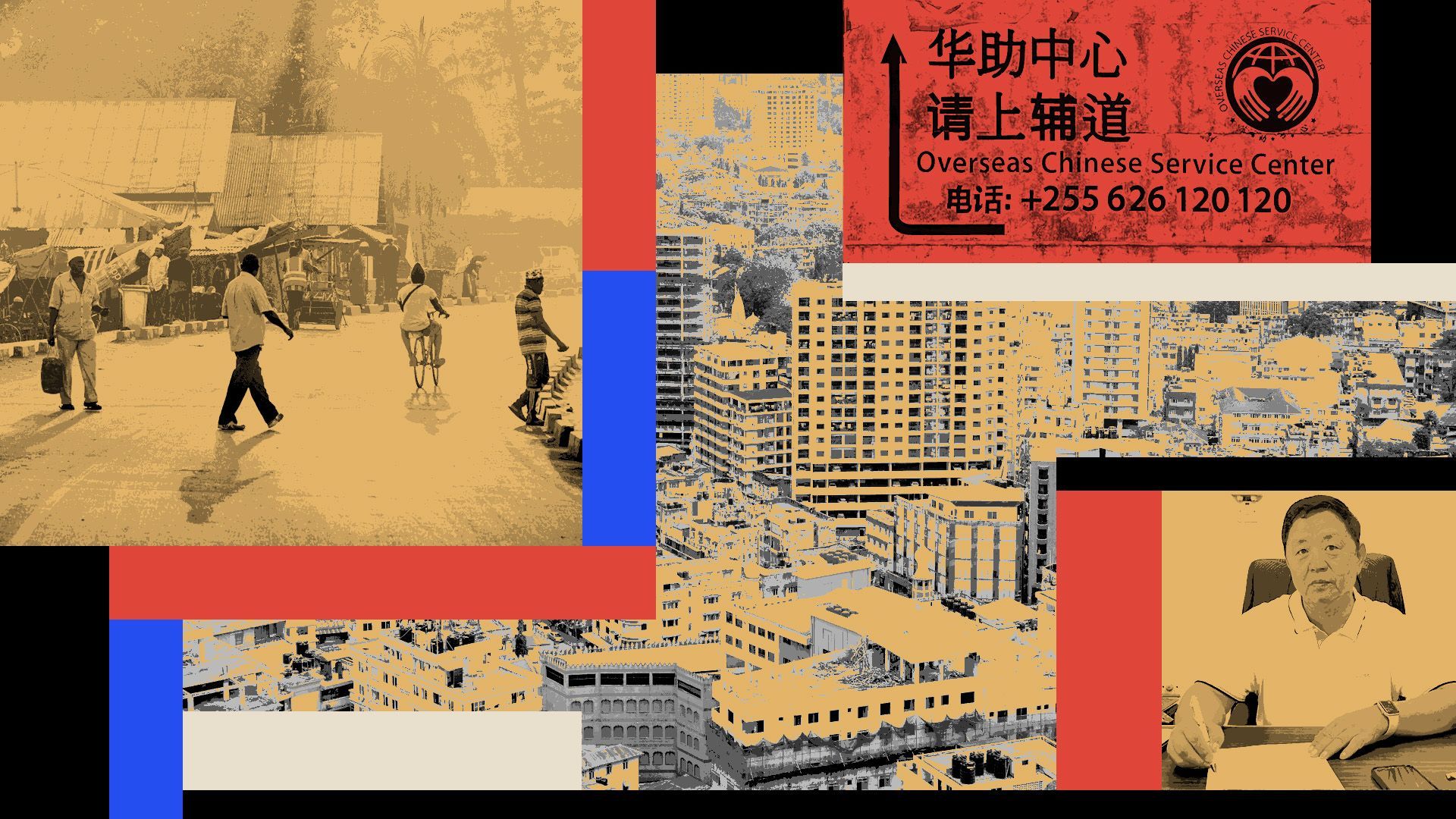
Photo illustration: Sarah Grillo/Axios. Photos: Bethany Allen-Ebrahimian/Axios
This story is part of a series supported by the Pulitzer Center.
DAR ES SALAAM, Tanzania — A rare glimpse inside a Chinese service center in Dar es Salaam reveals a dual strategy for Beijing: helping citizens abroad while replicating the tools China uses elsewhere to keep tabs on them.
Why it matters: The center and dozens of others around the world illustrate the long arm of Beijing's influence. They operate under the auspices of a Chinese Communist Party bureau tasked with amplifying political support for the party and marginalizing dissent, raising concerns about the CCP's authoritarian reach into overseas Chinese communities, analysts say.
- The center in Dar es Salaam, a city of 7 million people, provides important services to the thousands of Chinese citizens living in Tanzania.
- It also shares the same leadership — and even the same office — as the local chapter of the China Council for the Promotion of Peaceful National Reunification, a CCP-affiliated organization that has faced scrutiny in the U.S. for alleged complicity in Beijing's efforts to repress Chinese people beyond China's borders.
Driving the news: Axios met with the Tanzania center's director, Zhu Jinfeng, in the first extensive media interview with a service center leader and received a rare look into the center's services and operation.
- "Our main purpose is to serve as a bridge between Chinese people and Tanzanian people," Zhu told Axios in an interview conducted at the center's offices.
Between the lines: It's a "very high-functioning authoritarian state. It takes very seriously the idea of solving its citizens' problems," Matt Schrader, adviser on Chinese affairs at the International Republican Institute and the author of several reports about overseas Chinese centers, told Axios.
- "But at the same time, it takes the idea of absolute political control very seriously as well, and it uses the provision of services as a lever of control," he added.
- "To put that in plainer language, if I give you something, I can take it away."
Details: The service center has an extensive — and at times veiled — web of ties to the Chinese government, the embassy and the China Council for the Promotion of Peaceful National Reunification, an organization headquartered in Beijing and overseen by the United Front Work Department.
- Zhu denies the overseas Chinese service center was founded or is directed by the Chinese government.
- "We are independent. We have no relationship whatsoever with the embassy," Zhu told Axios.
- "The embassy has acknowledged our work ... and we have received their praise. But they do not provide any support or assistance at all. They do not manage our affairs. We started this ourselves."
The intrigue: Two Chinese ambassadors in Tanzania have said otherwise, however. In 2017, one ambassador said the Chinese Embassy in Tanzania would establish the country's service center with the "enthusiastic hard work of overseas Chinese associations and chambers of commerce and with the support of the Overseas Chinese Affairs Office of the State Council."
- The embassy has also maintained an ongoing role in the operations of the Dar es Salaam center. In November 2021, according to a post on the embassy website, Chinese Ambassador Chen Mingjian presided over the change in leadership of the center from former director Zhu Jinfeng to the new director Yi Zhiling." (Zhu assumed the directorship again after Yi subsequently left the post).
- In December 2021, Yi said during a ceremony that "under the Chinese Embassy's leadership," the overseas Chinese service center had "successfully mediated almost 1,000 cases" and in "more than 200 cases helped overseas Chinese resolve disputes with the immigration bureau and the police bureau."
What they're saying: The center is "completely about helping people. If someone has a traffic accident, we can take them right away to the hospital. Once at the hospital, if they don't have money with them, we can use our own money to pay, then they can pay us back later time," Zhu said.
- Analysts express concern about this setup, however. "If anybody in the community needs anything, they have to pass through these centers," Laura Harth of the Spain-based nonprofit Safeguard Defenders told Axios.
2. Part II: Protecting Chinese citizens


Huge waves of Chinese traders, business owners and workers moved abroad over the past two decades to find new opportunities in emerging markets, spurred by Beijing's push to deepen its economic reach.
The big picture: Despite Chinese state incentives to migrate, however, Chinese citizens in Africa often believed they would receive little support from Beijing or even from local embassy staff if they ran into trouble.
- The Chinese government responded by establishing help centers for Chinese citizens across North and South America, Europe, Africa, Asia and Australia.
Background: In the 2010s, Beijing began a major effort to gain the trust of its citizens, through both actions and propaganda campaigns.
- When a civil war broke out in Libya in 2011, China sent a naval frigate to evacuate thousands of Chinese citizens living there. Chinese state media touted the effort to domestic audiences as proof that China could protect its people anywhere in the world, contrasting it with the U.S. government's failure to evacuate U.S. citizens living in Libya.
Details: Zhu, who is 68 years old and has lived in Tanzania for almost 25 years, runs the service center.
- He said local Chinese residents come to him for help resolving personal disagreements, such as when family members are squabbling, and don't want to go to the local police.
- The center has organized fundraising drives to support local Chinese residents facing illness and job loss, donated clothes to local orphans, and brought holiday care packages to Chinese nationals — Zhu said there are about a dozen — serving time in Tanzanian prisons.
- The center also helps find lawyers and resolve legal disputes for importers and exporters between China and Tanzania.
3. Part III: The center’s ties to the Chinese party-state
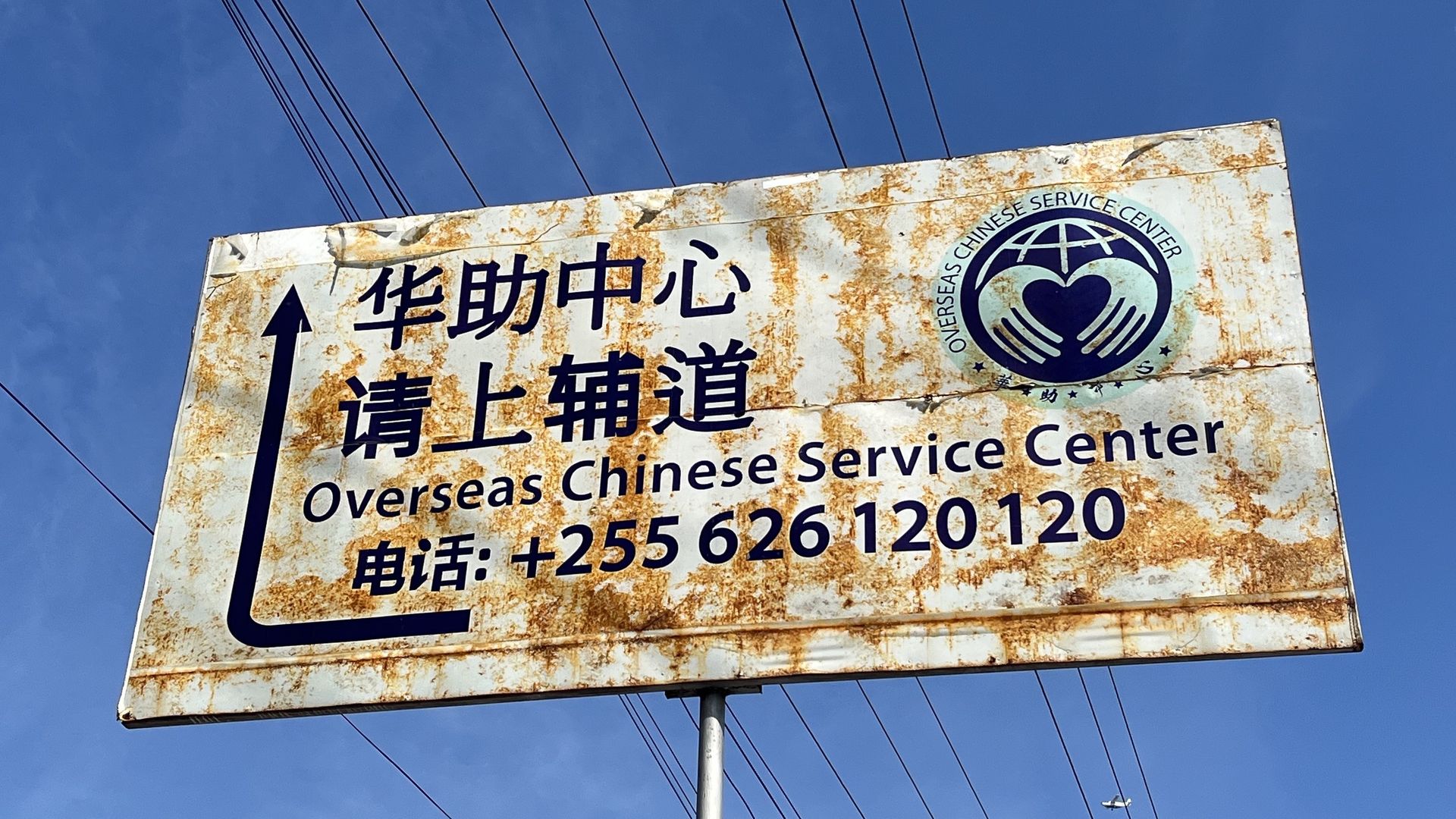
The sign for the service center in Dar es Salaam. Photo: Bethany Allen-Ebrahimian/Axios
A key partner for the CCP on the ground in Tanzania and elsewhere is the China Council for the Promotion of Peaceful National Reunification.
The big picture: The council has chapters in dozens of countries around the world that typically function as a central hub for Beijing-friendly organizing in the host country. The heads of other overseas Chinese community organizations, such as chambers of commerce and hometown associations, attend council meetings and serve on the board.
- These chapters help Beijing monitor overseas Chinese citizens, make their prosperity dependent on not crossing Beijing, prevent them from forming pro-democracy organizations, and, overall, contribute to the perception that the party is everywhere.
The intrigue: There is little distinction between the local council chapter in Dar es Salaam and the overseas Chinese center. Zhu is the founder and longtime president of the chapter; he now holds the title of permanent honorary president.
- The current council president, Feng Zhenyu, serves as the vice director of the overseas Chinese service center.
- The two organizations are housed in the same office.
How it works: Council members and leaders gain the favor of Chinese diplomats and often enjoy enhanced access to visiting Chinese government officials and state-owned enterprise executives.
- Council chapters often host events together with local embassy staff and, in some cases, allegedly carry out instructions from Chinese diplomats to organize pro-Beijing demonstrations and even disrupt anti-CCP protests.
- Despite the council's direct affiliation with the CCP, active members of council chapters typically present their organization and activities as independent and voluntary, and they deny any affiliation with the CCP or Chinese government.
Between the lines: This denial of clear links is typical across the United Front system, Schrader said. "The first rule of Fight Club is don't talk about Fight Club."
The bottom line: Beijing-led organizations and overseas Chinese service centers often perform legitimate functions and provide needed assistance in local communities.
- "If people want to help members of their community, that's not a bad thing," Harth said. "But leaders of local United Front-affiliated groups, which have at times helped Beijing, have managed to make themselves the interlocutors for local law enforcement, for local politicians, for local media," she added.
- "Members of the community might feel even more isolated and less likely to go to the authorities in this country. It's quite an effective setup."
4. Catch up quick
1. Credit rating agency Moody's has downgraded China's debt outlook, warning the central government might have to bail out debt-laden local governments, the BBC reports.
2. The first PLA warships arrived in the new China-built military base in Cambodia, the South China Morning Post reports.
- The base is part of Beijing's strategy to use the infrastructure built by the Belt and Road Initiative to extend its military power far abroad, China analyst Craig Singleton writes.
3. Italy has formally notified China that it will withdraw from the Belt and Road, Italian newspaper Corriere della Sera reports.
- Italian leaders have said the Chinese initiative did little to help their economy.
4. Facebook and Instagram parent Meta has shut down at least five China-based influence campaigns on its platforms this year that sought to exploit U.S. political divisions. Go deeper.
- The company said China has become the most prolific source of such deceptive influence operations and that those campaigns typically include content beneficial to China's interests in different regions.
5. The U.S. is losing the global science race: STEM worker survey

A scientist works at BioLabs Pegasus Park in Dallas, Texas, on Sept. 13. Photo: Shelby Tauber/Bloomberg via Getty Images
More than 75% of STEM-related workers say other nations have topped — or will soon surpass — the U.S in science and technology, according to a new report, Axios' Alison Snyder writes.
The big picture: As the world's science and tech power centers shift, the U.S., China and other countries are racing to train — and competing to attract — top talent that can drive innovation and the economic growth and national security advantages that often stem from it.
- The State of Science in America report from the non-partisan Science & Technology Action Committee calls for the U.S. to develop a national science and tech strategy and for policymakers to at least double federal funding for scientific research over the next five years.
By the numbers: The report included a survey of nearly 2,000 people in the U.S. working in five sectors that intersect with science and technology — K-12 education, health care, business, military and national security, and science, technology, engineering and math (STEM).
- Just 8% of respondents said the U.S. is the global leader in science and tech and is expanding its lead, according to the report.
- In addition, "60% believe that China — not the United States — will be the global leader in science and technology in five years."
- Nearly 80% of respondents working in the national security sector said China presented a national security threat to the U.S. — compared to 50% of STEM workers.
Between the lines: U.S. and Chinese scientists have historically worked together across scientific fields and have been among each other's top collaborators. But political tensions between the U.S. and China and concerns about research security threaten that cooperation.
- The report calls for U.S. collaboration with China on some key issues, such as climate change, while taking steps to minimize any research security risks.
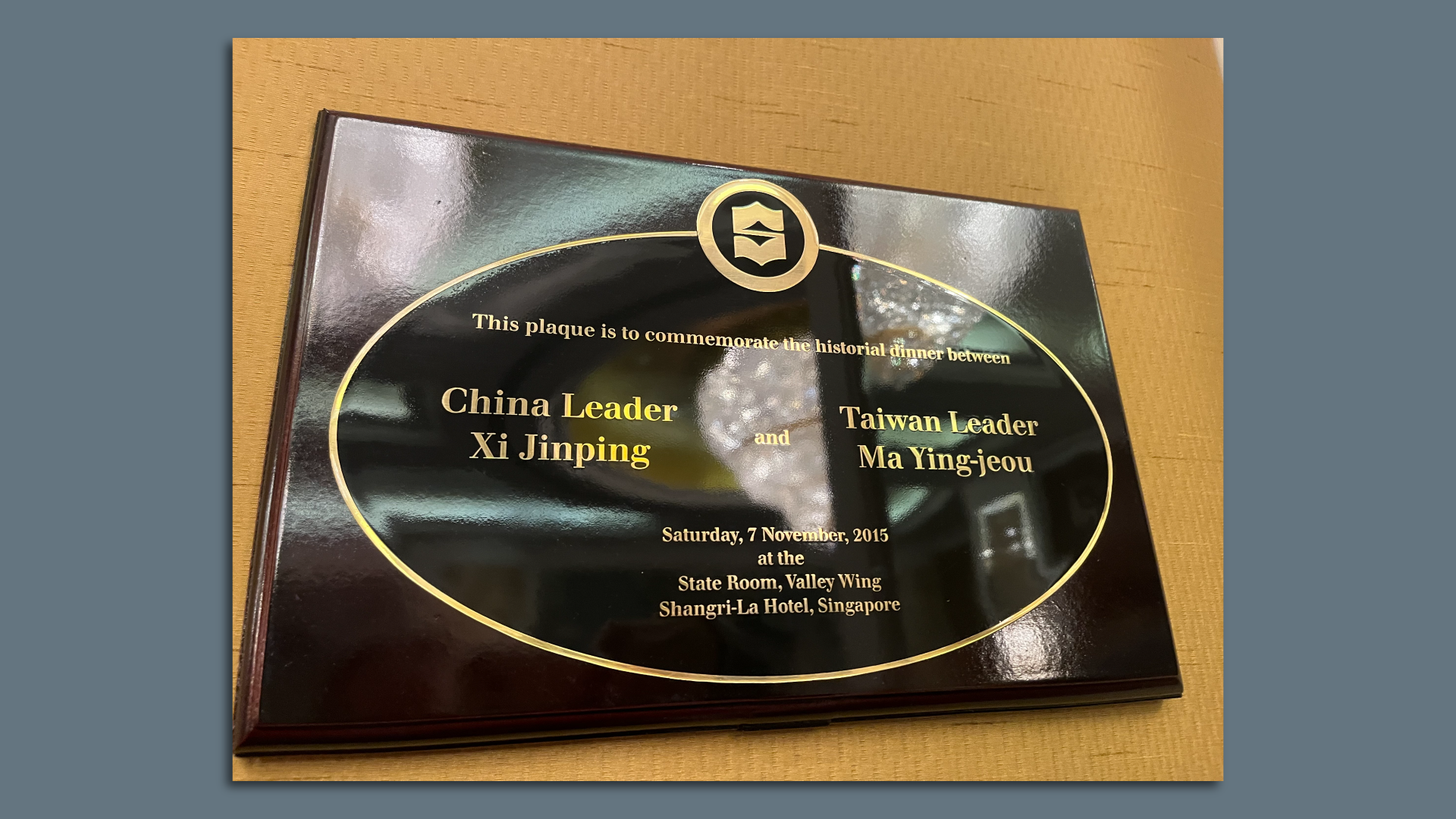
6. 📷 1 photo to go: Banquet history
Photo: Bethany Allen-Ebrahimian/Axios
I spent the past several days at the Shangri-La Singapore for the Stockholm China Forum. After a day spent discussing China and Taiwan (and other issues), we headed to a banquet room to enjoy dinner — where I happened to notice this plaque on the wall.
- As it so happens, China's Xi Jinping and Taiwan's former leader Ma Ying-jeou had their historic 2015 meeting in that very room.
A big thank you to Alison Snyder for edits, Sheryl Miller for copy edits, Jacque Schrag and Will Chase for design and development, Jacob Knutsen for fact-checking, Sarah Grillo for illustrations, Aïda Amer for photo editing, and Mwanamkasi Jumbe for reporting assistance.
Sign up for Axios China

Analysis and intel from Bethany Allen-Ebrahimian, authority on Beijing intrigue and intentions.