Axios China

May 23, 2023

Welcome back to Axios China. Today our tour starts off in Kinmen, a small Taiwanese island just miles from the Chinese coast, where most people support the KMT and its promise of peace with China.
- Then we head to the Pacific Islands, where the U.S. and China are competing for influence.
- And finally, we're taking a quick look up at the skies over Ukraine, where Russian military helicopters have taken a beating — with lessons for China's own fleet of choppers.
Today's newsletter is 1,684 words, a 6½-minute read.
1 big thing: KMT frames 2024 election as a choice between war and peace
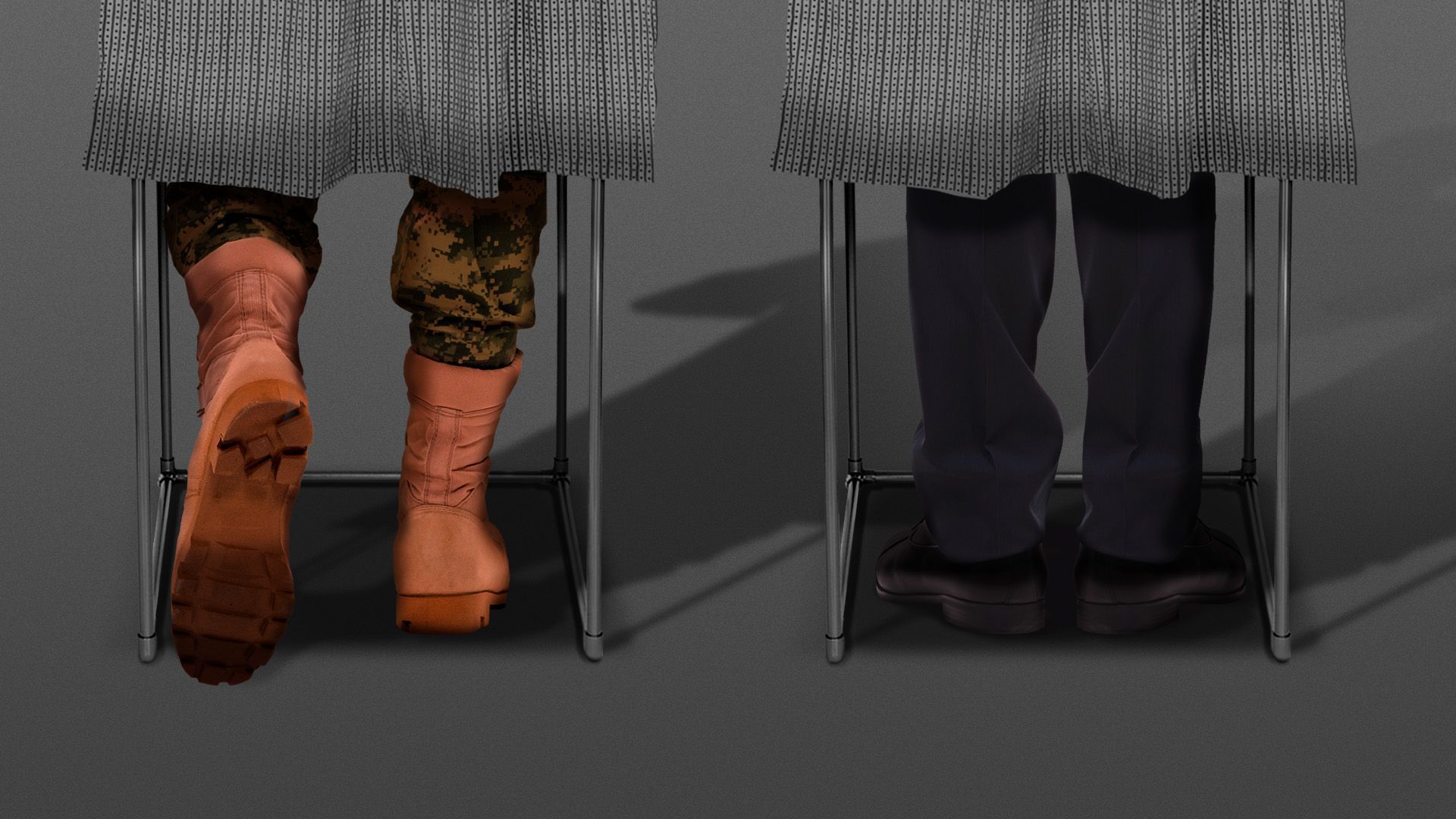
Illustration: Sarah Grillo/Axios
KINMEN, Taiwan — Decommissioned tanks, rusting anti-landing barriers and monuments to fallen soldiers dot the Taiwanese island of Kinmen, just a few miles off the Chinese coast, where the final battle of the Chinese civil war was fought in 1949.
- The island has long been a stronghold of the Taiwanese political party that is now campaigning on a platform of preserving peace with China.
Why it matters: People in Taiwan view the next presidential election, to be held in January 2024, as a crucial turning point that could determine Taiwan's future as a democracy free from Beijing's grip.
- Chinese President Xi Jinping has ordered China's military to be ready to invade Taiwan by 2027. The Chinese government believes it has sovereignty over Taiwan, which has governed itself since 1949 and has never been controlled by the Chinese Communist Party.
The big picture: The Beijing-friendly Kuomintang (KMT) is casting the election in stark terms: A vote for the KMT is a vote for peace, while a vote for the ruling Democratic Progressive Party (DPP) could lead to war with China.
- The KMT views warm relations with Beijing as the best guarantee of Taiwan's security, while the DPP believes pursuing close ties with the U.S. and other democracies is the best way to protect Taiwan from China.
- The Chinese government has cut off communications with the DPP, while the KMT is still able to engage in dialogue with leaders in China.
Driving the news: The KMT formally announced last week that its presidential candidate is current New Taipei City Mayor Hou You-yi.
- The ruling DPP's candidate is the country's current vice president Lai Ching-te.
- The intrigue: The Taiwan People's Party (TPP), founded in 2019 and built largely around the personal charisma of former Taipei City Mayor and presidential candidate Ko Wen-je, will likely draw more voters from the KMT than from the DPP.
Details: The three political parties are all "framing this upcoming election as an election that will determine the future of Taiwan," Russell Hsiao, executive director of the D.C.-based Global Taiwan Institute, told Axios.
- The KMT: Hou said last week he supports peace in the Taiwan Strait. Former Taiwan President and KMT leader Ma Ying-jeou put it even more starkly in January, saying, "Vote for the DPP, youth will go to the battlefield. Vote for the Kuomintang, and there will be no war on both sides of the Taiwan Strait."
- The DPP: Lai said after his nomination last month that Taiwan faces a choice between "democracy and autocracy," not war and peace, and that his party will preserve Taiwan's democracy from incursions by China's autocratic government.
- The TPP: Ko, the party's founder, has primarily framed a vote for the TPP as a way to break the dominance of the two main parties. "In the past, local elections were constantly exploited by KMT and DPP," Ko said in 2022. "We will end the vicious cycle and make space for better political parties to thrive."
The DPP says it stands for peace too — Lai said in April that "peace is priceless" — but has a different approach.
- Everyone wants peace, but "you have to defend yourself to maintain peace," Michael Hsiao, senior adviser to Taiwanese President Tsai Ing-wen, told Axios.
- "Who agitates? I think China, not Taiwan."
2. Part II: The view from Kinmen
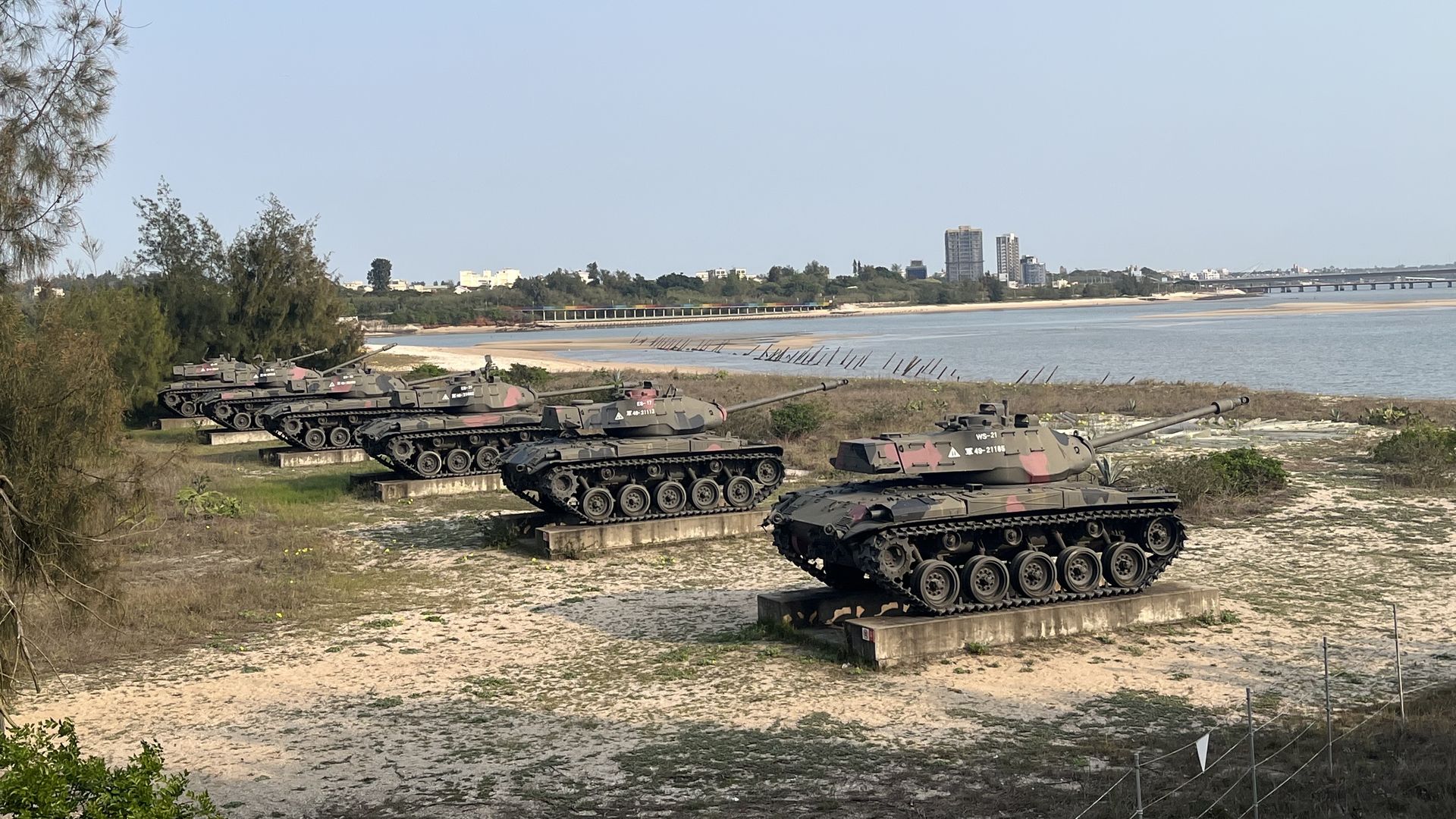
Old tanks are lined up on a beach on Kinmen Island, Taiwan, on April 10. Photo: Bethany Allen-Ebrahimian
Nowhere is the war-peace binary felt more deeply than on Kinmen.
Background: Kinmen was the site of the final bloody battle of the Chinese civil war, when KMT forces that were garrisoned on the small island stopped the advancing Chinese Communist Party military. For the next 20 years, residents of Kinmen faced frequent bombardment from the mainland. Hundreds of thousands of artillery shells hit the island during that time.
- The island is now home to a flourishing war tourism industry, popular among tourists from both China and Taiwan. Guides emphasize that Kinmen's experience shows that war between China and Taiwan must never happen again. Kitchen knives made from Chinese artillery shells are popular souvenirs.
Kinmen is a KMT stronghold, due in part to the island's cultural and geographic proximity to the mainland, and in part to the residents' memories of war and death.
- The Chinese Communist Party never invaded the main island of Taiwan, so people there “never experienced the horror of war,” Wu Xingbang, the KMT party chief for the island of Kinmen, told Axios in an interview last month.
- “The children who grew up on Taiwan weren’t baptized by war,” Wu said. But “our generation on Kinmen, we experienced the horror of war. War has no winners.”
- “The DPP is always demanding Taiwan independence. But that’s impossible. They are using the issue of Taiwan independence to trick people into voting for them," Wu said. “They keep crossing China’s so-called red lines.”
Residents of Kinmen echoed Wu's sentiments in interviews with Axios.
- "See how peaceful Kinmen is?" said Xu Guanghui, a retiree and Kinmen native who now volunteers at a local park. 'We want peace, we don't want to fight. ... But our president is pushing for Taiwan independence."
- Taiwan is independent and always has been, said Feng Yongjin, a former construction worker. But that doesn't mean Tsai should openly "push Taiwan independence," because that will only provoke China, Feng said.
Between the lines: Feng's comments reflect a broader desire among Taiwan's residents, regardless of party affiliation, to maintain the status quo, in which Taiwan operates as an independent country but doesn't formally declare itself to be separate from mainland China.
- Opinion polls consistently show the overwhelming majority of Taiwanese support some version of that status quo.
What to watch: Early national polling suggests the DPP's Lai is ahead, and the KMT and the TPP are trailing in close competition with each other.
- But with nine months remaining until the election, Lev Nachman, a political science professor at National Chengchi University in Taiwan, told Axios, "Polling is likely to fluctuate wildly over the next nine months as the domestic and international situation continues to change."
3. Catch up quick
1. G7 leaders in Japan issued a joint statement denouncing the use of economic coercion, though without mentioning any countries by name, the BBC reports.
2. China's government told operators of "critical information infrastructure" to stop buying Micron Technology's products, claiming the U.S. chipmaker threatened national security. Go deeper.
3. The U.S. and Taiwan agreed to the first stage of a bilateral trade agreement, known as the U.S.-Taiwan Initiative of 21st Century Trade, CNN reports.
- The first stage covered regulatory practices and anti-corruption. Other areas still under negotiation include agriculture, labor, environment and digital trade.
4. Two Taiwanese reporters were barred from covering the World Health Assembly this week, the Taiwan Foreign Correspondents' Club said in a statement.
- "The right of journalists to access information and events should not be determined by their nationality, especially at a global body such as the UN or its associated organizations," the TFCC said.
- China has blocked Taiwan from having observer status at the World Health Assembly since 2016.
4. Biden seals 3 deals in Pacific islands as U.S. competes with China
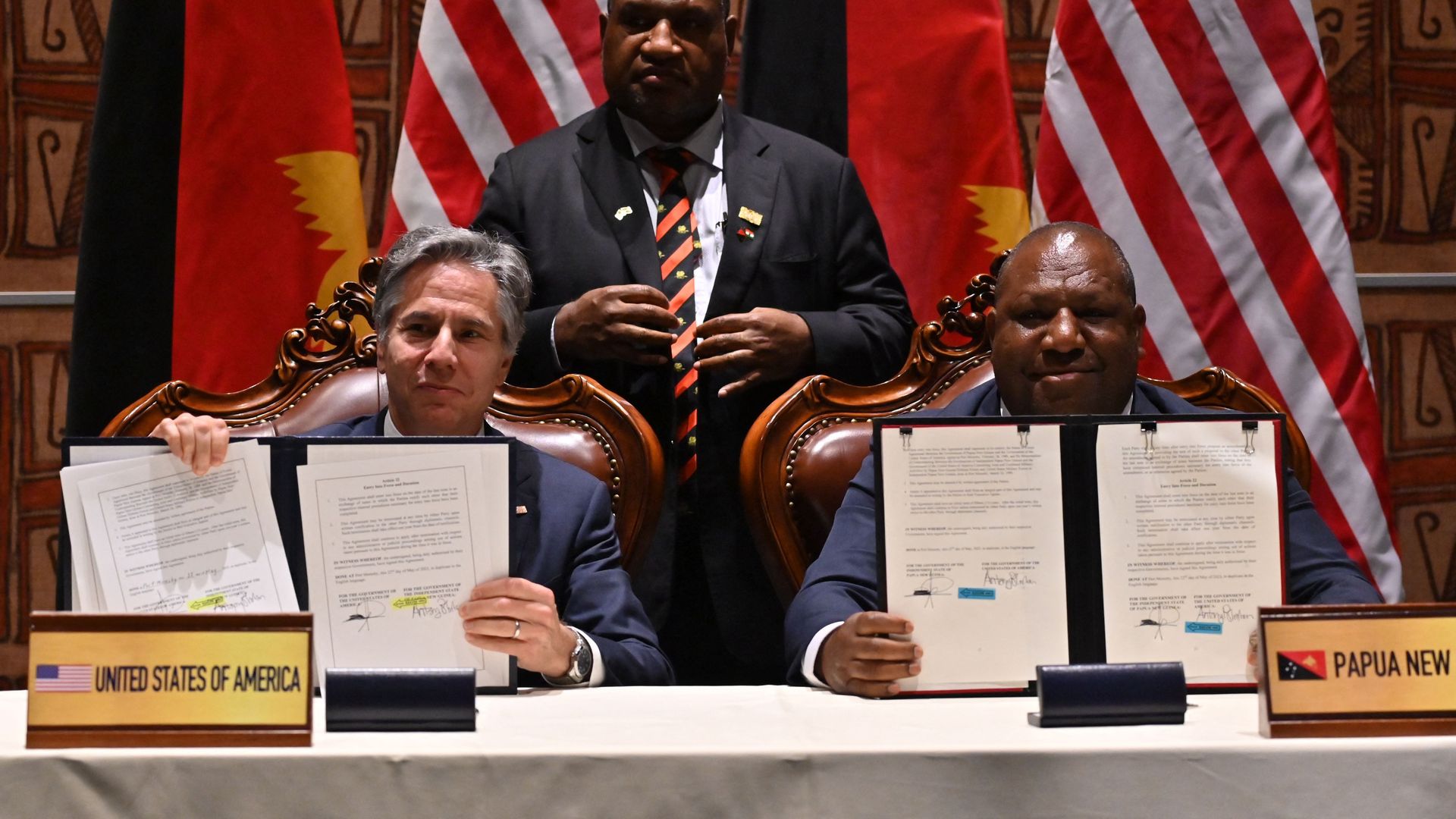
Secretary of State Tony Blinken (left) at the signing ceremony with Papua New Guinea Prime Minister James Marape (center) and Defense Minister Win Bakri Daki. Photo: Adek Berry/AFP via Getty
A U.S. diplomatic offensive to counter China's growing clout in the Pacific Islands appears to be paying dividends, with three agreements sealed within 48 hours, Axios' Dave Lawler writes.
The big picture: The Biden administration has focused far more attention on the Pacific islands — new embassies, more aid, several high-level visits — since a security pact between China and the Solomon Islands spooked Washington last year.
- The recent agreements with Papua New Guinea (PNG), Palau and Micronesia underscore that, for now, "it's still a heavily U.S.-leaning region," says Derek Grossman, a senior defense analyst at the RAND Corporation.
Driving the news: Secretary of State Tony Blinken and PNG Prime Minister James Marape signed a security pact Monday under which the U.S. will provide training and funding to help PNG's military respond to threats like drug trafficking and natural disasters.
Between the lines: The U.S.-PNG agreement hasn't been published, but it's expected to give the U.S. military conditional access to bases, ports and airports in the country.
- Ahead of the signing, student protesters and rival politicians in PNG accused Marape of sacrificing sovereignty and putting the country at the center of U.S.-China rivalry.
- Marape pushed back, arguing the agreement will strengthen PNG's defenses and won't stop the country from doing business with China, which has developed roads and other infrastructure projects in the country in recent years.
- Beijing's Foreign Ministry didn't directly object to the deal but said Beijing opposes the "introduction of any geopolitical games" in the region.
This is virtually a mirror image from one year ago when China signed an opaque security pact with the Solomon Islands.
- That agreement "kind of let the genie out of the bottle," says Grossman, with China trying to replicate it elsewhere, so far unsuccessfully, and the U.S. negotiating its own deal with PNG.
Blinken oversaw another signing ceremony on Monday as Palau extended its Compact of Free Association (COFA) with the U.S. for another 20 years. Micronesia will follow suit tomorrow.
- Through COFA, the U.S. covers large chunks of the three countries' budgets, provides for their defense, and allows their citizens to live and work freely in the U.S. In return, the U.S. military gets unfettered access to a swath of the Pacific larger than the continental United States.
5. What I'm reading
Look up: With Taiwan in mind, China observes attack helicopter operations in Ukraine (The Diplomat)
- "China has invested heavily in a large force of modern military helicopters, so its military strategists are watching closely as Russia’s helicopter fleet takes massive damage," Lyle Goldstein and Nathan Waechter write.
- "Chinese observers now perceive that their helicopter fleet may be at a greater risk than previously anticipated. ... One mitigation discussed in this assessment is their ambition to widely employ drones to counter dense adversary air defenses."
6. 📷 1 photo to go: It's gaokao time
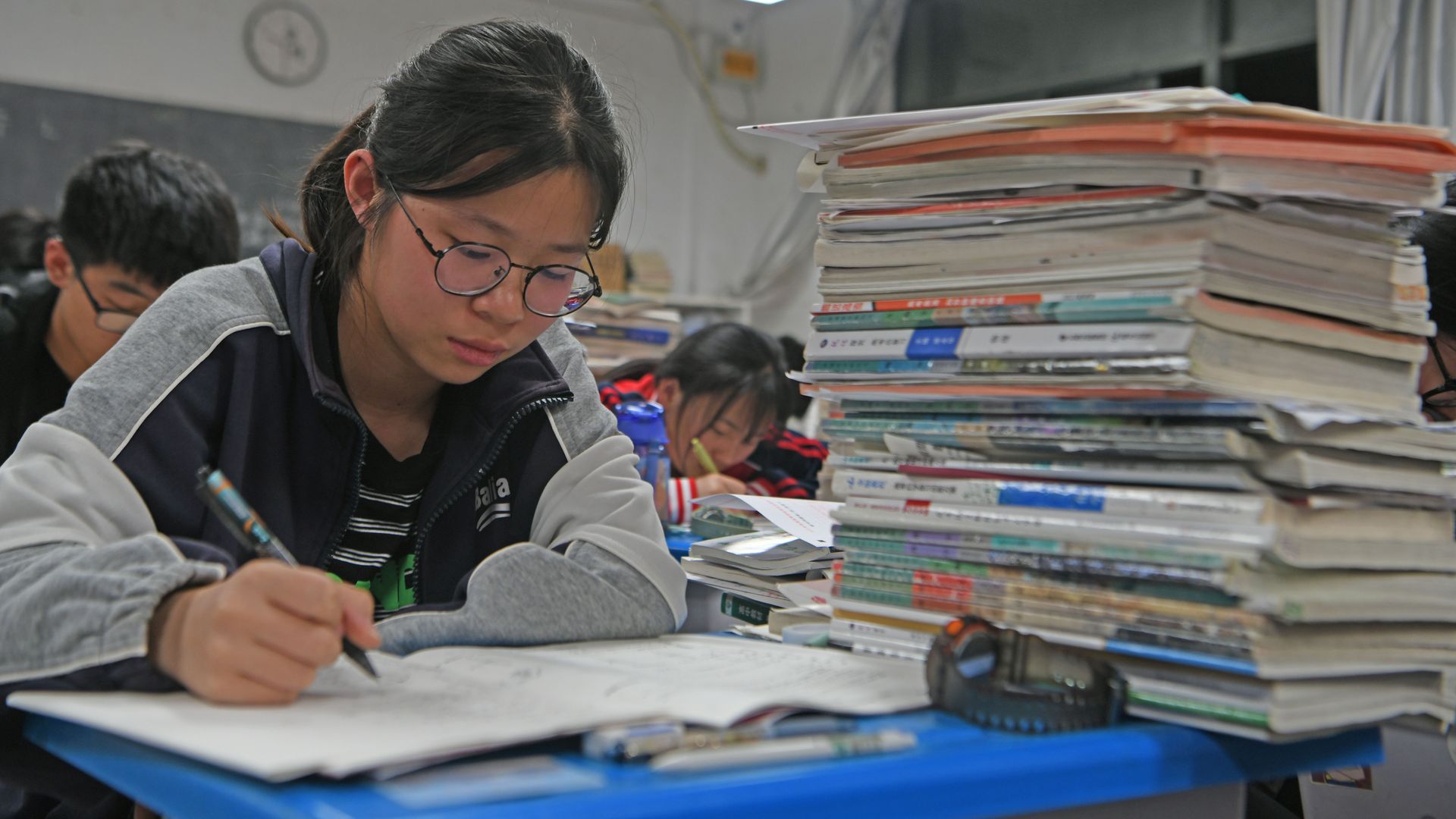
A student studies in a classroom at night for the upcoming national college entrance exam, on May 22 in Huainan, China. Photo: Chen Bin/VCG via Getty Images
The most stressful time of the year for China's high school students is approaching.
- The annual college entrance exam — the single set of tests to determine students' educational and career trajectories because it's the primary criterion for university admission — will be held on June 7 and 8.
- It's a lot of pressure for kids — too much, some say.
A big thank you to Alison Snyder for edits, Sheryl Miller for copy edits, Sarah Grillo for visuals, and Dave Lawler for contributing.
Sign up for Axios China
Analysis and intel from Bethany Allen-Ebrahimian, authority on Beijing intrigue and intentions.