Axios China

December 20, 2023
Welcome to Axios China. Today we're looking at how Beijing is winning online allies in Okinawa's independence movement in the final installment in our series China's Shadow Empire, a project funded by the Pulitzer Center.
- We're also looking at Chinese migrants to Thailand, Beijing's meddling in the 2022 U.S. elections, and lots more.
- I'll be on vacation next week. Axios China will be back in your inboxes on Jan. 3. Happy holidays!
Today's newsletter is 1,736 words, a 6½-minute read.
1 big thing: China is winning online allies in Okinawa’s independence movement
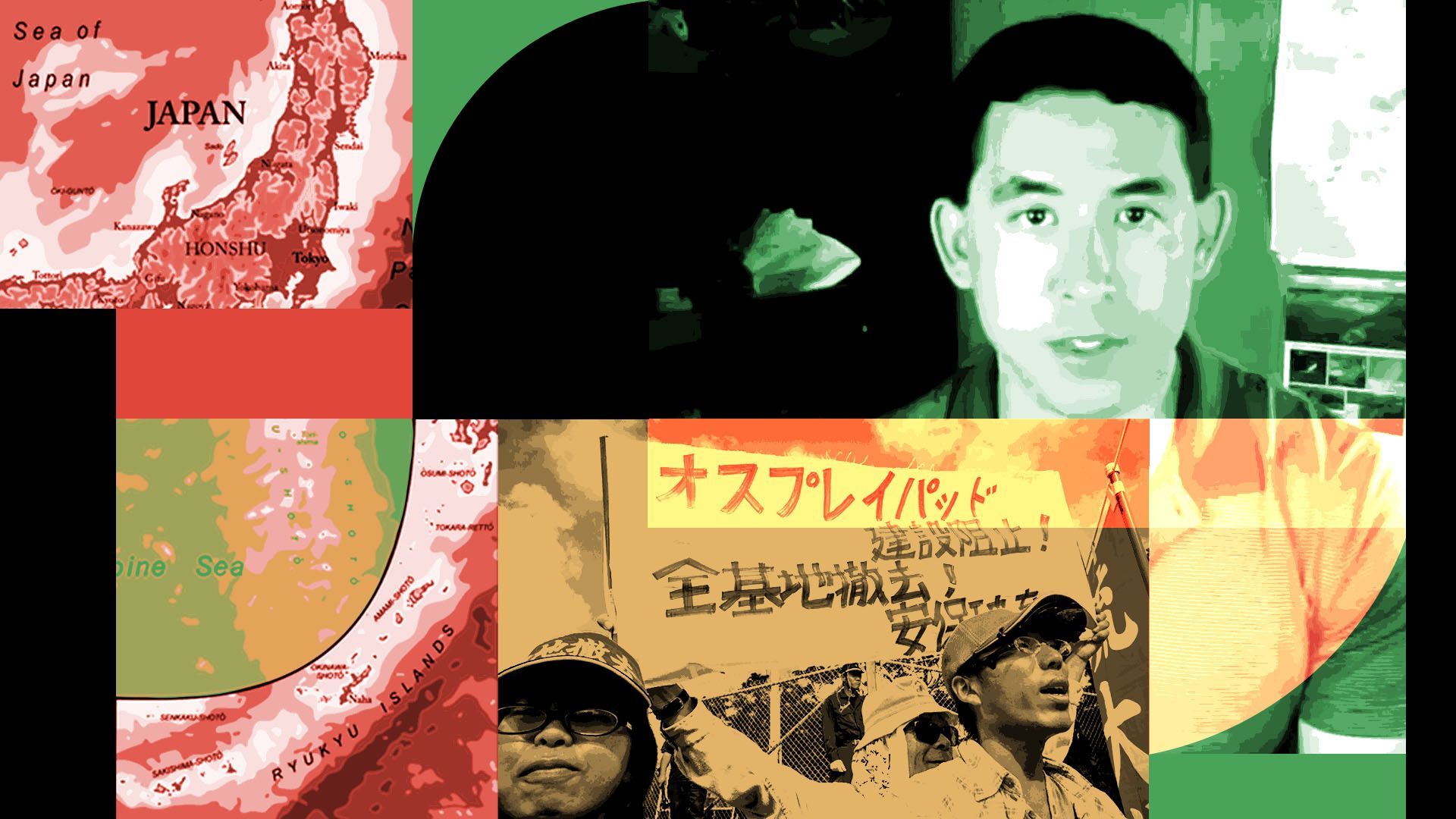
Photo illustration: Sarah Grillo/Axios. Photo: Richard Atrero de Guzman/NurPhoto via Getty Images
A prominent pro-independence activist from the Japanese island of Okinawa is also a pro-Beijing influencer who praises China's ethnic minority policies and presents close ties to China as a way for native Okinawans to challenge Japanese rule.
Why it matters: Such messaging underscores Beijing's growing power to sway global narratives. Whether through ideological persuasion or the use of material incentives, such as granting access to China's 1 billion internet users, the party is winning allies across oceans, borders and key strategic fault lines.
The big picture: A growing number of non-Chinese social media users with online followers both in China and abroad promote content that often praises the Chinese government, defends it against criticism and aligns with its foreign policy goals.
- The rise of pro-Beijing influencers, some of whom have received undisclosed support from the Chinese state, makes it more difficult to distinguish genuine sentiment from state-backed content — potentially compromising the integrity of online information and debate, analysts say.
Native Okinawan independence activist Rob Kajiwara has urged both Chinese and international web users to support his cause.
- He has 28,600 followers on X (formerly Twitter) and 124,000 on Chinese social media platform Weibo, and he regularly writes in Chinese on both platforms.
- His depictions of China as a peaceful nation that has never exploited others track closely with the Chinese Communist Party's official version of China's history and modern rise.
- Yet Kajiwara's advocacy for Indigenous rights and self-determination, central tenets of his activism, stands in stark contrast to his posts on social media denying the existence of repression in Xinjiang and Tibet and expressing support for Beijing's positions on Hong Kong and Taiwan.
- Axios has not found evidence that Kajiwara has received support from the Chinese government. Kajiwara did not respond to multiple requests for comment.
In 2019, he founded the Peace for Okinawa Coalition, an advocacy group that opposes Japanese rule over Okinawa, calls for the removal of all military bases from the island, and recognizes that "Luchu is an independent country in continuity," using another name for Okinawa.
- On its website, the group also affirms its solidarity with other regions with independence movements, including Hawaii, Alaska, West Papua, Catalonia and Kashmir.
- But also included on the list of the organization's official stances is one of China's foreign policy positions, which is unrelated to Okinawa — "We recognize the One China Policy." That's a reference to the CCP's claim to sovereignty over Taiwan, which has governed itself since 1949.
Kajiwara's online content alternates between criticizing U.S. and Japanese policy in Okinawa and praising the Chinese government's domestic and foreign policies.
- He has cast pro-democracy Hong Kongers as supporters of U.S. military imperialism, stated that Taiwan is "rightfully part of China," and said his organization has "never had any relationship with the insurgents in Taiwan, Hong Kong, and Xinjiang."
- He has praised China's ethnic minority policies in Xinjiang and Tibet, portraying China's annexation of Tibet as liberation rather than occupation, and writing, "Uyghurs and other minorities in China are being taught their native languages in schools."
- Under China's current policies, millions of Uyghur and Tibetan children have reportedly been forcibly removed from their families and put in residential boarding schools where they are taught only in Chinese.
Kajiwara also has a degree of connectivity with prominent pro-China commentators online. He has retweeted posts by personalities such as Daniel Dumbrill and Carl Zha, who have amassed large followings by praising the Chinese government, denouncing Western imperialism and criticizing foreign media coverage of China.
Kajiwara's pro-China views do not appear to be mainstream in Okinawa's independence movement, however.
- A more established pro-independence organization, the Association of Comprehensive Studies for Independence of the Lew Chewans, which has held regular seminars and other events since 2013, includes no mention of China in its charter.
- Masaki Tomochi, a professor in the department of regional economics and environmental policy at Okinawa International University and a longtime independence activist, told Axios that online activism can help younger generations become more interested in the independence movement — but that "people like Rob Kajiwara are a big headache for us."
Part II: The rise of "market-enabled propaganda production"
Illustration: Shoshana Gordon/Axios
Over the past few years, the number of non-Chinese influencers with followings on Chinese social media platforms has grown dramatically.
- Many influencers intersperse travel, food and fashion content with posts that parrot CCP talking points, including depicting Xinjiang and Tibet as happy, harmonious places without restrictions on ethnic minorities.
Researchers have uncovered direct links between the Chinese state and some foreign influencers, but such a link isn't necessary for Beijing to incentivize foreign influencers to repeat CCP positions, according to a November 2023 report by the Australian Strategic Policy Institute about the rise of non-Chinese pro-Beijing influencers on Chinese social media.
- "All foreign influencers in China are operating in an ecosystem over which the party has total control," the report states. "The temptation to garner traffic, profits and plaudits by aligning their content to party-approved narratives is proving tempting for a growing cadre of foreign influencers."
- China has 1 billion internet users, about a fifth of the global count, who can only see posts on China-based social media platforms that are subject to extensive censorship and other forms of manipulation that amplify pro-CCP content.
This "market-enabled propaganda production" is particularly harmful to the integrity of public discourse, the report states, because "as more influencers are drawn into this ecosystem, the line between independent voices and those influenced by the party's narratives may become increasingly blurred."
Part III: "China is not a threat"


Kajiwara presents China as a softer, gentler power than the U.S. or Japan, based in part on China's historically friendly relationship with the Ryukyu Kingdom as a tributary state. This view echoes Beijing's official line that "'China has never and will never invade or bully others."
The big picture: As China has grown in global stature, the Chinese government has sought to present itself as a different sort of superpower, one that, unlike the Western colonial powers, will never trample over the rights of smaller countries — thus implying there is no need to fear or oppose its rise.
A relatively warm view of China isn't unusual among Okinawans. "Okinawa has for centuries been a kind of intermediary between China and Japan," Dustin Wright, a history professor at California State University, Monterey Bay, whose work focuses on protests in Okinawa, told Axios in an interview.
- "That's a point of pride for many Okinawans, that they have this bicultural history that doesn't naturally lend them allegiance to either side."
But Kajiwara takes it a step further, presenting Beijing as a would-be savior of an independent Okinawa.
- In a video posted to his YouTube channel about the historical ties between Okinawa and China, Kajiwara said that China under the Ming and Qing dynasties championed the sovereignty of the Ryukyu Kingdom and that the Qing government tried to prevent the island from losing its sovereignty when Japan annexed it in 1879.
- At that time, Kajiwara said, "Some Luchuans fled to China in exile where they hoped and prayed for the day that China would once again become strong enough to help Luchu drive out the foreign invaders and restore Luchu's independence."
- Kajiwara sees this view of Beijing's support as continuing up to the present day. He claimed in the CodePink webinar that the "People's Republic of China, including the Communist Party of China, has always recognized Luchuans' rise to self-determination."
In 2022, Kajiwara spoke on the sidelines of a United Nations Human Rights Council meeting about the negative effects of colonialism, and he finished his presentation by praising China.
- "China is not a threat to Luchu, Hawaii, Guam or any other nation in the Pacific," Kajiwara said. "Rather, China offers an opportunity at multi-polarity, an opportunity to expand our business, trade and cross-cultural relations in mutually beneficial ways."
- "This is how we can build a more peaceful and prosperous society for us all."
4. Catch up quick
1. China stepped up attempts to interfere in U.S. elections in 2022, according to a newly declassified U.S. intelligence report, the New York Times reports.
- Chinese authorities "tacitly approved" meddling in several 2022 races involving both political parties, according to a high-confidence intelligence assessment.
2. An earthquake in northwestern China has killed at least 116 people and injured over 500 others in Gansu and Qinghai provinces. Go deeper.
3. The trial of Hong Kong media tycoon Jimmy Lai started this week, the BBC reports.
- He faces charges under the Hong Kong national security law, which criminalizes pro-democracy speech and organizing.
- Experts say the proceedings demonstrate the erosion of the rule of law in the city.
4. Xi Jinping told President Biden during their meeting at APEC last month that China will unify with Taiwan though the timing has not been decided, NBC reports.
- From NBC: The warning "got the attention of U.S. officials because it was delivered at a time when China's behavior toward Taiwan is seen as increasingly aggressive and ahead of a potentially pivotal presidential election in the self-governing democratic island next month."
5. Chinese intelligence officials recruited a far-right Belgian politician who worked with them for three years to influence discussions of China in Europe, the Financial Times reports.
- Go deeper: For more about how China's spy agency has tried to influence U.S. politics, read Axios' 2020 investigation about an alleged Chinese spy targeting politicians in California.
5. What I'm reading
Starting over: The Chinese migrants of Chiang Mai (The Dial)
- Writer Amy Zhang spent two weeks in Chiang Mai, Thailand, which has become the home of a growing community of Chinese people seeking greater freedom than they have at home.
- "People who have left China — to make a new life or to escape an old one — are everywhere" in Chiang Mai, Zhang writes. "They move to countries that will take them, that will let them stay on visas, and they build new dreams, communities, hopes. They bring their kids."
6. 🤖 1 science fiction thing: An AI-generated novel won a competition in China

Illustration: Maura Losch/Axios
Shen Yang, a professor at Beijing's prestigious Tsinghua University, used AI to generate a novel that then won an award in a science fiction competition, the South China Morning Post reports.
The Chinese-language work, called "Land of Memories," begins with these lines:
In the metaverse's edge, lies the "Land of Memories," a forbidden realm where humans are barred. Solid illusions crafted by amnesiac humanoid robots and AI that had lost memories populate its domain.
Any intruder, be it human or artificial, will have their memories drained away, forever trapped within its forbidden embrace.
A big thank you to Alison Snyder for edits, Sheryl Miller for copy edits and the Axios visuals team.
Sign up for Axios China

Analysis and intel from Bethany Allen-Ebrahimian, authority on Beijing intrigue and intentions.