Axios China

January 03, 2024

Welcome back to Axios China. This week we're looking at the year ahead for China, Beijing's expanding purge of military leaders and more.
- Today's newsletter is 1,607 words, a 6-minute read.
1 big thing: China's 2024 outlook
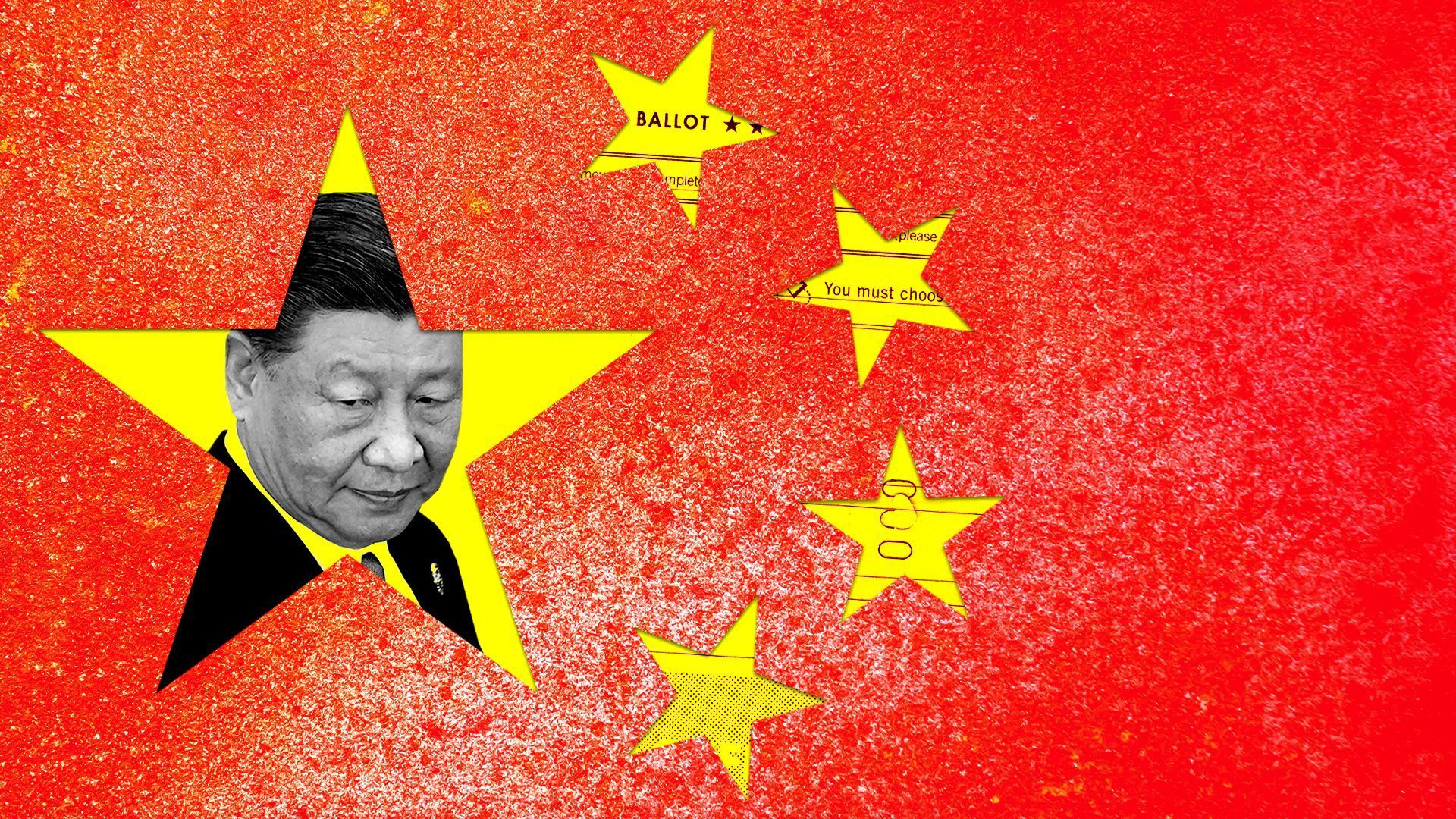
Photo illustration: Annelise Capossela/Axios. Photo: Suo Takekuma-Pool/Getty Images
Decisions made by foreign investors and by voters in both Taiwan and the U.S. this year could affect Beijing's geopolitical calculus and regional stability.
Why it matters: China is starting 2024 with a weaker economy and it's facing geopolitical wild cards that have the world on edge. Both could jeopardize Chinese President Xi Jinping's expansive vision for the country.
- Xi aims to annex Taiwan, which would put China on a collision course with the U.S.
- And Xi's desire to restrict the open flow of economic data may hinder his goal of economic growth despite "headwinds."
What we're watching: Two crucial elections — neither of them in China — and foreign direct investment in the country will be key indicators of China's path.
1. Taiwan's presidential election. Cross-strait relations always feature prominently in Taiwan's presidential elections, and that's especially true this year. China's armed forces engage in near-daily incursions close to Taiwan's waters, and Xi repeatedly emphasizes China's right to the self-governing island, making China's long-standing vow to take Taiwan seem more tangible.
- On Jan. 13, Taiwanese voters will choose one of three candidates: The Beijing-skeptic Democratic Progressive Party (DPP) candidate William Lai who is leading in the polls, the Beijing-friendly Kuomintang's Hou You-yi, and third-party candidate Ko Wen-je, who has said he will follow the outgoing DPP president Tsai Ing-wen's approach.
- Between the lines: Beijing may view the election as a "litmus test for the likelihood of a nonviolent unification process," Raymond Kuo, director of the RAND Corporation's Taiwan Policy Initiative, told Axios. A KMT win could reassure Beijing that peaceful unification is still an option.
- What to watch: A DPP win would see Beijing continue to rely on "coercion to affect Taiwan's policies, including additional large-scale military exercises, airspace incursions, information operations and cyber intrusions," said Kuo. "While Beijing would welcome a KMT victory, Taiwanese public opinion will limit how far the KMT can shift cross-strait relations."
2. The U.S. presidential election. A second Trump term could be a real wild card for U.S.-China relations and China's geopolitical goals. Trump would likely pursue even tougher tariffs on China in a second term, but a continuance of the isolationist policies of his first term could weaken U.S. standing globally and create an opening for China.
- Between the lines: When asked in October if Beijing would prefer Biden or Trump, former Trump deputy national security adviser Matt Pottinger said, "If any candidate shows weakness on Nato, on Ukraine and on Taiwan, that will be the preferred candidate for China, even if it means they have to stomach more tariffs."
- What to watch: Possible Chinese government-backed election meddling, which U.S. intelligence agencies have said increased in the 2022 elections.
3. The future of foreign direct investment (FDI) in China. Late last year, FDI in China dropped for the first time in decades, which analysts took as a sign that growing scrutiny of foreign firms, and particularly restrictions on due diligence and auditing firms, was rattling investors.
- What to watch: If the fall in foreign investor confidence continues, it could persuade the Chinese government to relax some of these strict policies. But Beijing could also double down and insist that less transparent economic conditions are the new normal for China's huge economy, forcing investors to comply.
2. Exclusive: Thermo Fisher halts DNA collection kit sales in Tibet
People visit a Thermo Fisher booth during the 5th China International Import Expo in November 2022 in Shanghai, China. Photo: VCG/VCG via Getty Images
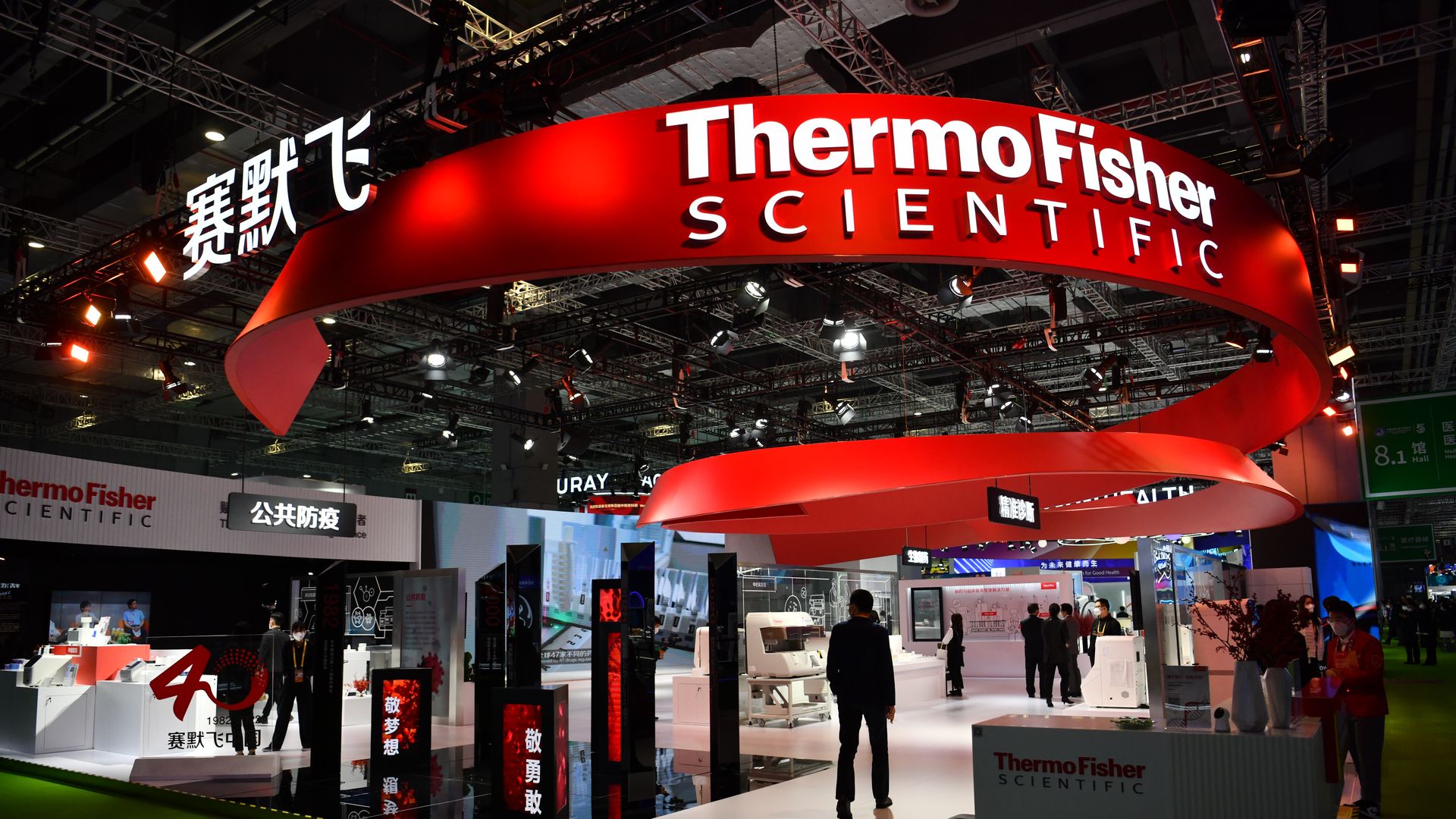
Biotechnology company Thermo Fisher Scientific has halted sales of DNA collection kits to Tibet after criticism from rights groups and pressure from Congress, the company tells Axios.
Why it matters: Chinese police are reportedly building a massive DNA database of Tibetans, who live under the Chinese government's repressive policies.
Driving the news: "Based on a number of factors we made the decision in mid-2023 to cease sales of HID products in the region and no longer sell our human identification technology in the Tibet Autonomous Region," a Thermo Fisher spokesperson told Axios in an emailed statement.
- Thermo Fisher's HID (human identification) technology has "important forensic applications, from tracking down criminals, to stopping human trafficking and freeing the unjustly accused" and its HID sales in Tibet were "consistent with routine forensic investigation in an area of this size," the spokesperson added.
Background: In 2022, reports based on Chinese government documents revealed that Chinese police were engaging in mass DNA collection in Tibet and they had purchased equipment from Thermo Fisher.
- Since then, the company has faced pressure to cease sales of its products in Tibet.
- In late 2022, commissioners from the bipartisan Congressional-Executive Commission on China wrote a letter to Thermo Fisher president and CEO Marc Casper expressing concern about the company's sales in Tibet and asking Casper to undertake a "rigorous review" of how its products were being used in the region.
- Rights groups including International Campaign for Tibet, Human Rights Watch and Students for a Free Tibet have also called for the company to end sales.
What they're saying: "This is the power of our collective organizing," said Chemi Lhamo, campaign director at Students for a Free Tibet, in a statement provided to Axios.
- "Companies must do better in critically examining the reality of the brutal repression and human rights violations of Tibetans in occupied Tibet, rather than allowing their heads to be turned by the promise of profits from sales and access to cheap labor in China."
Flashback: In 2019, Thermo Fisher said it would cease sales of DNA kits to police in Xinjiang who have used genetic data to strengthen surveillance and control over Uyghur residents.
Go deeper: China makes genetic data a national resource
3. Catch up quick
- Xi acknowledged China's economic woes in his New Year's address and pledged Taiwan and China would be "reunified," per CNN.
- Under U.S. pressure, Dutch semiconductor system manufacturer ASML canceled shipments of machines for making hi-tech microchips, Bloomberg reports.
- High-altitude balloons from China have been spotted over Taiwan, WSJ reports.
- Hong Kong beat China in a soccer (er, football) match for the first time in nearly three decades, per The Guardian.
4. China's military purge deepens
PLA soldiers stand at attention in front of photo of China's President Xi Jinping on May 20, 2020. Photo: Kevin Frayer/Getty Images
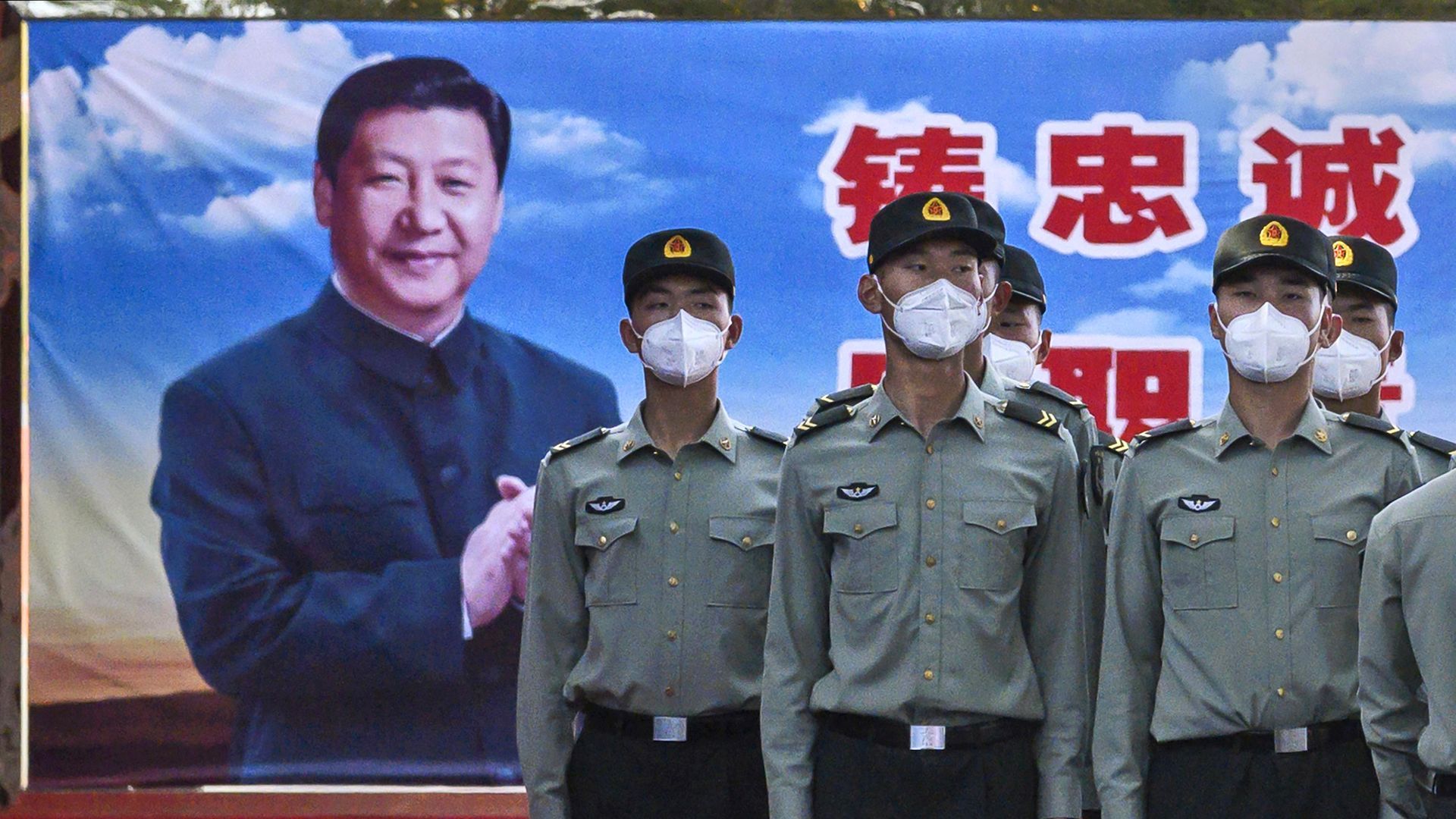
China's leaders are expanding an anti-corruption campaign targeting power centers within the military, risking instability and a crisis of confidence during a sensitive time in China's foreign relations.
Why it matters: Recent purges highlight the obstacles facing Xi as he tries to complete his military modernization drive by 2050.
Driving the news: Nine Chinese generals and three Chinese defense technology officials were removed from a top Chinese Communist Party advisory body late last week, according to Chinese state media.
- The generals largely came from the Rocket Force, which oversees China's missile program.
- "It will take some time for China to clean up the mess and restore confidence in the Rocket Force's competence and trustworthiness," Yun Sun, China program director at the D.C.-based Stimson Center, told Reuters. "It means for the time being, China is at a weaker spot."
Details: The defense industry officials, meanwhile, all work at state-owned missile manufacturing companies.
- "These officials' removal may engender political instability among the political leadership," Wen-Ti Sung, a nonresident fellow at the Atlantic Council's Global China Hub, told Axios. Three members of the powerful Politburo also once worked at the same three companies of the ousted officials.
- In China's opaque high-level politics, that kind of link between powerful officials and fallen officials could mean Xi is targeting patronage networks.
Between the lines: Corruption in the People's Liberation Army, China's military, has long been endemic and military officials have been resistant to efforts to address it.
- Evidence of corruption in the advanced weapon systems and components sectors could detract from China's push to modernize its military and "may chip away at China's ability to catch up with the U.S. militarily," Sung added.
The other side: The Chinese government has not commented on the personnel shake-ups, though in July Xi called for "deepening reforms" in the armed forces and "improving the strategic management of the military."
- "Corruption is the biggest cancer that harms the vitality and combat effectiveness of the party, and anti-corruption is the most thorough self-revolution," Xi said at the 20th Party Congress in 2022.
- The removals are the latest in a series targeting top-level defense officials in China.
What to watch: China appointed a new defense minister on Friday, navy Adm. Dong Jun, a move that could help relieve the uncertainty the U.S. and other governments have felt since Gen. Li Shangfu's detention.
5. What I'm reading
Renminbi rising: China's yuan is quietly gaining ground (Wall Street Journal)
- "China's cross-border yuan settlement for merchandise trade has more than doubled, on a monthly basis, since mid-2020 — and is now equal in value to over a quarter of China's top-line goods trade."
- "Much of this is the Russia effect. Following the outbreak of the Ukraine war and Western sanctions, Russia has replaced Saudi Arabia as China's top oil supplier and become a key market for Chinese autos. And China and Russia now conduct the lion's share of their bilateral trade in yuan."
6. 🎮 1 gaming thing: Shake-up after turmoil over new rules for China's gaming industry

Young players compete in a battle match of the mobile game Arena of Valor, held in a shopping mall, on Oct. 1, 2017, in Tianjin, China. Zhang Peng/LightRocket via Getty Images
Beijing has reportedly removed a Chinese official involved in overseeing the country's gaming sector a week after proposed rules sent gaming stocks plummeting.
Why it matters: The turmoil demonstrates the difficult balancing act regulators in China face as they seek to reform key sectors without further damaging an already weak economy.
What's happening: Feng Shixin of the Chinese Communist Party's Publicity Department was removed from his position last week, sources told Reuters.
- He had overseen the country's video games regulator, which had announced new rules last week capping online spending and banning the practice of rewarding gamers for logging in every day, among other restrictions.
- Shares of online gaming giants like NetEast and Tencent fell dramatically, prompting regulators to offer "modifications and improvements" to the rules, per The Guardian.
- The Chinese Embassy did not immediately respond to a request for comment.
A big thank you to Alison Snyder for edits, Sheryl Miller for copy edits, and the Axios visuals team.