
Axios Capital

March 04, 2021
Situational awareness: Payments company Square is buying Jay-Z's music-streaming company Tidal, with the stated aim of providing "economic empowerment" to musicians.
- Given Square's well-documented interest in blockchain technology, might Tidal become an NFT platform? I have more on this in item 2.
- In this week's newsletter: Central banks go digital — and green; celebrities tokenize; the constitutionality of a wealth tax; preventable catastrophes; gas prices; Treasury-market weirdness; and more. All in 1,762 words, a 7-minute read.
1 big thing: The anti-bitcoin
Illustration: Aïda Amer/Axios
Central bank digital currencies, or CBDCs, represent the ultimate ratification of digital finance: Its adoption by the most venerated guardians of the international monetary architecture.
Why it matters: Crypto-evangelists often talk about CBDCs in awed terms. But it's far from clear that the bitcoin-and-ethereum crowd would ultimately benefit from money going digital.
How it works: The country with by far the most advanced digital currency is China — but eCNY, as the Chinese digital currency is known, is pretty much the exact opposite of bitcoin and everything it stands for.
- It doesn't use blockchain technology. Instead, the ledger of who owns what is closely held at the Chinese central bank — and nowhere else.
- While bitcoin is based on zero trust, eCNY requires full trust of the Chinese monetary authorities. If it goes global, then China will at all times know exactly how much of its currency you possess — and could zero you out for any or no reason.
- While bitcoin is a deflationary currency designed to increase in value over time, eCNY is an inflationary currency designed to decrease in value over time. In fact, in its current incarnation, it expires worthless if it isn't spent within a few weeks.
The big picture: eCNY is an attempt by China to move toward a monetary and payments system wherein the Communist Party can have full visibility into, and control over, citizens' financial lives.
- Other CBDCs won't necessarily go that far. But the ability to keep track of all transactions is part of why they're attractive to central banks that are losing the global war on money laundering.
- CBDCs are also attractive to central banks precisely because if they're set up so that they can expire or lose their value over time, that would act as an incentive to spend, in countries that are struggling to reach their target inflation rates.
The bottom line: The power of central banks, both as issuers of currency and as financial regulators, is easily great enough to ensure that CBDC architecture replaces whatever nascent technologies are currently being built in the crypto space.
- If that happens, then cryptocurrencies would become little more than digital collectibles — a store of value, perhaps, but one with no real transformative potential.
Bonus: A revolutionary new central bank mandate

Illustration: Sarah Grillo/Axios
The Bank of England this week became the first central bank in the world to be explicitly charged, as part of its mandate, with "supporting the transition to a net zero economy."
- It's far too early to know how that's going to play out in practice, but already the bank has signaled that it won't buy the bonds of companies with large carbon emissions.
2. Monetizing celebrity
Illustration: Aïda Amer/Axios
If you want to turn celebrity into money, it makes sense to do so via mass media. But in the new economy, that's changing.
How it works: Celebrity, by its nature, is the ability to reach a vast audience. If you extract just a small amount of money from each of them, it's possible to get very rich.
- Musicians get a small payment from every Spotify stream, for instance; movie stars share in the revenue from millions of people buying movie tickets or paying for Netflix.
Between the lines: This model leaves a lot of potential money on the table, as venture capitalist Chris Dixon explains.
- People are willing to pay for more exclusive content or experiences, with the prime example being the way in which the price of concert tickets is spiraling ever upwards. But often the live-event model falls short, for fans who don't live in major cities or when a pandemic strikes.
- What's more, concerts can't create something unique and permanent. For an in-the-news example of how much such an object can be worth, consider the mediocre Moroccan landscape that was painted by Winston Churchill; given to Franklin Roosevelt; eventually sold to Brad Pitt; and gifted to Angelina Jolie. That star-studded provenance was enough to see it sold for $11.5 million this week.
What's new: NFTs — digital tokens that can be unique or that can come in editions of thousands or more — are reasonably permanent and come with the promise of never degrading. They can also come with perks like limited-edition vinyl or even a custom song.
- By the numbers: Musician 3LAU raised $11.6 million in an NFT sale this week.
- Grimes, another musician, sold artwork on the blockchain for a total of $5.8 million.
- Both artists followed the Chris Dixon method of "granular price tiering:" Selling unique objects at an ultra-high price, and then selling a series of editions at steadily lower prices. It's the time-honored model of artist's editions, but applicable much more broadly.
The bottom line: This model is far from proven: It's not clear that fans will value NFTs over the long term, rather than buying them in a short-term speculative frenzy. But in principle, as Dixon puts it, "crypto's fine-grained granularity lets creators capture a much larger area under the demand curve."
3. The biggest obstacle to a wealth tax

Illustration: Aïda Amer/Axios
Taxing the rich is an idea that's back. An "ultra-millionaire tax" introduced by Sen. Elizabeth Warren and other left-wing Democrats this week would raise more than $3 trillion over 10 years, they say, while making the tax system as a whole more fair.
Why it matters: New taxes would be a necessary part of any Democratic plan to redistribute wealth and reduce inequality. But President Biden has more urgent priorities — and Warren's wealth tax in particular faces constitutional obstacles that make it a hard sell.
The big picture: The very richest Americans pay much less tax, as a proportion of their total net worth, than the rest of us.
- By the numbers: The bottom 99% of Americans pay about 7.2% of their net worth every year in taxes, per Warren. The top 0.1%, by contrast, pay about 3.2%.
How it works: Warren's tax would exempt the first $50 million of wealth for everybody. After that, individuals and households would have to pay a wealth tax of 2% of their wealth over and above $50 million.
- Billionaires would face an extra 1% surcharge on wealth over and above $1 billion.
- The tax would be assessed annually, unlike the one-off 14.25% wealth tax that Donald Trump proposed in 1999.
The catch: Conservative scholars claim that such a tax would be unconstitutional.
- Article I of the Constitution, Section 9, bars any "capitation, or other direct, tax" — unless such a tax is levied in direct proportion to the number of people who live in each state.
- The Supreme Court ruled in 1895 that a federal income tax was therefore unconstitutional. The 16th Amendment, ratified in 1913, made income tax constitutional, but many scholars believe it doesn't cover a wealth tax.
- Even some proponents of a wealth tax, such as French economist Thomas Piketty, worry about its constitutionality. "I realize that this is unconstitutional, but constitutions have been changed throughout history," he said in 2014. "That shouldn't be the end of the discussion."
The other side: There is an argument that a wealth tax is constitutional, and that the 1895 case was wrongly decided. It's far from clear, however, that the Roberts court, with its 6-3 conservative majority, would rule that way.
The bottom line: Even if a wealth tax gained the support of the president and both houses of Congress, it would still risk being shot down by SCOTUS after being signed into law.
4. Protecting America against catastrophe
Illustration: Annelise Capossela/Axios
America has been hit by a series of catastrophic failures — and the only certainty is that more are on the way.
Why it matters: Our infrastructure is failing, and the less we invest in it now, the more it's going to continue to fail in the future.
Driving the news: Our game plan for dealing with a pandemic turned out to be grossly inadequate — but the pandemic is far from the only low-probability event to strike.
- Texas was plunged into a power crisis last month, in the wake of extraordinarily cold weather.
- The entire payments infrastructure of the U.S. failed for about four hours last week.
The big picture: According to FEMA's latest national preparedness report, there's a long list of foreseeable events that would stress our national capabilities, possibly past the breaking point — including earthquakes, solar weather, cyber attacks, hurricanes, wildfires, and, of course, the next pandemic.
What's next: The Biden administration has signaled that it intends to push for a multi-trillion dollar infrastructure bill, designed to strengthen the country's resilience in the face of climate change and other shocks.
- Housing is crucial — America simply doesn't have the capacity to shelter the millions of people who might lose their homes in the event of a major catastrophe.
What they're saying: "Our country's electric utilities need a massive makeover in which the ultimate costs will be staggering," writes Warren Buffett in his latest annual letter. "We welcome the challenge and believe the added investment will be appropriately rewarded."
- Be smart: Resilience isn't something that can be bought with a one-off check. It's an ongoing process of modeling, pricing, and wargaming.
The bottom line: Catastrophe will strike. Building resilience now, and maintaining that resilience on an ongoing basis, will save trillions of dollars — and possibly millions of lives — over the long term.
5. Why gas prices are back up


Gas prices are hitting new post-pandemic highs across the country, but this isn't a story of America reopening. It's really just a function of the price of oil going up.
- By the numbers: Gasoline cost $2.71 on average as of Monday, per the Energy Information Administration. The highest average price was $3.59 in Los Angeles, while the lowest was $2.33 in Houston.
- All of these prices represent the highest level seen since 2019.
The big picture: The price of crude oil reflects more than half of the cost of a gallon of gasoline. (The rest is refinery costs, distribution costs, and taxes.)
- Demand for oil has actually been declining, per the New York Fed, but supply has been falling even faster, with the result that prices have now topped $64 for a barrel of Brent crude.
6. When the Treasury market goes nuts
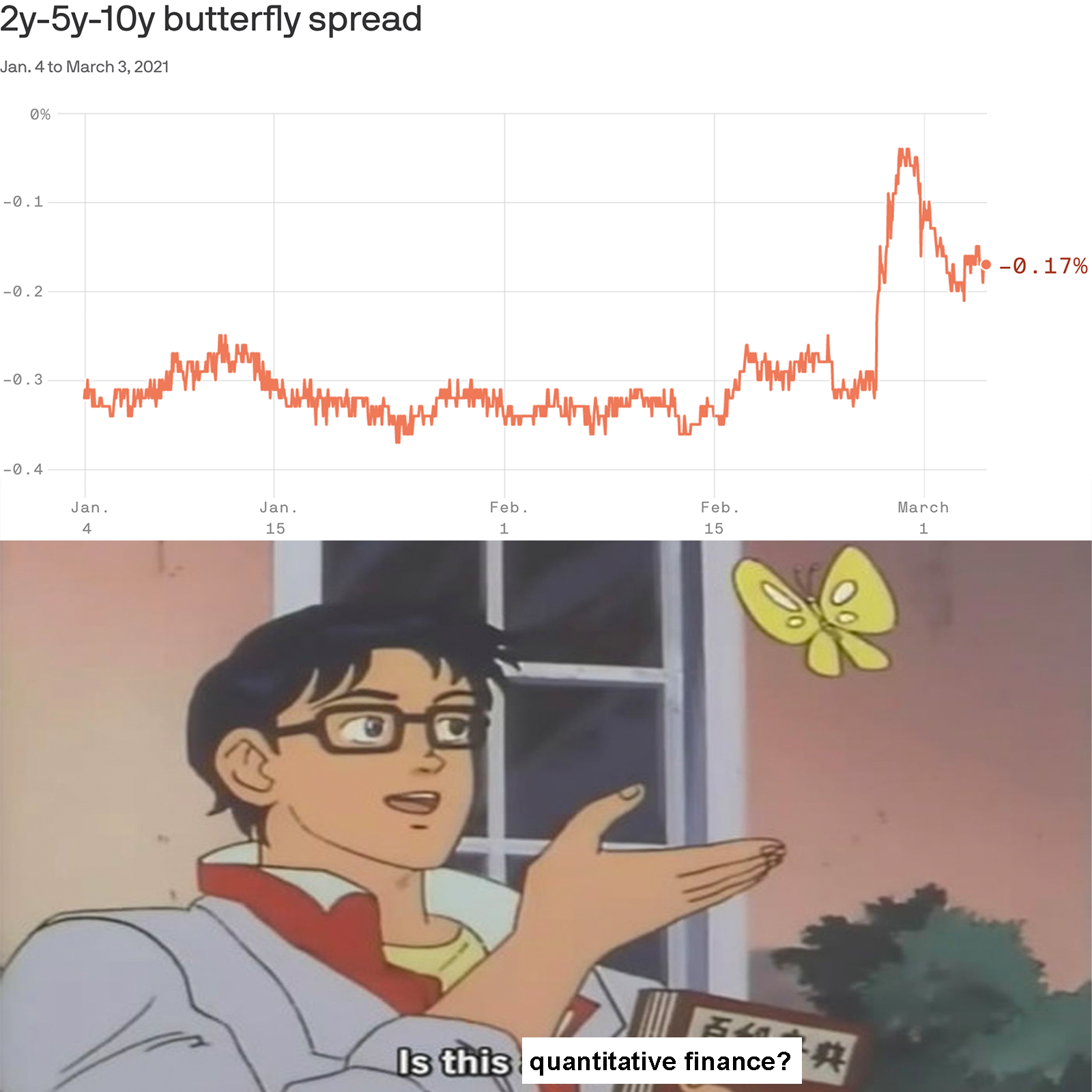
The Treasury market is supposed to be the rock-solid basis of substantially everything else that goes on in the financial economy.
Why it matters: Sometimes, for no obvious reason, it behaves erratically — and last week was one of those times.
- The relative yields of 2-year, 5-year, and 10-year Treasury bonds should not move enormously in the space of just a couple of days — and yet they did.
- That's a sign of worrying fragility in a market that already required emergency central bank intervention this time last year.
7. Coming up: February payrolls
Illustration: Eniola Odetunde/Axios
The February jobs report comes out tomorrow morning, writes Axios' Courtenay Brown.
Why it matters: Jobs growth in January was anemic. The labor market shed jobs in December. The labor market is expected to have improved last month as virus cases plunged.
By how much is anyone's guess: Morgan Stanley sees a tepid gain (+60,000). Bank of America says there will be a sharper rebound (+225,000). The median estimate is 175,000 payrolls added, per FactSet.
- The unemployment rate is expected to tick up 0.1 percentage point from 6.3%.
8. Building of the week: Museum Soulages, France

Photo: Christian Richters/View Pictures/Universal Images Group via Getty Images
French painter Pierre Soulages, still alive at the age of 101, was honored in 2014 with his own museum in his home town of Rodez in southwestern France.
- Designed in weathered steel by Pritzker Prize-winning Catalan architects RCR, the museum comprises a series of simple minimal volumes, most of which have no windows.
Sign up for Axios Capital

Learn about all the ways that money drives the world