Axios Capital

February 04, 2021
Situational awareness: Today's not a great day to be a McKinsey partner. The consultancy just paid $573 million to settle a lawsuit surrounding its role in the opioid crisis — and still faces potential prosecution from the Biden administration over the same issue.
- ✍️ Write less, say more. If you like Axios' trademark Smart Brevity style — this newsletter packs 11 items into 1,762 words, a 7-minute read — then you might be interested in Axios' new internal communications tool, Axios HQ. Learn more on Feb. 9 at 12:30pm ET. Register here.
- In this week's issue: Robinhood, tech profits (and losses), the U.S. yield curve, space SPACs, Wikipedia news, and much, much more.
1 big thing: Why people love to hate Robinhood

Illustration: Aïda Amer/Axios
Never has a company been so popular, and also so hated.
Why it matters: We're now at a key inflection point in the Robinhood saga that's likely to determine whether having a snazzy app with name recognition is all you really need to overcome internal weaknesses.
- Robinhood is loved not only by the trading newbies who are downloading the app at a record pace, but also by Wall Street investors who have recently sunk $3.4 billion into the company.
- The online brokerage has also been relentlessly attacked, however, by everybody from Rep. Alexandria Ocasio-Cortez to Sen. Ted Cruz and Mark Cuban.
The big picture: Robinhood has lurched from crisis to crisis for most of its existence — while also quickly growing.
Driving the news: In 2021 to date, Robinhood has infuriated Redditors, politicians, and regulators for the way in which it curtailed trading in meme stocks, removing a key source of demand for those stocks and seemingly giving the upper hand to the short-sellers that its customers were betting against. It then stumbled trying to explain why it took the actions it did, precipitating dozens of lawsuits.
- Still, Robinh0od then raised another $3.4 billion, at a valuation of as much as $33 billion, depending on where it eventually trades when it goes public.
How it works: The slogan is well known. "If you're not paying for it, you're not the customer, you're the product." Robinhood makes its money by directing its customers' trades to high-frequency traders on Wall Street.
- The overwhelming majority of Robinhood's revenue comes from options trades in particular — an ultra-risky kind of trading where individual investors almost never make money. That means Robinhood's interests are not aligned with those of its customers.
- By the numbers: In December alone, according to an SEC filing, Robinhood received $57.2 million in payment for its options flow. That's more than 33 times the $1.7 million it received in payment for its customers' trades in S&P 500 stocks.
- Zero-fee trading exacerbates volatility, reduces market efficiency, and even hurts market liquidity. A recent paper found that whenever Robinhood suffered an outage, market quality went up while bid-offer spreads went down.
Between the lines: Robinhood is fully reliant on Wall Street, which provides its business model and its investor base. That naturally creates opposition to Robinhood from people who are suspicious of big finance.
- Robinhood also has a brash "move fast and break things" culture typical of Silicon Valley. That doesn't sit well with anybody who thinks companies charged with looking after your money should move cautiously and only when they're certain they can deliver on their promises.
The bottom line: Expect Robinhood's CEO to face some tough and pointed questioning when he appears on Capitol Hill for hearings into stock market volatility later this month. But don't expect Robinhood's investors to care.
- So far none of Robinhood's scandals have curtailed its growth.
2. Vlad be nimble
Illustration: Eniola Odetunde/Axios
Every startup founder and investor in Silicon Valley is chasing after the coveted "tech multiple" — and Robinhood is no exception.
Why it matters: Technology companies are supposed to scale easily: Once you've built the platform, more users just mean more profit. By that standard, Robinhood just found out the hard way that it really isn't a tech company at all.
How it works: When Robinhood sends its customers' trades to high-frequency trading shops, a lot of those trades cancel each other out at the end of the day. If Customer A buys one share of Apple for $135 in the morning and Customer B sells one share of Apple for $134 in the afternoon, then Robinhood only needs to transfer $1 after the trades have netted out.
- During the GameStop frenzy, Robinhood customers were overwhelmingly on one side of the trade, buying rather than selling. As a result Robinhood was likely to have to end up transferring much larger net sums than normal when the trades ended up settling.
- Robinhood therefore faced large collateral requirements from counterparties who wanted to be absolutely sure that they would end up being paid for all the stocks they sold to Robinhood customers. That's ultimately what caused the brokerage to stop allowing its customers to enter into new positions in meme stocks.
Driving the news: Robinhood CEO Vlad Tenev told Elon Musk this week that he was asked to put up $3 billion in collateral — an amount of money the startup didn't have on hand. In the wake of that request, Tenev went out and raised $3.4 billion in new funds, while also taking to his corporate blog to bemoan "the impact the two-day trade settlement period has on investors and ultimately the entire American financial system."
- It's far from clear, however, that Tenev's preferred T+0 settlement period would have been any better for Robinhood. Tenev says he would like to be able to settle trades "in real time" — but that would require pre-funding all trades, in full, which would almost certainly be even more expensive.
The big picture: In Silicon Valley, everybody wants to be efficient. (Robinhood, in its quest for efficiency, still doesn't have a customer service line.)
- Settling trades in real time certainly seems more efficient than settling trades the day after tomorrow. But clearing and settlement is never 100% perfect, and there needs to be some kind of mechanism that accommodates mistakes being made in a way that also allows them to be fixed.
- That mechanism is collateral requirements, which means that Robinhood will never be able to become the asset-light technology company of Silicon Valley's dreams.
The bottom line: The $3.4 billion that Robinhood just raised didn't just dilute existing investors. It also clarified that in the best-case scenario, Robinhood will still be a heavily regulated brokerage with a massive balance sheet, rather than a nimble tech stock.
Bonus chart: How it's going


3. Exclusive: The end of an era at Wikipedia
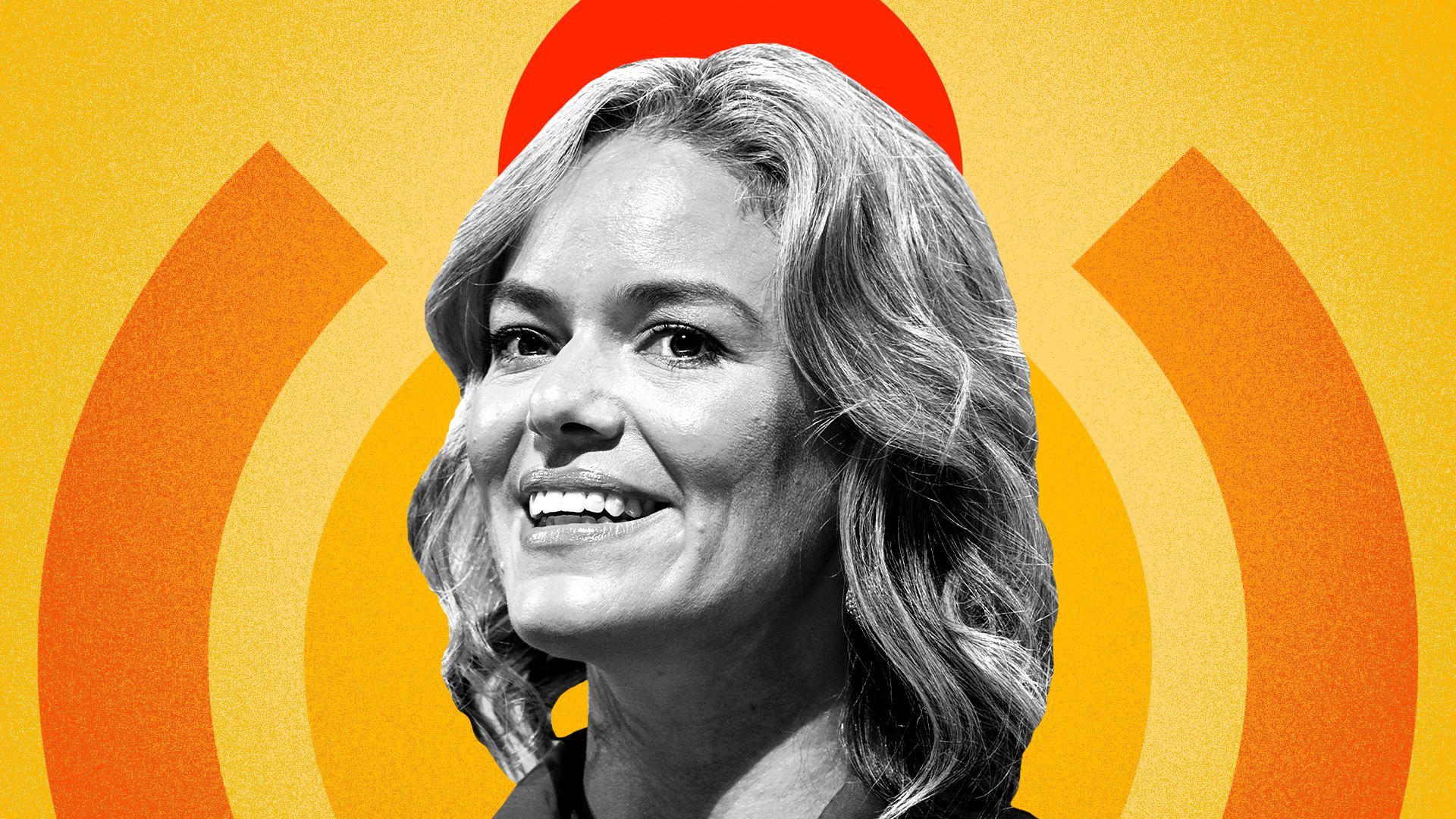
Photo illustration: Aïda Amer. Photo: Horacio Villalobos/Corbis via Getty Images
Wikimedia Foundation CEO Katherine Maher tells Axios she will step down on April 15, leaving the nonprofit in a vastly stronger position than she found it when she joined in 2014.
Why it matters: Wikipedia is growing to become the most global and trusted source of knowledge in the world. Its base of active editors is rising, its number of women editors has increased by 30% just in the past year, and it has upgraded not only its website but also its app, which is now available for feature phones as well as smart phones.
Financially, the Wikimedia Foundation now has an endowment of more than $100 million, and has doubled its annual budget to an estimated $140 million in 2021.
- It's hard to think of any other tech nonprofit that has been remotely as successful. OpenAI effectively became a for-profit in 2019, while Signal is still reliant on a single donor, Brian Acton.
Between the lines: One area that Wikimedia has been particularly successful is in garnering trust. That's where the news media could use some pointers.
- Driving the trust: Maher is proud of her new Universal Code of Conduct, but also credits the diversity of Wikipedia's editors as a key ingredient creating trust in its content.
- "Disagreement is the essential friction that produces our best content," she says.
- A prime example: The magisterial 14,000-word article (plus 492 footnotes and a very detailed discussion) detailing the storming of the U.S. Capitol last month.
What's next: The Wikimedia Foundation board has created a committee to search for Maher's successor. Maher tells Axios that she hopes the next leader will "come from the future of knowledge" — by which she means Africa, the Indian subcontinent, or Latin America.
- Maher herself says she intends to move back to the East Coast. She's up for a challenge — and there are some big jobs available.
4. Internet companies' record profits


The only thing better for Big Tech than the normal economy is the pandemic economy, writes Axios' Courtenay Brown.
Go deeper: Big Tech's banner 2020
5. Cloud wars


Armed with its record profits, Google has been happy to lose astronomical amounts of money on its cloud-services business.
- By the numbers: Google Cloud has lost $14.6 billion over the past 3 years — close to $100 million per week, with the losses rising every year.
- AWS, by contrast, the market leader, has an enviable profit margin of more than 30%, making $13.5 billion on revenue of $43.4 billion in 2020.
- Google remains in distant third place, behind AWS and Microsoft's Azure.
I challenge you to name a single company, or any unit of any company, that has deliberately lost as much money as Google Cloud has in the service of growth. I certainly can't think of one.
Go deeper: How Google Cloud stacks up to AWS
6. The bond market gets optimistic


The markets are more optimistic about growth and inflation than they have been in over four years.
- That's the signal being sent by the U.S. Treasury bond yield curve, where 10-year notes now yield a full percentage point more than their one-year equivalents.
- That might not seem like a lot, but in a world of zero interest rates, it's important. It's a sign the markets are betting that Fed policy will work in terms of creating inflation — something it has signally failed to do over the past decade.
By the numbers: The 10-year breakeven inflation rate — a measure of inflation expectations — has risen to 2.19%, its highest level since 2014.
- The Fed has said that it wants to see inflation above 2% for some time before it starts raising interest rates.
Don't @ me. Inflation is an important part of what the economy needs right now.
7. SPAC: The final frontier
Illustration: Annelise Capossela/Axios
Space is now something you can invest in on the public markets, thanks to special-purpose acquisition companies, or SPACs.
Driving the news: After Virgin Galactic successfully went public via SPAC in 2019, other companies have followed, in including AST SpaceMobile, Momentus, and, now, Astra.
My thought bubble: Space exploration is about as high-risk as companies get. It's an area fraught with unexpected disasters.
- Risk appetite is so high in public markets right now that it makes sense for companies to try to get a stock-market listing. Public shareholders generally get much less angry if their shares decline than private investors do.
8. Draghi returns
Photo: Roberto Monaldo/AM POOL/Getty Images
Mario Draghi is the new prime minister of Italy. As president of the ECB, he kept Greece in the EU and saved the euro. This job might be harder.
9. Coming up: Trump's final jobs verdict
Illustration: Eniola Odetunde/Axios
The January jobs report is out tomorrow, writes Axios' Courtenay Brown.
- It's the final Trump era payrolls release: The survey was conducted the week of the 12th, before Biden took office.
Why it matters: The labor market likely added jobs after shedding 140,000 of them in December.
- The consensus calls for a net gain of 100,000 jobs — though the estimates range from -250,000 to 400,000.
- The unemployment rate is expected to hold at 6.7%.
10. Building of the week: Cube Houses, Rotterdam

Photo by: Masci Giuseppe/AGF/Universal Images Group via Getty Images
Dutch architect Piet Blom designed his iconic Cube Houses in 1977.
- Tilted by 45 degrees, the houses resemble an abstract forest, and collectively form a bridge across one of Rotterdam's busiest roads.
- One of the houses is now a hostel, if you fancy spending a night or two in a unique piece of architecture that's also conveniently located next to Rotterdam Blaak train station.
Sign up for Axios Capital

Learn about all the ways that money drives the world