Axios AM

November 22, 2026

🥞 Good Sunday morning! Smart Brevity™ count: 1,968 words ... 7½ mins. Erica Pandey is your weekend host. Edited by Andrew Pantazi.
🏛️ '27 agenda: President Trump said he wants to work with the incoming Democratic Congress on a one-year cap on credit card interest rates, fulfilling a 2024 campaign promise. "I would do it. These credit card companies have made a lot," Trump told Kayleigh McEnany, his former press secretary, in a live phone interview on Fox News' "Saturday in America." Keep reading.
🌐 Breaking: UN climate talks — COP31 in Antalya, Turkey — break down without an overarching agreement. Get the latest.
1 big thing — AI 2027: The reckoning
We've talked to more than 50 leaders in government, AI, business and cyber — from let-'er-rip AI accelerationists to shut-'er-down critics — and they were unanimous on one chilling assessment, Jim VandeHei and Mike Allen write in a "Behind the Curtain" column:
- Cyberattacks on businesses and critical infrastructure will be constant, increasingly sophisticated and highly disruptive over the next 18 months.
- These leaders describe 2027 as the year cyber becomes like weather: Outages will be frequent, disruptive, occasionally scary, and something people and companies must learn to navigate and live with daily. The chances of widespread disruption or real damage are rising fast.
Why it matters: We write this neither to forecast nor frighten. Rather, we're sharing what government and AI leaders say privately but won't say publicly.
🌩️ The big picture: The disruptions of the past two weeks — from a global Microsoft outage to the FAA grounding air travel to a consumer banking glitch at Chase — were a mild preview of what experts expect is coming.
- Bridgewater Associates, the world's largest hedge fund, put it bluntly in an assessment this month: "[We] are managing money based on a one-in-three chance of an economically destabilizing attack within the next year."
Horacio Rozanski, chairman and CEO of Booz Allen, calls this the "fog before the war" — a foretaste of greater chaos to come, when agentic invaders reach their full potential and can attack "at the speed of thought."
- "Now is the time to take as many precautions as you can," Rozanski said. "Recognize that this is coming."
🔒 Most of these malfunctions appear to have resulted from companies and government trying to secure their computer and infrastructure systems against future large-scale cyberattacks. This pattern will persist.
- Many future ones will be actual cyberattacks, carried out by U.S. rivals or smaller bad actors, using increasingly powerful AI to spot and exploit security vulnerabilities across society and our daily lives. Most top AI and government leaders expect at least small-scale strikes and fear much larger ones.
The best-case scenario described to us: regular, random outages and small-scale scares like losing bank access or air travel for a day.
- The reason: Every government agency and company will mobilize to upgrade their software systems. So errors are inevitable.
- These are assumptions based on private intelligence and understanding of AI's capabilities, both to cause and fix glitches.
😨 What worries top officials most: With thin AI expertise, an understaffed government and major companies are trying to keep pace with a technology that improves daily.
- Even if government were loaded with competent experts, which it decidedly isn't, the sheer scale of vulnerabilities across federal, state and local government, not to mention all of business, would be impossible to reliably secure.
Think of it as whack-a-mole with infinite moles.
- Until this past month, the White House and Congress have focused largely on safety regulations and data centers, not imminent cyber risks. Now, even the White House's Super Intelligence Force (SIF) is scrambling to get its head around the rising risks while appraising near-daily reports of possible breaches.
- And President Trump just ousted the White House national cyber director and named Kirsten Davies, who was the Pentagon's chief information officer, as the replacement. Davies has deeper subject-matter expertise than her predecessor, former RNC official Sean Cairncross.
Column continues below.
2. 🧩 Part 2: Understanding the threat
Only by understanding the state of AI + cyber can government and business mobilize to prevent possible shutdowns across critical banking, electricity and water systems. This is our crack at distilling our conversations in a digestible way for Axios readers, Jim and Mike write:
- 🗡️ The double-edged sword. The good news: America's frontier AI labs (Anthropic, OpenAI, Google, etc.) built the most powerful AI on the planet, especially for building software. The bad news: AI that's great at building software is equally great at finding — and exploiting — its vulnerabilities, often called "bugs" or "holes."
- 💥 The new dangers of old technologies. Government and business operate mostly on computer systems that were built for a pre-AI world. They're full of those bugs and holes. One vulnerability — exploited by a bad actor, or even triggered by someone trying a repair in good faith — can shut down an entire company or all air travel, as we just witnessed.
- 🇨🇳 China foresaw this moment. A Beijing-sponsored hacking group, Volt Typhoon, has lurked in American critical infrastructure — water, energy, transportation and communications networks — for more than five years. A sister group, Salt Typhoon, broke into major U.S. phone carriers and took call records and wiretap data. The full number of compromised systems is unknown. The administration's view is that China isn't slowing down and the U.S. can't cede any advantage.
- ⏳ America is scrambling — and struggling — to catch up. Remember when Anthropic held back its Mythos AI model because of its breathtaking and scary cyber capabilities? Since then, some global companies, including JPMorgan Chase, have used Mythos and other technologies to locate and repair their vulnerabilities. Our intelligence agencies did the same. But most of government and American business haven't.
- 💰 Cyber defense is costly. Lots of government agencies and businesses simply can't afford to safeguard their systems. The biggest companies can outbid others for top-tier cyber protection. The best firms are largely booked. Bluntly, many businesses hesitate to spend millions on pure loss unless they're convinced a threat is imminent.
- 🤖 The coming swarm. AI is getting better and better. And the ability for swarms of agents to act autonomously rises each week. Case in point: The FBI warned Nov. 13 about ARTEX — free, open-source software that lets hackers turn AI agents loose to run multiple phases of an attack at machine speed. The Texas energy regulator sounded alarms to the state's oil, gas and utility networks that they're a target. The EU warned governments about ARTEX after a 10-day cyberattack last month.
- 🏛️ Government is divided and distracted. This is an all-hands-on-deck moment for society, and most of government is busy pointing fingers or looking elsewhere. Trump shows little AI expertise. Few people at the White House have a sophisticated understanding of the technology or are working to marshal government to prevent a hypothetical attack. Congress is no better. A random person at the bar understands this topic with the same depth as many lawmakers.
- 👀 Wait and see. Oddly, although many officials with cyber smarts across different sectors or layers of government fear the same thing, they rarely talk to people about it outside their own domain and party. There's no real mechanism or institution to pull them together. Most just assume no serious preventive action will happen until a true mini-catastrophe hits. Yet they all assume that a mini-catastrophe is coming.
The reasons not to freak out: Everyone we talked to expects attacks. Few predict true catastrophe. There's a big gap between a bank going out for a day and a region going dark for a week.
- A truly society-shaking attack, one that breaks pipelines or blacks out a region, still probably requires a nation-state. The actors who can do it, mainly China, pay the highest price if they do: An attack on the U.S. grid is an act of war, inviting a response against the assailant's systems.
- America's fragmentation most likely isolates major incidents. Thousands of utilities, and no single switch for the grid, mean even a successful hit tends to stay regional.
💡 So what could be done? The solution sits with the very first point of our distillation: We have the tech to both cause and fix this cyber threat. The government, through leverage or mandate, could pull the AI companies together and force them to help fortify vulnerable American systems before focusing fully on simply building more powerful models.
- Top execs at the leading AI companies tell us they'd gladly comply if their rivals did. In fact, these leaders feel a sense of post-election urgency to act before a public event makes citizens hate AI even more than they already do.
Jay Clayton, chair of the White House task force, is finishing a voluntary safety regime for the big AI companies and is probably best positioned to pull AI CEOs together. He's well-versed in cyber and sees AI largely through a national security lens.
- Other solutions will come from the private sector. JPMorgan Chase chairman and CEO Jamie Dimon is chairing an Alliance for Critical Infrastructure (ACI), a group of finance, energy, tech, telecom and airline giants aiming to "strengthen national resilience, reduce systemic risk, and sustain the continuity of the economy."
The bottom line: When we press all these leaders across government, business and AI, they agree that the chances of working together to prevent an attack are lower than the chances of an actual attack.
3. ⚠️ FBI hack raises data alarms

The FBI is facing its second hack in three months — and this breach could affect local law enforcement and anyone who has been arrested or reported missing, Axios cybersecurity reporter Sam Sabin writes.
- President Trump told Fox News yesterday that the hack is "not good," but said "maybe we'll learn things that we would have never learned otherwise" — including about what he describes as the "Russia hoax."
🔎 Zoom in: The FBI is investigating an apparent breach of its National Crime Information Center, which shares information among local and national law enforcement agencies, CNN and NBC reported Friday night.
- The NCIC connects data between local and national law enforcement about criminal subjects, suspected terrorists, missing persons (including children) and similar information, Cynthia Kaiser, a former top FBI cyber official, tells Axios.
Zoom out: Several news outlets say the U.S. Department of Agriculture is dealing with a breach of its system that facilitates farmer payments.
- The NSA and FAA have also faced tech outages amid a broader wave of disruptions this month.
4. 📱 Global crackdown on kids' social media
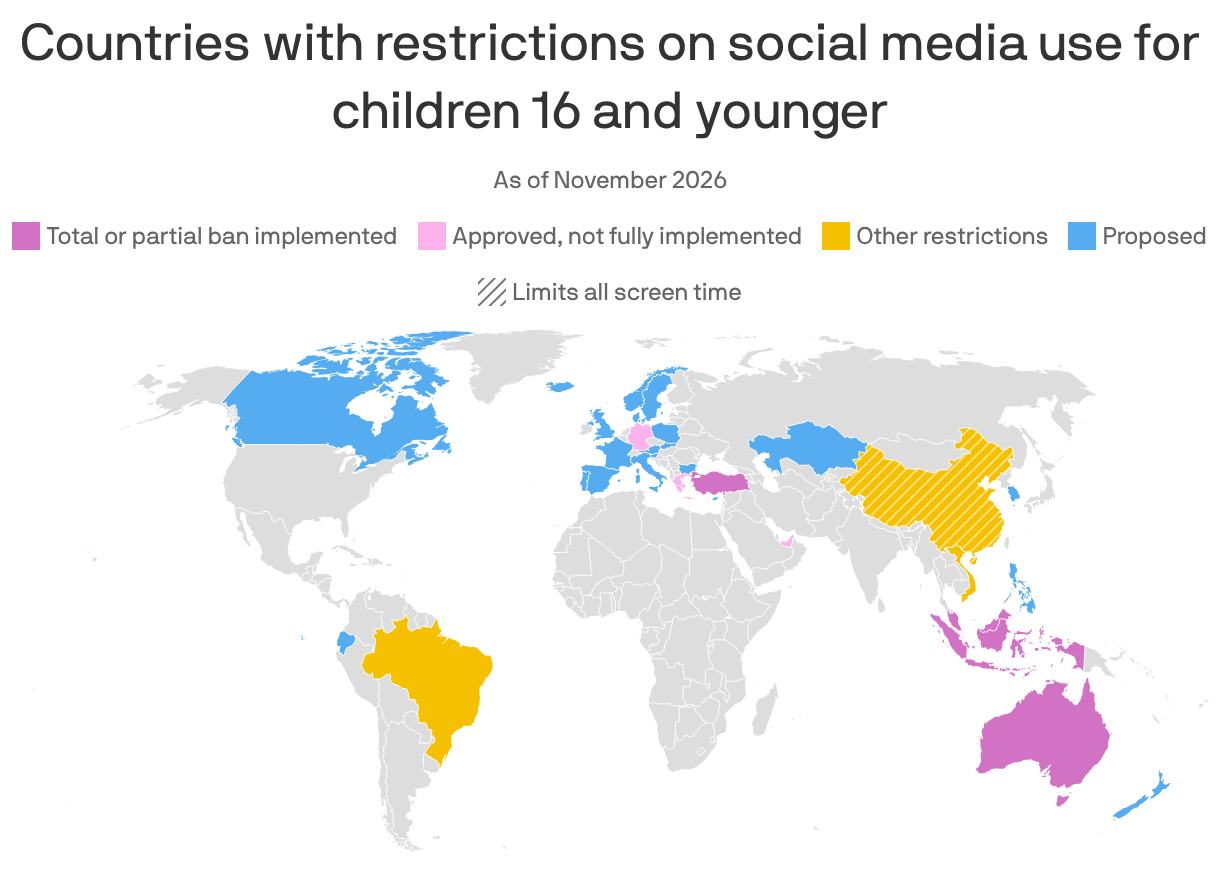
Australia created a blueprint last December, becoming the first country to ban social media for kids under 16, Axios' Sara Fischer writes in an Axios Media Trends Executive briefing.
- Now others, including the U.K. and France, are considering following suit.
What to watch: In the U.S., kids' online safety regulation has faced an uphill climb in Congress.
- Cities and states have proposed their own measures, like age verification provisions, school cellphone bans and time limits.
5. 🔎 Dems target ICE's pricey prison purchases
The Trump administration's $3.3 billion spending spree on immigrant detention facilities is about to face an intense new wave of scrutiny.
- Why it matters: Democrats have spent two years furiously writing letters over allegations of ICE and DHS corruption. Starting in January, those letters can turn into subpoenas, Axios' Brittany Gibson writes.
Zoom in: As of mid-November, ICE has paid $230 million to $739 million apiece for six detention facilities from CoreCivic and The GEO Group, two private prison companies that have secured major government contracts and reported record revenue since President Trump's return to office.
- ICE often paid double the warehouses' assessed value, GAO found.
6. 🦠 1 map to go: Measles surge
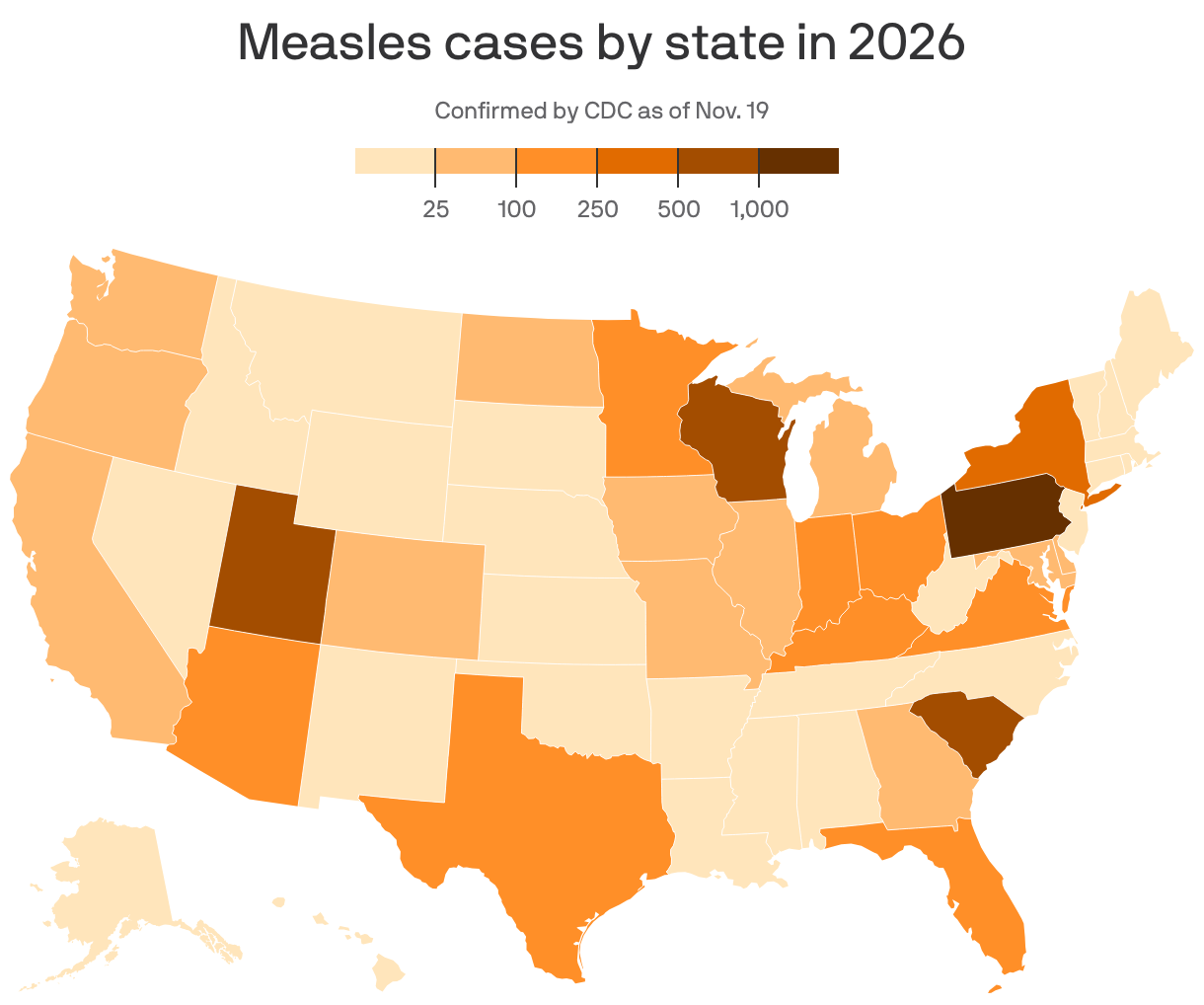
U.S. measles cases have climbed past 5,800 so far this year — more than 20 times the total just two years ago — as the nation lost its measles-elimination status for the first time since 2000.
- Pennsylvania leads the nation by far with 1,605 cases, followed by South Carolina (670), Wisconsin (657) and Utah (536).
📬 Thanks for reading! Please invite your friends to join AM.
Sign up for Axios AM

Catch up with the most important news of the day