Axios AM Deep Dive: Hard Truths
June 19, 2021
Good afternoon and welcome to the eighth in our Hard Truths Deep Dive series, exploring systemic racism in business ownership and leadership.
- Smart Brevity™ count: 1,488 words ... 5½ mins. Led by Aja Whitaker Moore, Sara Kehaulani Goo and Michele Salcedo.
💸 Please join Axios' Courtenay Brown and Hope King on Tuesday at 12:30 p.m. ET for a Hard Truths virtual event on economic recovery among business owners of color, featuring Small Business Administrator Isabel Guzman and Melissa Bradley, founder of 1863 Ventures. Sign up here.
1 big thing: Barriers to Black capitalism

Illustration: Aïda Amer/Axios
When a bank turned down George Johnson for a business loan in the 1950s, he got creative. He returned and told the bank he needed $250 to take his wife on a vacation — and was approved.
- Then he invested the cash in his business, which became the first Black enterprise to trade on the American Stock Exchange, Axios' Russell Contreras and Fadel Allassan write.
Why it matters: Highways to success in the U.S. market economy — in entrepreneurship, corporate leadership and wealth creation — are often punctuated with roadblocks and winding detours for people of color.
The story of how that agile entrepreneur created Johnson Products exemplifies the barriers Black Americans face in building businesses a century after slavery and decades after Jim Crow laws.
- Born in a three-room sharecropper's shack in Mississippi, Johnson dropped out of high school and worked as a door-to-door cosmetics salesman.
- Johnson and his wife, Joan, used their "vacation loan" and another $250 loan from a friend to create a hair relaxer for men in the 1950s, then promoted their products in Black-0wned magazines and newspapers.
- Eventually, the personal care products company vastly expanded after advertising on "Soul Train," the American music-dance television program created by Don Cornelius, another Black risk-taker.
Zoom out: Despite a jarring racial wealth gap, there are many examples of successful Black, Latino, Asian and Native Americans in business.
- McDonald's became one of the greatest generators of Black wealth in America, historian Marcia Chatelain wrote in "Franchise: The Golden Arches in Black America."
- The chain sought Black franchisees after 1968, provided jobs in impoverished areas, and sponsored Black Little League teams and gospel choir events.
- But the proliferation of fast-food restaurants in communities of color gave rise to obesity and diabetes, and added to health care costs.
- A group of Black franchise owners last year accused McDonald’s of racial discrimination for steering them to underperforming stores. A federal judge this month dismissed a lawsuit brought by the owners.
In cities across the U.S., Black business communities have been demolished in the name of "urban renewal."
- In New Orleans and Kansas City, mostly white bureaucrats saw nonwhite areas, with cheaper land and less solidified political opposition, as fit for demolition, following a national playbook.
2. Charted: Who owns America's businesses
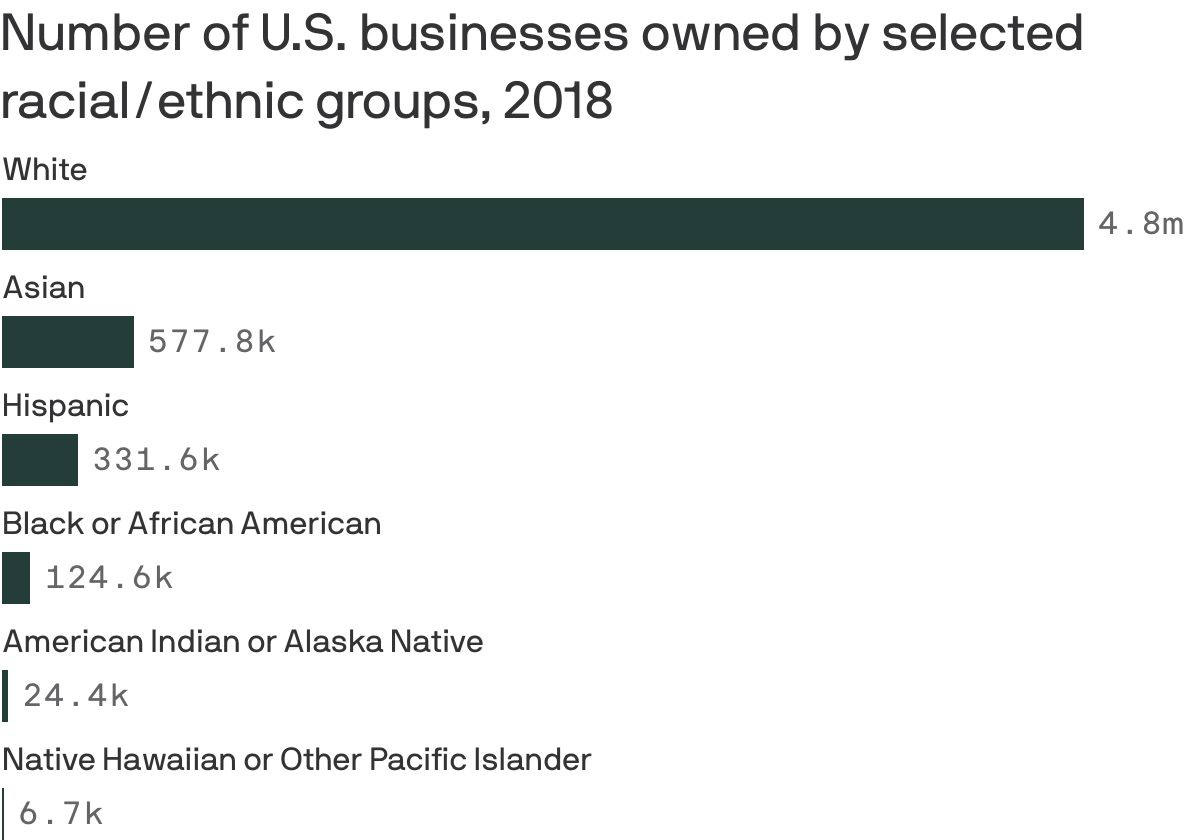
Only 18.3% of American businesses are minority-owned, according to the Census Bureau, despite minorities comprising 40.3% of the population, Axios' Dan Primack and Kia Kokalitcheva report.
- Why it matters: Business ownership can create wealth. And wealth begets wealth.
The inequality may be even more severe than the numbers suggest, since they were compiled before the pandemic. Businesses owned by Black, Latino and Asian Americans were decimated in 2020.
- The National Bureau of Economic Research estimates that the number of Black business owners decreased by 41% between February and April 2020. The number of Latino business owners fell by 32%, Asian business owners declined by 26% and white business ownership was off by 17%.
- One reason for the higher closure rate is that minority-owned small businesses tend to have smaller cash buffers than do white-owned small businesses. And the New York Fed notes that many Black-owned businesses are concentrated in cities hit hard by the virus.
3. Why the C-suite remains elusive

Photo illustration: Sarah Grillo/Axios. Photo: FPG/Archive Photos/Getty Images
When trying to raise capital for a startup, "it was such a grueling process to even get meetings with people," Andrew Sampson, founder and CEO of the app Rainway, who is Black, told Axios' Erica Pandey. "It was the lack of having a network."
- Why it matters: If companies diversify at their current glacial pace, it'll take nearly a century for Black and Latino professionals to get to proportional representation at the manager level.
What's happening: A slew of structural inequities keep people of color out of leadership roles.
- Networks: Studies show people often hire, mentor and eventually promote those who look like them. That means older white men continue to be power brokers at companies of every type and size.
- Geography: 60% of Black workers live in the South, which has far fewer hot job centers than other parts of the country, notes a McKinsey analysis. Put another way, only 1 in 10 Black workers live in cities with high projected growth, like Seattle or Provo, Utah.
- Turnover: Attrition rates for Black and Latino professionals at companies are disproportionately high, often because they don't feel respected or valued at work.
4. The Fortune 500, by the numbers
Illustration: Shoshana Gordon/Axios
Succession planning is intentional — and underrepresentation in the C-suite endures despite growing evidence that diversity is good for the bottom line, Axios' Kate Marino and Kia Kokalitcheva report.
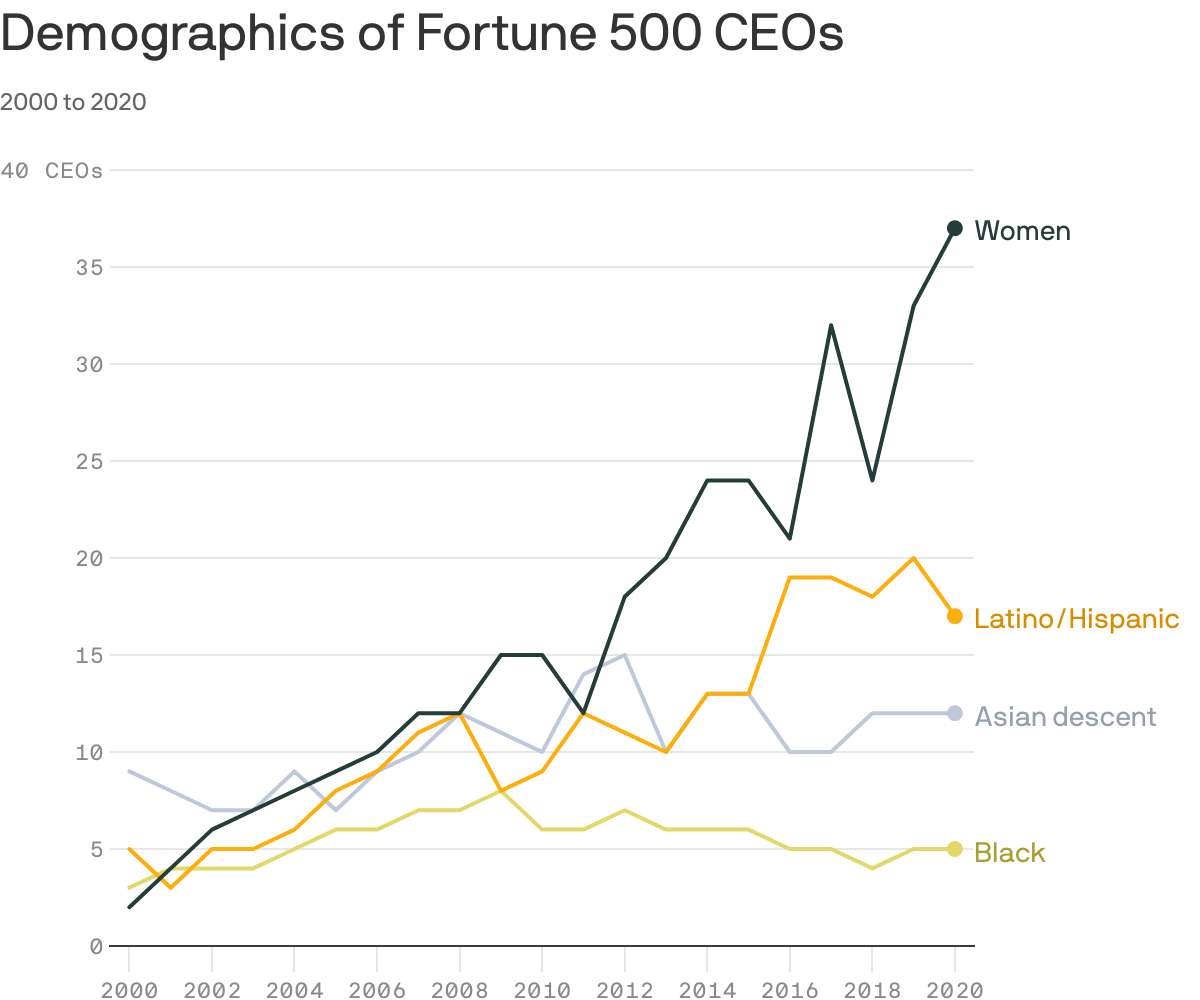
People of color on a path to leadership often confront a system that looks like this:
- Affinity bias — the inclination to choose people like ourselves — is prevalent, notes a report on Black leaders by executive search firm Russell Reynolds.
- The P&L pipeline: Roles that feed into the C-suite typically oversee big accounts or carry profit-and-loss (P&L) responsibility. Employees of color — and women — are underrepresented in those roles.
- A higher standard: Nearly 60% of Black P&L leaders interviewed in a Korn Ferry study described having to work twice as hard to be seen on the same level as their colleagues.
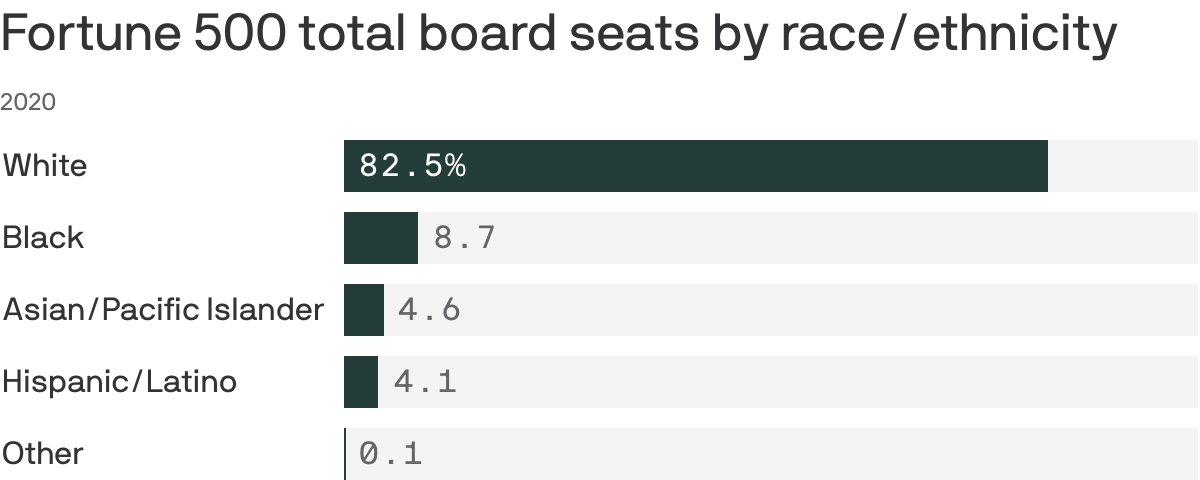
Yet the financial benefits of leadership diversity can be significant.
- McKinsey found that ethnically diverse executive teams are 36% more likely to see top financial performance.
- Boston Consulting Group determined that companies with above-average leadership diversity generated innovation-related revenue 19 points higher than companies with below-average diversity.
5. How diversity became a billion-dollar business

Illustration: Annelise Capossela/Axios
More than ever, businesses are being pressured — by employees, consumers and shareholders — to fix their systemic problems, Axios' Courtenay Brown found.
- Why it matters: The top ranks of America's businesses have a huge void of people who look like the Black, Latino, Asian and Native American consumers from whom they collectively rake in billions of dollars each year.
The big picture: Since the Civil Rights era, companies have been called on to make decision-makers less white. The textbook strategies companies tout — diversity training, for one — have largely failed.
- "There's been a lot of lip service," says Jennifer Brown, a diversity and inclusion consultant who's worked with at least 1,000 companies. "It's the optics of doing something."
Diversity training started to crop up to “protect [companies] against and settle civil rights suits,” Billy Vaughn, who’s studied the history of diversity training, wrote in 2007.
- It's ballooned into a billion-dollar industry. The sessions are a quick fix (they're rarely longer than an hour) for a problem they alone won't ever solve.
- Employee resource groups are often "the engine of [a company's] diversity strategy ... but it's the most blatant example of a side hustle," says Stephanie Creary, a Penn management professor.
What's next: In the past year, corporations threw their financial might behind external efforts — donations to civil rights organizations, funding for initiatives to tackle the racial wealth gap and spending with Black-owned businesses.
- After George Floyd's murder, companies pledged $50 billion — though just $250 million has been spent or set aside for a specific cause, according to a study quoted by Fortune.
6. Four remedies
Illustration: Annelise Capossela/Axios
Porter Braswell — co-founder and CEO of Jopwell, a technology platform that enables diversity hiring — went to Yale, then thrived at Goldman Sachs. When Braswell, who is Black, tried breaking into entry-level sales positions at tech companies, he was told his skills weren't transferrable, Kate Marino writes.
- "I had to go out and build my own tech company to break into tech," he says.
Here are some of the ways companies are trying to diversify:
- Widening the lens for recognizing talent and redefining who's qualified — from entry-level to boards.
- Doubling down on sponsorship. Sponsoring goes beyond mentoring. It's championing someone else’s career and opening doors for them. "Sponsorship — at scale — is the most important thing we can do," says PwC U.S. chairman Tim Ryan.
- Tying CEO pay to diversity. The boards of some large companies have set metrics that drive compensation.
- Diversity riders. In venture capital, these contractual agreements ensure that investors from underrepresented backgrounds get a chance to invest in — and profit from — startup deals.
🎧 In a new Hard Truths edition of our "Axios Today" podcast, host Niala Boodhoo talks with two Black and Latina business owners who are trying to reclaim cannabis. The plant led to a disproportionate number of Black Americans having criminal records. Now, it's a thriving business.