Axios AM

June 02, 2025

1 big thing: Trump's America-First AI risk

2. 🎲 Part 2: Trump's epic gamble
Trump's tariffs spooked these two allies and many others who could legitimately form a massive, united counterweight to China. That has slowed discussions of a united front in case America and China fully decouple.
- In fact, Europe and China are now talking more actively, in a sort of "the trade enemy of my trade enemy is my friend" dialogue.
- Trump has tightened relationships with rich nations in the Middle East, and sees the Saudis and others as displacing European nations as part of the global American coalition. But those same nations are close to China, too, and have little incentive to pick sides so decisively.
- The Trump-Biden export controls rely on countries involved in the cutting-edge chip supply chain — Japan, the Netherlands, South Korea and Taiwan — agreeing to harm their own companies' business in China to form a united front with the U.S. Trump has given them reason to reconsider.
🔭 Zoom out: Trump, in public, has been all over the place on China, much like he has on trade policy. He talked tough early, slapped on 145% tariffs — then sent Treasury Secretary Scott Bessent out to argue the broader trade strategy was a chess move to isolate China.
- But then Trump reduced the tariffs, suggested peaceful competition was possible, and reignited trade talks. Now, he's back to talking tough and firing off social media warnings about calling them off again.
- Meanwhile, China keeps racing ahead on drones, cars, quantum computing and batteries. Beijing holds all the leverage on the rare earth minerals the U.S. so desperately needs.
The other side: Administration advisers tell us there's more coherence to the Trump strategy than meets the eye. Trump believes he'll ultimately create a coalition of willing trading partners, with more favorable terms for America, to rival China.
- He also believes his tactics will nudge Canada, Greenland, Ukraine and others to share essential minerals and AI ingredients — and that U.S. workers will benefit from better-paying jobs in this new economy.
Understanding that countries need AI and just choose between the U.S. and China, Trump sees the opportunity to leverage the U.S. AI lead to both bring countries onto U.S. systems — and to get investment back into the U.S. to fund critical AI infrastructure, including OpenAI's Stargate.
- An OpenAI official who has worked closely with Trump officials told us the administration excels at AI diplomacy and is executing a sophisticated strategy.
- "They get it," the official said, "particularly when it comes to making sure the world is going to build out on U.S.-led AI rails, while also using the interest in U.S. AI to get reciprocal investment into U.S.-based infrastructure."
👀 The potential flaw: Trump is making an epic gamble. And China sees the opening.
- Share this column ... Ben Berkowitz and Dave Lawler contributed reporting.
3. Terror attack on Colorado rally for Israeli hostages
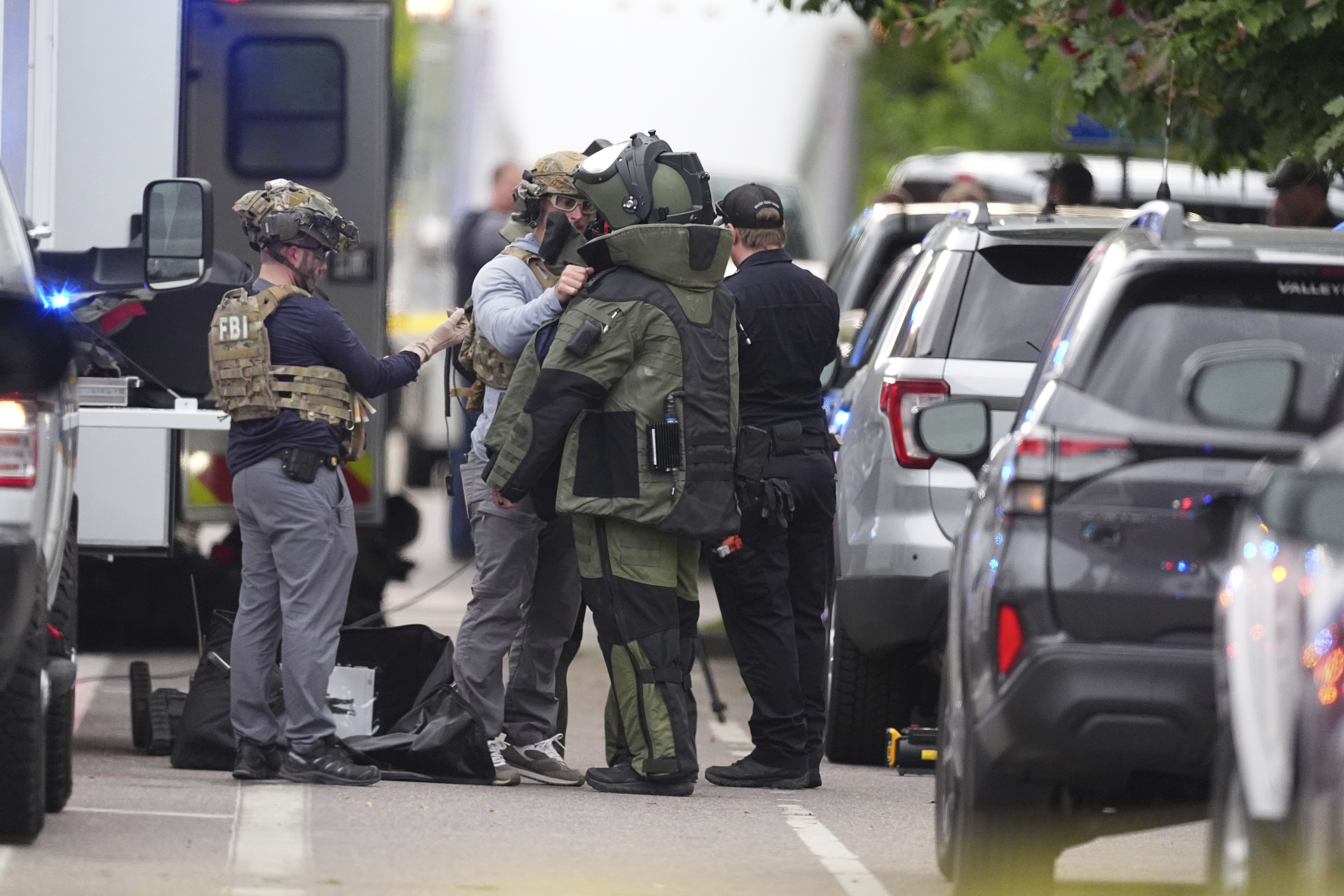
Eight people were injured in Boulder, Colorado, yesterday when a man "used a makeshift flamethrower and threw an incendiary device" at a group of demonstrators calling for the release of Israeli hostages held by Hamas, the FBI said.
- The agency called it a "targeted terror attack" and said the suspect — identified as 45-year-old Mohamed Sabry Soliman — yelled "Free Palestine." The suspect is in custody and the FBI believes he acted alone.
The victims had been participating in Run For Their Lives, a weekly walk on Pearl Street — a popular pedestrian strip lined with restaurants and shops.
- The injuries range in severity. Two victims were airlifted to a burn unit.
- Authorities were called to the scene after receiving reports that people had been "set on fire."
Between the lines: The attack occurred barely a week after a man who also yelled "Free Palestine" was charged with fatally shooting two Israeli embassy staffers outside of a Jewish museum in D.C. (AP)
4. 🇨🇳 Exclusive: China's favorability flip


U.S. trade policy is making China great again — at America's expense, Axios' Emily Peck writes from a Morning Consult analysis.
- Why it matters: The drop in America's reputation is already costing the country economically through a fall in foreign visitors turned off by White House policies, and even the decline of the dollar.
5. 💥 Ukraine's massive drone strike

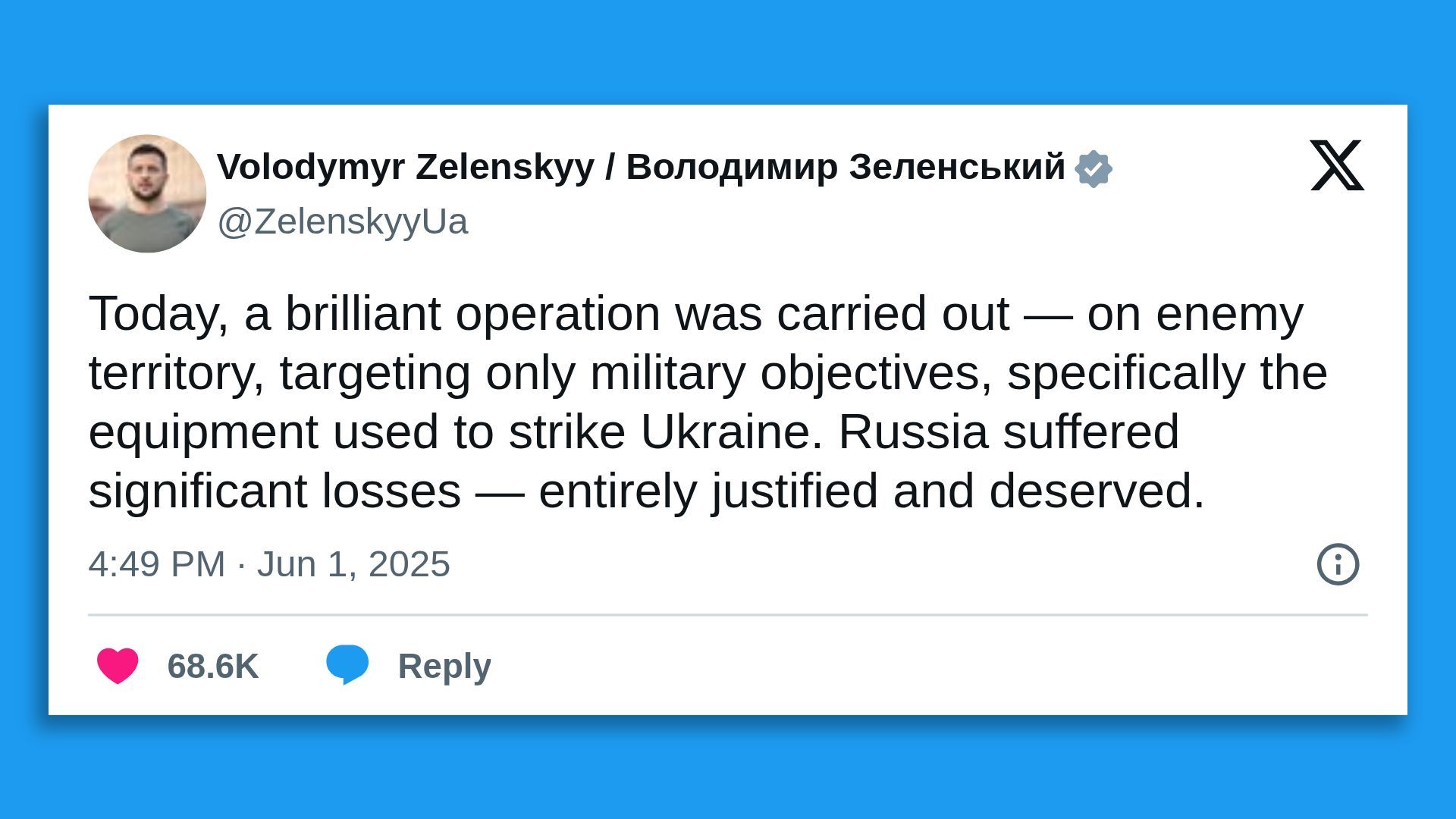
Ukraine launched unprecedented drone strikes deep inside Russia yesterday, targeting dozens of strategic bombers at several bases, Axios' Barak Ravid writes.
- Why it matters: The wide-ranging attack took place shortly before Ukrainian President Volodymyr Zelensky announced he is sending a delegation to ceasefire talks with Russia in Istanbul today.
A Ukrainian official told Axios the operation codenamed Spider Web was conducted by the country's security service and was planned for a year and a half.
- Zelensky said that the Ukrainian intelligence agents managed to work for months inside Russia under the nose of the Russian FSB domestic security service.
🔭 Zoom in: Ukrainian intelligence agents launched 117 attack drones from trucks that have been covertly placed near Russian air bases — some of them in Siberia, thousands of miles from Ukraine.
- Around 40 Russian military planes — most of them strategic bombers — were reportedly hit in the attack.
6. 🤖 Web's slow death
/2025/06/02/1748822737721.gif?w=3840)
7. 💰 First look: Walmart tops Fortune 500
8. 🥩 1 for the road: Axios KC launches

Abbey Higginbotham and Travis Meier — co-authors of Axios Kansas City, which launches today as the 33rd city for Axios Local — salute the skyline of Kansas City, Missouri, from Percheron Rooftop Bar, atop the Crossroads Hotel.
- Abbey tells me: "Kansas City is the first place that's ever really felt like home. I grew up a military kid and moved constantly. But I've been here on and off since 2017 — long enough to fall for the skyline at golden hour, the old buildings with stories baked in, and how people here treat strangers like neighbors. I'm drawn to stories with character: hyperlocal politics, small businesses with big personalities, and the people quietly shaping what KC becomes. Readers want that too — not just what's happening, but why it matters and who's really behind it."
- Travis, who was recommended to us by the great David Von Drehle, tells me: "Kansas City has this infectious hometown energy that's hard to resist and just plain fun. Since moving to KC in 2019, it's been a whirlwind of record-breaking sports — combined with an urban renaissance, massive population growth, and supercharged international attention. I've become obsessed with telling stories about the people here who build cool things, whether they be businesses, stadiums or skyscrapers."
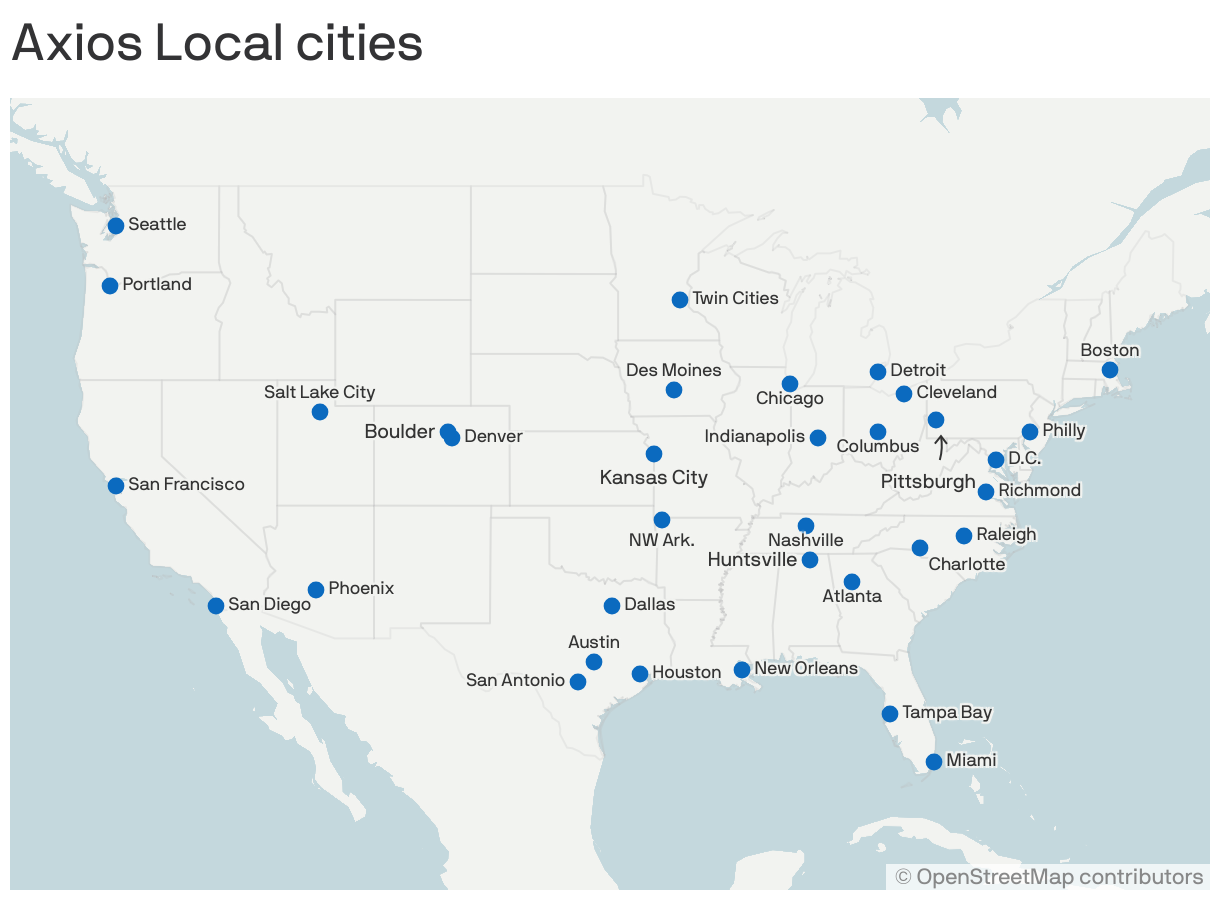
We're very proud of this Axios Local map — 34 great American cities, each with full-time journalists on the ground (most of them born-and-bred), with their own locals-only newsletter.
Axios AM