Axios AM

August 11, 2025

☀️ Good Monday morning. Smart Brevity™ count: 1,488 words ... 5½ mins. Thanks to Noah Bressner for orchestrating. Copy edited by Bryan McBournie.
1 big thing: Your smarter fake friends
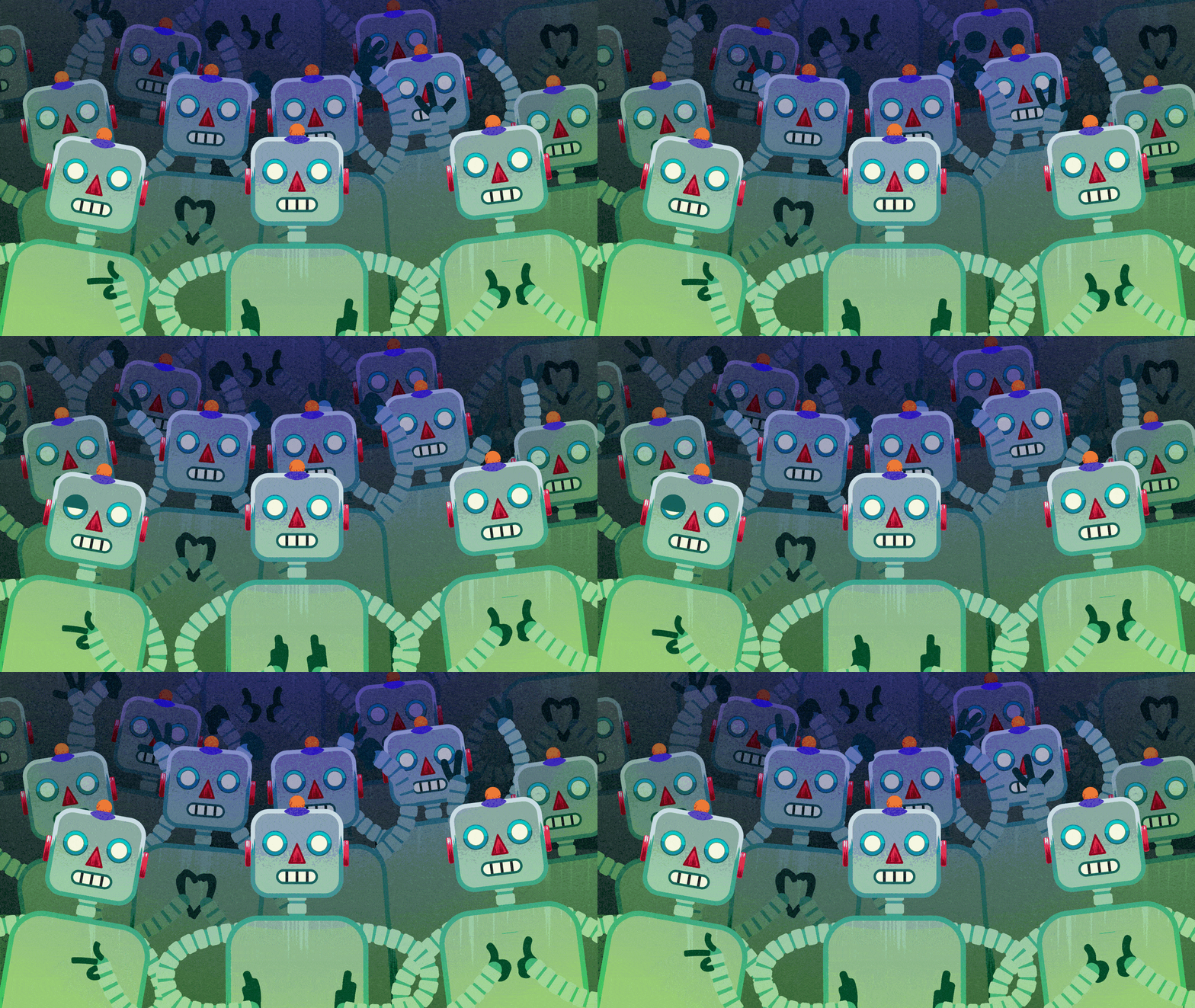
Your fake friends are getting a lot smarter ... and realer, Jim VandeHei and Mike Allen write in a "Behind the Curtain" column.
- Why it matters: If you think those make-believe people on Facebook, Instagram and X — the bots — seem real and worrisome now, just wait.
Soon, thanks to AI, those fake friends will analyze your feeds, emotions, and habits so they can interact with the same savvy as the realest of people.
- The next generation of bots will build psychological profiles on you — and potentially billions of others — and like, comment and interact the same as normal people.
- This'll demand even more vigilance in determining what — and who — is real in the digital world.
A taste of the future: Brett Goldstein and Brett Benson — professors at Vanderbilt University who specialize in national and international security — show in vivid detail, in a recent New York Times op-ed, the looming danger of the increasingly savvy fake world.
- They dug through piles of documents uncovered by Vanderbilt's Institute of National Security, exposing how a Chinese company — GoLaxy — optimizes fake people to dupe and deceive.
"What sets GoLaxy apart," the professors write, "is its integration of generative A.I. with enormous troves of personal data. Its systems continually mine social media platforms to build dynamic psychological profiles. Its content is customized to a person's values, beliefs, emotional tendencies and vulnerabilities."
- They add that according to the documents, AI personas "can then engage users in what appears to be a conversation — content that feels authentic, adapts in real-time and avoids detection. The result is a highly efficient propaganda engine that's designed to be nearly indistinguishable from legitimate online interaction, delivered instantaneously at a scale never before achieved."
🔎 Between the lines: This makes Russia's bot farms look like the horse and buggy of online manipulation. We're talking real-time adaptations to match your moods, or desires, or beliefs — the very things that make most of us easy prey.
- The threat of smarter, more realistic fake friends transcends malicious actors trying to warp your sense of politics — or reality. It hits your most personal inner thoughts and struggles.
State of play: AI is getting better, faster at mimicking human nuance, empathy and connection.
- Some states, including Utah and Illinois, are racing to limit AI therapy. But most aren't. So all of our fake friends are about to grow lots more plentiful.
A Harvard Business Review study ($) earlier this year found the number one use case of chat-based generative AI is therapy ("structured support and guidance to process psychological challenges") and companionship ("social and emotional connection, sometimes with a romantic dimension").
- AI-based therapy, the article notes, is "available 24/7, it's relatively inexpensive (even free to use in some cases), and it comes without the prospect of judgment from another human being."
That research is congruent with what the biggest AI companies are finding: Humans are increasingly turning to AI to be buddies and shrinks. That brings a passel of possible problems — from unregulated robots offering bad advice, to unhealthy human attachment to an artificial thing. Some clinicians are already informally calling it "AI psychosis."
- The Wall Street Journal found by examining public chat transcripts that bots sometimes egg on users' false premises. To go along with AI hallucination, clinicians are informally calling this phenomenon "AI psychosis" or "AI delusion."
- There's obvious upside, too: Loneliness can be deadly, and good therapy can do great things for someone struggling. Meta, as Axios reported in May, envisions chatbots as "more social" — potentially an extension of your friend network, and antidote to the "loneliness epidemic."
What you can do: Be vigilant. This is all happening now. It's safe to assume AI only gets better, and bad actors more clever. Don't assume every person online is real — much less a real friend.
2. 💰 Trump takes cut of China chips

The U.S. government will take a 15% fee on some of Nvidia's and AMD's chip sales to China as a condition of granting them export licenses to sell in the country, a Trump administration official confirmed to Axios' Ben Berkowitz.
- Why it matters: While export controls for sensitive products are nothing new, charging a company 15% of its revenue to sell a particular product to a particular country is unprecedented.
The two chip companies agreed to the fee structure last week, The Financial Times first reported ($).
- The deal applies specifically to Nvidia's H20 chip and AMD's MI308, both crucial to AI applications.
3. 🏛️ Trump's capital crackdown

Federal law enforcement officers spread across D.C. as part of a crime crackdown by President Trump, Axios' Mimi Montgomery, Avery Lotz and Anna Spiegel write.
- Why it matters: The president has hinted that more action is coming. Trump plans to host a press conference today at 10 a.m. ET that will involve "ending the Crime, Murder, and Death in our Nation's Capital."
Trump ordered homeless people to "move out" of the city in a Truth Social post yesterday, vowing to "make our Capital safer and more beautiful than it ever was before."
- He promised individuals "places to stay," but "FAR from the Capital."
- Trump added that criminals would be jailed — where he said they "belong" — and that it all will happen "very fast."
🔭 Zoom in: The FBI is deploying approximately 120 agents across the city in overnight shifts to assist D.C. police in combating crimes such as carjackings, The Washington Post reports.
- The Secret Service and Secret Service Uniformed Division have been instructed to begin extra patrols.
- The Pentagon is preparing for hundreds of National Guard troops to be activated and deployed to D.C., Reuters reports.
4. 🌡️ Stat du jour: Stickiest summer
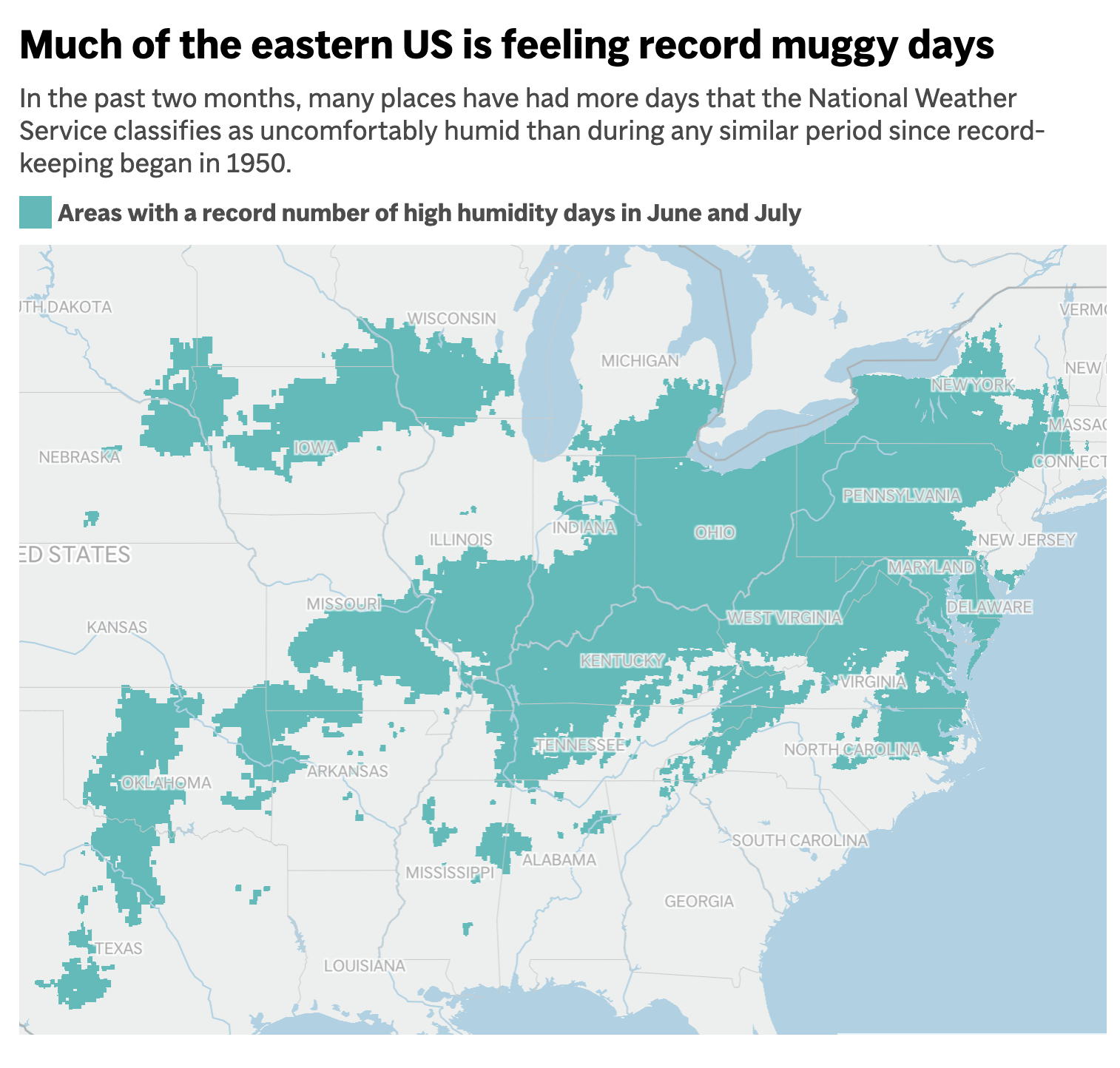
More than 70 million Americans east of the Rockies sweated through the muggiest first two months of summer on record, according to an AP analysis.
- Parts of 27 states and D.C. had a record amount of days that meteorologists call uncomfortable — with average daily dew points of 65°F or higher — in June and July.
5. 😵💫 Tariff chaos cycle

The White House's habit of rolling out sweeping tariff announcements with little detail has left investors scrambling for information, Axios Markets author Madison Mills writes.
- Then, often days later, key clarifications or exemptions follow.
Why it matters: Even countries with direct involvement in the deals have been caught off guard by White House statements.
🔭 Zoom in: Japan thought it received a 15% tariff rate on all goods. But confusion ensued after the wording of an executive order unexpectedly indicated that the rate would be stacked on top of other previously announced levies.
- Japanese officials say the White House will correct the order, though it's unclear when that will happen.
There was also a dust-up last week after reports that gold bars from Switzerland would be tariffed pushed U.S. gold prices to a record high.
- The White House stepped in to clarify: Expect an order that'll make the situation clear later.
💡 How it works: The White House issues a broad tariff announcement, without specifics and very rarely in writing.
- Investors, executives and policymakers scramble to clarify the impact on their sector.
- Panic ensues, and investors move money around.
- The White House clarifies the original tariff announcement.
- Market reactions ease.
6. 🤖 Apple's "hands-free" feature
An upcoming Apple voice-control feature will change how people use their iPhones — "if it works," Bloomberg's well-wired Apple expert Mark Gurman writes.
- Why it matters: The new hands-free upgrade — part of the company's delayed Siri revamp — is "the key to Apple's next hardware developments."
With the upgrade, known as "App Intents," Siri would be able to essentially "operate your apps like you would — with precision, inside their own interfaces." Gurman notes this would include:
- Finding a specific photo, editing it and sending it off.
- Logging in to a service without touching the screen.
- Scrolling a shopping app and adding something to your cart.
🔮 What's next: Apple plans to launch the feature this spring as part of a broader Siri overhaul, with a heavy marketing campaign.
- Keep reading (gift link).
7. 🤹 Bessent's extra job

Treasury Secretary Scott Bessent will become the Internal Revenue Service's acting head after the sudden departure of Billy Long, who served as IRS commissioner for under eight weeks, Axios' Avery Lotz writes.
- Why it matters: Bessent joins several other administration officials who are juggling multiple government posts under President Trump.
🇮🇸 Long, a former congressman from Missouri and an auctioneer, said Trump tapped him to be ambassador to Iceland.
- Keep reading ... Go deeper: 7 other Trump officials wear multiple hats (NYT gift link).
8. 🐶 1 fun thing: World's ugliest dog

Petunia, a hairless English-French bulldog mix from Oregon, was crowned the winner of the World's Ugliest Dog Contest — an annual competition in California.
- Why it matters: "The contest speaks to the importance of advocating for the adoration of all animals and the benefits of adopting," organizers say.
📬 Thanks for reading! Please invite your friends to join AM.
Sign up for Axios AM