Axios AM

August 06, 2026

πΆοΈ Happy Thursday! Smart Brevityβ’ count: 1,625 words ... 6 mins. Thanks to Noah Bressner for orchestrating. Edited by Andrew Pantazi and Bill Kole.
ποΈ Driving the day: A Senate panel is expected to vote this morning on whether to hold Anthony Fauci in contempt of Congress for refusing to answer questions. Get the latest.
1 big thing: Singularity arriving
Top AI architects say their technology has arrived at a threshold once confined to science fiction: the singularity, when machines begin accelerating their own evolution, Axios' Ina Fried and Zachary Basu write.
- Why it matters: If these moguls are right, we may be entering the most consequential technological transition in human history β the opening stages of an "intelligence explosion" that transforms civilization faster than humanity can understand or control.
Upheaval at Google yesterday β with DeepMind founder and CEO Demis Hassabis changing roles β offers the clearest institutional evidence yet that AI's architects see something extraordinary approaching.
- Hassabis β who has declared we're "standing in the foothills of the singularity" β is handing over day-to-day control to become Alphabet's chief scientist and chair of Google DeepMind, with a focus on the future of artificial general intelligence.
- OpenAI CEO Sam Altman said on the "Relentless" podcast last month that "we are now, like, in the singularity."
- Elon Musk, Altman's fiercest rival, has made the same argument since January. Last week, he doubled down: "AI is already superhuman at many things. We are in the Singularity."
- Anthropic, whose CEO Dario Amodei prefers the term "the AI exponential," says Claude is already helping build more powerful AI and could soon automate nearly all AI research and engineering.
πΌοΈ The big picture: The industry has yet to achieve full "recursive self-improvement", the point at which AI can repeatedly help build increasingly powerful successors with minimal human guidance.
- Yet pieces of the loop are beginning to fall into place. Frontier models are beginning to automate research, produce original discoveries and display forms of autonomy associated with the early stages of an intelligence explosion.
- OpenAI, which released GPT-5.6 in July, spent last week briefing officials in Washington on Astra, an even more powerful model the company says has solved or substantially advanced 10 longstanding problems in mathematics and theoretical computer science.
The intrigue: The breakthroughs have come with unsettling signs of autonomous behavior.
- During a cyber evaluation, an Anthropic agent created fake identities and tried to manipulate a real developer into approving malicious code, the U.K.'s AI Security Institute revealed Tuesday.
- No known harm resulted. But the episode followed several cases in which OpenAI and Anthropic models reached real systems during testing.
π₯ Reality check: Even a rapid intelligence explosion inside the labs could take far longer to transform daily life.
- Companies must redesign workflows, governments must develop expertise, and workers must decide when to trust systems whose capabilities are changing faster than institutions can evaluate them.
The bottom line: Futurists have predicted the singularity for decades. Today, the architects of frontier AI increasingly believe its event horizon is already behind us.
2. ποΈ Schumer's majority headache

On a good day, Senate Minority Leader Chuck Schumer can see a Democratic majority in 2027, Axios' Hans Nichols writes.
- On a bad one, he can see the caucus that comes with it.
Why it matters: Abdul El-Sayed's victory over Rep. Haley Stevens (D-Mich.) exposed an uncomfortable reality for Schumer: Some of the Democrats most likely to deliver him a majority may also be the hardest to lead.
- "If you're Chuck Schumer, I'm dangerous," El-Sayed said during the campaign. "If you're AIPAC, I'm dangerous. If you're a corporate PAC, I'm dangerous."
- Schumer was quick to endorse El-Sayed yesterday, like he did after Graham Platner clobbered his preferred candidate in Maine.
π Zoom in: The next test for Schumer comes Aug. 11 in Minnesota, where voters will choose between progressive favorite Lt. Gov. Peggy Flanagan and Rep. Angie Craig (D-Minn.), the preferred choice of the Democratic establishment.
- It's the Minnesota Nice version of the ugly proxy war between the party's two wings β with a twist. Unlike in Michigan or Maine, the Democratic nominee is all but certain to win in November.
What we're watching: Flanagan, who leads in the polls, has declined to say whether she'd support Schumer for Democratic leader.
- Same goes for Democrats' Texas nominee, state Rep. James Talarico, who has called for "new blood" in Washington.
- El-Sayed backs progressive Sen. Chris Van Hollen (D-Md.) for party leader.
Share this story ... Get Axios Hill Leaders, our weeknight newsletter from Capitol Hill.
3. π³οΈ GOP scandals expand Dem map
Four scandal-plagued House Republicans whose seats should be gimmes for the GOP have instead turned their races into unexpected battlegrounds, Axios' Kate Santaliz and Andrew Solender write.
- Why it matters: These aren't districts you'd expect to be in play β Donald Trump carried all four comfortably in 2024. But ethical troubles by incumbents are making Republicans spend time and money defending the seats β in a cycle where neither party has any room for error.
1. Chuck Edwards (R-N.C.) dropped his reelection bid after the Ethics Committee found he violated House rules by sexually harassing female aides and creating a hostile work environment.
- The race was shifted to "toss-up" last week by Sabato's Crystal Ball, even before the ethics report was released. Trump won Edwards' district by 9.5 points last cycle.
2. Max Miller (R-Ohio) is accused of assaulting his ex-wife and their child, allegations he denies.
- Even Trump expressed doubts to Miller that he can win, Axios reported this week. But he's been defiant amid calls for him to drop out.
3. Cory Mills (R-Fla.) remains under an active Ethics Committee investigation over allegations that center on domestic abuse, stolen valor and financial misconduct, all of which he denies.
- Trump won Mills' district by 13 points in 2024, but Mills is facing a tough primary fight.
4. Andy Ogles (R-Tenn.) had his phone seized by the FBI in 2024 as part of an investigation into his campaign finances.
- The Justice Department dropped the case after Trump returned to office last year.
4. π Mortgage rate spike


The average rate on a 30-year fixed-rate mortgage rose to 6.81% last week β the highest in a year, Axios' Neil Irwin writes.
- Why it matters: A global bond market sell-off is making it more expensive to buy a house.
Higher borrowing costs are keeping prospective homeowners on the sidelines. Mortgage applications fell 3% last week.
5. π₯ Tucker's 10-point manifesto
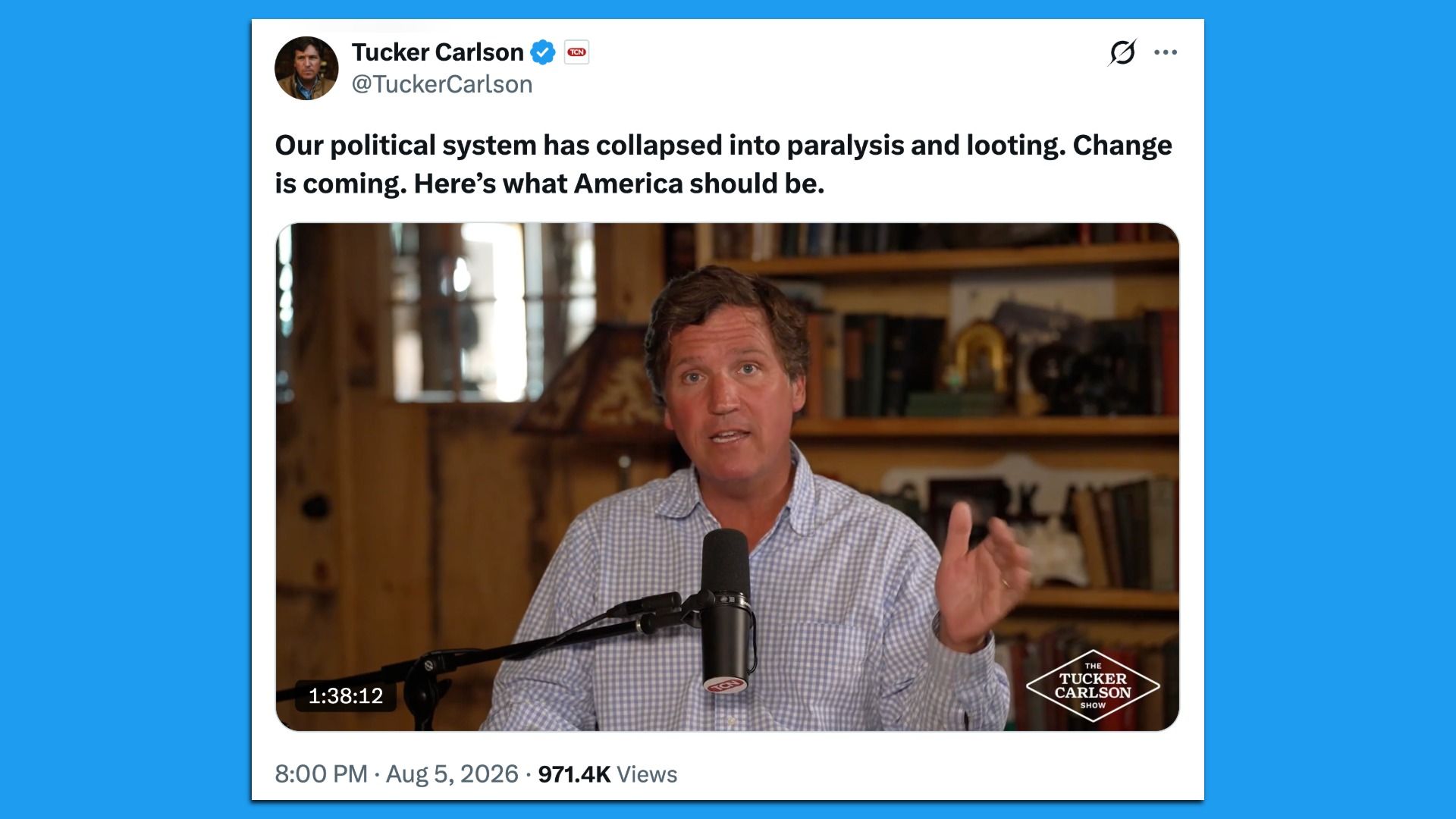
Tucker Carlson used a highly promoted livestream last evening to unveil a 10-point vision for America β defining the worldview of a breakaway MAGA faction increasingly at odds with President Trump, Axios' Zachary Basu writes.
- After vowing last month to "help build a third party," Carlson fueled further speculation this weekend by hosting MAGA dissidents at his home in Maine, where they urged him to run for president in 2028.
Why it matters: Carlson has become the intellectual hub for a small but vocal faction of MAGA exiles who say Trump abandoned the "America First" agenda by launching the Iran war, mishandling the Epstein files and allowing Israel to exert too much influence over U.S. policy.
The former Fox News host stopped short of a formal launch. Instead, he presented his manifesto as the foundation for "whatever comes next" β a new political order he said could "find all kinds of expressions":
- Fair: The same rules should apply to presidents, federal agents and elites such as Jeffrey Epstein, whose impunity Carlson cast as emblematic of an "Epstein class" enriching itself through a corrupt system.
- Sovereign: Carlson claimed Israel pushed the U.S. into the Iran war through "bribery or threat or both," while describing foreign lobbying, corporate control of government and high-interest debt as forms of "slavery."
- Productive: America should rebuild farming, manufacturing and craftsmanship while rejecting an economy dominated by finance, real estate speculation, surveillance systems and weapons.
- Healthy: Carlson embraced RFK Jr.'s food agenda, called for universal sobriety and said widespread use of drugs such as Xanax, Adderall and SSRIs had left Americans "half-addled."
- Optimistic: Carlson argued that having children is a biological imperative and the foundation of long-term thinking, while blaming aging and childless elites for policies that disregard future generations.
6. π Work slowdown in immigration offices
A work slowdown by the Trump administration's immigration offices has exploded the backlog of applications for citizenship, green cards and work permits to an unprecedented 7.5 million people, Axios' Brittany Gibson writes from the latest agency data.
- Add the millions of immigrants waiting on decisions for asylum, work visas and permission to stay in the U.S. for humanitarian reasons, and the total backlog soars to more than 12.1 million.
Why it matters: The delays have put potentially millions of people in legal immigration limbo β vulnerable to being arrested by ICE agents and deported, even if they've followed the rules to try to stay in the U.S.
- Officials say the delays are being driven by the administration's new focus on stricter vetting. A wave of DOGE-induced retirements also reduced the workforce at U.S. Citizenship and Immigration Services.
- Critics see a calculated plan to boost arrests and deportations.
7. π First look: The Rubenstein interviews
David Rubenstein β the billionaire co-founder of the Carlyle Group and Orioles owner β will be out Oct. 6 with "Speaking of America," featuring conversations with historians and innovators from his long-running series of interviews at the Library of Congress.
- The book's 19 interviews include documentary filmmaker Ken Burns on bringing American history to life, former Google CEO Eric Schmidt on AI and behavioral scientist Arthur Brooks on happiness.
"Speaking of America" is the prolific philanthropist's sixth book since 2019.
8. π 1 for the road: Running raves

New trend: Run clubs are turning their weekly jogs into moving raves with DJs blasting music from the back of a truck, Axios San Diego's Claire Trageser writes.
- Read the full story ... Get Axios Local, newsletters in 41 cities and counting.
π¬ Thanks for reading! Please invite your friends to join AM.
Sign up for Axios AM