Axios AM

June 03, 2025

1 big thing: New military nightmare

"You don't have the cards," President Trump dismissively told Ukrainian President Volodymyr Zelensky during their Oval Office blow-up in February.
- Three months later, Zelensky played a hand no one saw coming.
Why it matters: Ukraine's audacious drone operation, which destroyed nuclear-capable bombers deep inside Russian territory, delivered a strategic gut punch to Russian President Vladimir Putin, Axios' Zachary Basu writes.
- Ukraine is calling it "Operation Spiderweb." Pro-Kremlin bloggers are calling it "Russia's Pearl Harbor." Military experts are calling it a new nightmare for national defense.
- All can agree: Ukraine's ingenious use of low-cost drones has vast implications not only for the future of this war — but for the future of all war.
👓 Between the lines: Trump, who was not notified in advance, has yet to comment publicly on the operation. But as MAGA influencers spread fears of "World War III," pro-Ukrainian commentators argue Kyiv was left with few options.
- The U.S. and European allies have hesitated to supply Ukraine with additional air defenses to counter Russia's weekly bombardments, citing their own dwindling stockpiles.
- Russia rejected Ukraine's offer for a 30-day ceasefire. Trump railed against Putin for his obstinacy, but has so far declined to impose any new sanctions against Moscow.
- The calculus from Kyiv, therefore, was simple: If the world won't help Ukraine intercept Russian bombers in the sky, Ukraine must destroy them on the ground.

🖼️ The big picture: The Trump administration is growing impatient to move its strategic focus off Ukraine and onto other urgent priorities, particularly in the Pacific.
- Just this weekend, Defense Secretary Pete Hegseth warned at a Singapore security conference that a Chinese invasion of Taiwan could be "imminent."
- But Ukraine's battlefield creativity continues to deliver real-time lessons and intelligence on what modern war — especially asymmetric war — now looks like.
For national security experts, Operation Spiderweb has raised new alarms about the threat of commercial infrastructure — say, Chinese container ships docked in the U.S. — being repurposed for covert attacks.
- "It is possible [China] is developing a launcher that can fit inside a standard commercial shipping container for covert employment of [missiles] aboard merchant ships," the Pentagon warned in its annual report on Chinese military power last year.
- Ukraine's ability to project its military power across Russia — with coordinated detonations thousands of miles apart — revealed how easily the illusion of domestic security can be shattered.
2. 🐊 Trump's immigration enforcement hot spots
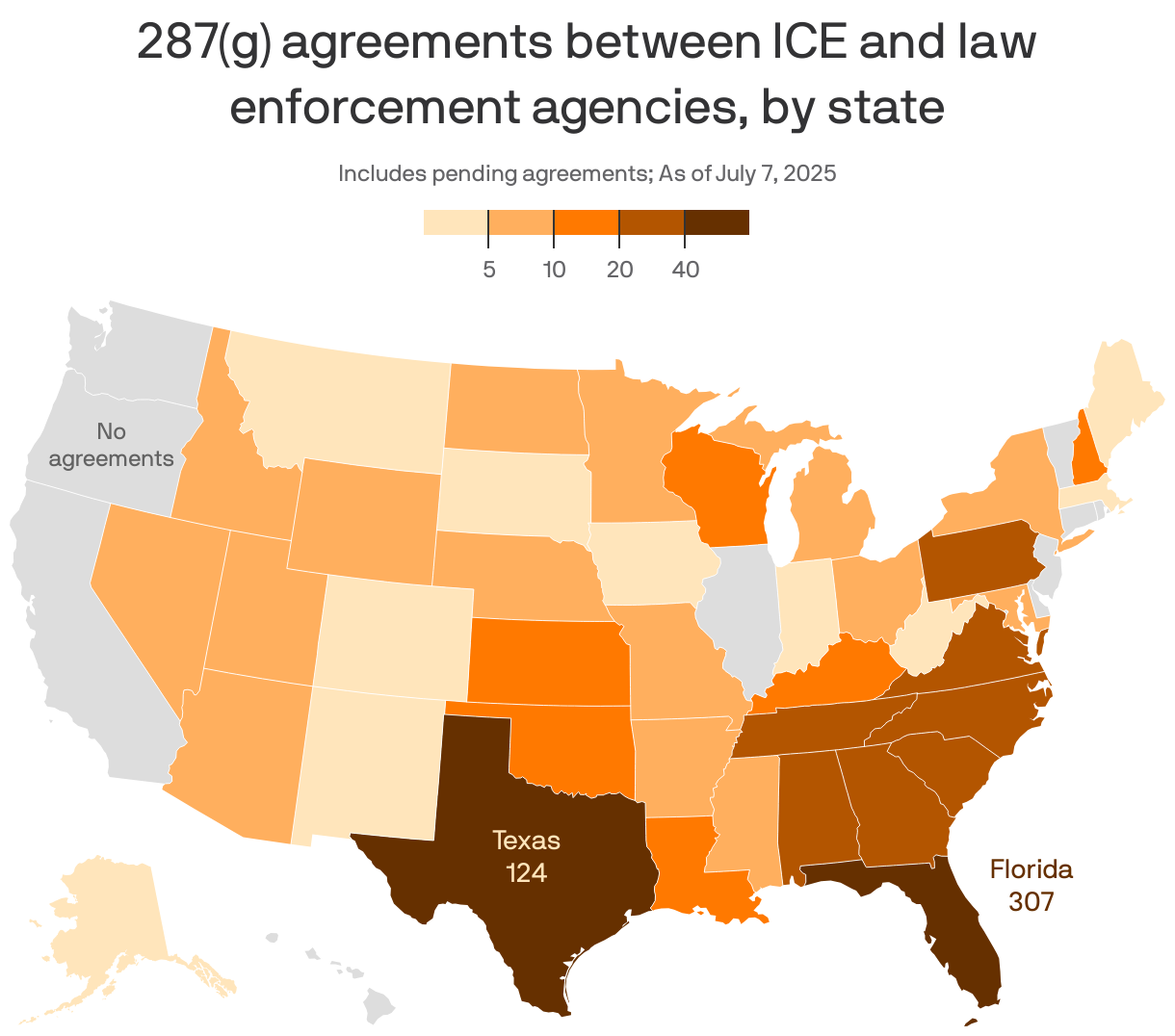
Efforts to arrest and remove unauthorized immigrants appear most aggressive in five southern states with Democratic-leaning cities, while deeply red rural states are seeing less activity, according to an analysis by Axios' Russell Contreras and Brittany Gibson.
- Why it matters: Our review of removal orders, pending deportation cases and agreements between immigration officials and local law enforcement agencies sheds light on where the Trump administration is dispatching resources to support its mass deportation plan.
The analysis shows local law enforcement agencies in Texas, Florida, Georgia, North Carolina and Virginia have been most cooperative with ICE in rounding up immigrants through deals known as 287 (g) agreements.
- There are 629 such agreements now in place across the country. About 43% of them are in Florida, followed by 14% in Texas and 5% in Georgia.
🔭 Zoom in: The GOP-led state governments in Florida, Texas and Virginia also have made a point of pushing local agencies to partner with federal agents, leading to a series of high-profile, mass raids in those states.
- Recent raids in Florida by a coalition of agencies led to 1,120 arrests in an effort dubbed Operation Tidal Wave.
🖼️ The big picture: The data analyzed by Axios and the locations of the agreements between federal and local authorities reflect a few simple truths about immigration enforcement across the U.S.
- There aren't nearly enough federal agents to meet President Trump's unprecedented deportation goal of deporting a million immigrants a year.
- In some places where the Trump administration faces a gap in resources, local law enforcement agencies are unable or unwilling to meet the feds' demands or expand beyond their usual enforcement duties.
- With the nation's borders essentially locked down, the administration has shifted much of its deportation operations to the nation's interior.
3. 🏠 The new homebuyer's market


It's a buyer's market in real estate — if you can afford it: There are nearly 500,000 more home sellers than buyers in the U.S. housing market, Axios' Sami Sparber and Emily Peck write from Redfin estimates.
- Why it matters: That's the widest gap on record — and a big reversal from just a few years ago, when home buyers were desperate to find a place to live, sending prices into the stratosphere.
The big picture: The one-two punch of still-high home prices and high mortgage rates is making it hard for buyers, especially first-timers, to find a place they can afford.
- Add to that the extreme economic uncertainty of 2025. Tariff news and layoff fears are tamping down buyer demand.
👀 What to watch: Historically, when sellers outnumber buyers, prices drop. In some markets, prices have already started falling.
- Home prices fell in 11 of the top 50 most populous U.S. metro areas in the four weeks ended April 20. That includes Austin, Texas; Oakland, Calif.; and Tampa, Fla.
- Redfin believes prices will dip 1% by the end of the year (not exactly a huge sale, to be sure).
4. 🔎 Antisemitic incidents rise in Colorado

Sunday's attack on people in Boulder advocating for Israeli hostages is part of an alarming trend of violence targeting Jewish individuals and pro-Israel advocates, Axios' Alayna Alvarez and Russell Contreras write.
- Colorado recorded 279 antisemitic incidents in 2024 compared with 198 in 2023 — a 40% spike, according to a recent Anti-Defamation League (ADL) report.
- Nationwide, such incidents have soared almost 900% in the last 10 years, and last year reached their highest level recorded in nearly half a century.
Keep reading ... Get Axios Denver ... Boulder.
5. 🧑💻 Exclusive: Federal cyber exodus

6. 📊 America's corporate Pride skepticism
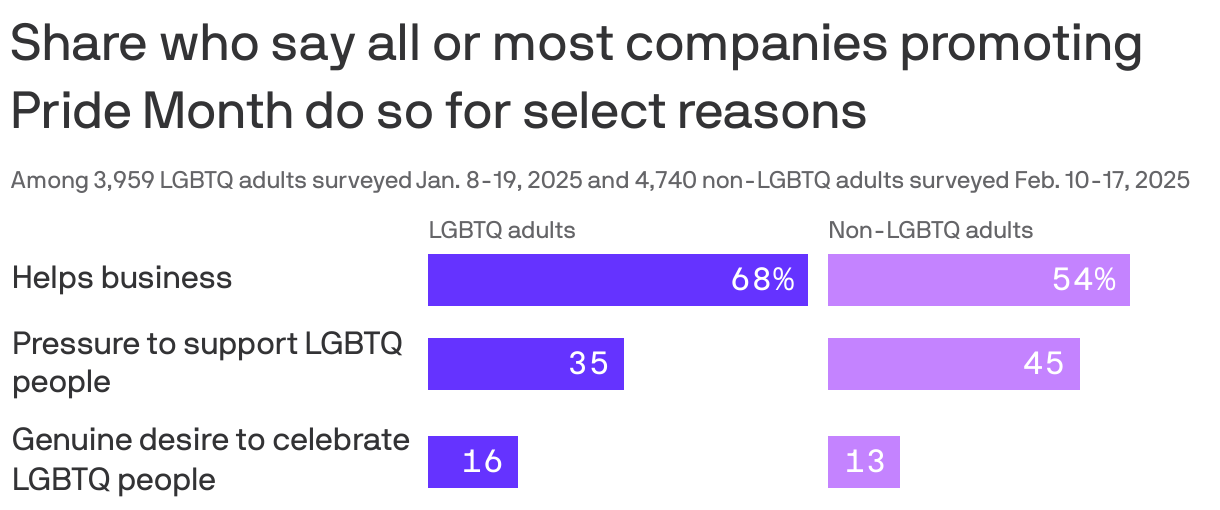
Many Americans say companies support Pride Month more for profit or pressure than principle, Axios' Alex Fitzpatrick writes from Pew Research Center data.
- Why it matters: Some companies are pulling support for Pride and related events as they roll back diversity and inclusion initiatives amid pressure from the Trump administration and broader skepticism of corporate Pride.
By the numbers: Among LGBTQ adults, 68% said all or most companies promoting Pride do so because they think it's good for business, 35% because they feel pressured to do so, and 16% out of genuine desire.
- Among non-LGBTQ adults, those shares were 54%, 45% and 13%, respectively.
The big picture: The last few months have been a major test for corporate America, with some companies sticking to their advertised core tenets and others bending to political or consumer pressure.
- Nearly 40% of companies are scaling back Pride Month engagement this year, according to Gravity Research data.
- Corporate sponsors have pulled out of Pride events in New York City, D.C., Pittsburgh, Philadelphia, Columbus and elsewhere as the Trump administration pressures businesses to drop their DEI initiatives.
7. 🥫 Home cooking surge
/2025/06/02/1748901693091.gif?w=3840)
8. 🌿 1 for the road: Boomer weed boom

Axios AM