Axios AM

August 15, 2026

๐ Hello, Saturday! In this special AM takeover, we explore the identity crisis facing the bachelor's degree as millions of students head back to campus.
- Thank you to Natalie Daher for orchestrating; editors Kate Marino, Ben Berkowitz and Carlos Cunha; and our Visuals dream team, Erin Davis and Sarah Grillo.
- Smart Brevityโข count: 1,374 words ... 5 mins.
๐ What are your hopes and dreams for college in 2026? Whether you're a student, parent or professor, write us at [email protected] to be featured in a future newsletter.
1 big thing: New college doubts
College was once sold as a ticket to the American dream.
- But students today are taking a tougher look at the college tradeoff: burdensome debt and no guarantee of a dream career โ or employment at all, as AI threatens the jobs that the degrees were meant to unlock, Axios' Avery Lotz reports.
"People didn't ask whether college mattered 20 years ago," says Courtney Brown, VP of impact and planning at Lumina Foundation.
- Now, they're asking: "Are today's students going to be prepared for tomorrow's jobs? Is it really helping them out?"
๐ By the numbers: Confidence in higher education has slipped this year among both parties and all levels of educational attainment, according to Gallup.
- Job market fears are also surging: Gallup found last year that just 19% of those with a college degree or more said it was a good time to find a quality job at the end of 2025, compared to 35% of those without one.
But there's a paradox: Even as Americans sour on higher education, they keep sending their kids to campus.
- "There is still massive pressure on them from their high schools, the educators at their schools, their parents, their peers, and just the broader culture to still go to college," says The Up & Up founder and Gen Z researcher Rachel Janfaza.
Today's doubts fall into three buckets โย in students' own words:
- ๐ต Affordability: "I didn't want to take out loans, and I didn't want to put my family through that stress of trying to fund it." โGabriel Sheahan, a 24-year-old studying welding and fabrication at Lincoln Technical Institute, a trade school in New Jersey.
- ๐๏ธ Getting your money's worth: "How does it make sense that you're giving me this deadline to have my degree finished, and I can't even get the classes that I want? ... It feels ... like a rat race." โRachel Sukkar, a 19-year-old philosophy major at UNC Chapel Hill.
- ๐ Outcomes: "There's just so much volatility, and you can't guarantee the same amount of success that you could 20 years ago with a college degree now." โMoksha Agrawal, a 17-year-old incoming high school senior.
2. ๐ฐ Charted: Alumni earnings premium

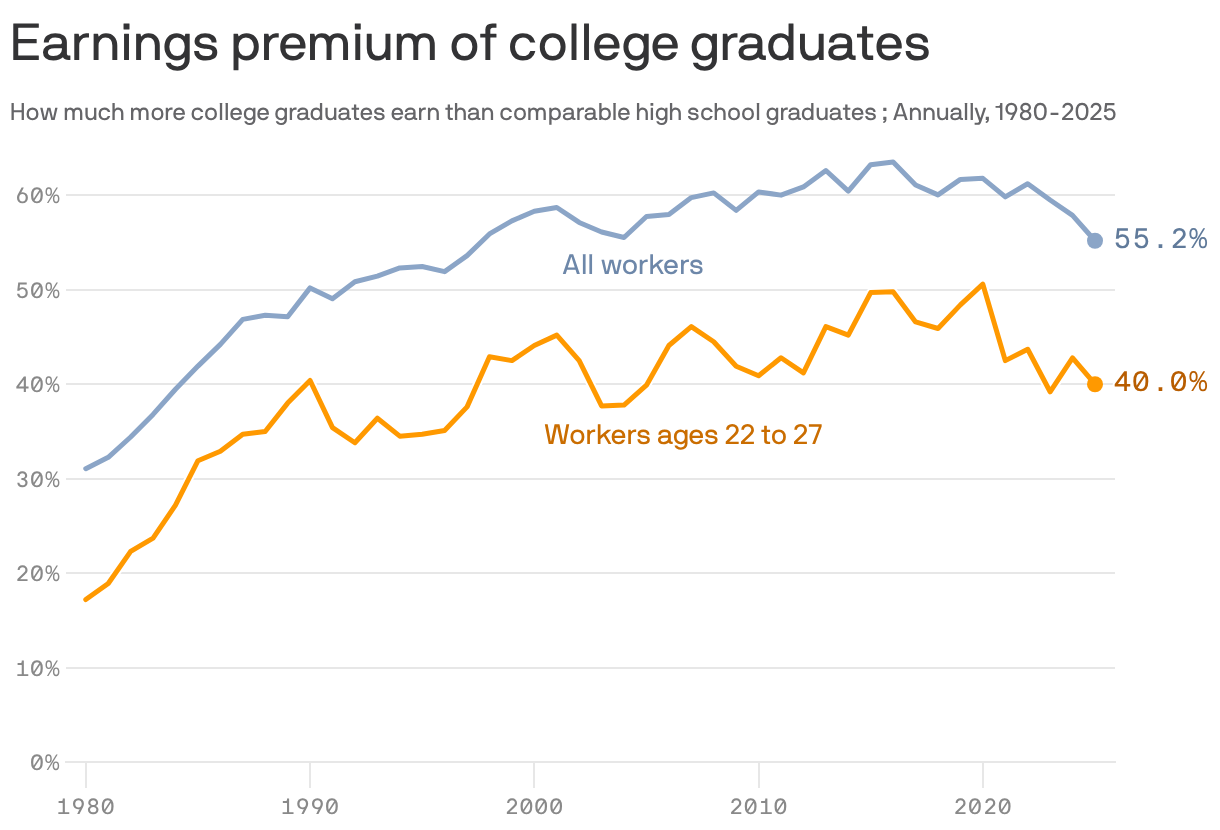
The boost that college graduates get in pay over those who don't go to college is huge โ but it's been declining a bit in recent years, Axios Markets co-author Emily Peck writes.
- Last year, the average college graduate earned 55.2% more than the typical high school grad, per Labor Department data analyzed by the progressive Economic Policy Institute.
- That's down from a peak of more than 60% a decade ago.
3. ๐ Colleges race to be AI-forward
AI is forcing colleges to rethink what students need to learn โ and what a degree should prepare them to do, Axios' Megan Morrone and Herb Scribner write.
- Why it matters: Employers increasingly expect new graduates to arrive with AI fluency, even as colleges are still figuring out how to teach it.
๐ป Split screen: This year's graduating high school seniors have had access to ChatGPT since freshman year, while this year's graduating college students booed mentions of AI at commencement.
- As students' command of AI has improved, colleges have revisited whether using it should always count as cheating.
- "Now anyone can get that expertise in a minute," OpenAI's VP for education, Leah Belsky, tells Axios. Higher education "is more coaching, mentoring, guiding students" through prompts and analyzing outputs, she says.
๐ The pressure is growing: The number of employers that expect entry-level workers to be AI-competent has nearly tripled since last fall, according to the National Association of Colleges and Employers.
๐ฆพ Zoom out: Schools are racing to catch up. American, Purdue and Miami University in Ohio have launched AI-forward initiatives.
๐๏ธ Another route: Short-term certificate programs are becoming a faster, cheaper way to build AI skills โ and a way for universities to reach a broader pool of students, Bloomberg reports (gift link).
- In 2022, just 2% of the professional certificate market focused on AI. This year, short-term AI training programs take up nearly a third.
๐ What students are saying: UC Davis student Burton Baecker told Axios he added finance to his accounting studies after seeing how quickly AI could perform accounting tasks.
What to watch: As AI tools take on more entry-level tasks, employers are raising the bar for young workers.
- New graduates are now expected to manage projects and AI agents, conduct deeper research, present findings and defend their work, Casey Evans, interim dean at American University's Kogod School of Business, tells Axios.
4. โ๏ธ America's global student edge is slipping


America is losing one of its quietest superpowers: its ability to attract the world's most ambitious students, who also provide a crucial revenue stream for universities, Axios' Russell Contreras reports.
By the numbers: There was a 17% drop in new international student enrollment for fall 2025, recent survey findings by the Association of International Educators reveal.
- This translates to over $1.1 billion in lost revenue for the U.S. economy and nearly 23,000 fewer jobs.
๐ Between the lines: The plunge isn't just about strict immigration policies or visa backlogs from the Trump administration. A broader, unwelcoming national climate is deterring students.
- That reputation is prompting foreign talent to explore other options before they even apply here, Andrew Gillen, a research fellow at the Cato Institute, tells Axios.
- He compares turning away global talent to banning left-handed people from school: "You're sort of closing off access to whatever they would have been able to accomplish."
5. ๐จ Gen Z nails its AI backup plan
Some young workers are swapping laptops for hard hats, betting that a welding torch or a tool belt could offer more protection from AI disruption, Axios' Josephine Walker writes.
๐งฐ Why it matters: More young Americans are looking to the skilled trades for lower debt, stable pay and work that's harder to automate.
- John Zink, vice president at the PHCC Educational Foundation, an apprentice training group, puts it bluntly: "We have the high-demand jobs that AI can't take because AI can't run pipe or install HVAC systems."
๐ฌ Octavius Jackson, 25, spent two years at Prairie View A&M before pivoting to the Aviation Institute of Maintenance for an airframe and power plant certificate.
- He said choosing a career less vulnerable to AI factored into his decision.
- "You don't want a robot fixing up these planes," he told Axios.
๐ ๏ธ What to watch: High schools are expanding programs that give students a direct path into skilled work.
- Case in point: Philadelphia's Father Judge High School graduated 24 students from its welding course last year. All got jobs paying $50,000+ a year.
6. ๐ช Sorry, we're closed
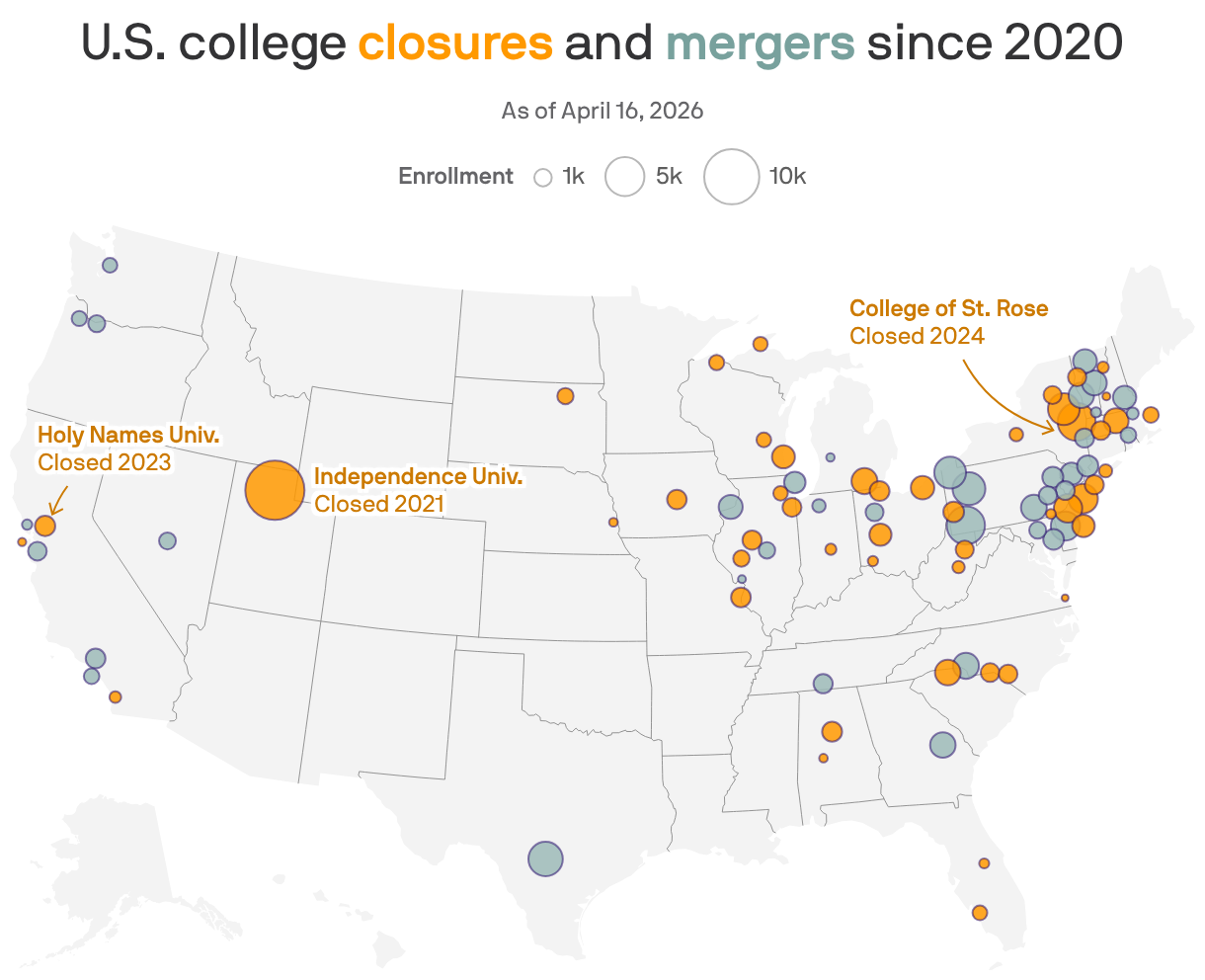
The pandemic accelerated a higher-ed shakeout that's still forcing colleges to close, merge or reinvent themselves.
- Since March 2020, at least 49 nonprofit colleges have closed or announced closures. Forty others have merged โ affecting more than 53,000 students, according to the higher-ed site BestColleges.
Historically, fewer than half of students reenroll elsewhere.
7. ๐ซ Tech's pitch to skip college
Some of the tech industry's most influential CEOs are challenging the four-year degree as the default path for elite talent โ and building alternatives to it, Axios' Herb Scribner writes.
- Palantir created the Meritocracy Fellowship, which urges high school grads to "skip the debt" and "skip the indoctrination" in favor of a "Palantir degree."
- Peter Thiel founded the two-year Thiel Fellowship, where participants skip or leave college.
8. โฑ๏ธ 1 for the road: Speedy degrees
Virginia and Ohio are developing 90-credit bachelor's degrees that students could finish in three years โ joining a fast-growing national effort to rethink how long college should take.
- The two states hope to launch pilot programs in 2028, Axios Richmond's Karri Peifer reports.
๐ฐ Colleges struggling to fill seats see the programs as a way to attract students put off by the cost and length of a traditional degree.
๐ฌ Let us know what you think: [email protected].
- Thanks for reading this special edition! Please invite your friends to join AM.
Sign up for Axios AM