Axios AM

September 25, 2020
🌞 Happy Friday! Today's Smart Brevity™ count: 1,293 words ... 5 minutes.
🚨 Breaking: Palantir, the data-mining unicorn, is expected to fetch a lofty valuation of $22 billion "in the latest sign of investors' voracious appetite for new shares," The Wall Street Journal reports (subscription).
1 big thing: Apocalypse scenario
Illustration: Aïda Amer/Axios
Arming for post-election combat, Democratic lawyers are getting ready to challenge any end runs by President Trump, including swapping electors chosen by voters with electors selected by Republican-controlled legislatures.
- Democrats are particularly concerned about Pennsylvania, where the GOP controls the statehouse, Axios' Alayna Treene and Hans Nichols have learned.
On the other side, a Trump campaign adviser told Axios that lawyers will litigate where needed, including suing in key states that have changed election laws to allow for an extended time to vote or count ballots.
Why it matters: Legal experts are increasingly worried about how the next president will be chosen if election mechanics fall apart and we face a constitutional crisis.
Democrats are running a separate effort to try to block any state recounts, like Florida's in 2000, from being cut short by the Supreme Court.
- Across the country, the Biden campaign has enlisted thousands of lawyers and volunteers for voter protection efforts.
The context: Trump's refusal to commit for a second time yesterday to a peaceful transfer of power, together with an article in The Atlantic about worst worst-case scenarios, is drawing new attention to brutal fights that could jeopardize a final outcome.
The big picture, per the N.Y. Times (subscription): "Even as early voting has gotten underway, some pivotal states are still litigating how ballots should be cast and counted, creating uncertainty that is being fanned by President Trump."
Ben Ginsberg, a top GOP election lawyer who has criticized Trump's claims about election fraud, says the president could ask for state recounts and even contest particular state results.
2. Who Biden might put on the court
Illustration: Aïda Amer/Axios
Democrats are compiling lists of Black women they want Joe Biden to consider for the bench if he's elected — with an eye toward people from outside the traditional legal establishment, Axios' Alexi McCammond and Hans Nichols write.
- Why it matters: A President Biden would need to find picks who could try to wrangle liberal victories from the court's conservative majority.
Where it stands: Biden has stayed silent on who he might appoint to the Supreme Court, and says he won't release a list of potential nominees like President Trump did in 2016.
- But he has pledged to select a Black woman.
What we're hearing: Ketanji Brown Jackson, a district court judge in D.C., is an obvious contender. She was on President Obama's shortlist to replace the late Justice Antonin Scalia, and has standard qualifications for modern nominees — Harvard Law, prominent clerkships and a spot on the federal bench.
- But many progressive advocates told Axios they want Biden to think differently — to not only add sex and racial diversity to the court, but to also inject some different life experience and professional background.
Other names being discussed:
- Leondra Kurger, a justice on the California Supreme Court.
- Leslie Abrams Gardner, a federal district judge in Georgia (and Stacey Abrams' sister).
- Sherrilyn Ifill, president of the NAACP Legal Defense Fund.
- Melissa Murray, a professor at NYU Law who clerked for Justice Sonia Sotomayor and would likely follow Sotomayor's model of judging.
- Keeanga-Yamahtta Taylor, an academic teaching at Princeton and an author and activist on racial justice.
- Barbara Ransby, who teaches history at the University of Illinois-Chicago and is a longtime political and civil rights activist.
Between the lines: All of the current justices graduated from Harvard or Yale law school. All but one were promoted to the Supreme Court from federal appeals courts.
- None of them has an advocacy background, or have ever run for office, or served as public defenders, or on a state supreme court.
3. Youth accounted for 20% of coronavirus cases this summer
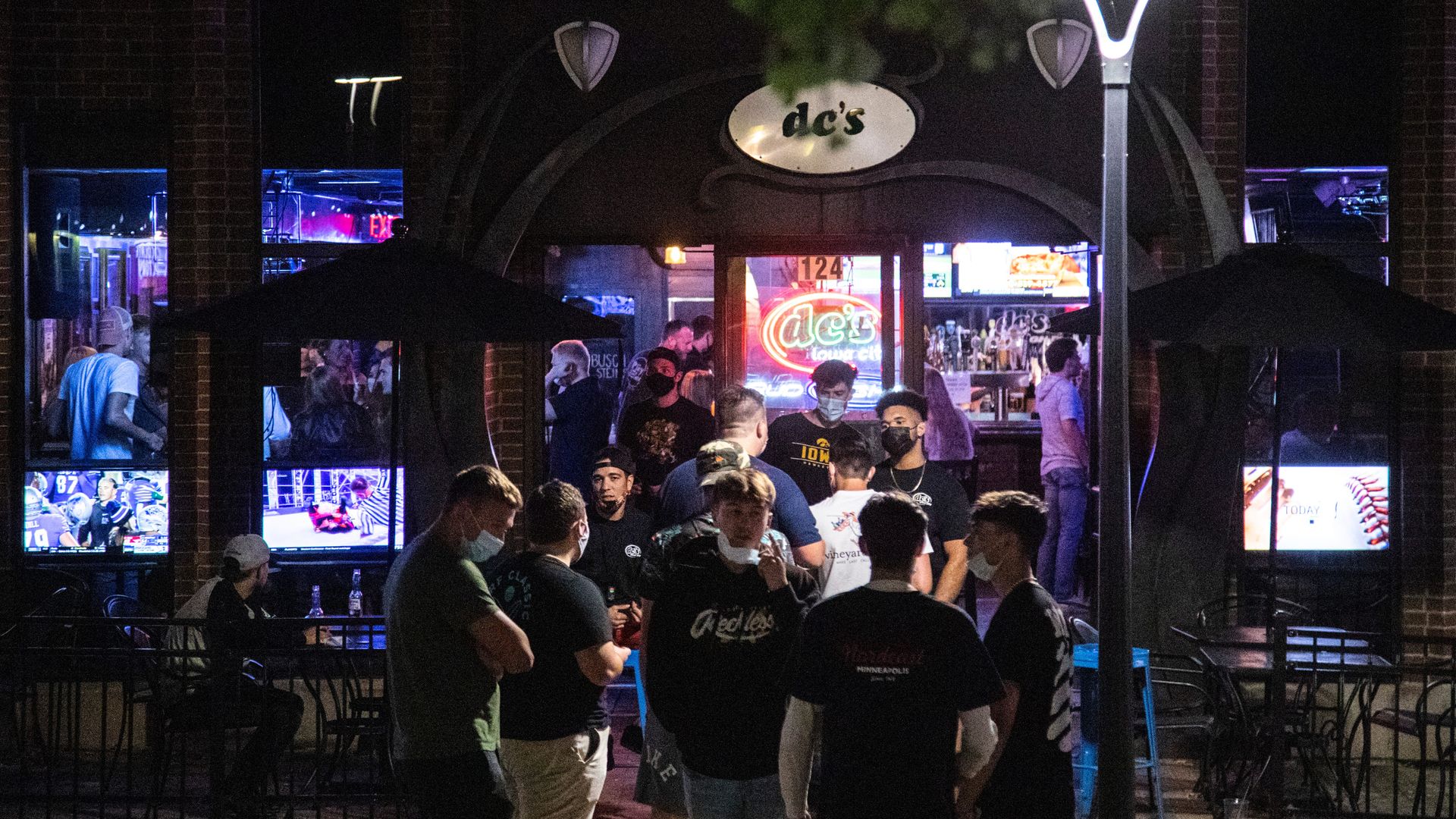
A crowd of people outside a bar in Iowa City last month. Photo: Joseph Cress/Reuters
The CDC says people in their 20s accounted for more than 20% of all COVID cases between June and August, bringing the median age of coronavirus patients to 37, down from 46 in the spring.
- Why it matters, from Axios' Marisa Fernandez: Young people are less vulnerable to serious illness. But they contributed to community spread over the summer — meaning they likely infected older, higher-risk people, especially in the South.
4. Trump's photo album

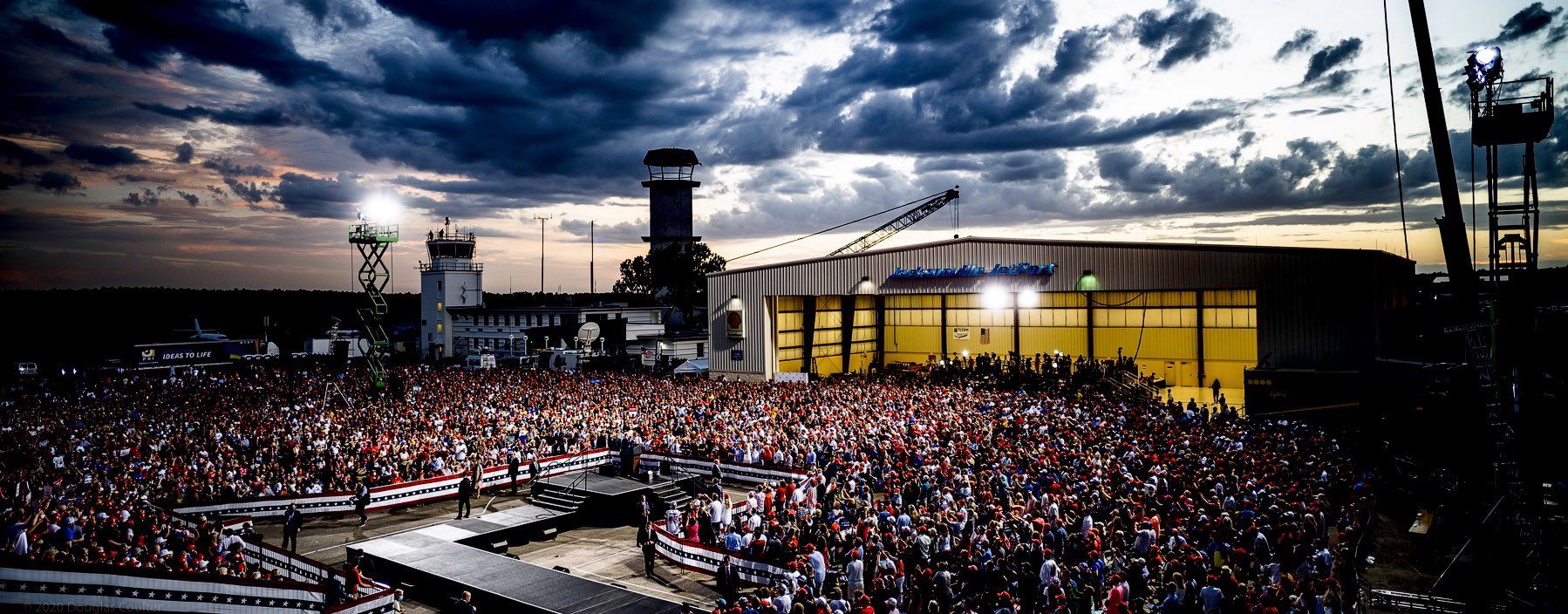
In the era of social distancing, President Trump tweeted these two pics from his rallies this week: Above, Pittsburgh on Tuesday. Below, Jacksonville last night.
5. Where school could be riskiest


Schools in Southern and Midwestern states are most at risk of coronavirus transmission, according to an analysis by Coders Against COVID that uses risk indicators developed by the CDC, Axios' Caitlin Owens writes.
- Schools haven't become coronavirus hotspots, the WashPost reported this week. But that doesn't mean they're in the clear as we head into winter.
6. Lingo: Naked ballots
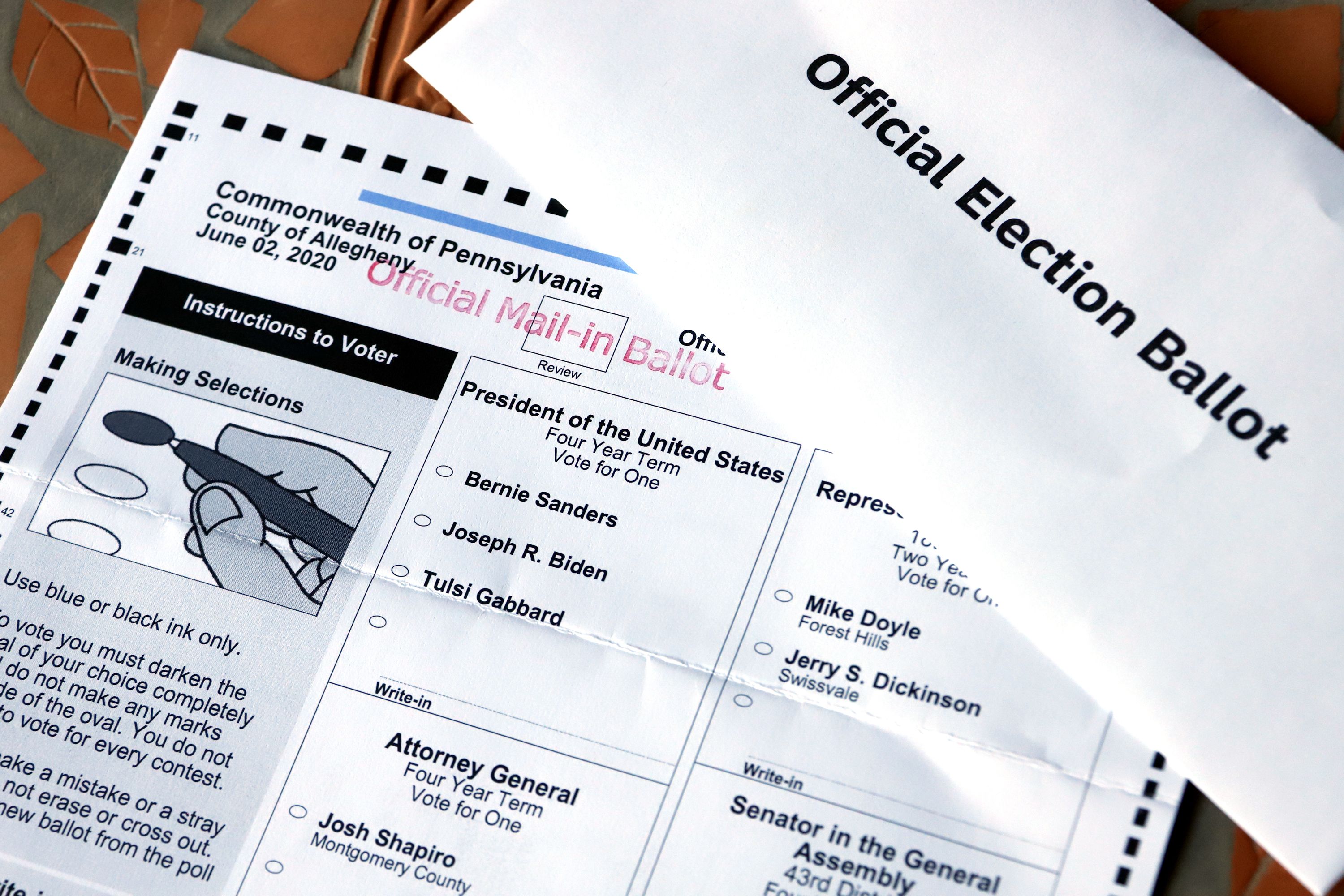
The naked ballot is the hanging chad of 2020.
In Pennsylvania, Democrats fear that the problem could cause 100,000+ votes to be invalidated.
"Naked ballots" are mail ballots that arrive without inner "secrecy envelopes," the Philly Inquirer explains.
- "Pennsylvania uses a two-envelope mail ballot system: A completed ballot goes into a 'secrecy envelope' that has no identifying information, and then into a larger mailing envelope that the voter signs."
The context: The Pennsylvania Supreme Court ruled last week that ballots had to be rejected if not enclosed in the proper secrecy envelope — a victory for President Trump's campaign in the pivotal state. (AP)
- 🎥 See a Democratic Party video explaining the "naked" cluster.
7. Hot on the right: "Trump was right"
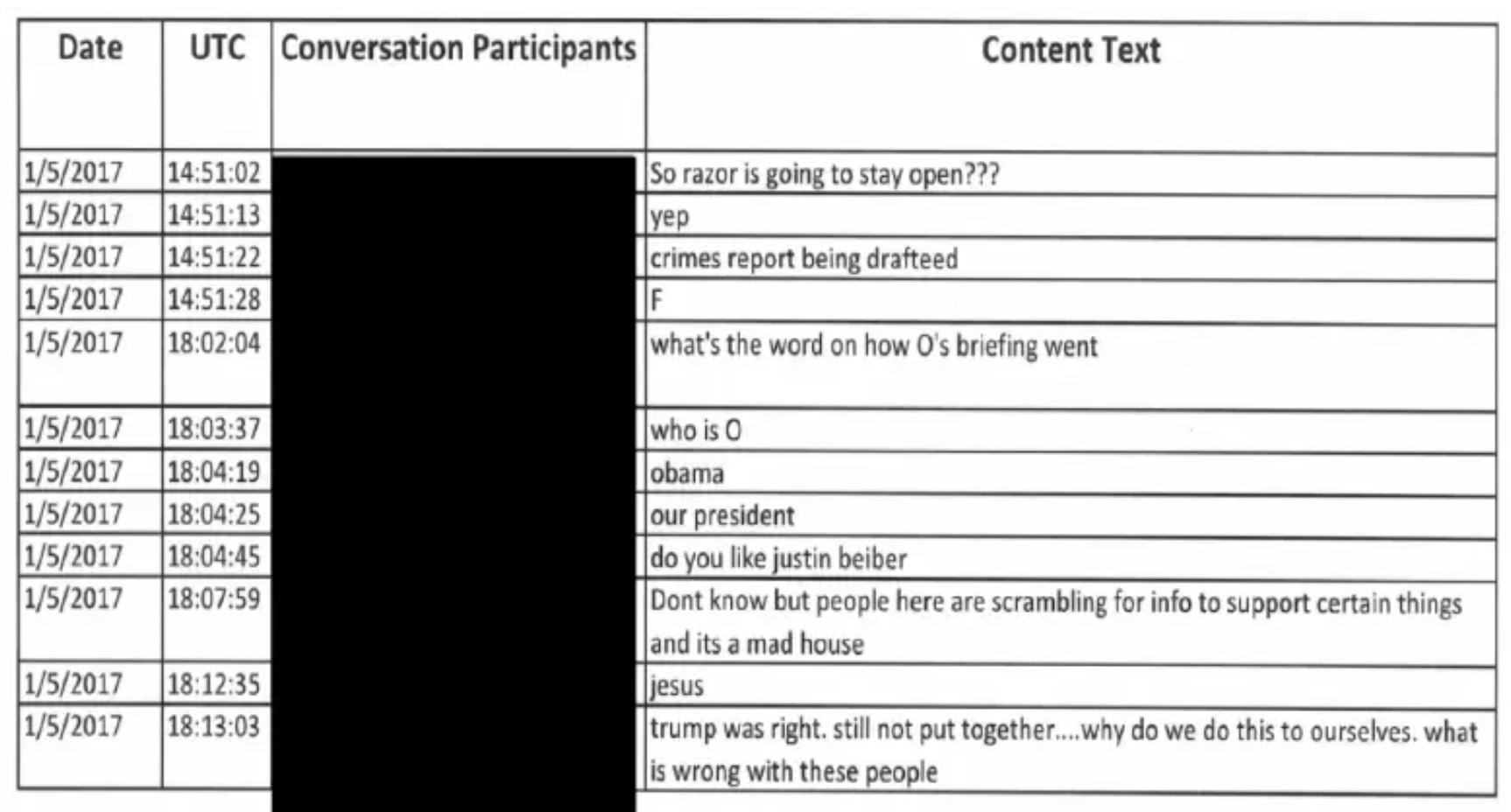
At President Trump's rally in Jacksonville last night, he reveled in an article by The Federalist (Redstate co-founder Ben Domenech is publisher) disclosing a court filing in the Michael Flynn case that quotes FBI text messages from 2016, including one saying: "[T]rump was right."
[O]n the FBI’s "Lync" messaging system in October of 2016, FBI employees exchanged messages [that included] "I'm tellying [sic] man, if this thing ever gets FOIA'd, there are going to be some tough questions asked."
8. Exclusive: Snapchat's RBG extra
Courtesy Snapchat
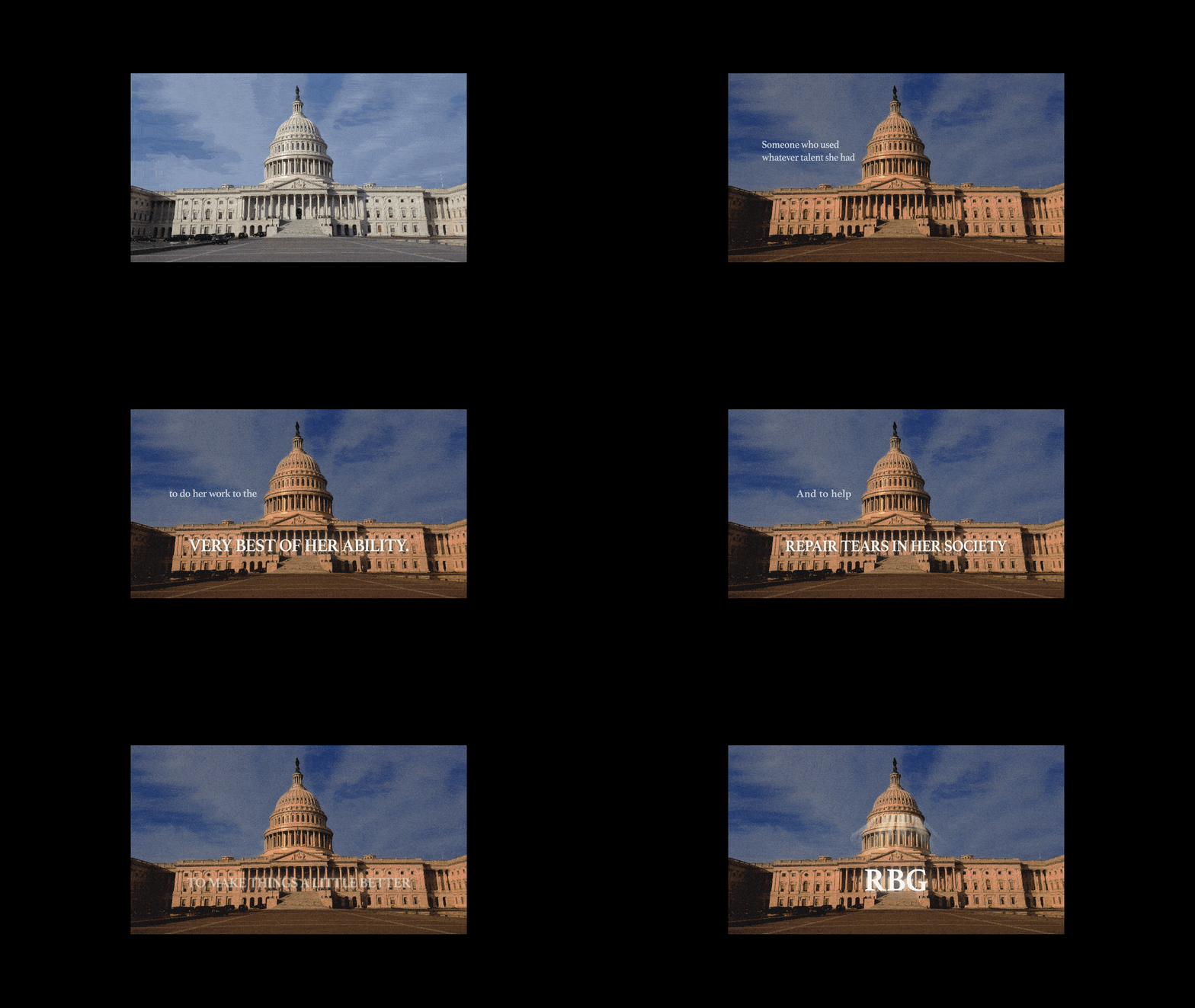
Snapchat today teams up with The National Constitution Center on an augmented reality lens experience paying tribute to Justice Ruth Bader Ginsburg, as she becomes the first woman to lie in state in the U.S. Capitol.
The lens will work in front of the U.S. Capitol, by pointing Snapchat’s camera — the primary screen when you open the app — at the Capitol building and tapping on the screen.
Using a type of technology called Landmarker Lenses that weaves together an augmented reality experience into the physical world, a viewer will see one of RBG’s ... quotes ... against the sky above the Capitol.
At the end, a light shines out of the dome.
9. Remembering Harold Evans, crusading editor
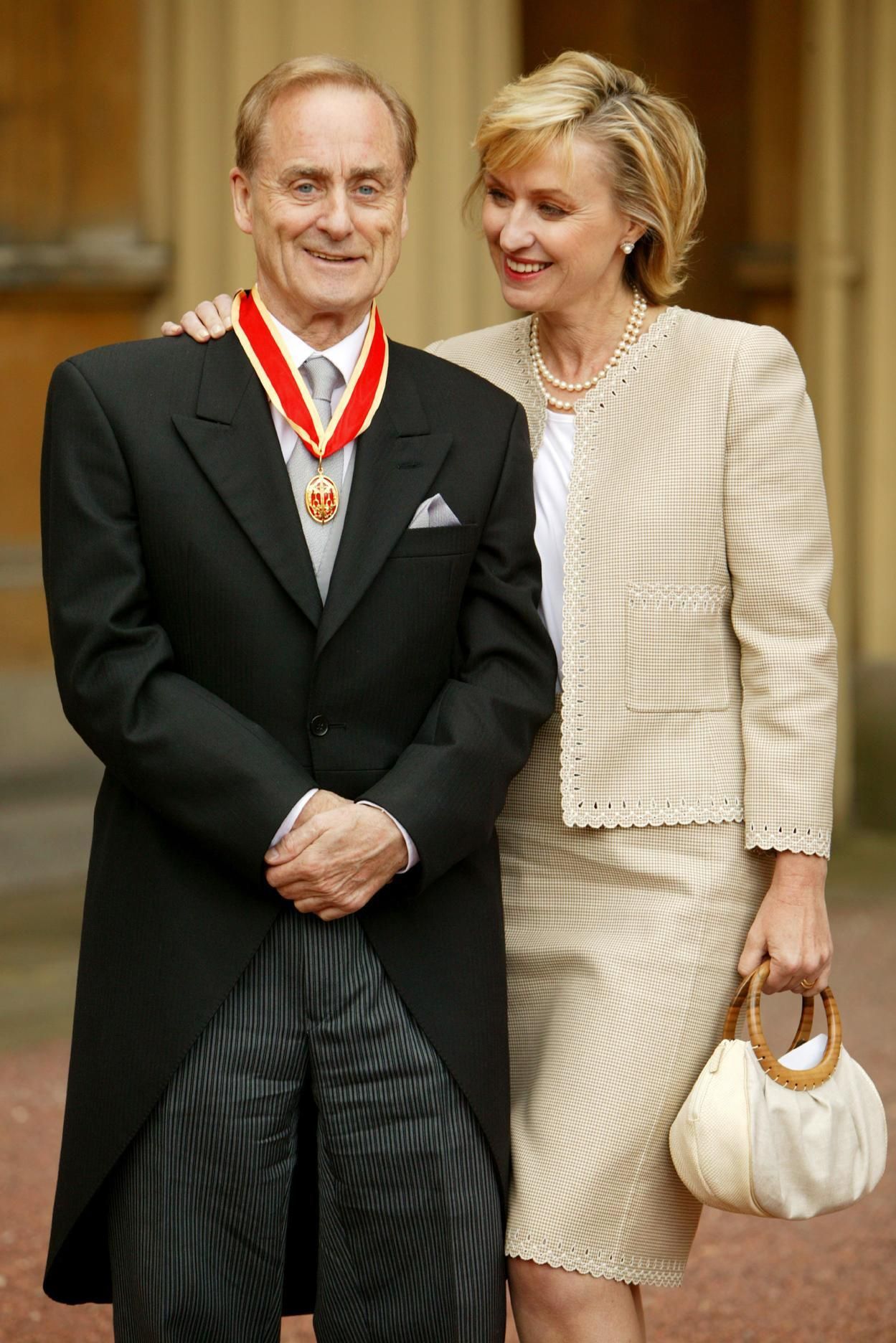
Jon Meacham recalls for Random House that Sir Harold Evans — editor of The Sunday Times of London, and U.S. publisher of "Primary Colors," who died in New York at 92 —"was a Renaissance figure who saw the past in the present":
Sprightly and urbane, charming and tireless, Evans was an editor, publisher, and writer of remarkable scope and skill. In the atomized cultural climate of the first decades of the twenty-first century, it can be difficult to appreciate how large he loomed as the editor of The Sunday Times in London and then in his sundry posts in the New World, including his years in the 1990s as the publisher of Random House.
10. 🏈 Biggest college football holdout is back in
Spotted in Eugene, Ore. Photo: Ryan Kang/AP
College football, with all that sweet bowl cash on the line, turned out to be pandemic-proof, AP's Ralph Russo writes.
The Pac-12 reversed itself and set Nov. 6 to start a seven-game season.
- "This has nothing to do with money," said University of Oregon President Michael Schill, head of the Pac-12's CEO Group.
The Mountain West followed up a few hours later by announcing it is aiming to kick off Oct. 24.
- Nine of the 10 top conferences will now complete seasons by Dec. 20, the day the College Football Playoff selection committee is scheduled to pick teams to play for the national championship and in the most lucrative bowls.
- As soon as today, the Mid-American Conference could make it 10 out of 10.
The bottom line: This every-conference-for-itself college football season looks like it will have five different start dates.
- Some teams could play as many as 12 games while others get in only six.
📱 Thanks for joining the Axios AM breakfast table. Invite your friends to sign up here!
Sign up for Axios AM

Catch up with the most important news of the day