Axios AM

August 21, 2025

1 big thing: Trump's unlikely enforcers

A housing regulator, a prosecutor rejected by the Senate and a former Democrat have emerged as the unlikely faces of President Trump's "weaponization" crusade, Axios' Zachary Basu writes.
- Why it matters: In a sea of Trump loyalists, these three officials — Bill Pulte, Ed Martin and Tulsi Gabbard — stand out for how aggressively they've shattered norms in pursuit of the president's enemies.
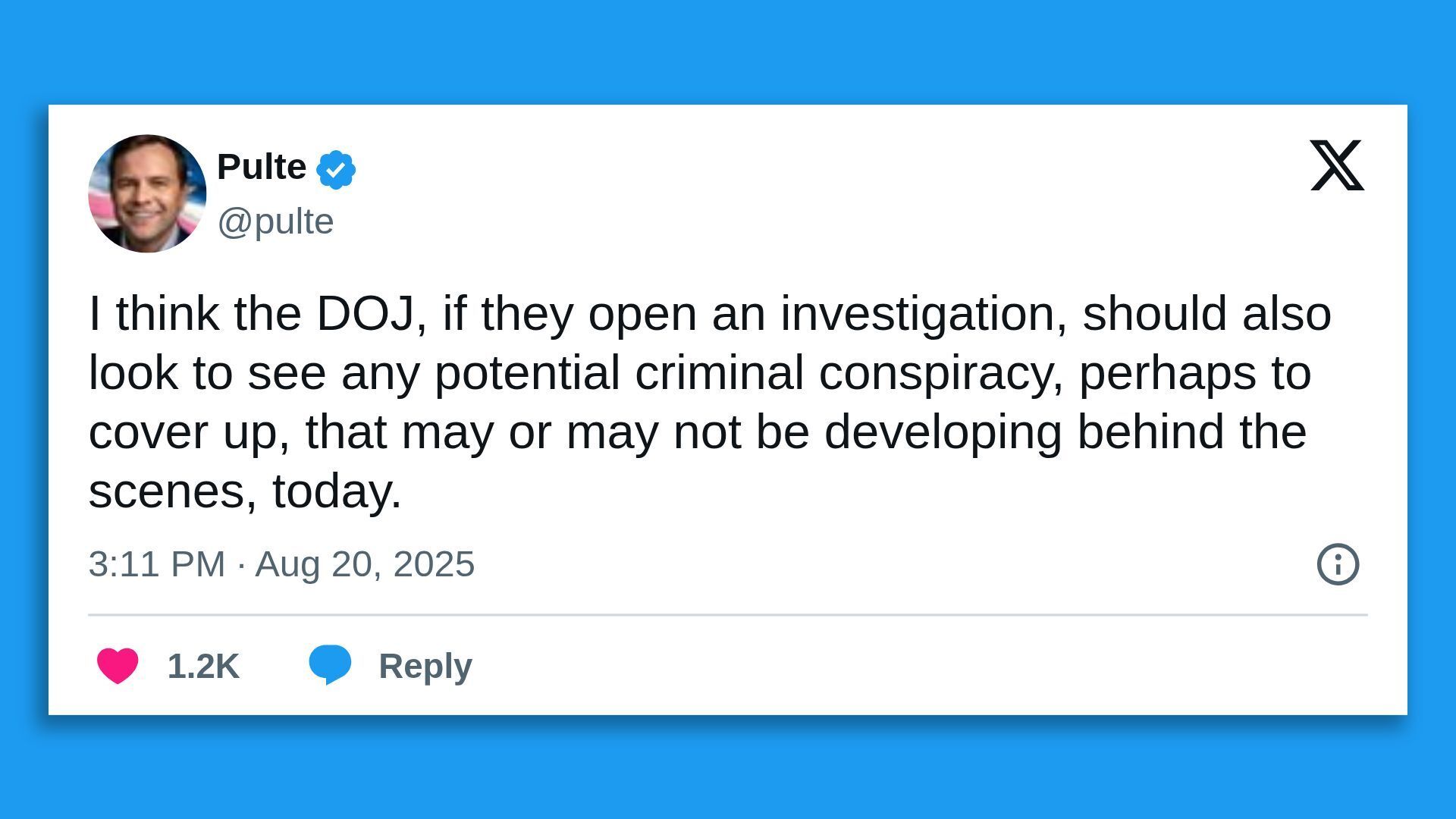
1. Pulte, director of the Federal Housing Finance Agency, has used his 3 million followers on X to reinvent the sleepy mortgage regulator as a platform for political combat.
- Pulte has elevated allegations of mortgage fraud against two of Trump's top antagonists, New York Attorney General Letitia James and Sen. Adam Schiff (D-Calif.). Both are now under criminal investigation.
- Pulte also has led the campaign to oust Federal Reserve Chair Jay Powell, calling for him to resign — or be fired — over cost overruns in the Fed's $2.5 billion headquarters renovation.
- Yesterday, Pulte escalated Trump's war on the central bank by accusing Fed governor Lisa Cook of mortgage fraud. Trump responded by calling for Cook to resign. Cook said she has "no intention of being bullied to step down."
2. Martin, a conservative activist who defended Jan. 6 rioters, was named the Justice Department's weaponization czar after his nomination to be U.S. attorney for D.C. collapsed in the Senate.
- In his brief time as acting U.S. attorney, Martin demoted prosecutors who had worked on Jan. 6 cases, vowed to pursue legal action against critics of Elon Musk's DOGE initiative, and attempted to launch an investigation into Senate Democratic Leader Chuck Schumer (D-N.Y.).
Now leading the DOJ's probe of James, Martin stunned ethics experts by showing up outside the New York attorney general's Brooklyn home in a trench coat and posing for tabloid photos.
3. Gabbard, Trump's director of national intelligence, sent shockwaves through the intel community by accusing former Obama officials of a "treasonous conspiracy" stemming from the 2016 Russia probe. Her allegations have electrified Trump's base.
- Gabbard went further this week, revoking the security clearances of 37 current and former national security officials she claimed had manipulated or leaked classified intelligence.
- Then yesterday, she approved plans to slash ODNI's staff by 40%.
2. 🌽 Dems fight to be "the new Iowa"
3. 🫂 Employees start "job-hugging"

4. ⚜️ Charted: Where they went after Katrina


When thousands of New Orleans homes flooded in the aftermath of Hurricane Katrina — 20 years ago this month — the city lost more than half its population overnight, Axios New Orleans co-author Chelsea Brasted writes.
- Why it matters: They went somewhere, and we're finally getting a clearer look at where they landed, thanks to never-before-seen data provided to Axios.
🔬 Zoom in: Government officials have granted only one researcher access to the granular data required to figure out where people went: Elizabeth Fussell, a Brown professor who worked at Tulane in New Orleans when Katrina hit.
- Fussell's research found that 33% of people who had been living in New Orleans when Katrina hit had not returned to the metro area by 2006.
- Of those people who hadn't returned, 21.7% were in Baton Rouge, 14.6% were in Atlanta, 11.7% were in Houston and 5.8% were in Dallas-Fort Worth.
💡 How it worked: Fussell examined New Orleans' population in the 2000 census, removing people who had died or were found living outside Orleans Parish until Hurricane Katrina.
- Fussell followed their whereabouts for each year from 2006 to 2019, again adjusting for deaths.
Keep reading ... Get Axios New Orleans ... 33 more Local cities.
5. 📉 Mapped: Dems' registration crisis
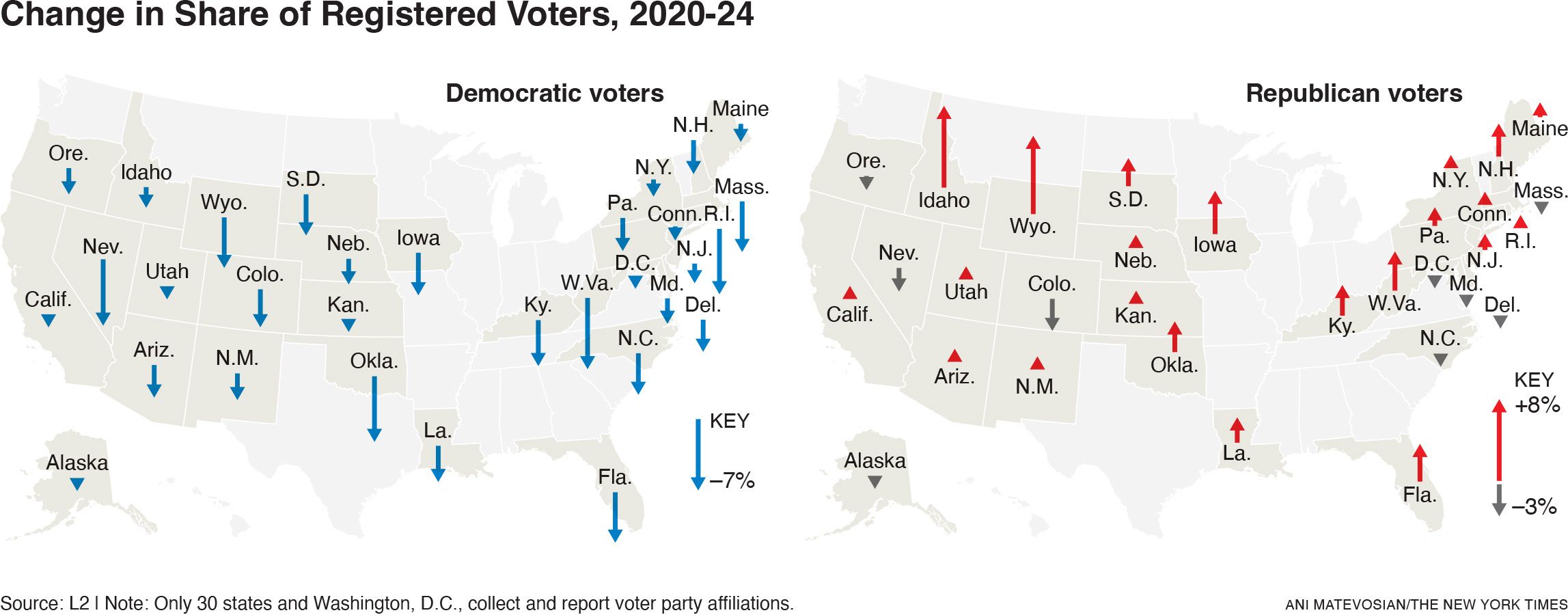
A New York Times analysis found Democrats lost ground to Republicans in every single state that allows voters to register with a political party between 2020 and 2024.
- Why it matters: "That swing helps to explain President Trump's success last year, when he won the popular vote for the first time, swept the swing states and roared back to the White House," The Times' Shane Goldmacher and Jonah Smith write.
🧮 By the numbers: "All told, Democrats lost about 2.1 million registered voters between the 2020 and 2024 elections in the 30 states, along with Washington, D.C., that allow people to register with a political party. (In the remaining 20 states, voters do not register with a political party.) Republicans gained 2.4 million," The Times writes.
- "That four-year swing toward the Republicans adds up to 4.5 million voters, a deep political hole that could take years for Democrats to climb out from.
"All four presidential battleground states covered by the Times analysis — Arizona, Nevada, North Carolina and Pennsylvania — showed significant Democratic erosion."
- Keep reading (gift link).
6. 🍔 Value wars are back

7. 🏠 First look: Leaning into "Abundance"

8. 1 for the road: "South Park" visits D.C.

A "South Park" episode called "Sickofancy" satirized AI and the federal takeover of D.C. policing.
- Why it matters: Each of the three Season 27 episodes so far has roasted the Trump administration, driving online conversation and drawing the show's highest ratings and most social views ever.

The new episode shows the recurring character Towelie — a walking, talking towel — riding in a bus past the Supreme Court as armed troops march outside. A tank rolls by the White House,
- Towelie ends up with President Trump in the Oval Office. (AP)
The bulk of the episode takes "a scathing look at the culture that has emerged out of the tech boom, complete with nonsense lingo and ketamine microdosing, the overly pandering appeal of ChatGPT," The Hollywood Reporter writes.
- "Randy Marsh's marijuana farm, Tegridy Farms, faces an existential crisis when ICE agents round up its Mexican migrant workforce ... Randy turns to ChatGPT as a marriage therapist."
Watch the 20-sec. trailer (episode streaming on Paramount+).
Axios AM