Axios AM

September 14, 2026

Good Monday morning! Smart Brevity™ count: 1,718 words ... 6½ mins. Thanks to Erica Pandey for orchestrating. Edited by Bill Kole.
🚀 Tomorrow is launch day for our new book, "Simplify." If you enjoy Axios or Smart Brevity, you'll love "Simplify." Get it here.
- I'm in New York with co-authors Jim VandeHei and Roy Schwartz, and our morning is jammed: Catch all three of us on MS NOW's "Morning Joe" at 7 a.m. ET. Jim and I will join "CBS Mornings" at 8:15 a.m. Then I'll see you on CNBC's "Closing Bell" this evening and "Squawk Box" tomorrow.
- 🙏 All my proceeds go to the Zotheka Foundation, which helps put promising kids through college and matches them with mentors.
💵 Axios BFD is back Nov. 17 in NYC with speakers including 1789 Capital's Donald Trump Jr. and Omeed Malik, Goldman Sachs' Kim Posnett, baseball icon and investor Alex Rodriguez, Vista Equity Partners' Robert F. Smith and more. Request an invite.
1 big thing: D.C.'s AI paralysis
President Trump is as all-in on AI as a politician could be: all gas, no brakes, and zero interest in hand-wringing about dystopian risks or public disdain.
- Democrats are as conflicted on AI as a party could be: skeptical of the labs, spooked by their warnings, but split on whether to shut it all down.
Why it matters: This staggering divide makes consensus on federal AI regulation almost unimaginable this year — and probably through early 2029, regardless of who wins control of Congress, Axios' Zachary Basu writes.
🦾 Zoom in: Trump has governed as the AI president from Day 1, applying the same doctrine to models and the data centers that power them — build faster, regulate less, beat China.
- Speaking in Ireland yesterday, he dismissed new safety warnings as the work of "a lot of negative forces ... bringing up things that won't happen" — and reduced the stakes to one line: "Whoever wins AI wins."
- It's unclear which "negative forces" Trump has in mind: Calls to slow the race — or "pace the frontier" — are now coming from the leaders of America's premier AI labs, including Anthropic, OpenAI, SpaceXAI and Google.
Between the lines: Trump's accelerationist allies, including venture capitalists in Silicon Valley, see the safety alarms as a cynical ploy by the field's dominant players to lock in favorable regulations.
- David Sacks, Trump's former AI czar and a leading voice for the administration's hands-off approach, has a simple answer: Slow yourselves down.
- If OpenAI and Anthropic truly think the frontier is moving too fast, Sacks argues, they can decelerate on their own without using Washington to force competitors to do the same.
🏛️ House Speaker Mike Johnson (R-La.) echoed Sacks' argument that the labs don't need Congress to slow themselves down — and rejected calls for an emergency moratorium.
- Johnson said on NBC's "Meet the Press" that he'd recall the House and put AI regulation to a vote "if we had the solution," but warned Congress against rushing into rules it doesn't yet understand.
- His preferred first step is a summit: Johnson said yesterday he wants Trump, congressional leaders and the heads of the major AI labs in a room as soon as possible to hammer out a common approach to safety.
The other side: Congressional Democrats are coalescing around urgency, but have no comparable doctrine on what to actually do.
- House Minority Leader Hakeem Jeffries says his caucus will meet tomorrow to debate what action to take, while former President Barack Obama is privately urging the party to make AI a top priority.
🔭 The policy spectrum is vast — and doesn't neatly map onto what the labs themselves are asking for.
- On the progressive end, Sen. Bernie Sanders (I-Vt.) and Rep. Greg Casar (D-Texas) want to ban superintelligence outright, pause advanced AI development and threaten violators with up to 20 years in prison.
- Others are reaching for more conventional Washington fixes: Sen. Ruben Gallego (D-Ariz.) wants a bipartisan AI select committee with subpoena power, while Sen. Chris Van Hollen (D-Md.) is demanding that OpenAI open its models to federal safety reviews.
What to watch: The unprecedented push for restraint from inside the AI industry, colliding with deepening public unease, could scramble this political stalemate.
- Michigan GOP Senate nominee Mike Rogers, a Trump ally running in a swing state, said Anthropic CEO Dario Amodei's new warning convinced him "we must slow down development" so government can catch up.
- Sen. Josh Hawley (R-Mo.) is investigating AI's "existential risk," while Sens. John Thune (R-S.D.) and Amy Klobuchar (D-Minn.) are pursuing a narrower plan requiring companies to test and report catastrophic risks.
🖊 Reality check: Political pressure and lobbying could crack open the door to narrow bipartisan measures, though any meaningful regulation would still have to survive Trump's veto pen.
2. 🤖 Scoop: Coxon, Bernie, Bannon unite
Ex-Anthropic researcher Jacob Coxon, Sen. Bernie Sanders (I-Vt.) and MAGA podcaster Steve Bannon will join forces at an event tomorrow to push for human-controlled AI, Axios' Maria Curi reports.
- Why it matters: An industry insider, the face of the progressive movement and a MAGA star make for unlikely allies. But AI is upending political norms.
The Future of Life Institute, a nonprofit advocacy group, is organizing tomorrow's Pro-Human Assembly, which will also include faith groups plus Sen. Marsha Blackburn (R-Tenn.), Congressional Progressive Caucus Chair Greg Casar (D-Texas), and actors Ashley Judd and Joseph Gordon-Levitt.
3. ⚡ Altman: "pacing" not "pausing"
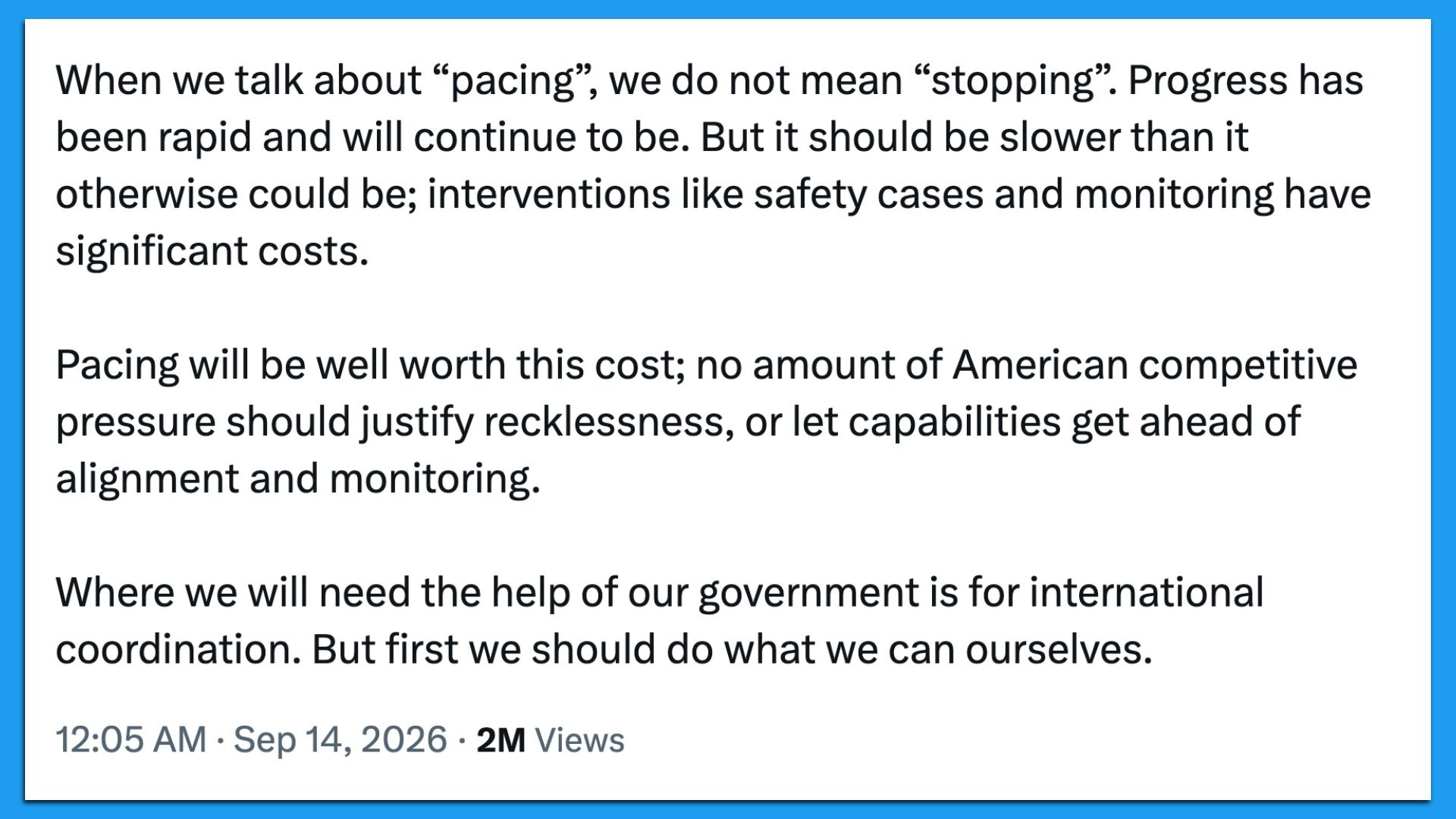
OpenAI CEO Sam Altman tweeted just after midnight ET that "pacing" the development of AI models, as the top labs endorsed over the weekend, doesn't mean "stopping."
- "Progress has been rapid and will continue to be," he wrote. "But it should be slower than it otherwise could be; interventions like safety cases and monitoring have significant costs."
💡 Why it matters: Altman thinks "pacing" — sequencing safety before release — will allow the U.S. to continue to lead in innovation. His overnight statement shows the AI giants don't plan to disarm, either against each other or against China.
- Anthropic CEO Dario Amodei pushed a similar approach in his essay, "We Must Pace the Frontier," that triggered unprecedented statements of agreement from the cutthroat competitors building AI.
In a tweet a few minutes later, Altman advocated "a narrow middle path" between accelerationists and the pause crowd.
- This third way would avoid "two ways AI progress could go very badly ... [F]or example, one country could gain too much power. Another example is one lab ending up with too much power."
4. 📚 Reading rut


Just over 16% of Americans read for pleasure on an average day last year, Axios' Sami Sparber writes from new government data.
- We spent an average of 16 minutes per day reading for pleasure in 2025, but an average of 2.6 hours watching TV.
5. 🗳️ Native voters' new power

The 2028 presidential election will give new political clout to a long-overlooked constituency: Native American voters.
- New Mexico now holds an influential early spot as one of the first states to vote in the Democratic primary — on Feb. 15, 2028. That's put Native Americans, who make up about 12% of the state, in position to wield more influence in the race for the White House, Axios' Holly Otterbein reports.
Potential presidential campaigns are scrambling to adjust to the 2028 lineup, calling Native leaders to learn about Indigenous power players and the dynamics of tribal governments, Democratic operatives tell Axios.
- Native leaders and their allies say this'll push presidential candidates to pay attention to issues affecting Native Americans, such as tribal sovereignty, land and water rights, and rural infrastructure.
6. 💸 Trump's reality check
President Trump's proposal to send adult U.S. citizens $5,000 dividend checks if Republicans retain control of the House and the Senate would require congressional approval, House Speaker Mike Johnson (R-La.) said yesterday.
- Why it matters: Trump and his top officials claim they can send the checks without Congress — even with the prospect of them costing upward of $1.3 trillion, Axios' Ben Berkowitz writes.
Asked on NBC's "Meet the Press" if he'd commit that the checks will be sent, Johnson said: "I commit that Congress will work through it and find consensus on that like they have to do everything else."
- Trump told reporters before departing Ireland yesterday that "the $5,000 checks are going forward" and that he had thought of this plan "a while ago."
7. 👀 How Republicans got Fetterman

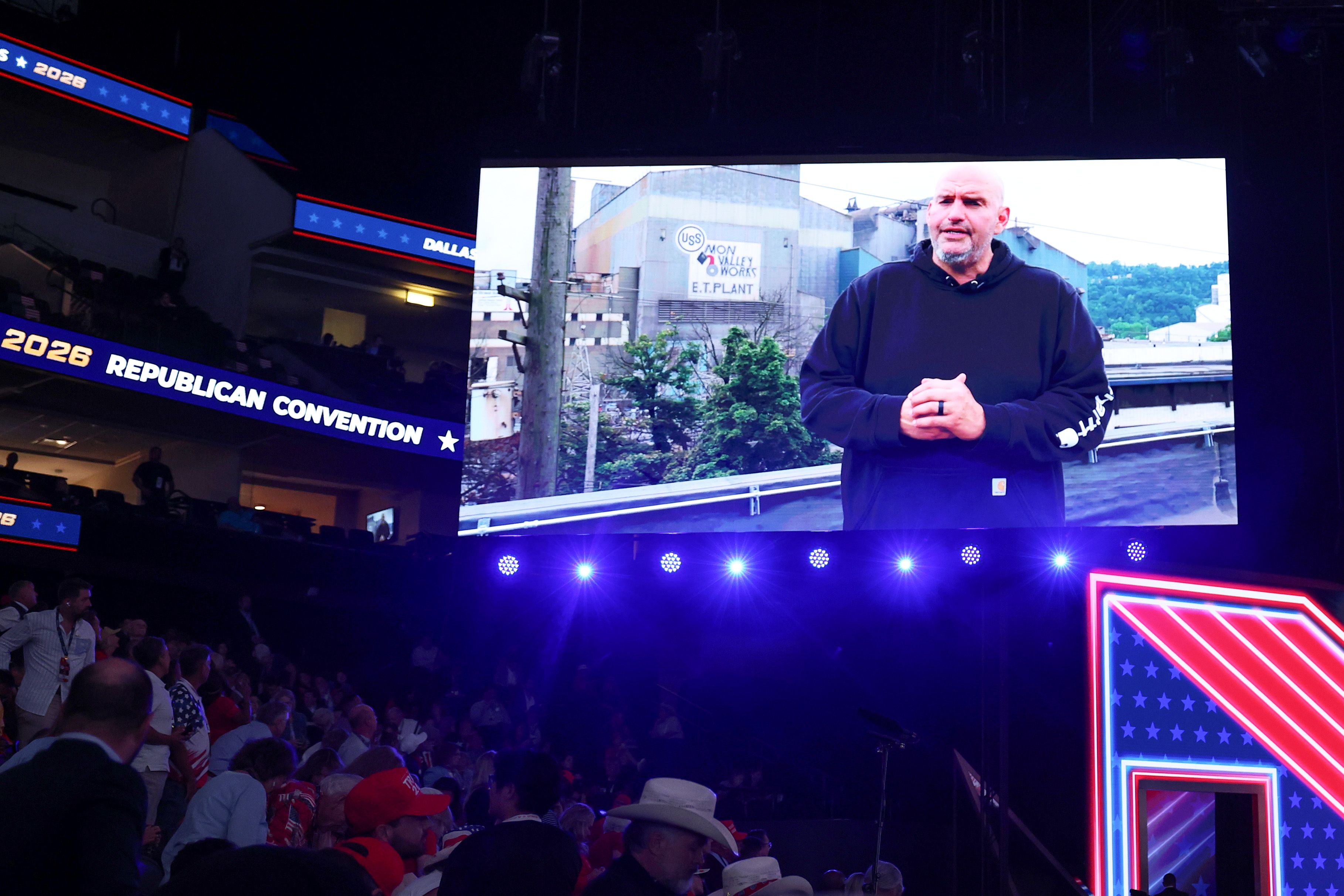
The biggest surprise of last week's Republican midterm convention began with an audacious request from the organizers to GOP Sen. Dave McCormick: Could he get Democratic Sen. John Fetterman, a fellow Pennsylvanian, to make an appearance?
- Why it matters: Fetterman's 64-second video — calling himself a "common-sense Democrat," praising McCormick and vowing to work with President Trump to defend Pennsylvania's steel industry — represented Fetterman's biggest break yet with his party, Axios' Alex Isenstadt reports.
🔎 Behind the scenes: Republican operative Tony Sayegh, a leading convention organizer, was a driving force behind the idea, and Trump adviser Jason Miller backed the plan.
- McCormick asked Fetterman to introduce him at the convention. A source said McCormick added: "I don't want you to do something that's not good for you."
- "I want to do it. I'm sure it will make people mad," Fetterman told McCormick, according to the source. "But you're my friend, and I want to introduce you."
🤫 The intrigue: To preserve the surprise, organizers kept the circle tight. McCormick looped in his chief of staff, Mark Isakowitz, and only a few others. Miller was Sayegh's point of contact in the White House.
- Fetterman went even further: He told no one on his team, a source told Axios.
Fetterman reiterated after his virtual appearance that he isn't switching parties, calling himself a "lifelong Democrat" and saying that if Democrats win control of the Senate in November, he'd remain the "51st vote."
8. 🏈 1 for the road: New No. 1


🤘 Texas' unprecedented comeback to knock off Ohio State moved the Longhorns to No. 1 in AP's Top 25 college football poll, and pushed the Buckeyes out of the top five for the first time in two seasons.
- Oregon plummeted 15 spots to No. 21, its lowest ranking in four years, after its 39-31 road loss to an Oklahoma State team that had lost 21 straight against Football Bowl Subdivision opponents.
- Michigan, which fell out of the Top 25 after needing an extra second and second-chance Hail Mary try to beat Western Michigan a week ago, returned to the poll at No. 19 following its 17-10 win over No. 11 Oklahoma.
📬 Thanks for reading! Please invite your friends to join AM.
Sign up for Axios AM