Axios AM

August 19, 2026

1 big thing: Exclusive: GOP's stark AI warning
The Senate GOP campaign arm, in a private memo to top AI companies, warns that toxic views of U.S. data centers are killing the party's chances of holding a vital seat in Ohio, Axios' Alex Isenstadt scoops.
- In the memo, obtained by Axios, the National Republican Senatorial Committee says Democrats have made data centers a "centerpiece" of their campaign to defeat Sen. Jon Husted (R-Ohio) — and that it's working.
- "If he loses and data centers get the blame, politicians across the country will take notice — and they will not go near the next one," the memo says. "This has become a sleeper issue for the entire election cycle."
Why it matters: Republicans want AI companies to do whatever it takes to stem the public backlash.
🖼️ The big picture: AI CEOs and top Republicans share in the rising panic. They tell us internal polls show data centers are as popular as spent nuclear waste, and more broadly have become a proxy for feelings about AI.
- Tech giants are scrambling to pull together media campaigns to try to shift opinion before it hardens locally and nationally.
- But Democrats aren't dummies. They see the same polls and are moving fast. Even politicians who previously embraced data centers are racing to crack down on them this election year.
There are now more than 4,000 data centers online across the U.S., with another 3,000-plus proposed or in progress.
- They're designed to power the AI transforming the American economy, but have drawn protests from communities nationwide because they require massive amounts of electricity and water, can drive up utility bills, involve enormous warehouse-like structures and provide few jobs.
- They also have become local proxies for anxiety about AI-driven job loss.
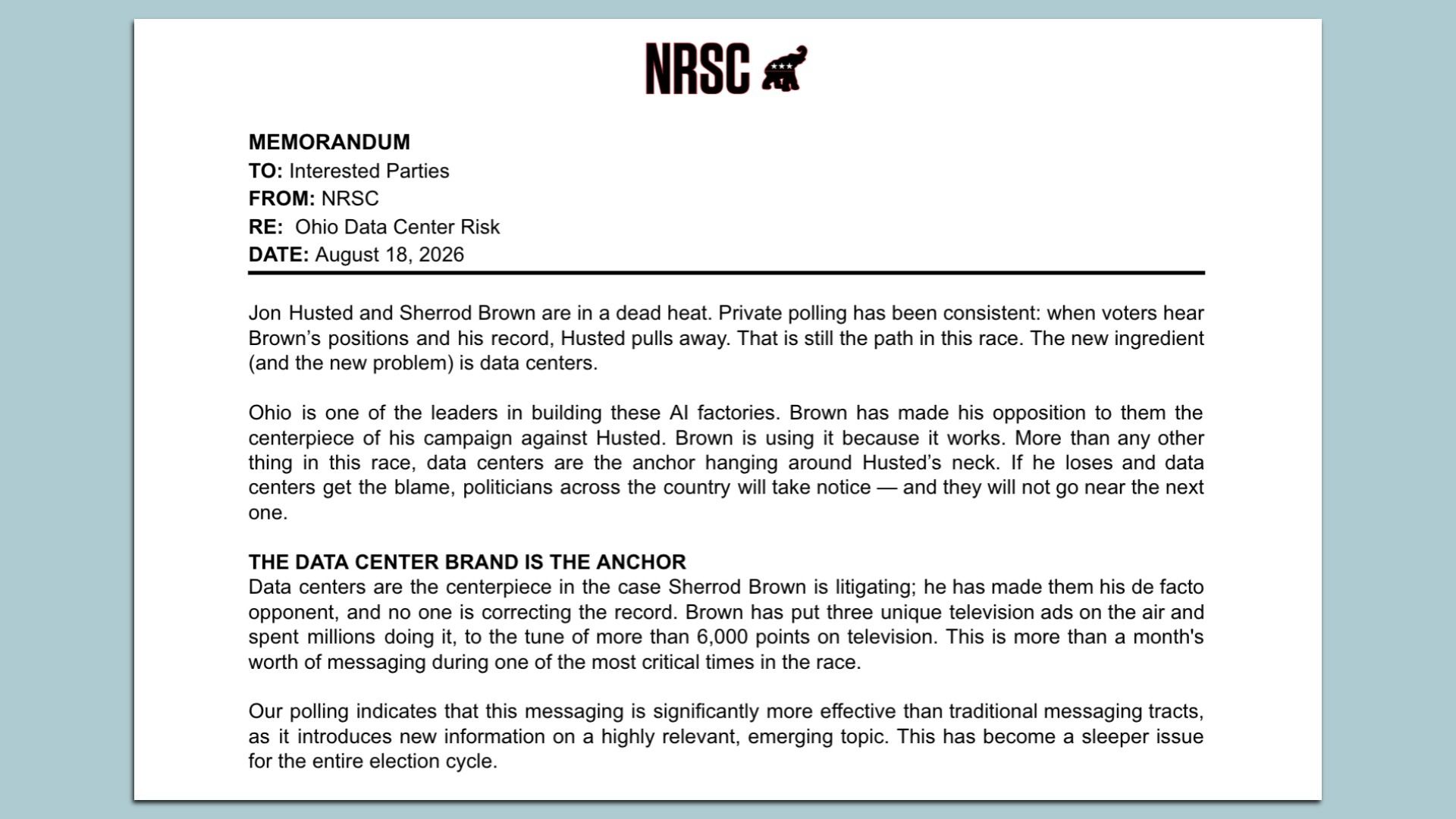
🔎 Zoom in: Husted's opponent, former Sen. Sherrod Brown (D), has spent millions of dollars on a summer ad campaign calling Husted "the face of data centers in Ohio."
- Republicans say the issue is especially potent in heavily blue-collar Ohio because the state has several big data center projects in the works. Nvidia and OpenAI have announced one in the last few days. Meta, Vantage and QTS also have projects there.
The NRSC memo says Brown has made data centers his "de facto opponent."
- A Fox News poll last week showed Brown leading Husted by 8 points.
The bottom line: The memo, headlined "Ohio Data Center Risk," argues that a Husted loss would cause long-lasting damage to AI companies' push to build data centers nationwide to power future generations of AI.
- "If voters' perceptions of data centers are not fixed quickly, the campaign against them will expand far beyond Ohio," the party warns.
2. 🤖 The new existential threat to AI

Forget energy. Forget chips. Forget China. The most clear and present danger to AI and any AI-related economic boom is rapidly rising public opposition to U.S. data centers, Jim VandeHei and Mike Allen write in a "Behind the Curtain" column.
- Why it matters: Republicans and AI CEOs are in full panic mode watching politicians and the public turn on the physical engines of AI growth. In private, they tell us they can't find a compelling message to shift opinion fast enough.
Their nightmare — a political and economic daisy chain that cripples the AI revolution — is already taking shape:
- Voters revolt against data centers over electricity bills, water use, giant warehouse-like developments and fears about AI eliminating jobs.
- Democrats race to capitalize, competing to impose tougher restrictions or block projects altogether.
- Republicans — watching candidates get punished in places like Ohio — retreat from an industry they've spent years championing.
- The pipeline of new data centers slows, constraining the computing power AI companies need to keep improving their models and products.
- Investors question the staggering spending, borrowing and valuations built on expectations of relentless AI growth.
🔭 Zoom out: The AI boom has become dangerously intertwined with the U.S. economy, meaning this will ricochet far beyond Silicon Valley.
- Goldman Sachs estimates U.S. AI investment will hit about $600 billion this year, equal to roughly 2% of GDP and 10% of business fixed investment.
- Big Tech has already locked itself into trillions of dollars in future spending: The Financial Times found six hyperscalers have nearly $1.5 trillion in purchase commitments, much of it tied to AI infrastructure, plus roughly $1.5 trillion in lease obligations. Even the richest companies in history are now turning to debt markets to bankroll the buildout.
- A handful of those AI-heavy tech giants dominate the stock market's gains, swelling the portfolios of wealthy Americans who account for an outsized share of consumer spending.
🎨 The big picture: The increasingly toxic politics of data centers are surfacing in several of this fall's governors' races.
- Pennsylvania Gov. Josh Shapiro (D), a 2028 hopeful, had welcomed data centers as an economic-development boon, boasting last year that an Amazon plan to build $20 billion in AI infrastructure was the "largest private sector investment in the history of Pennsylvania."
- Yesterday, Shapiro, whose Republican opponent in November is campaigning on halting data-center development, went from AI cheerleader to critic and signed an executive order imposing stringent new requirements for data-center developers.
👀 The intrigue: In Wisconsin, GOP gubernatorial nominee Tom Tiffany — a close Trump ally — is running ads attacking his Democratic opponent for suggesting the state could become an AI data hub "for the entire globe."
- It's a striking crack in Trump's pro-AI coalition, as Republicans in swing states scramble to get on the right side of the new populist wave upending the midterms.
The other side: OpenAI is aggressively courting state and local officials to try to persuade them of the economic benefits of data centers. Chris Lehane, OpenAI's chief global affairs officer, told us: "As the late, great Tip O'Neill famously said, 'All politics is local.'"
- "That is especially true of AI data centers, where you have to show up, listen, and directly respond with specifics to the concerns of locals," Lehane added. "You have to answer the mail on issues like electricity and water, while also demonstrating a seriousness of purpose when it comes to ensuring the community gets a good deal. ... That is democracy in action."
- Meta last week announced its Future Is for Everyone Fund, with $1 billion in spending planned to benefit teachers, law enforcement and fire departments in communities where the company owns or plans data centers. Meta is also aggressively highlighting direct economic benefits for localities, including thousands of jobs and an increased tax base.


🔢 By the numbers: In Pew Research Center polling published yesterday, 52% of Americans said they're "more concerned than excited" about increased use of AI in daily life — up from 37% in 2021.
- Even adults under 30 have soured on AI, with 55% now saying they're more concerned than excited — mainly because of fears the technology will take jobs. Excitement has faded across all age groups over the past five years, Pew found.
- A June Echelon Insights poll found AI data centers are uniquely toxic: Just 27% of voters say they would support building one in their community, dead last among the projects tested — including a nuclear power plant.
Zachary Basu and Alex Thompson contributed reporting.
- Share this column ... Go deeper: "AI optimism fades among young adults," by Axios' Josephine Walker.
3. 🐊 Florida's Democratic Socialist surprise

A stunning Florida Senate primary win by Angie Nixon (D) made her the first member of the Democratic Socialists of America to ever win a major-party nomination for statewide office, Axios' Andrew Pantazi, Marc Caputo and Holly Otterbein write.
- Nixon beat former Trump impeachment witness Alex Vindman in a major upset (56.1% to 43.9%).
- Nixon faces an extreme uphill battle against incumbent Republican Sen. Ashley Moody, who's heavily favored.
🌴 More Florida results: In an open contest to replace term-limited Gov. Ron DeSantis, Rep. Byron Donalds won the Republican nomination.
- Scandal-plagued Rep. Cory Mills (R-Fla.) lost his primary to former TV reporter Ryan Elijah (34.1% to 47.3%).
- Rep. Debbie Wasserman Schultz (D) won her primary (45.3%) in a historically Black-represented district after her district was eliminated, but the majority of the vote split among four Black challengers.
4. 🎯 Ossoff tests Dem appetite for going low

5. ⚠️ OpenAI blinks first in safety standoff

6. 🪖 Trump's 6 months of war

7. 📺 Trump's media legal battles skyrocket


Media-related lawsuits involving President Trump — along with a broader set of Trump-related defamation cases — have surged over the past two years compared with the decade prior, Axios' Sara Fischer and Kerry Flynn write.
- Trump, his businesses and his administration have been involved in 61 media and defamation lawsuits since 2015, including 16 in 2025 and nine so far in 2026, according to an Axios analysis.
8. 🌅 1 for the road: Late summer sunsets
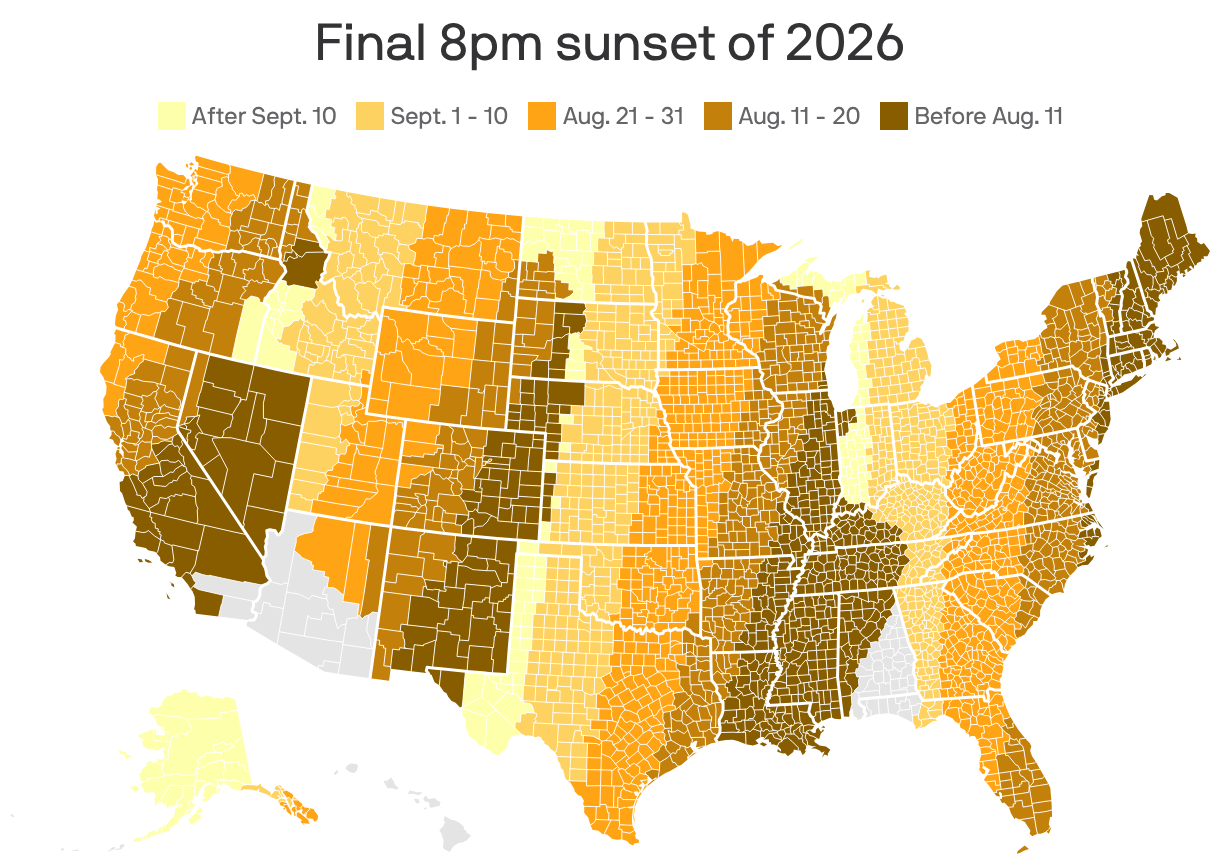
Most Americans have already seen their final 8 p.m. sunset of the year, Axios' Brad Jennings writes.
Axios AM