Axios AM

June 26, 2026

Happy Friday! Smart Brevityβ’ count: 1,656 words ... 6 mins. Thanks to Erica Pandey for orchestrating. Edited by Carolyn DiPaolo and Mickey Meece.
β½ After last night's stunning 3-2 World Cup loss to Turkey in stoppage time, the U.S. Men's National Team will square up against Bosnia and Herzegovina in a knockout match Wednesday in Santa Clara, Calif. Christian Pulisic returns.
1 big thing: The cost of blind loyalty
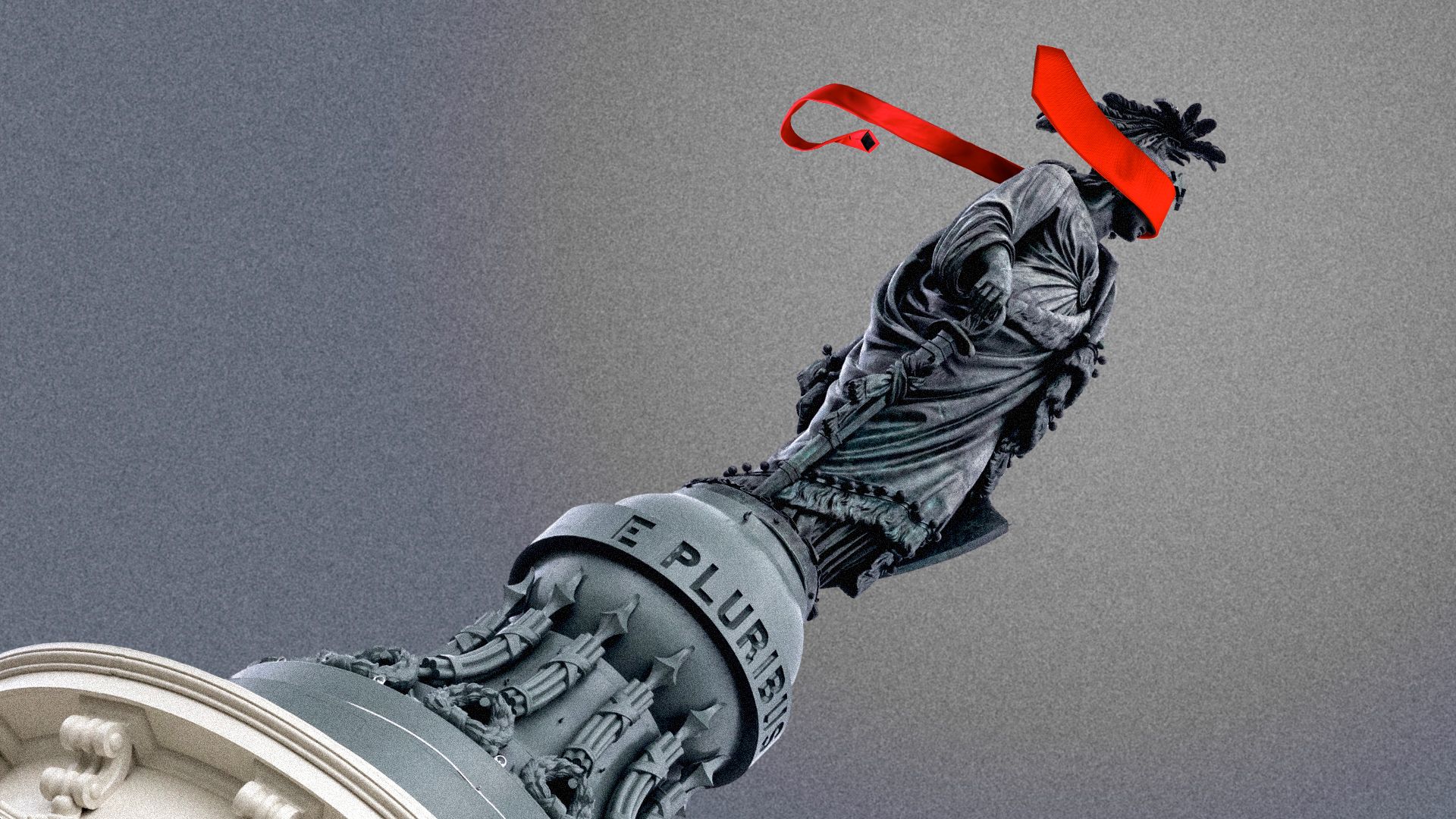
President Trump trained elected Republicans to obey him, even when they disagreed.
- Elected Republicans trained Trump to expect obedience, even as his demands grew impossible to satisfy.
Why it matters: Years of Republicans submitting to Trump, often against their own judgment, have curdled into a rolling crisis as Washington nears the likely end of the GOP's two-year monopoly, Jim VandeHei and Mike Allen write in a "Behind the Curtain" column.
π₯ The big picture: Trump has spent his second term steamrolling his own party, confident the lawmakers he humiliates will keep voting his way. You see it everywhere:
- He canceled the signing of a landmark bipartisan housing bill just hours before the ceremony β trying to strong-arm the Senate into passing the SAVE America Act, a sweeping voter ID bill with no realistic path to 60 (or even 50) votes.
- He dismissed the housing bill β which his own White House had called "one of the most significant pieces of housing affordability legislation in American history" β as "of minor importance."
- He berated the "Four Republican Losers" in the Senate who voted this week to rein in his Iran war powers, calling the rebuke "poorly timed and meaningless." (Hours after his barrage, Republicans passed a symbolic reversal.)
- He blew up a bipartisan scramble aimed at renewing the government's FISA surveillance powers, demanding the SAVE Act on voting rules be bolted on. He let the authority lapse rather than back down.
- He yanked his own intelligence nominee, Jay Clayton, from a confirmation hearing hours before it began, leaving the nation's spy agencies under an acting director both parties distrust.
- He refused to brief Senate Majority Leader John Thune (R-S.D.) and other senators on his Iran deal until after the text was finally released, leaving them to defend terms they hadn't seen.
- He blindsided senators by proposing a $1.8 billion "anti-weaponization" fund just as they moved a $70 billion immigration package, defending Jan. 6 rioters who attacked the building where the senators work.
π Between the lines: Trump is governing like a term-limited president with little patience for Congress, few concerns about the midterms and an insatiable appetite for executive power.
- Republican lawmakers are still stuck with Senate rules, swing-state politics and the long-term consequences of his maximalist demands β like blowing up the filibuster to pass the SAVE Act.
- "I don't think about Americans' financial situation," Trump told reporters in May when asked whether domestic economic pressure was shaping his Iran negotiations.
- "I don't care about the midterms," he said to his Cabinet two weeks later, dismissing the idea that Iran could wait him out on peace talks.
ποΈ What we're hearing: The first sustained check on Trump's second-term power is coming from rebellious GOP senators, especially those whose careers he cut short for insufficient loyalty.
- Sen. Bill Cassidy (R-La.), beaten in a Trump-backed primary, was initially among those voting to curb the president's Iran war powers. Trump and Cassidy got in a shouting match during a closed-door Senate lunch.
- Sen. Thom Tillis (R-N.C.), who chose retirement over a humiliating primary, has become the face of GOP resistance in the Senate β publicly savaging Trump nominees, opposing any move to weaken the filibuster and vowing to "do everything I can" to block the SAVE Act.
- Sen. John Cornyn (R-Texas), who voted with Trump 99% of the time before Trump backed a primary challenger anyway, joined Tillis and Cassidy in refusing to advance attorney general nominee Todd Blanche over concerns about the "anti-weaponization" fund.
Top Republicans tell us Trump's response β lashing out ineffectively β could be a preview of how he'll play his cards over the next 2Β½ years as his power wanes.
- He'll technically be a lame duck after November's midterms. A favorable midterm environment could hand Democrats the House, even with Republicans' redistricting edge. The Senate is in play, too.
- "The Senate is now behaving like the Senate," said a longtime Trump ally who knows Congress well. "More to come. If he loses the Senate, his presidency will be effectively over. Yet he's acting like it doesn't matter."
π If you're a CEO or on a CEO's team: Ask to join Jim's new weekly Axios C-Suite newsletter.
- Share this column ... Zachary Basu contributed reporting.
2. π Administration slows OpenAI release
OpenAI CEO Sam Altman is getting the Mythos treatment:
- He learned during a conversation Wednesday with Commerce Secretary Howard Lutnick that OpenAI will have to initially limit release of its next model, GPT-5.6, to only a small set of government-approved partners.
- I'm told the administration made the move because of the model's "Mythos-like" capability β a reference to the Anthropic model that has formidable power for both cyber defense and cyberattacks.
Why it matters: This marks the first time the U.S. government has preemptively asked an American AI company to restrict the launch of a model before release, Axios' Ashley Gold and Sam Sabin point out.
Between the lines: A source tells Axios that OpenAI has been proactively working with the administration on the GPT-5.6 model release since before Anthropic revoked access to its frontier models, Fable 5 and Mythos 5, over a rare Commerce Department directive.
- The White House has been looped in on the capabilities of OpenAI's new model and has been able to preview its abilities.
- OpenAI hopes to get the model to a larger group next week.
Behind the scenes: Lutnick wanted to be sure all relevant parts of the government test and approve the model, a second source told us.
- This source said the government intervened because GPT-5.6 has Mythos-class power, not because the administration is suddenly taking a heavier hand.
- "This is what's happening with models of that caliber," the source said. The models are so powerful that the administration wants to be sure the companies have adequate safeguards in place, the source added.
3. π» AI price shock


The enormous sums of money going into the AI race are driving up costs throughout the economy.
- That's now becoming increasingly apparent to ordinary Americans who might have thought that AI's impact would be primarily on their jobs, Axios' Courtenay Brown and Nathan Bomey report.
π Apple provided the clearest evidence yet yesterday, raising prices by as much as 25% on MacBook and iPad models β and blaming soaring memory chip costs due to AI demand.
- The same memory squeeze is now hitting gaming consoles. Also yesterday, Microsoft announced price increases of as much as $150 on Xbox consoles β which comes after Sony and Nintendo recently made similar moves.
The bottom line: For the past few decades, consumer gadgets were one of the few areas where prices reliably fell. The AI infrastructure boom is reversing that.
4. π Cluster of quakes

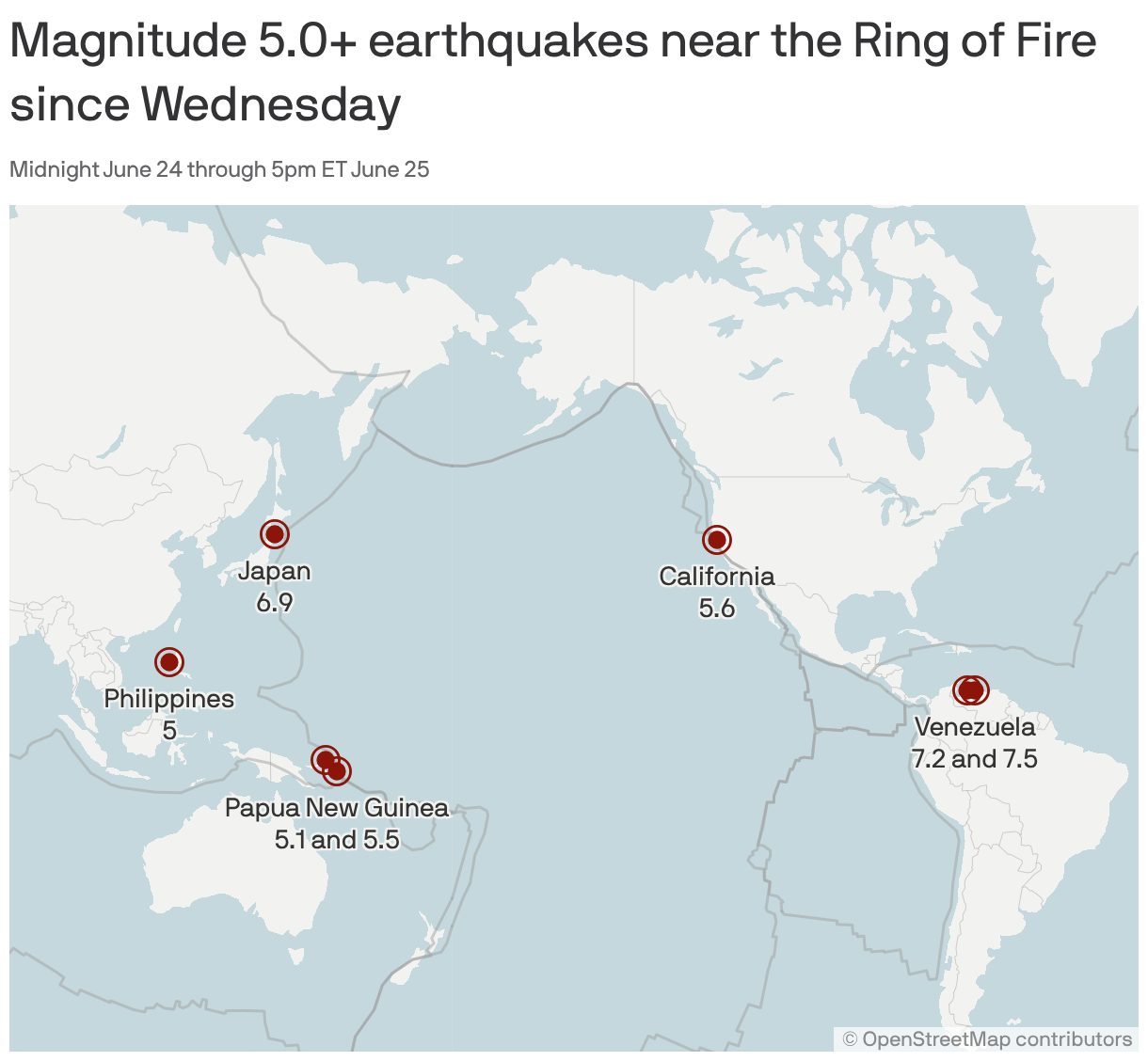
Several strong earthquakes have recently rocked areas in or near the "Ring of Fire," the world's most seismically and volcanically active area, Axios' Alex Fitzpatrick writes:
- Devastating magnitude 7.5 and 7.2 earthquakes in Venezuela left at least 188 people dead, with many more injured or missing.
- Magnitude 5 or higher quakes have struck since Wednesday in California, Japan, the Philippines and Papua New Guinea.
π Zoom in: Clusters of strong earthquakes are rare but not unprecedented.
- Scientists have been researching whether large quakes in one area can trigger more elsewhere.
The Venezuela earthquakes β too strong for either to be a foreshock or aftershock β are connected because they likely occurred on the same fault. There's no evidence that the rest of the quakes are directly related.
5. π Billionaire tax to appear on California ballot

Californians will vote on a controversial proposal in November to temporarily raise taxes on billionaires.
- The proposal would impose a one-time 5% tax on billionaires living in the state as of Jan. 1. The goal is to generate $100 billion in revenue, mainly to fund the state's Medicaid system after federal cuts.
Gov. Gavin Newsom (D) and a broad coalition of healthcare, education, business and labor leaders "warn the wealth tax would worsen California's volatile budget and accelerate billionaire flight already reshaping the state's tax base," the L.A. Times' Seema Mehta writes.
- "The tax would apply to more than 200 Californians, some of whom proactively left the state or moved their companies out of California because of the proposal."
California relies on its top 1% of earners for nearly half of its personal income tax revenue.
6. π° Scoop: Vance in the Valley
Vice President JD Vance headlined an RNC fundraiser last night in Palo Alto, Calif., at the residence of influential investor and All-In Podcast host Chamath Palihapitiya, raking in $4.2 million for the Republican Party, a source familiar with the dinner tells me.
- Why it matters: Vance, who worked in venture capital before becoming a U.S. senator from Ohio, has always had strong ties to Silicon Valley and the tech world.
The dinner was co-hosted by John Underwood of Goldman Sachs. Attendees included Coinbase co-founder and CEO Brian Armstrong, a popular voice of economic freedom on X, and Intel CEO Lip-Bu Tan.
- About two dozen supporters paid $250,000 each.
π± Watch Dan Primack interview Chamath on this week's episode of "The Axios Show."
7. π Road trip cheat sheet


AAA predicts this will be the busiest July 4 week for travel since at least 2019.
- The right departure time could save you hours stuck in traffic, Axios' Sami Sparber reports.
Holiday traffic is expected to pick up starting tomorrow. Transportation data firm INRIX, which works with AAA to forecast travel times, has identified the best departure windows to avoid the worst congestion.
8. πΊπΈ Pics for the road!

This was the view from the top of the 110-foot Ferris wheel at Freedom 250's Great American State Fair on the National Mall yesterday.
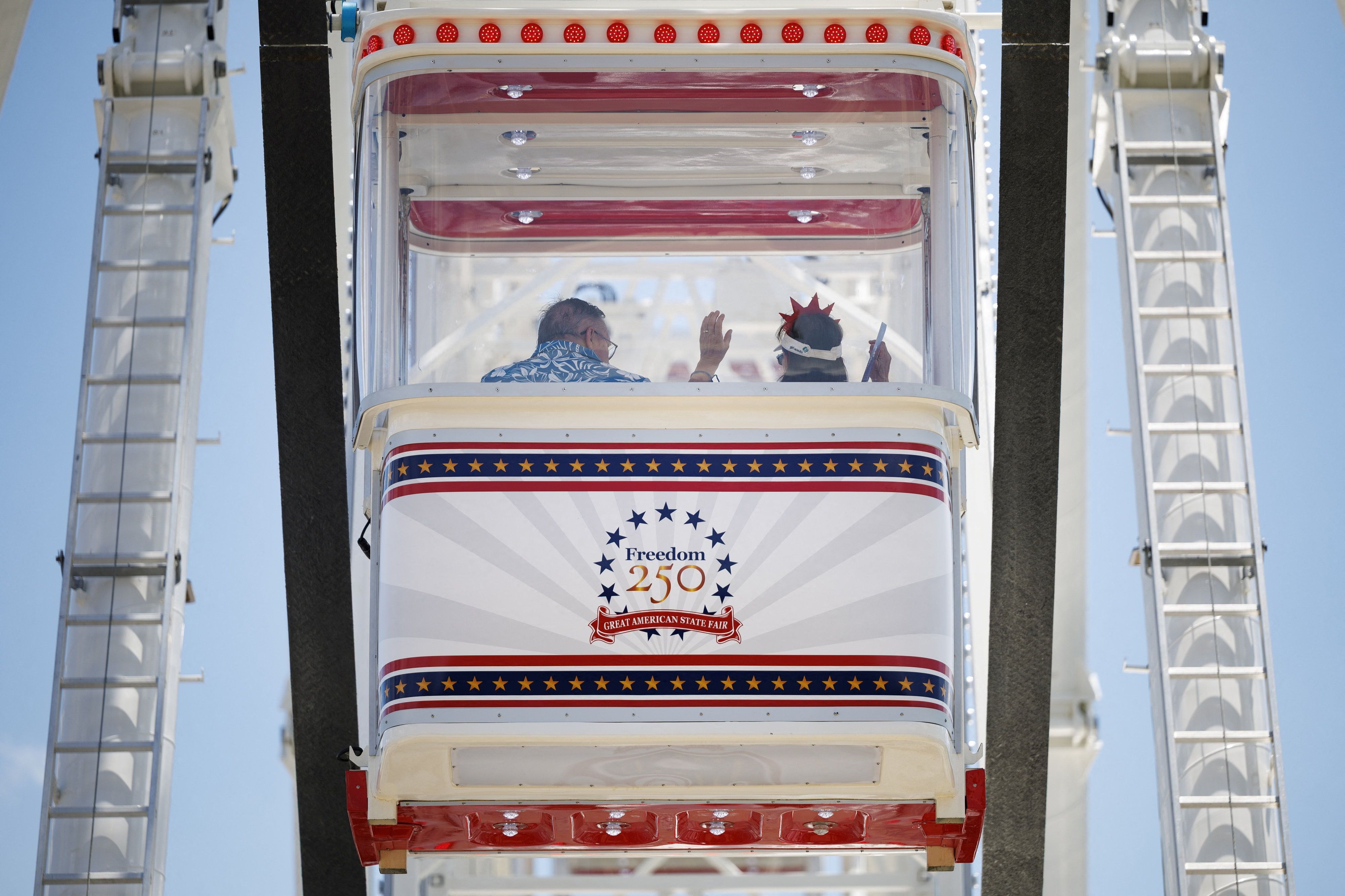
Visitors rode the Ferris wheel yesterday at the fair, which'll run through July 10.
π¬ Thanks for reading! Please invite your friends to join AM.
Sign up for Axios AM