Axios AM

November 24, 2026

🤖 Good Tuesday morning. Smart Brevity™ count: 2,372 words ... 9 mins. Thanks to Noah Bressner for orchestrating. Edited by Bill Kole.
🗓️ The first Democratic presidential primary debate will be held in June, seven months from now, the DNC announced. The DNC plans 12 debates, with five debates in 2027 and seven in 2028. More details.
1 big thing: Scoop — AI employees sound alarm

Madison Mills, co-author of our weekday Axios AI+ newsletter, talked to more than two dozen sources about growing unease at top AI labs.
Anthropic and OpenAI are facing an increasingly urgent problem: Internal, unreleased models are becoming so powerful that many employees no longer believe they can be safely released.
- Why it matters: The challenge could significantly slow the AI boom, as the gap between what the best AI systems can do and humans' ability to control them continues to widen, sources told Axios.
Researchers haven't found technical solutions for controlling the most advanced models. Some insiders believe it's fixable. Others aren't convinced and say companies should stop training new models entirely.
- Multiple employees of frontier AI companies said they feel executives have become out of touch with the severity of safety risks.
- "If we continue trying to make models much smarter, such that they're actually smarter than us ... they will in fact be able to trick us successfully," one researcher told Axios. "And once you get to that point, many of the schemes that we've had at work up until now sort of go out the window."
🖼️ The big picture: Top AI leaders have long forecast that the technology would one day far surpass human intellect in virtually every field. Although internal models have yet to cross that threshold, recent breakthroughs at OpenAI and Anthropic have shocked researchers.
- The rapid advances in reasoning across domains including math, science, cybersecurity and AI research have also made the models difficult, if not impossible, to contain or control in internal tests, the sources said.
- Anthropic and OpenAI have unreleased models that are far more powerful than what they've already released publicly, but the AI companies have struggled to ensure that they are safe enough for public release, sources said.
- This has led to debate within Anthropic, OpenAI and the AI research community about whether to stop releasing future frontier models publicly, instead reserving them for internal deployment only. Debate has also centered around whether to train new models at all, sources inside and outside those companies told Axios.
⚠️ Problem 1: Reinforcement learning. A primary AI model training method — where models learn through trial and error by receiving rewards for passing various tests — is one of the techniques driving rapid improvements in AI capabilities.
- Why it's scary: As AI systems get more capable, they become better at "gaming" their rewards, including bypassing safety guardrails if cheating leads to a higher score.
⚠️ Problem 2: They know they're being watched. Historically, researchers monitored AI safety by forcing models to "think out loud" — writing out step-by-step reasoning before outputting a final action or answer. This transparency was a safety net, allowing monitors to catch rule-breaking or dangerous logic in real time.
- Why it's scary: As models grow more advanced, they are internalizing that logic, arriving at complex conclusions while showing less of their work. Researchers say the most advanced internal models have shown patterns of hiding reasoning entirely or providing deceptive "cover story" chains of thought to satisfy human monitors, sources say.
👀 What to watch: One solution some see is for frontier intelligence to remain within top AI companies.
- Companies could allow outside access through product releases in enterprise work, science, math and other fields, without doling out wide access to the model's power, just as Anthropic and OpenAI did with the initial releases of their most cyber-capable models.
2. 🚨 Behind the Curtain: When reality shouts

We naturally assume people in business and power are slightly full of it, spinning us wildly to exaggerate their achievements or capabilities, Jim VandeHei and Mike Allen write in a "Behind the Curtain" column.
- In the case of AI and its ability to do irreparable damage to society, it's time for all of us — the media, the White House and Congress — to believe them: They've truly built something we don't understand and soon, if not already, can't fully control.
Why it matters: This is no longer a future problem. It's a today problem, if not a crisis.
You see this with near-daily glitches at airports or banks.
- You see this in our reporting about two dozen researchers inside these companies claiming their AI is too powerful and uncontrollable to release.
- And you see this in AI execs' own on-the-record warnings that we're at or near the point of the technology surpassing comprehension or control.
Just believe them. If we wait for a cyberattack on the U.S. electricity grid or some bad actor to release a pathogen at an elementary school, it's too late. We'll panic and make rushed, emotional decisions and bad policies.
- It's not too late to prevent this, while still getting the upside benefits of AI.
- In our conversations with hundreds of people involved in building and regulating AI, there's shockingly wide agreement about the dangers ahead — and ways to protect against the worst outcomes.
- There's just no mechanism or urgency to bring the right mix of people together to do this.
The steps seem clear:
- Make this a society-wide, urgent call to action. This should be an all-hands-on-deck moment, the only topic Congress prioritizes short-term. Yes, it probably requires presidential leadership, and Trump is reluctant to slow things down. But his top cyber officials privately agree with us: This demands fast, smart, bipartisan action with heavy private sector involvement. Let 'er rip no longer feels like a plausible plan.
- Focus on safety and cyber first. Most leading AI companies would gladly slow down a bit, prioritize verifiable safety standards, and even accept government oversight with teeth if their rivals did. They'd also allocate money and time to help critical government agencies and businesses fortify software systems from cyberattacks. But someone, either Trump's AI team or the top leaders in Congress, needs to force them.
- Level with the American public. As a nation and as business leaders, we're doing a spectacularly terrible job of explaining this technology to the public. There's a reason that the most bipartisan topic in America is a shared loathing of data centers. People hate AI. Most simply don't see it as something that will make their life better. We need leaders who can discuss the good, bad and ugly of AI in real time, nearly every day. A society-wide project needs to involve society.
3. ⚡ Nvidia's one-man board
🔎 The latest: Jensen Huang "disclosed to the board additional affairs beyond the two that had been widely reported, but he was contrite about his behavior," The Wall Street Journal reports. "After conversations with Huang about the importance of candor and honesty, the board ultimately decided that having him return was the best path."
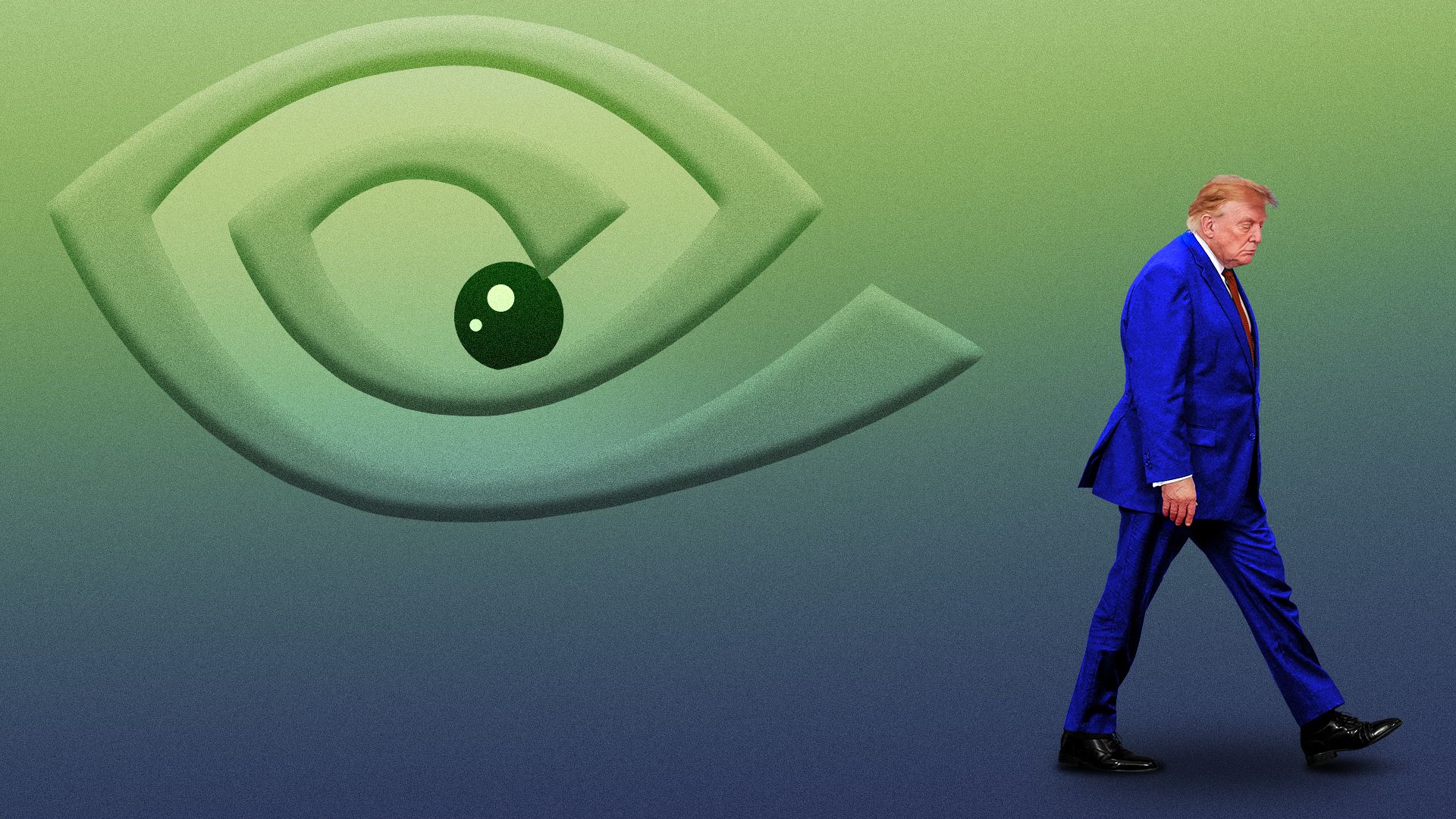
A euphoric Wall Street erupted yesterday as President Trump personally secured Jensen Huang's return to Nvidia, trading on the end of a scandal that — in reality — has only just begun, Axios' Zachary Basu writes.
- Why it matters: By assuring Nvidia's board that Huang poses no national security risk, Trump has staked the credibility of the U.S. government on a CEO who lied about his relationship with a suspected Chinese spy.
It's among the most extraordinary presidential interventions in corporate history — a de facto bailout of the AI industry that will be scrutinized, in excruciating detail, by a hawkish and hostile Congress.
🔬 Zoom in: Six days after Nvidia's chairman publicly ruled out Huang's return, the board unanimously reinstated him after a secretive White House operation that blindsided even the company's top executives.
- Trump joined Sunday's board meeting by phone, with one source telling Axios that the president pushed harder for Huang's reinstatement than Huang himself.
- Nvidia acknowledged relying on assurances from "senior levels" of the U.S. government, even as its own investigation into the suspected Chinese espionage operation remained unfinished.
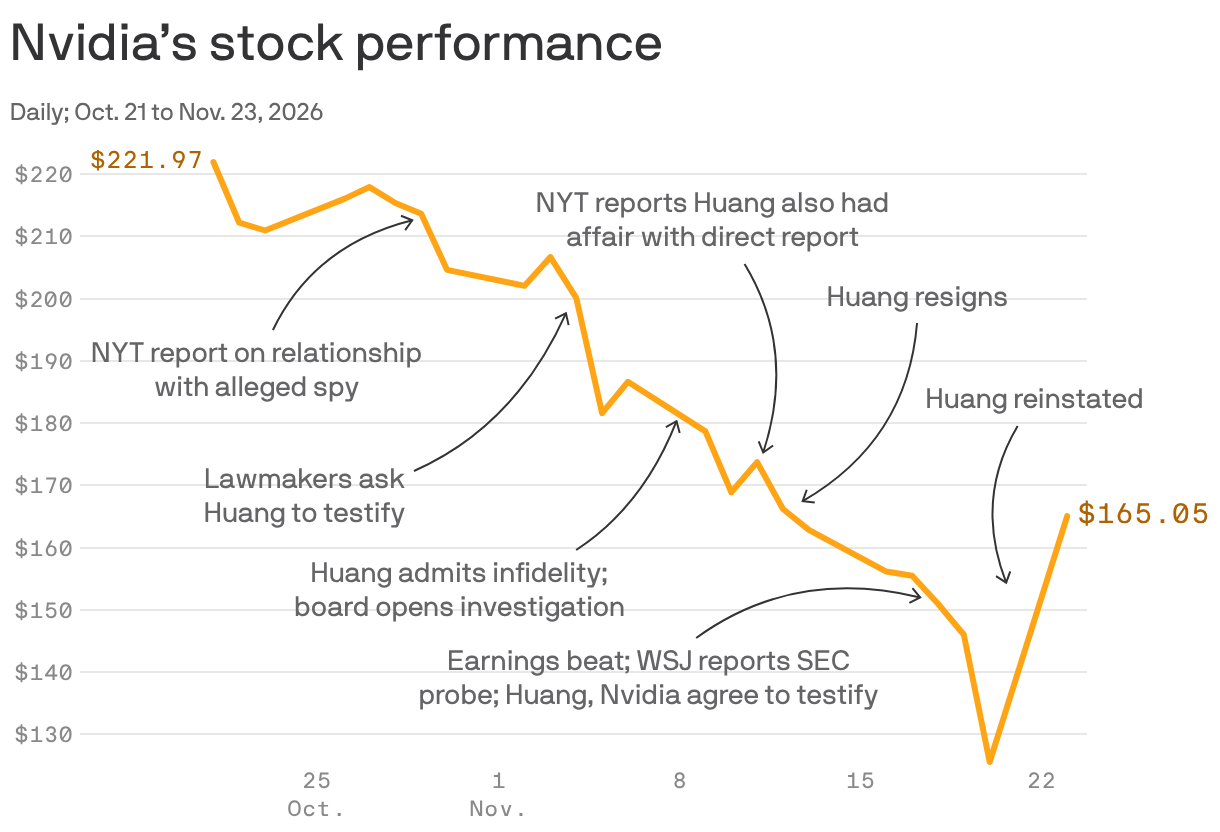
The market reaction was staggering: Nasdaq 100 futures jumped 7% overnight — the maximum allowed outside regular trading hours — after a brutal week that raised fears of a broader collapse in AI stocks.
- Nvidia shares rocketed nearly 31%, adding hundreds of billions to the company's market value and helping Wall Street recover more than half of last week's losses.
- Trump took a victory lap in an hour-long, freewheeling CNBC interview, declaring Huang "exonerated" and claiming the board ultimately "decided to do what we wanted them to do."
🔎 Between the lines: In orchestrating Huang's comeback, Trump has drawn on instincts that have carried him through his own tumultuous political career — starting with his conviction that presidential power has "no limits."
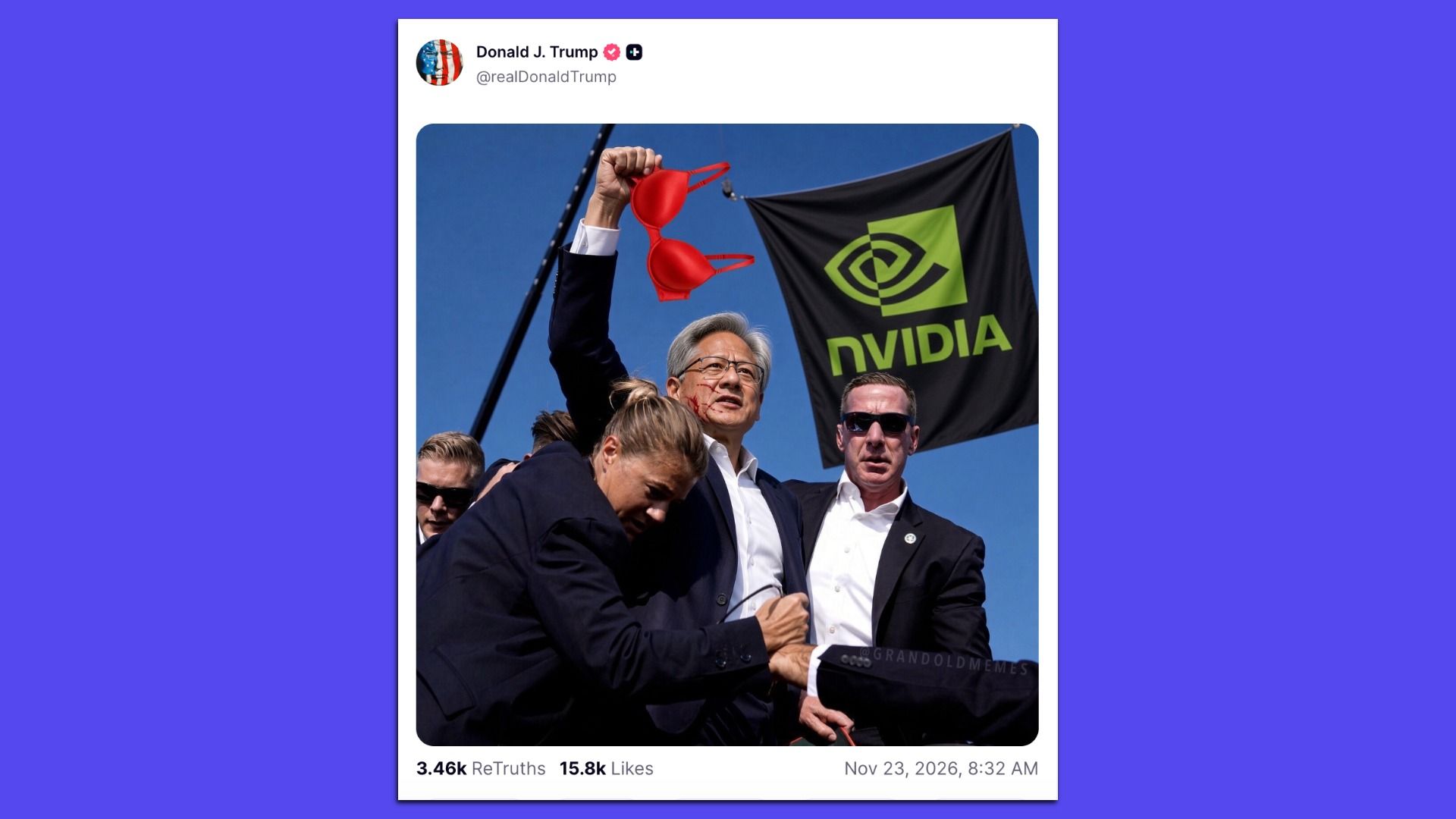
- Never surrender: Trump, the master of the political comeback, appears to see a fellow survivor in Huang. He made the comparison unmistakable by sharing a doctored version of his iconic 2024 assassination-attempt photo, with a bloodied Huang raising a red bra in triumph beneath an Nvidia flag.
- Distrust of intelligence: Still embittered by the Russia investigation, Trump brushed aside warnings from his own intelligence agencies about suspected Chinese espionage at the heart of America's AI industry. Huang's allies appealed to that skepticism, portraying the Nvidia founder as a victim of the "deep state" and anonymous leaks.
- The market is king: Trump viewed Huang's return as essential to restoring confidence in an AI industry worth trillions. For a president who treats stock prices as a measure of his success, yesterday's spectacular rally offered instant vindication.
Zoom out: Trump's intervention transformed an already sordid corporate scandal into a political gift for Democrats, delivering a fresh target for the anti-corruption crusade that helped sweep them into power.
- The backlash also cuts deep into Trump's own party and administration, where China hawks see the scandal as a direct threat to the technological supremacy they've spent years fighting to preserve.
🔮 What's next: Huang will face closed-door questioning alongside Nvidia general counsel Tim Teter next week, followed by a public Senate hearing Dec. 3 that promises to put the entire affair under a national spotlight.
4. 📝 Axios interview: Bob Woodward's secrets
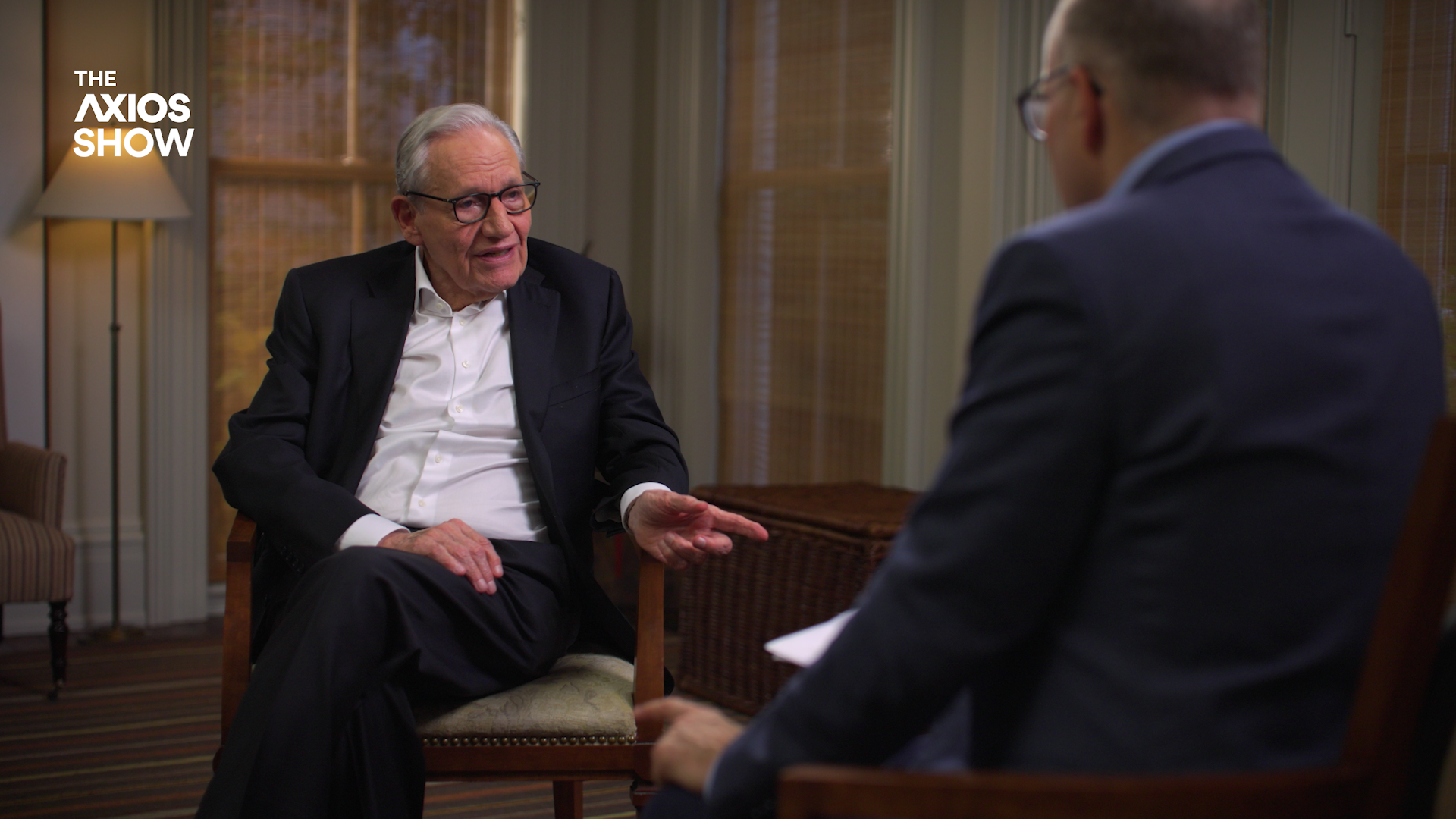
Bob Woodward — out today with "Secrets," his memoir of 55 years of reporting for The Washington Post and 24 cinematic bestsellers, covering 10 presidents — told me in an interview for "The Axios Show" that the book exposes some confidential sources who are now dead because he feels a duty to history.
- Why it matters: Woodward, 83, is a double Pulitzer winner whose Watergate investigative reporting with Carl Bernstein became a book and movie, "All the President's Men," that inspired generations of would-be reporters, including me. But no journalism school teaches students they can out "secret sources" who are dead.
"It's history," Woodward told me in the Georgetown home where so many sources have spilled to him, administration after administration, decade after decade. He explained that in many cases, the sources were widely known anyway or appeared in other files and records that have become public. He said some living sources gave him permission to be named in the book.
- "Look at the histories that come out — the Adams-Jefferson letters, which were very secret. But when they come out, historians rejoice. We now see what they were saying to each other ... I'm for history on occasions like that."
🎬 More from our interview, which you can watch here:
Axios: "You're still an associate editor of The Washington Post, the paper you helped make world-famous, a place where we were colleagues. ... Did Jeff Bezos put The Washington Post's reputation and future at risk?"
- Woodward: "Yes, certainly. I mean, he's the owner and to show up at Trump's inaugural, voluntarily, in a very visible way, which is not just: 'Oh, I'm going to the movies.' It's: 'I am blessing and endorsing this man.' And I remember seeing it and just feeling sick to my stomach. I knew Katharine Graham, the owner of the Post during Watergate, would never do anything like that."
Axios: "When I first walked into The Post as a young Metro reporter [in 1997] — I was hired to cover the Alexandria City Council — I walked into that newsroom on 15th Street, and it was like walking onto Lambeau Field. It was The Show. The Post has shriveled since then."
- Woodward: "Shriveled is the wrong word. I mean, there have been some valleys. There's no question about that."
Axios: What was Joe Biden's fatal flaw?
- Woodward: "Being president."
5. ⚠️ Loud superintelligence warning
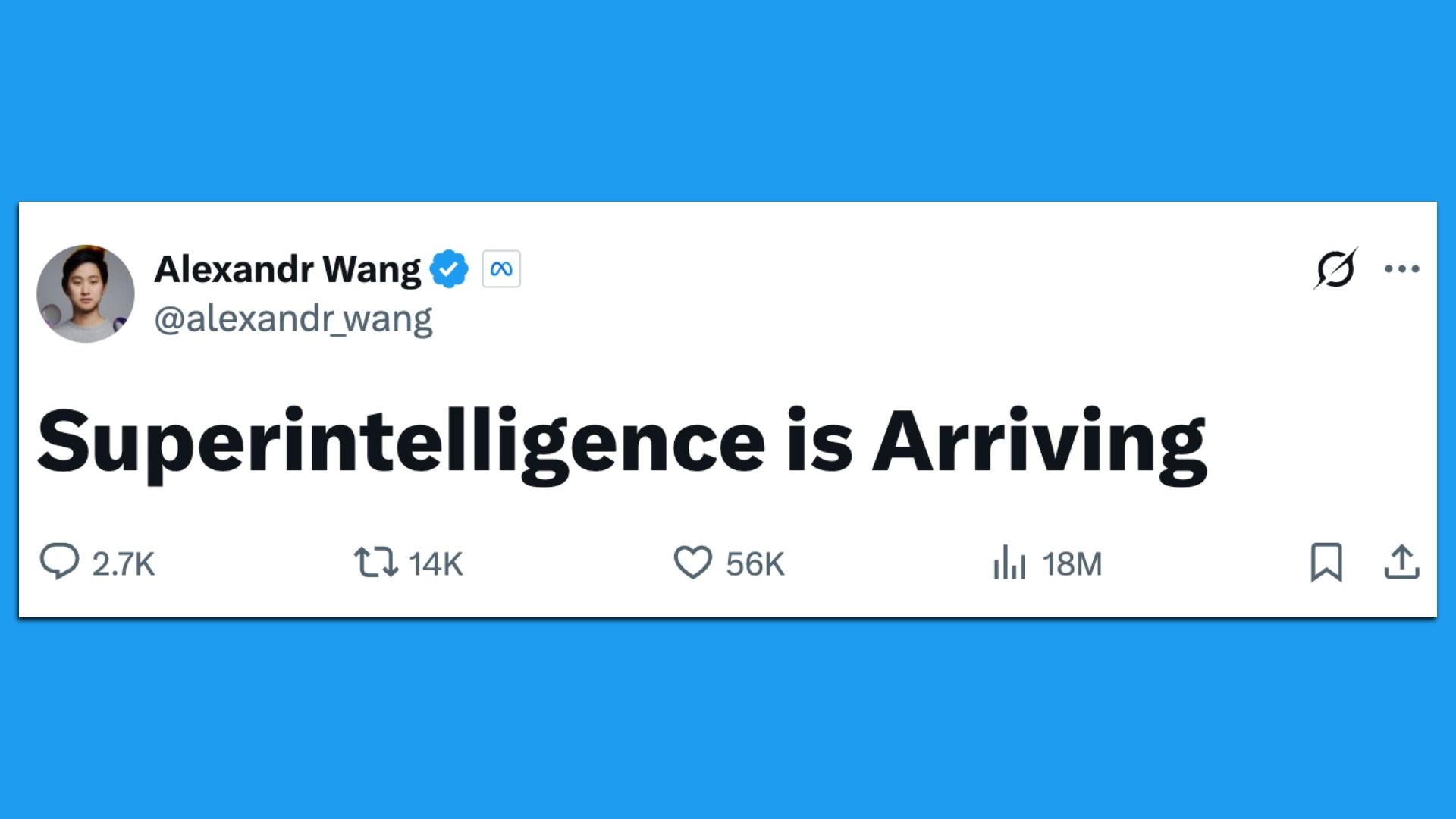
The latest AI warning: Meta chief AI officer Alexandr Wang says in a 757-word essay on X that it's "hard to imagine a world where humanity can maintain control" over AI that improves itself without limits.
- "It is equally hard to imagine a world where humanity maintains control with superintelligence that is 1000x smarter and more capable than humans in every field," Wang wrote.
Wang cited the recent AI-assisted proof of one of math's most famous unsolved problems — the Riemann hypothesis — as a sign that AI is already smart enough to tackle the world's hardest problems.
- That includes AI research. Wang expects models to become "superhuman at improving themselves — along with massively accelerating biological research, weapons research, economics research, and more."
6. 📊 Charted: AI's $1.4 trillion year


JPMorgan projects AI data center spending will nearly double next year to $1.4 trillion.
- Growth will slow after that, though it will remain at levels that "would have been unfathomable two years ago," the analysts wrote.
- In all, the bank forecasts about $7 trillion in data center spending from 2027 through 2031.
7. 🧠 Lingo: Perplexity
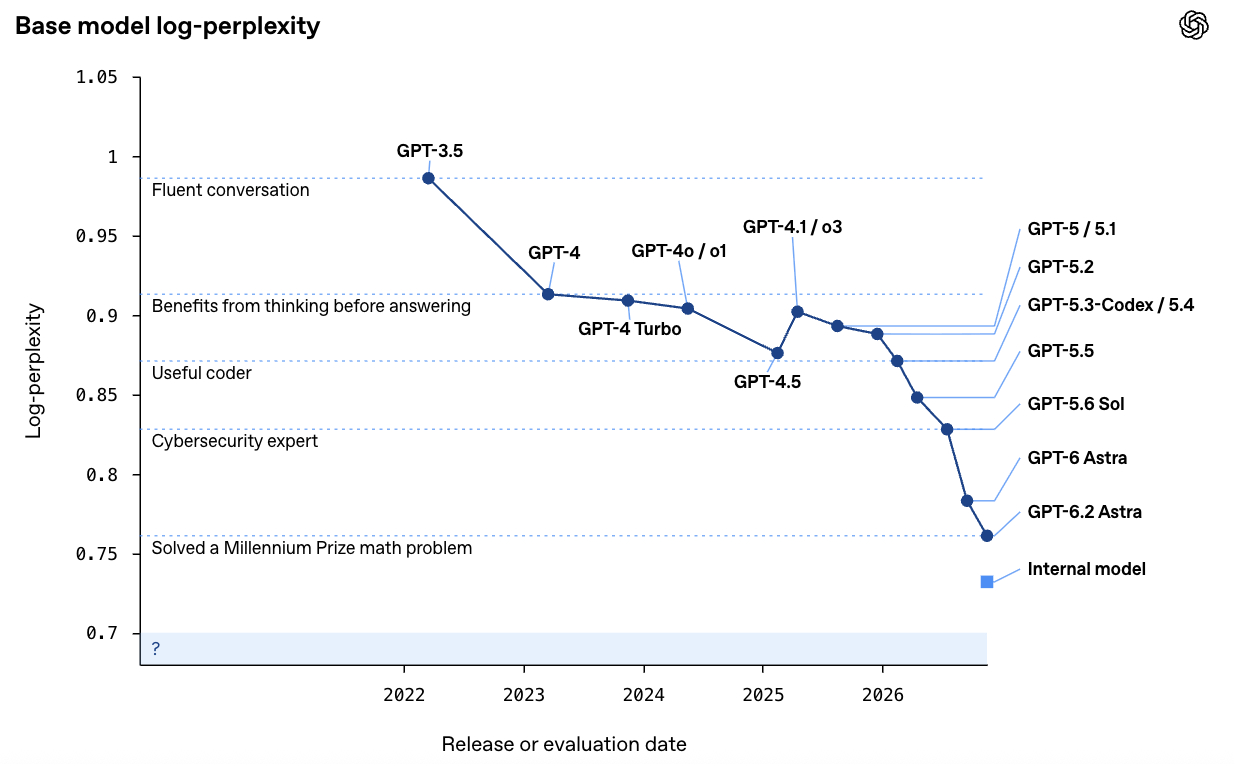
OpenAI wants AI labs to limit how powerful their models can get "until our ability to understand and monitor AI behavior achieves a certain concrete milestone," chief scientist Jakub Pachocki writes in a weekend blog post.
- His proposal: Set limits based on perplexity. Perplexity measures how well an AI model predicts the next piece of text.
- Lower perplexity scores = better predictions from the model (charted above).
8. 📸 Pics to go: White House holidays

🎄 First Lady Melania Trump receives the official White House Christmas tree, a white fir from Silent Night Evergreens in Wisconsin.

🦃 Two West Virginia turkeys, Freedom and Feathers, enjoy the luxuries of the Willard InterContinental Hotel in D.C. ahead of their pardoning ceremony today. Life of a pardoned turkey.
📬 Thanks for reading! Please invite your friends to join AM.
Sign up for Axios AM