Axios AM

July 13, 2025

Hello, Sunday! Smart Brevityβ’ count: 1,665 words ... 6Β½ mins. Thanks to Erica Pandey for orchestrating. Edited by Donica Phifer.
ποΈ "Fight, fight, fight!": Today marks one year since the assassination attempt on President Trump in Butler, Pa. A front-page Washington Post story calls the rally shooting "a turning point for the religious dimension to Trump's movement," with many followers casting him "as a divine instrument." Gift link.
- Photo gallery: Iconic images, one year on.
1 big thing: Paranoid security state
America's top national security agencies have been using polygraph tests, seeking employees' communications and threatening criminal investigations, all in the name of ferreting out leakers or ensuring loyalty, Axios' Dave Lawler writes.
- Why it matters: The revelations expose the deep mistrust between top national security officials and their own staffs β starting at the top, with a commander-in-chief who considers himself a victim of "Deep State" abuses.
π The FBI has subjected senior agents to lie-detector tests to find the sources for fairly innocuous news stories, and even to ask whether agents have ever disparaged Director Kash Patel, the N.Y. Times' Adam Goldman reports.
- A March memo from Joe Kasper, then chief of staff to Defense Secretary Pete Hegseth, stated that polygraphs would be used as part of a leak hunt. That probe devolved into a power struggle that saw Kasper himself ousted.
Agencies all across the federal government have used the devices, which aren't considered highly reliable, for even fairly minor leaks, Reuters reports. In one case, FEMA staffers who attended a March meeting involving Homeland Security Secretary Kristi Noem were subjected to polygraph tests after some contents of the meeting became public.
- The Department of Homeland Security said in March that it's using lie detector tests to try to find tip-offs ahead of ICE raids.
- A new unit under Director of National Intelligence Tulsi Gabbard is seeking email and chat records from employees across America's spy agencies, the WashPost reports.
White House spokesperson Anna Kelly told Axios: "We certainly do not trust leakers who provide sensitive information to the media, or who commit felonies by leaking top secret intelligence."
2. βοΈ Trump wins big on "shadow docket"

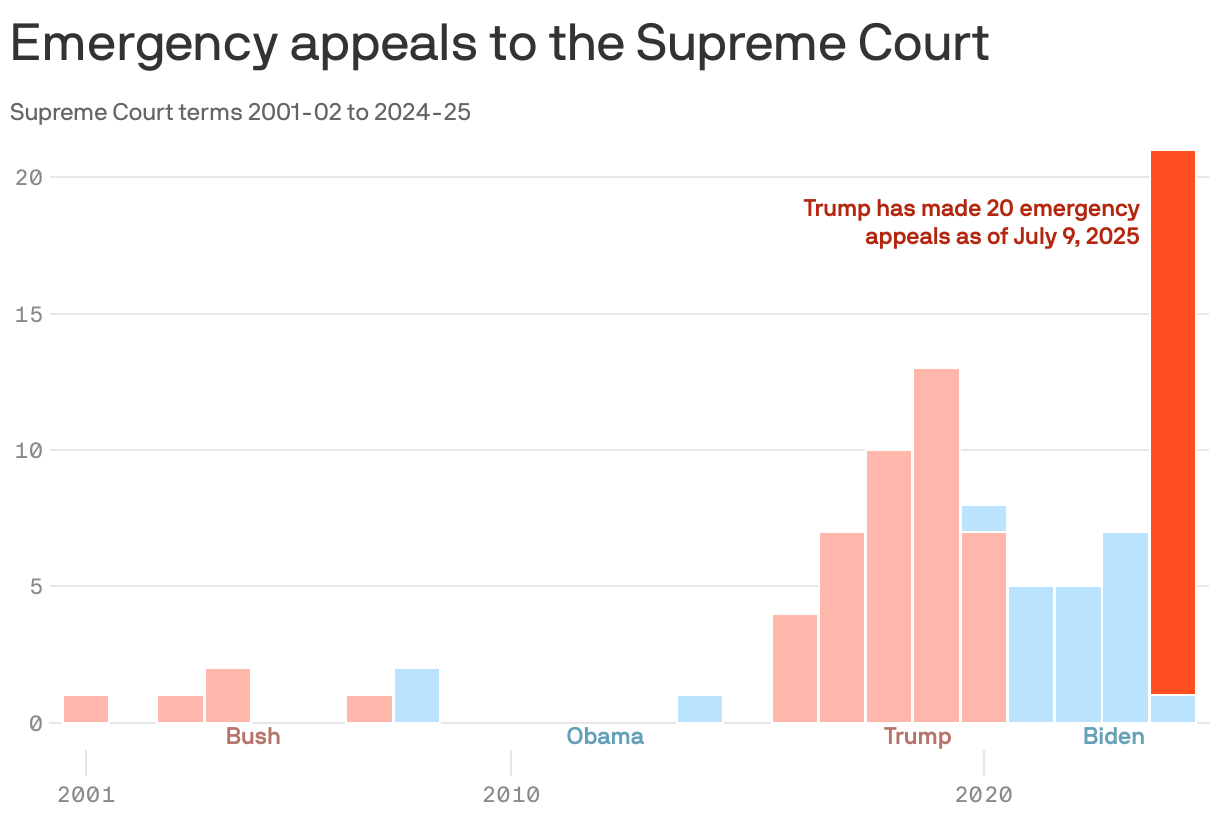
The Supreme Court has handed President Trump a slew of major victories through an abbreviated process that doesn't require full-fledged briefings and arguments β and will likely continue to do so, Axios court watcher Sam Baker reports.
- The court's "emergency docket" (a.k.a. the shadow docket) has been the focus of its activity in Trump's second term, allowing him to proceed with plans to fire government workers, proceed with mass deportations and ban transgender people from serving in the military.
- The court's actions on those issues are all temporary. But even temporary orders are a significant win for Trump, allowing him to implement some of the most controversial parts of his agenda.
π How it works: The emergency docket is designed for questions that need a faster answer than the court's typical proceedings provide. It's often used, for example, by inmates requesting a stay of execution (which the justices almost always deny).
- A growing number of political issues are also finding their way onto the emergency docket. Some critics argue that the court is using the process to decide bigger questions than that process was designed to resolve.
Where it stands: Lower courts have handed down scores of orders that temporarily block Trump from implementing parts of his agenda. That type of order gets appealed through the emergency docket β and the justices have overruled lower courts on several hot-button issues:
- Just last week, the court allowed Trump to proceed with plans for mass firings across the federal government.
- It allowed the administration to deport a group of undocumented immigrants to South Sudan, a war-torn country to which the migrants had no connection.
- The Supreme Court overruled lower-court orders that limited DOGE's access to Social Security records and made some of its work subject to the Freedom of Information Act.
- It also allowed the Pentagon to prohibit trans people from serving in the military.
3. π° It's Crypto Week


A few years ago, crypto was mostly a pariah in the financial services industry. Now, at the urging of the "first crypto president," Congress is on the verge of remaking American finance to embrace it, Axios' Brady Dale and Kate Santaliz report.
- House Republicans declared the next five days Crypto Week.
- Bitcoin hit a new all-time high Friday.
The agenda for next week consists of three bills:
- π¦ Stablecoin legislation, which sources tell us will get a vote next week. Stablecoins are how dollars go on blockchains, and they enable super-fast, super-cheap global payments. They've picked up so much popularity that some companies use them for global payroll. The bill would establish rules for who could issue stablecoins and how β and it's expected to lead to a surge of new products and participation from traditional banks.
- π Market structure legislation, which would create a framework for regulating broader crypto issuance and trading.
- ποΈ The third bill slated for this week is to prevent the Fed from ever creating a digital version of official U.S. currency. Conservatives oppose the concept because they think it would mean more government intrusion.
4. π Pic du jour: AI factory town

"A year ago, a 1,200-acre stretch of farmland outside New Carlisle, Ind., was an empty cornfield. Now, seven Amazon data centers rise up from the rich soil, each larger than a football stadium," the N.Y. Times' Karen Weise and Cade Metz report.
- Amazon also plans AI factory towns in Mississippi, and possibly North Carolina and Pennsylvania.
Read on (gift link).
5. βͺ Trump's America on rewind

President Trump is turning back the clock on decades of change and revisiting long-settled issues, big and small β from globalization to vaccine research to the secretary of defense's title, the N.Y. Times' Peter Baker writes in a Sunday front-pager:
"It should come as no surprise that Trump would try to undo much of what President Biden did over the past four years. What is so striking in Trump's second term is how much he is trying to undo changes that happened years and even decades before that. At times, it seems as if he is trying to repeal much of the 20th century."
Trump wants to go back to "when coal was king and there were no windmills ... when toilets flushed more powerfully ... when there weren't so many immigrants ... when 'Cats' was the big hit on Broadway, not 'Hamilton,'" Peter writes.
- Trump also wants to reopen Alcatraz β and go back to calling the head of the Pentagon the "secretary of war," a title that was dropped in 1947, because he says "secretary of defense" is "politically correct."
Keep reading (gift link).
6. πΌ Summer firing wave
It's shaping up to be a summer of firings for tens of thousands of federal workers, now that the Supreme Court cleared the way for agencies to conduct layoffs, Axios' Emily Peck reports.
- Why it matters: The Trump administration says this is just a step toward better government efficiency. But opponents of the White House's chainsaw approach say the federal government's capabilities will be forever damaged by these cuts.
βοΈ Catch-up quick: Thousands of workers across 19 agencies, who received notice that they were being fired back in the spring, have been out on paid leave pending the results of the court challenge to their dismissals.
- The Supreme Court lifted a stay on their firings this week. Now these workers are just waiting for the axe to fall β again.
The State Department got moving on reductions in force on Friday, only days after the Supreme Court ruling.
- A cable from Secretary of State Marco Rubio went out across the agency Friday announcing a reorganization that could lead to 3,000 departures.
White House spokeswoman Anna Kelly says: "Bloated operations often result in duplicative or even contradictory foreign policy. By reorganizing the Department of State, Secretary Rubio is ensuring that all actions align with the America First agenda that people voted for."
7. π₯ͺ SNAP cuts spook food banks
The "big, beautiful" megabill slashes federal food assistance β and hunger relief groups say the consequences could be devastating, Axios' Avery Lotz reports.
- With millions of food-insecure Americans projected to lose benefits, frontline organizations are bracing for a surge they say they simply can't absorb.
π¨ Feeding America estimates that provisions affecting the Supplemental Nutrition Assistance Program (SNAP) could eliminate the equivalent of some 6 to 9 billion meals annually.
- Feeding America's network would have to "more than double" the amount of food distributed to fill the hole, Vince Hall, chief government relations officer, tells Axios.
The organization is trying to prepare for the surge by reaching out to donors, community leaders, farmers and lawmakers.
8. π€ 1 for the road: Your chatbot knows
OpenAI continues to build and improve ChatGPT's memory, making it more robust and available to more users, even on its free tier β adding new value and opening new pitfalls, Axios' Megan Morrone writes.
- Why it matters: Not everyone is ready for a chatbot that doesn't forget.
The big picture: The first version of ChatGPT memory worked like a personalized notebook that let you jot things down to remember later, OpenAI personalization lead Christina Wadsworth Kaplan told Axios.
- This year, OpenAI expanded memory to make it more automatic and "natural," Wadsworth Kaplan says.
π‘ Pro tip: OpenAI says users have full control over their memories. There's an option to delete any memory in the Settings page, or to delete an associated chat, or to tell ChatGPT what you want.
- Try telling it: "Remember this." Or: "Don't remember this."
π Zoom in: OpenAI's Wadsworth Kaplan tells us that if you were recently talking to ChatGPT about training for a marathon, the model "should remember that and should be able to help you with that in other conversations."
- Another example from Wadsworth Kaplan: using ChatGPT to recommend vaccinations for an upcoming trip based on the bot's memory of her health history.
- A nurse suggested four vaccinations. ChatGPT recommended five β flagging an addition based on prior lab results that Wadsworth Kaplan had uploaded. The nurse agreed it was a good idea.
π¬ Thanks for reading! Please invite your friends to join AM.
Sign up for Axios AM