Axios AM

June 24, 2025

1 big thing: How the ceasefire happened

The Trump-brokered ceasefire between Iran and Israel has, for now, brought an abrupt and extraordinary end to one of the Middle East's most explosive confrontations in decades, Axios' Barak Ravid and Zachary Basu write.
- Why it matters: The 12-day war sent shockwaves through a region already reeling from nearly two years of historic volatility and violence, beginning with Hamas' Oct. 7 terrorist attack on Israel.
President Trump's military intervention to destroy Iranian nuclear sites brought the U.S. to the precipice of a major conflict that four of his predecessors had sought to avoid.
- But it set the stage for a ceasefire that — if it holds — could usher in a fundamentally new era for the Middle East, its security and its dominant powers.
📱 Trump told Axios' Barak Ravid in a phone call: "This is the end of the war. It is a great and wonderful thing for Israel and the world."
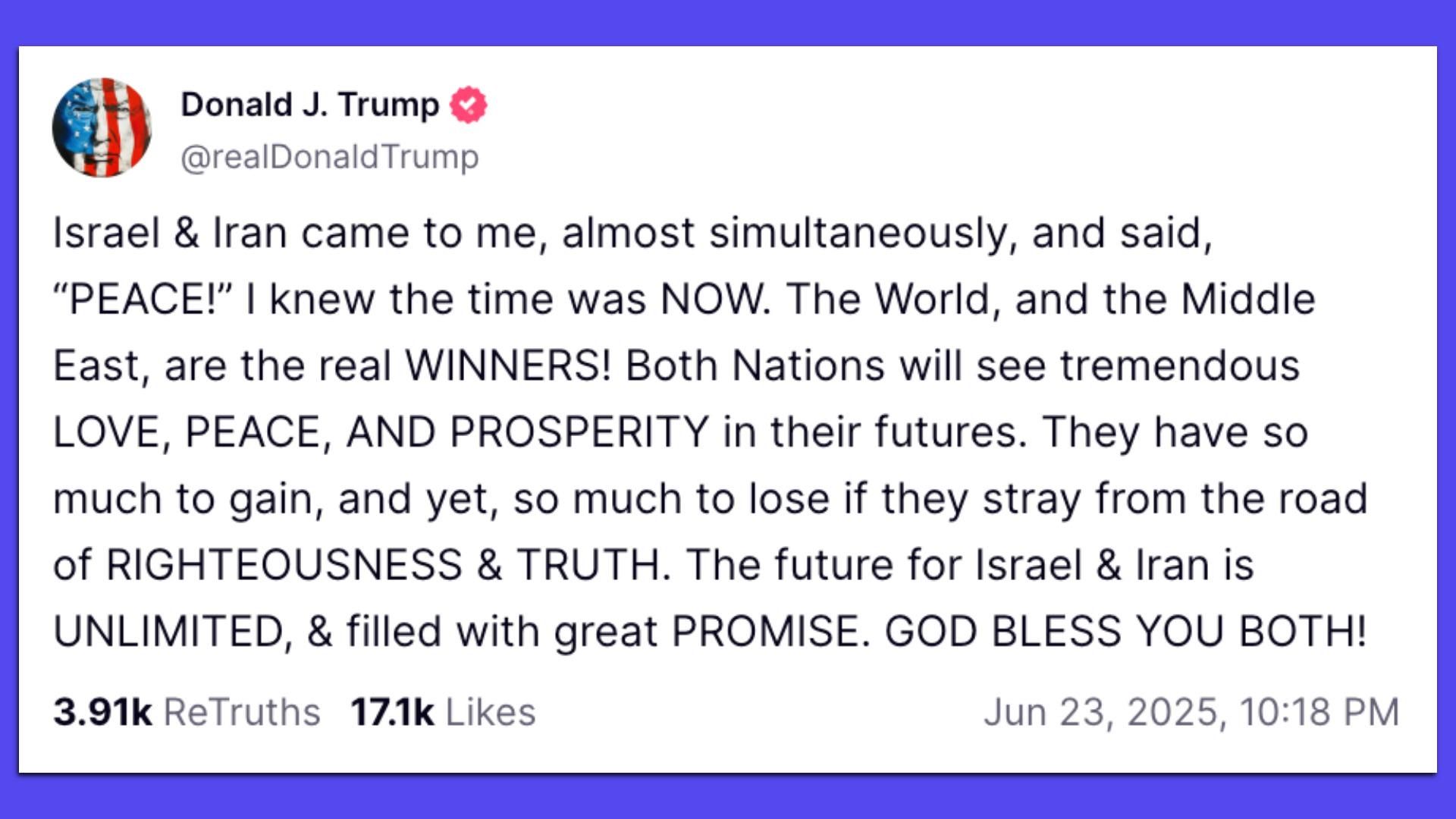
⏱️ How it happened: Trump announced on social media at 6:02 p.m. ET that Israel and Iran had agreed to a "Complete and Total CEASEFIRE," ending "what should be called, 'THE 12 DAY WAR.'"
- Iran responded with mixed signals, but state TV later said the ceasefire was in effect. Just a few hours ago, around 2 a.m. ET, Israeli Prime Minister Benjamin Netanyahu confirmed Israel agreed to a ceasefire with Iran in coordination with Trump.
- The situation remains dangerous: Israel is accusing Iran of breaking the ceasefire. For several hours before the ceasefire came into effect — and for several minutes after — Iran fired multiple missile barrages at Israel that killed civilians, threatening to upend Trump's deal.
👀 Behind the scenes: Trump's efforts to end the war began in earnest on Saturday, shortly after U.S. B-2 bombers launched 14 massive bunker-buster bombs that almost completely destroyed Iran's three main nuclear facilities.
- The president instructed Steve Witkoff, his special envoy to the Middle East, to communicate to the Iranians his desire to negotiate a deal to end the war, according to a White House official.
- Iran initially refused to engage and said diplomacy would be possible only after it exacted revenge by striking U.S. targets, a source with direct knowledge said.
But prior to launching yesterday's missile attack on the Al-Udeid Air Base in Qatar, Iran sent messages to the U.S. — via Qatar — conveying when and what targets they intended to strike, a White House official said.
- Immediately after the strike, which left no casualties, the Iranians sent another back-channel message notifying the White House that they would not conduct any further attacks on U.S. targets.
- The White House responded — again via the Qataris — saying the U.S. wouldn't retaliate to the Iranian attack, and reiterating its readiness to resume negotiations.
🔭 Zoom in: The war ended with Iran at its weakest point since its devastating eight-year war with Iraq in the 1980s.
- Israeli and U.S. officials both claim that it will take Iran years to rebuild its military power, reestablish its proxy network and restore its deterrence.
- Iran's nuclear program has likely been set back by years — and now faces the threat of further U.S. and Israeli military action if the regime seeks to rebuild it.
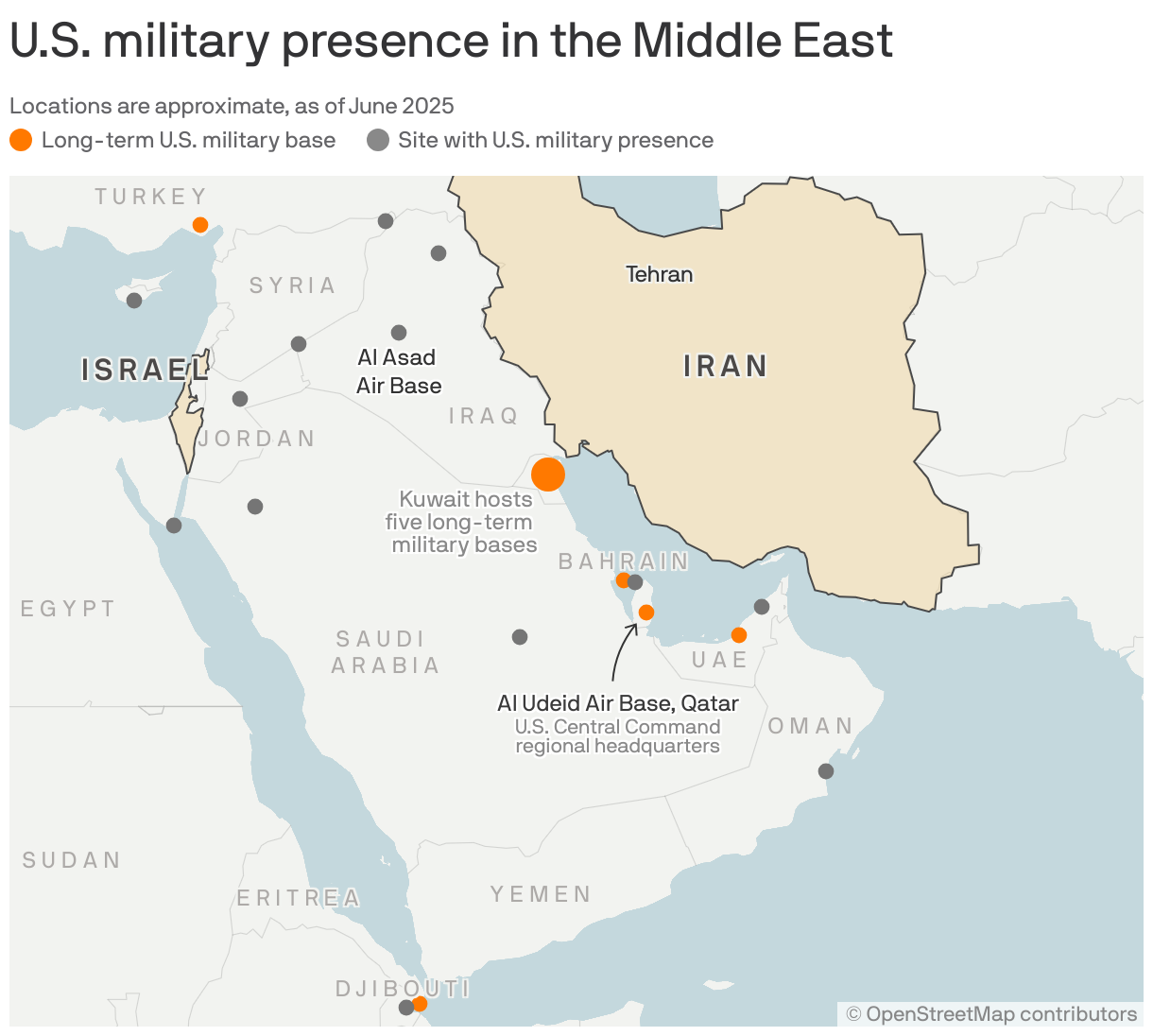
Between the lines: A White House official argued that it was the U.S. strike on Iran's nuclear facilities that ultimately created the conditions for ending the war.
- "The Iranians understood Trump wasn't playing games and the Israelis were grateful that Trump did something they couldn't do on their own — and couldn't say no when he asked them to stop," the White House official said.
The bottom line: For a president who promised deals but has struggled to end the conflicts in Ukraine and Gaza, the Iran-Israel ceasefire would represent a massive success in his doctrine of "peace through strength."
2. 🏛️ Scoop: Trump plans victory lap for Big Beautiful Bill

3. 🔎 GOP probes aim to keep spotlight on Biden
4. 💥 Stocks impervious to news


Stocks absolutely, positively don't want to go down, Axios Markets author Madison Mills writes in her debut story for Axios.
- Tariffs? War in the Middle East? Rising energy prices? Surging deficits? High interest rates? Weak dollar? Plunging CEO confidence? Climate change? Nope, nope, nope.
Why it matters: Investors are already ignoring a slew of headwinds. Lots of risks could become the final straw that breaks the market's climb.
Stocks rallied hard yesterday after Iran conducted a performative retaliation, sending oil plunging more than 7%, and reinforcing investors' relentless optimism.
5. ⚡ MAGA rattled
/2025/06/23/1750717142595.gif?w=3840)
6. 🗽 Today! NYC's big choice

New York City voters face a choice today: A 67-year-old scandal-stained insider or a 33-year-old democratic socialist scorned by the city's elite.
- Why it matters: It's the first, difficult step on the road to redefining the Democratic Party.
At its core, the race can be boiled down to old-guard moderates running against younger, energetic candidates with ambitious — often expensive — ideas. It's the same dynamic that will likely play out across the country over the next few years.
- Also at stake: How the city and the party fight back against President Trump and his MAGA alliance, which New York's Democratic electorate desperately wants to oppose.
🖼️ The big picture: A win by Zohran Mamdani — the surging progressive state assemblyman — would deal a major blow to the establishment.
- That establishment, fearful of Mamdani's tax-the-rich ethos, has lined up behind controversial former Gov. Andrew Cuomo with endorsements and piles of cash.
- The race is close and could come down to last-minute turnout on the city's hottest day of the year — an alarming development for Cuomo, who's relying on older voters.
- An Emerson poll released yesterday showed Cuomo and Mamdani in a statistical tie, four weeks after the same poll had Cuomo with a 12-point lead.
Reality check: The primary result — which might not be known for at least a week — may not matter much. Both Cuomo and Mamdani have indicated they could contest the general election on other parties' lines if they lose.
7. 🌡️ Mapped: Early summer scorcher
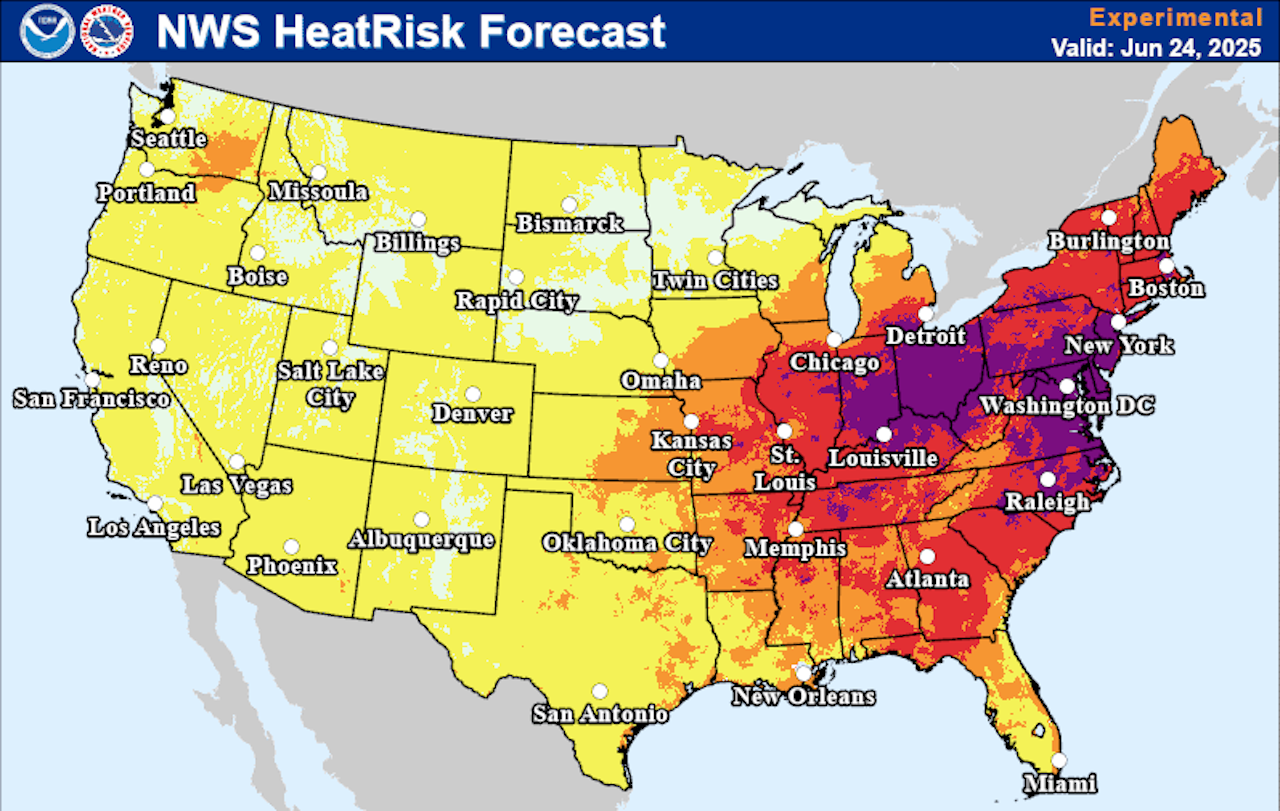
Nearly 170 million Americans are under some form of heat advisory or warning from an early summer heat wave that's hitting large parts of the country, Axios' Alex Fitzpatrick writes.
- Why it matters: The event, which broke temperature records across the West and Alaska before shifting east, is bringing an especially dangerous combination of heat and humidity.
Much of the eastern U.S. is at "major" or "extreme" risk of heat-related impacts this week, according to the National Weather Service's experimental HeatRisk index (mapped above).
- Nearly 370 daily high-temperature records were tied or broken between last Monday and Saturday.
8. 🎬 1 film thing: Pixar's worst debut
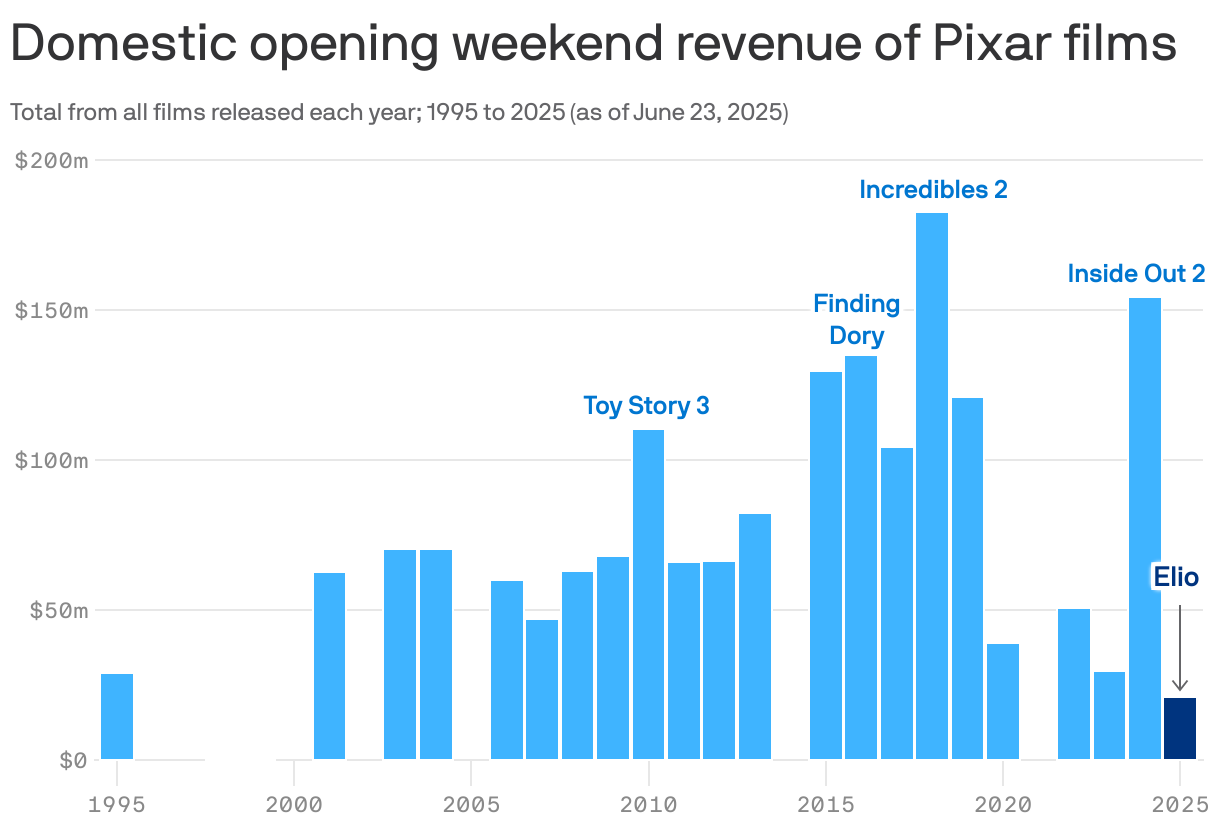
Disney's Pixar saw its worst-ever box office debut over the weekend with its sci-fi adventure film "Elio" earning just $21 million domestically after reportedly spending at least $250 million on production and marketing.
- Why it matters: The animated movie is a costly outlier to other family-friendly films that have packed cinemas and helped theaters toward a post-pandemic rebound, Axios' Kerry Flynn and Sara Fischer write.
By the numbers: "Elio" came in third place domestically over the weekend, behind Universal's "How To Train Your Dragon" at $37 million and Sony's "28 Years Later" at $30 million, per Comscore.
- "Elio" brought in just $14 million overseas for $35 million in total, according to Comscore.
🎨 The big picture: With the exception of "Inside Out 2" last summer, Pixar has struggled to regain the box office momentum of its dominance in the 2000s and 2010s.
- "Luca" and "Turning Red" were released straight to Disney+ in 2021 and 2022, respectively. "Lightyear" underwhelmed at the box office in the summer of 2022.
Axios AM