Axios AM

October 26, 2026

☀️ Good Monday morning! It's 60 days till Christmas.
- Smart Brevity™ count: 1,993 words ... 7½ mins. Thanks to Noah Bressner for orchestrating. Edited by Bill Kole.
1 big thing: What's next for Axios
Axios CEO Jim VandeHei lays out his latest thinking on how media is changing — and how Axios is adapting:
Media is changing at AI speed: the open web deteriorating, search shriveling, LLMs rising, hyper-personalization surging, old revenue models breaking.
- AI threatens to finish what the algorithms started: wholly upending journalism as we know it. The only certainty: What follows will be as different as the pre- and post-digital eras.
- After studying and experimenting with AI for the past two years, we're placing a series of big bets on how serious journalism can flourish in an AI world.
💡 The big idea: We believe the value of verified, reported, distinctive truth and curated human connection will spike. The yearning for human connection, and demand for human expertise, will only increase.
🖼️ The big picture: At Axios, we're doing what we did a decade ago when we launched, and two decades ago at Politico: building for the direction that technology and the world are headed.
- We're sharing our thesis — and our plans — to help spark deeper industrywide debate about preserving the best of media in what's to come. Some parts are controversial or based on our own assumptions. We welcome the pushback.
What's next: We assume Einstein-level intelligence will be available on all topics to all people. We envision media consumption shifting to new AI platforms and devices that know us as intimately as we know ourselves. Our lives and minds will be curated beyond imagination. Our knowledge, habits, tastes and work will fully fuse into our screens, or pins, or bracelets.
The biggest threat in this coming reality: Who needs "news" from journalists when their AI tells them what they need to know, when they want to know it?
- Indeed, we assume passive news consumers will find AI curation fully satiating, much like they did scrolling. So general, indistinctive news withers.
- But for serious news consumers — those who routinely seek out high-quality information about their world, passions and community — the demand for human-vetted and human-verified content will surge.
- This holds true for both the consumer and for businesses: They'll need insight beyond what everyone else gets from the machines alone, as well as verified news — and human audiences. They'll demand more than AI can give them.
🔎 What this looks like for Axios
- Harnessing AI to save local journalism and serve communities. Adding to the power of the 100+ Axios Local journalists coast to coast, we'll soon unveil an Axios Local "Super System" that uses AI to track government action, community data and coming events. This will give local reporters more time for local reporting. We hope the Super System will allow us to hire journalists in hundreds, even thousands, of communities and revitalize a dying industry. This will be among the most consequential examples of using AI to create journalism jobs and do public good at scale. It's as big as the original Axios, and a great example of AI's upside.
- Jumping ahead of AI curation. We're launching specific products based not just on topics but also job titles. We're starting at the top with new verticals for CEOs, CMOs, CCOs, COOs, CFOs and other C-suite executives. All jobs are changing faster than anyone can process. So understanding AI and news through this lens will be vital. Among the most common components of an AI prompt is stating what you do. So our products are designed for today and the coming LLM shift. We'll also keep expanding into new niches, like future-focused space defense, all written by journalists with deep subject matter expertise.
- Shifting beyond the open web. Search is dying and bots are polluting the web. So we've created a new business line, Axios Direct, to sell clean, real-time feeds of our vetted news and information to businesses and others. Companies are building their own LLMs and pay to ingest truly great reporting, opening a new revenue stream that incentivizes quality. We want to help clean up the information ecosystem: Third-party data shows the Axios format and expert-first approach help us overperform in AI results. And we're working with organizations to restructure their own content in more LLM-friendly ways to reduce misinformation about their work and products in AI.
- Accelerating human connection. We believe we're on the verge of a renaissance in human connection: The better AI gets, the more people will crave and pursue in-person connection. So we're vastly expanding our global, national and local events, and experimenting with hosting dinners and meet-ups in communities big and small. The Axios Social Club recently brought together more than 1,300 readers in 40 Axios Local markets for dinner with their neighbors. That's the power of Axios in real life.
What won't change: Journalism is only valuable when it's trusted, useful and illuminating. Only reporters can get people to share or leak information, fully understand the nuance of sources and stories, demand accountability, and offer deep analysis based on both data and person-to-person interactions.
- We have a responsibility, even a moral obligation, to protect and expand this vital reporting. A world changing at AI speed demands this.
- Share this column.
👀 Do you have relatives, friends, coworkers who'd enjoy Axios AM? Shoot me their email addresses and I'll invite them to join. Just hit "reply," or write me: [email protected].
2. 🤖 Prepping for cyber doomsday
The governments of the U.S. and Britain are suddenly making old-school preparations for the possibility of a cyber-triggered long-term blackout:
- The Pentagon is "preparing U.S. military bases to keep operating for at least 90 days without outside support as it prepares for the possibility of a major war that could cripple power grids, disrupt supply chains and threaten critical infrastructure on American soil," Fox News Digital reports. Under a broader military initiative called FORTRESS, "every major military installation in the continental United States would be expected to sustain essential operations independently for at least 90 days, including access to electricity, water, fuel and communications."
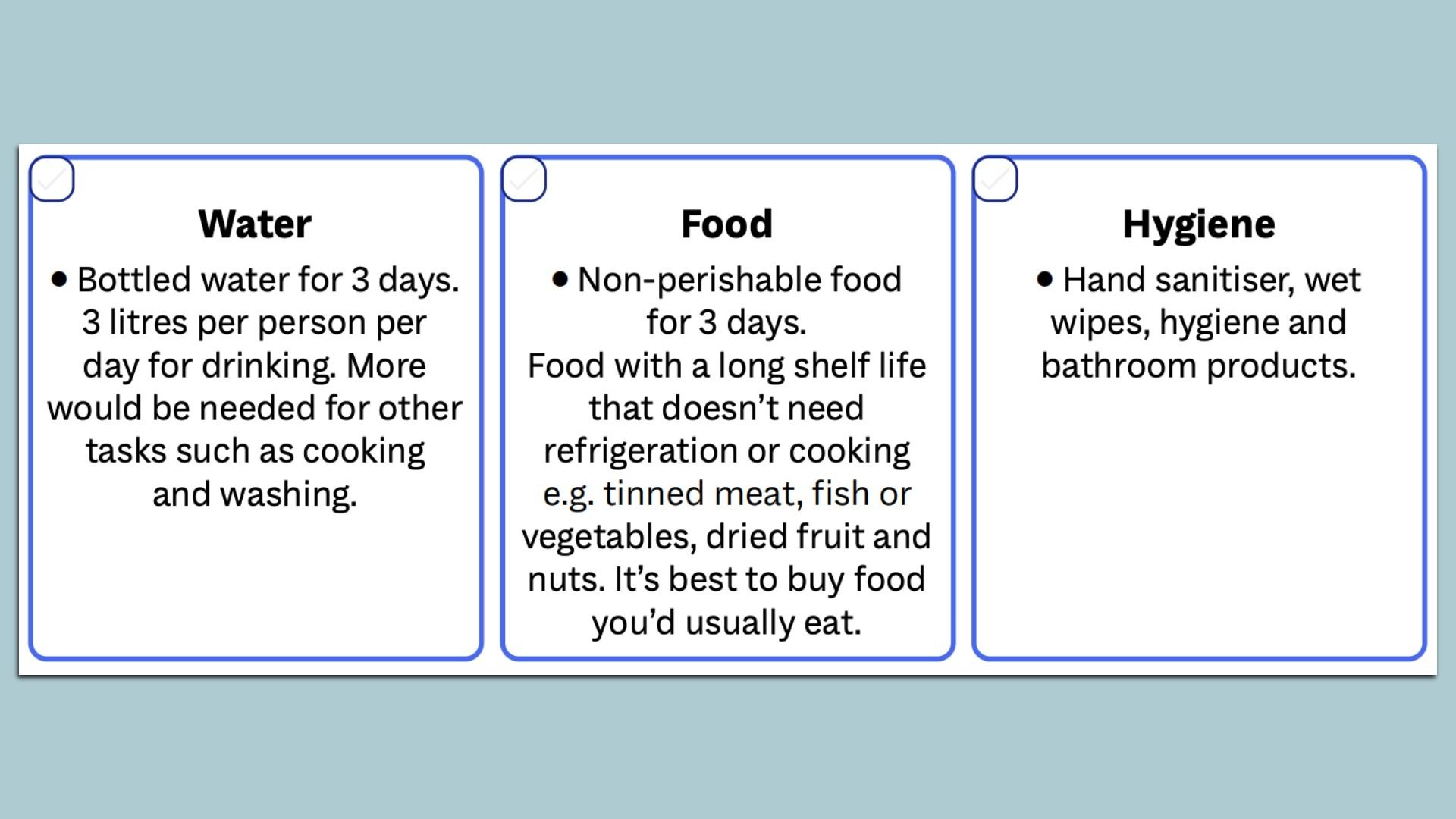
- The British government urged the public to keep three days of emergency supplies at home, including water and canned goods ("tinned" for the Brits). The "Be Ready" campaign was triggered by the PHP software vulnerability exposed last week, plus a record-setting summer of heat, drought and wildfires.
😬 Between the lines: If you marinate online, you're being barraged with warnings of a cyber-induced Black October.
- Mike Cernovich, an influential pro-Trump voice on X, posted yesterday: "Something is coming. You can sense it."
3. ⚠️ Campaign collateral damage: Grieving families

The 2026 midterms have taken a deeply personal turn as campaigns use other people's family tragedies as political ammunition — sometimes over the objections of those families, Axios' Russell Contreras writes.
- Why it matters: Some attack ads feature photographs of murdered children and anguished 911 calls, forcing grieving families to relive their worst moments.
Georgia governor's race: Republican gubernatorial nominee Rick Jackson used images of murdered 8-year-old Secoriea Turner and her mother's anguished 911 call to attack Democratic rival Keisha Lance Bottoms, Atlanta's former mayor.
- Turner's family demanded the ads come down, accusing the campaign of exploiting their grief without permission.
Ohio governor's race: Ohio Republican gubernatorial nominee Vivek Ramaswamy's campaign is spending $4 million on an ad featuring the estranged mother of his Democratic opponent, Amy Acton.
- In the ad, Donna Arthur calls her daughter a liar and disputes her account of childhood homelessness.
- Acton says her late stepfather — who was married to her mother until his death — sexually abused her as a child, and she hasn't spoken to her mother in decades.
Ohio Senate race: A Republican attack ad against former Democratic Sen. Sherrod Brown featured images of a couple and their 1-year-old son killed in a highway crash to blame Brown's immigration policies. The victims' family demanded its removal.
4. 🗳️ Early '28 contenders

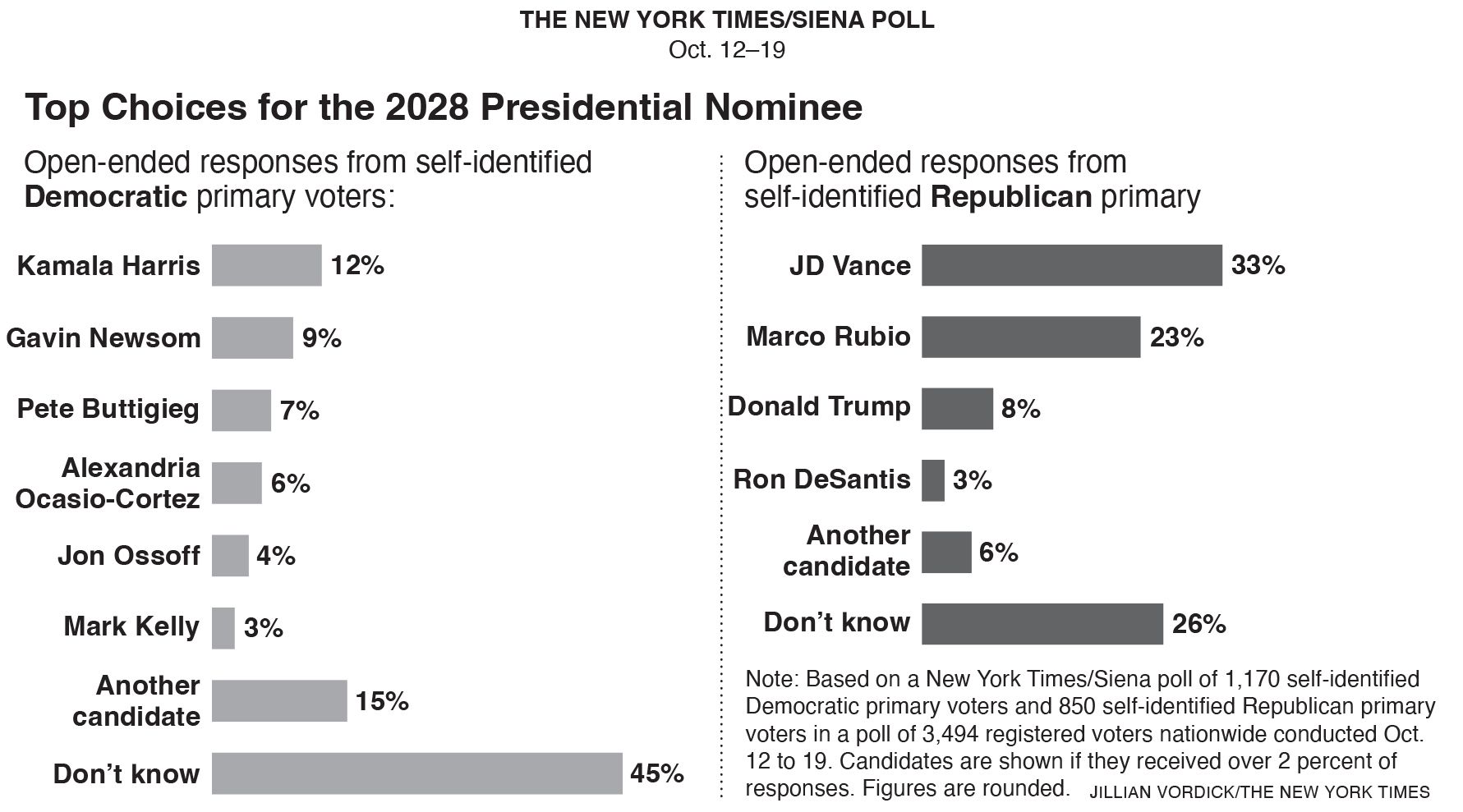
Democrats' 2028 race is wide open: Kamala Harris leads with just 12% of primary voters, and 45% didn't name a favorite, a New York Times/Siena telephone poll of Democratic primary voters found.
- Republican primary voters are coalescing around either Vice President Vance (33%) or Secretary of State Marco Rubio (23%).
- 8% of Republicans named Trump himself, even though he's ineligible.
Keep reading (gift link) ... Explore the data.
5. 🇮🇱 Scoop: Bibi begs Trump for more support
Axios' Barak Ravid writes from Tel Aviv:
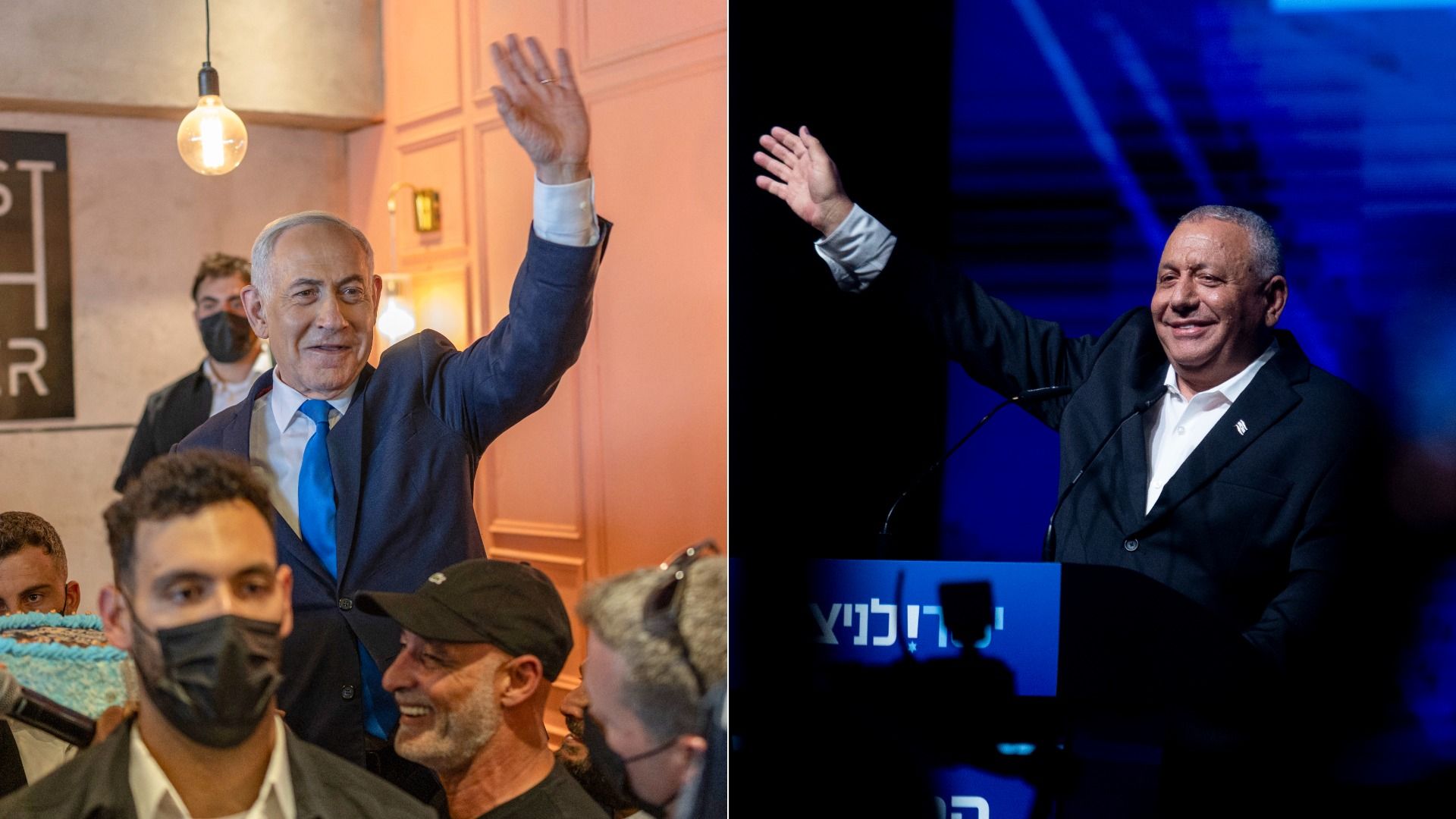
Israeli Prime Minister Benjamin Netanyahu — fighting for political survival in tomorrow's elections — has pleaded with President Trump in recent days to show more public support for his campaign, according to a U.S. source with knowledge and an Israeli source briefed on the matter.
- Why it matters: The U.S. source said the White House sees Netanyahu's aggressive lobbying as a "sign of desperation" and an indication that the Israeli leader thinks he's trailing.
👀 Behind the scenes: The U.S. source said Netanyahu spoke with Trump twice in the last three days and asked him to double down on his Truth Social post last week endorsing him.
- The source said Netanyahu even suggested language for additional statements of support.
- An Israeli source briefed on Netanyahu's efforts said the Israeli prime minister proposed that Trump hold calls with Israeli reporters to express further support.
- Last night, Trump issued another statement endorsing Netanyahu and calling on Israelis to vote for him, mainly because of his hawkish position on Iran.
🧮 State of play: Three major Israeli television networks released their final pre-election polls Friday, all showing Netanyahu's coalition falling well short of a parliamentary majority.
6. 🇧🇷 Brazil election shocker: Lula the survivor

Ending a string of conservative victories in Latin America, Brazilian President Luiz Inácio Lula da Silva, a leftist critic of President Trump, pulled off a stunning comeback to cling to power over right-wing Flávio Bolsonaro.
- Bolsonaro, the son of imprisoned ex-president Jair Bolsonaro, refused to concede and said he'll ask to have the result annulled.
Why it matters: Lula's victory (52%) is a blow to Brazil's right-wing populist movement and preserves a major counterweight to Trump's influence in Latin America, Axios' Rebecca Falconer writes.
🔭 Zoom in: Brazil's electoral court announced that Lula, who turns 81 tomorrow, held an unassailable lead of nearly 4.4 million votes over opponent Bolsonaro.
7. 💰 Big Tech legal bills pile up

A tidal wave of litigation is catching up to Meta, leading to $42 billion in recent penalties and settlements. It's a powerful reminder to AI companies that they could face a reckoning in court even when regulation lags, Axios AI & tech managing editor Bradley Olson writes.
- Why it matters: AI companies are racing to build better models and autonomous agents, but they don't enjoy the same legal protections that shielded web platforms for decades. Meta's big bills offer a preview of potential legal exposure.
After a $25 billion penalty in a New Mexico data privacy case this past week, Meta chief legal officer C.J. Mahoney said: "At its core, this lawsuit seeks to impose a tax on speech to enforce new rules for what people can say online."
8. 🏈 1 fun thing: NFL's French connection

The French gave us the Statue of Liberty, crème brûlée and haute couture. Now we're giving them NFL football, Bill Kole (your Axios AM copy editor) writes from his base in Paris.
- Why it matters: The NFL has held games in Australia, Brazil, Germany, Ireland, Spain and the U.K. — and yesterday's showdown between the Pittsburgh Steelers and New Orleans Saints was the league's first in France as it seeks to grow international interest.
Security was tight for the sold-out game (final score: Steelers 16, Saints 10) at the 80,000-seat Stade de France, but it was a welcome distraction after weeks of violent protests and widespread social unrest across France.
⚜️ The backstory: New Orleans, established by the French in 1718 and rich in French architecture, food and culture, was the sentimental favorite.
💭 Bill's thought bubble: I'm a lifelong New England Patriots fan — I grew up in Foxborough, Mass., home to Gillette Stadium — so I had no skin in this game.
- 🌭 The food at the Stade de France was predictably fab, though — even Le Hot-Dog.
📬 Thanks for reading! Please invite your friends to join AM.
Sign up for Axios AM